Soviet Writers Arkady (1925-1991) and Boris (1933-2012) Strugatsky
They were by far the greatest science fiction authors who ever lived. The two brothers produced a string of masterpieces (the greatest being Roadside Picnic, or Пикник на обочине) that are unlikely to be surpassed, ever!
I am currently reading two of their novels whose chapters are artfully interleaved. They wrote Ugly Swans (Гадкие лебеди) in 1972; in 1986, they wrote Lame Fate (Хромая судьба) and shuffled the chapters together. Reading it is an amazing experience. I’ve finished about 40% of the nested novels at this point. I haven’t even encountered the science fiction yet, though I feel it is lurking and waiting to pounce.
Among the brothers’ works I have read are:
Space Apprentice (1962)
Far Rainbow (1963)
Hard to Be a God (1964)
The Final Circle of Paradise (1965)
The Second Invasion from Mars (1967)
Prisoners of Power (1969)
The Dead Mountaineers’ Hotel (1970)
Roadside Picnic (1972)
Definitely Maybe (1977)
Beetle in the Anthill (1980)
The Time Wanderers (1986)
Many of the Strugatskys’ titles have never been translated into English. I think that, ultimately, they will all be. I can think of few Soviet writers working in any genre that have such a large and consistently excellent body of work.
There are only a handful of science fiction writers I admire. After the Strugatsky brothers, there are Stanislaw Lem from Poland and, in the United States, Philip K. Dick and Clifford D. Simak.
He’s from the same part of the world from which I hail. Painesville, the county seat of Lake County, is some 30 miles northeast of Cleveland. He has been called a science fiction writer, a designation which he (rightfully) hates. It’s more speculative fiction, with an emphasis on the short story form.
The man from Painesville was known for being something of a pain. His obituary in the Los Angeles Times remarks:
Over the years, Ellison has been described as fiercely independent, vengeful, sardonic, opinionated, confrontational, foul-mouthed, petulant, infuriating, defiant and a general all-around nuisance—as well as engaging, gregarious, funny, fastidiously organized and generous to his friends.
By his own measure, he was “a hard pill to swallow.”
He is gone, with all his objectionable behavior, but his stories remain. And they are well worth reading. I suggest you try one of the following collections:
I have No Mouth and I Must Scream (1967)
The Beast That Shouted Love at the Heart of the World (1969)
Approaching Oblivion (1974)
Deathbird Stories (1975)
Shatterday (1980)
You might also want to try reading the sci-fi story collection he edited in 1967 entitled Dangerous Visions.
Although he will be remembered as much for being a prickly character as a brilliant writer, I think that over time the latter will replace the former in the estimation of readers.
A Strange Film Set Near the California-Nevada Border in the 1950s
Yesterday afternoon, I went to see a matinee performance of Wes Anderson’s Asteroid City (2023). I had seen his earlier The French Dispatch (2021), which did the same for France as Asteroid City did for the 1950s American desert.
Is it a great film? Not exactly, but I think it is definitely worth seeing. Wes Anderson has, rattling around somewhere in his head, a great film; and I believe it will eventually be made.
Picture a group of Junior Stargazers and their parents descending on a nowhere town in the Mohave Desert. With a cast that includes Tom Hanks, Scarlett Johansson, Jason Schwartzman, Tom Hanks, Tilda Swinton, Margaret Robie, Steve Carell, and some very talented juvenile actors, the film ranged from riveting to “What the …?”
During the Junior Stargazers awards ceremony, a space alien kidnaps a meteor that was on display and later returns it with various inventory markings. The military proceeds to put Asteroid City on lockdown, with no one able to leave or arrive—until the alien makes his second appearance.
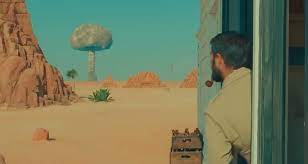
One of Two Nuclear Tests That Occur During the Course of the Film
The most striking thing about the film is its visual style. It all looks like desert postcards of the period. except for a connecting story of a writer and a group of play actors which is not only shot in black and white, but in Academa 4:3 ratio, whereas most of the film is in color and wide screen. In fact, the weakest part of the film is this connecting story.
I remember when I first saw The French Dispatch on TV at my brother’s house. At first, I didn’t know what to make of it. Some of it I loved, some I thought deplorable.
No matter, just hold your nose during the bad parts and enjoy the scenes set in Asteroid City.
If any writer alive today has a handle on the future—what it is likely to be—that writer is William Gibson, the author of Neuromancer and the inventor of the term cyberspace. I have just finished reading his book of essays, entitled Distrust That Particular Flavor. In a talk delivered o the Book Expo America in 2010, he wrote:
But I really think [that pundits are] talking about the capital-F Future, which in my lifetime has been a cult, if not a religion. People my age are products of the capital-F Future. The younger you are, the less you are a product of that, If you’re fifteen or so, today, I suspect you inhabit a sort of endless digital Now, a state of atemporality enabled by our increasingly efficient prosthetic memory. I also suspect that you don’t know it, because, as anthropologists tell us, one cannot know one’s own culture.
The Future, capital-F, be it crystalline city on a hill or radioactive postnuclear wasteland, is gone. Ahead of us, there is merely … more stuff. Events. Some tending to the crystalline, some to the wasteland-y. Stuff: the mixed bag of the quotidia.
I think of Gibson’s capital-F Future as being more along the line of the old The Jetsons animated television program or the novels of H. G. Wells or Isaac Asimov. The future presented in those works is more a reflection of their creators’ times, and not our own.
William Gibson
I think that, because of his belief regarding the future, Gibson’s more recent novels have been less science fiction-y. Books such as Zero History are set in what appears, on one hand, to be the present—but instead are set in some not-too-distant future with multiple hooks to our present.
In a number of essays, Gibson examines our strange atemporal present, with fascinating essays on Tokyo (“My Own Private Tokyo”) and Singapore (“Disneyland with the Death Penalty”).
The following is adapted from a post I made on the late unlamented Blog.Com on August 14, 2009.
I had not read one of Stanislaw Lem’s (1921-2006) novels for a number of years, remembering only that I always enjoyed them for their quirkiness and imagination. A few days ago, I picked up one of his books at random: It was Chain of Chance (1975).
Picture to yourself a series of murders or suicides of a seemingly random group of people. What they have in common is all are males in their fifties who were athletic in build, and all were visiting a spa in Naples, Italy. The victims consisted of both Americans and Europeans. Sent to investigate what happened in a washed-out American astronaut who calls himself Adams after one of the victims. He attempts to set himself up as a guinea pig doing what the average victim did and trying to see what happens. There were some strange occurrences, such as the collapse of a woman in a large shop where there are no visible employees on the Naples-Rome highway.
At the Rome airport, “Adams” survives a terrorist bomb blast and saves a young French girl’s life. Suspected as being in with the terrorists, he calls in his embassy; and matters get straightened out allowing him to proceed to Paris.
There he meets with Dr. Philippe Barth, a French computer scientist who served as a consultant for the Sûreté, the national security service. The story then suddenly sags as “Adams” describes in exhaustive detail what the victims had in common, what they did, and so on. I thought to myself at this point that perhaps I had picked up the first loser by Lem, but it took only a few pages for the author to recover and pose an ingenious demonstration.
At the Paris Orly airport, “Adams” begins feeling strangely demented and suicidal. In the nick of time, he handcuffs himself to some solid furniture and begins to take notes of what appears to be a series of attacks, culminating in unconsciousness.
I will not divulge Lem’s brilliant ending, except to drop one hint: There is a close tie-in with the subject of The Futurological Congress (1971), which remains my favorite of his books. One more clue. Here is the thinking of one of the people attending the security meeting with Barth, a mathematician named Saussure whom I think is a stand-in for the author:
Man wanted everything to be simple, even if mysterious: one God—in the singular, of course; one form of natural law; one principle of reason in the universe, and so on. Astronomy, for example, held that the totality of existence was made up of stars—past, present, and future—and their debris in the form of planets. But gradually astronomy had to concede that a number of cosmic phenomena couldn’t be contained within its scheme of things. Man’s hunger for simplicity paved the way for Ockham’s razor, the principle stating that no entity, no category can be multiplied unnecessarily. But the complexity that we refused to acknowledge finally overcame our prejudices. Modern physics has turned Ockham’s maxim upside down by positing that everything is possible. Everything in physics, that is; the complexity of civilizations is far greater than that of physics.
In the world of speculative fiction—and I regard him as more properly a writer of this rather than science fiction—few could approach the Pole in his inventive mind, humor, and psychological acuteness. Among his works that I have enjoyed are the following, all of which are still available in good English translations:
The Investigation (1959)
Return from the Stars (1961)
Solaris (1961), which was made into a great Russian film by Andrei Tarkovsky
Memoirs Found in a Bathtub (1961)
The Futurological Congress (1971)—my favorite among his works
Tales of Pirx the Pilot (1973) and More Tales of Pirx the Pilot (1973), published in Poland as a single work
One Human Minute (1986)
I see that I have read quite a few of Lem’s work—and at the same time, not nearly enough.
For the last few days, I have been re-reading the last two novels of William Gibson’s sci-fi Sprawl trilogy. The Sprawl is Gibson’s take on how the Boston to Washington DC corridor will develop in time to be the largest urban area in the world. The trilogy consists of:
Neuromancer (1984), in which the term cyberspace was first introduced
Count Zero (1986)
Mona Lisa Overdrive (1988)
The 1980s was a time when the United States was awed by the growth of the Japanese economy. Throughout the trilogy, the yakuza, or Japanese underworld, has a presence—along with Haitian Voodoo gods such as Baron Samedi and Papa Legba, who seem to have taken up residence in cyberspace.
I do not think it is possible to reprise the plot of any of these novels in a coherent way, and I am sure I will forget most of the details within a week or two. What I will not forget, however, is the wild imagination that Gibson displays in his work. For instance, many scenes in Mona Lisa Overdrive take place in a barren New Jersey rust belt area known as Dog Solitude.
One of the difficulties of summarizing any of these novels is that, typically, the action takes place in numerous locales with numerous characters, many of whom have numerous aliases.
For some reason, I have not read any Gibson for a number of years. Now I am hooked again.
One of the greatest of all science fiction films is a short consisting of nothing but black and white stills accompanied by a voice-over narration. I am referring to Chris Marker’s La Jetée, which is all of 28 minutes long. And yet for all its uniqueness, the film holds the viewer in its grasp until the last shot (shown above). Following is the film’s plot summary from Wikipedia:
A man (Davos Hanich) is a prisoner in the aftermath of World War III in post-apocalyptic Paris, where survivors live underground in the Palais de Chaillot galleries. Scientists research time travel, hoping to send test subjects to different time periods “to call past and future to the rescue of the present”…. They eventually settle upon the protagonist; his key to the past is a vague but obsessive memory from his pre-war childhood of a woman (Hélène Châtelain) he had seen on the observation platform (“the jetty”) at Orly Airport shortly before witnessing a startling incident there. He did not understand exactly what happened but knew he had seen a man die.
Apparently, motion is not necessary for a successful motion picture. As long as the images grab you, and as long as the story is well crafted, the result can be more than good. It can even be great.
See for yourself. The film is available in its full length on YouTube in French with English subtitles:
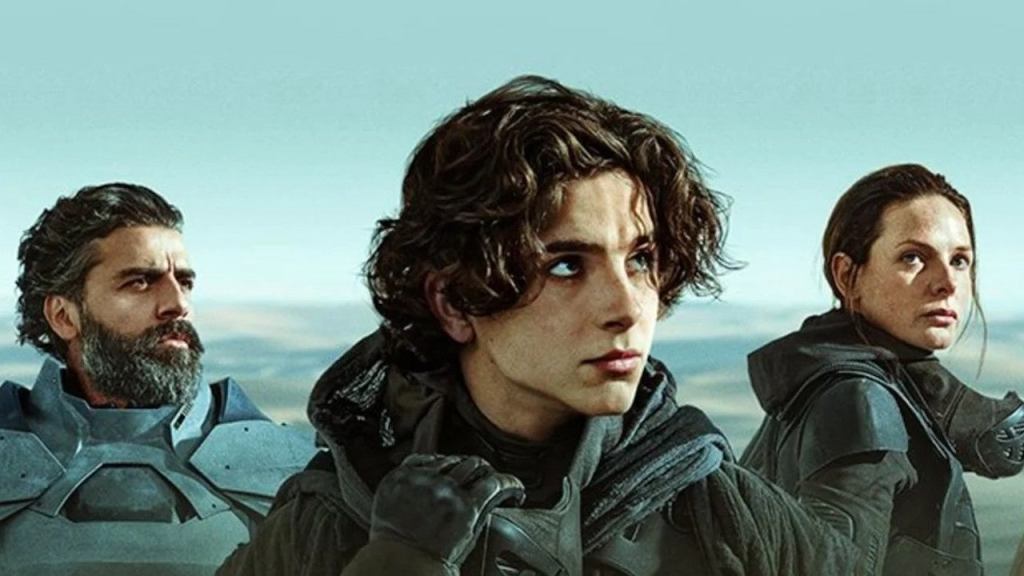
This afternoon, I went to the movies to see the new Dune: Part One directed by Denis Villeneuve. I went expecting not to like it, but ended up liking it a lot—but not quite so much as David Lynch’s magnificent 1984 Dune, as fragmentary as it was. What threw me off were all the stills of Timothée Chalamet as Paul Atreides. I kept saying to myself, “Why, he looks like a whiny little bitch!” In the actual film, he was quite good, at least as good if not better than the wooden Kyle MacLachlan in the David Lynch film.
Where the 1984 Dune came across as fragmentary, Villeneuve’s version plugged many of the gaps, such as the death of Duncan Idaho and the role played by Liet-Kynes, who seems to have changed both gender and race in the new film. (No matter, Sharon Duncan-Brewster was not only stunning: She could act!)
Frank Herbert’s original book is probably the closest the science fiction genre will ever come to a true epic. And as such, it is pretty much unfilmable. The new film does not tell the whole story: It stops just as Paul Atreides and Jessica are accepted by the Fremen, but does not show how Paul and the Fremen defeat the brutal Harkonnens and the whole empire. That was the weakest part of Lynch’s masterpiece, and I suspect that it would take a bit of doing to make it as interesting as Part One.
Whichever version you choose to see, I highly recommend you read the novel first. It is incredibly dense, but it manages to carry you along. To be confronted by the likes of the Bene Gesserit, the Spacing Guild, CHOAM, and Tleilaxu Face Dancers without having encountered them in the novel might be a bit much for most viewers. I’ve read the novel three times in the last half century, and I love it—despite its many flaws. As I said, it is probably the closest to an epic that you will ever see in the sci-fi genre.
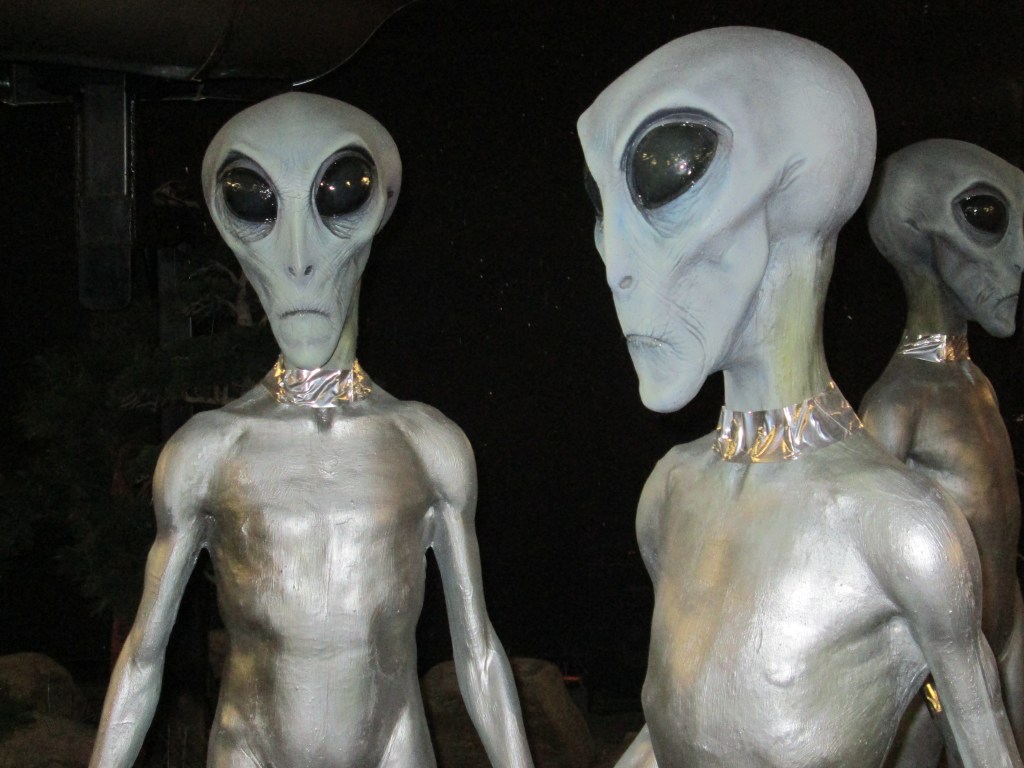
Let’s face it: Real space aliens—if they exist and they probably do—are probably nothing like this. We have gotten used to these skinny attenuated bipedal creatures who look vaguely humanoid. Life can take many possible forms, especially on planets that are significantly different from Earth.
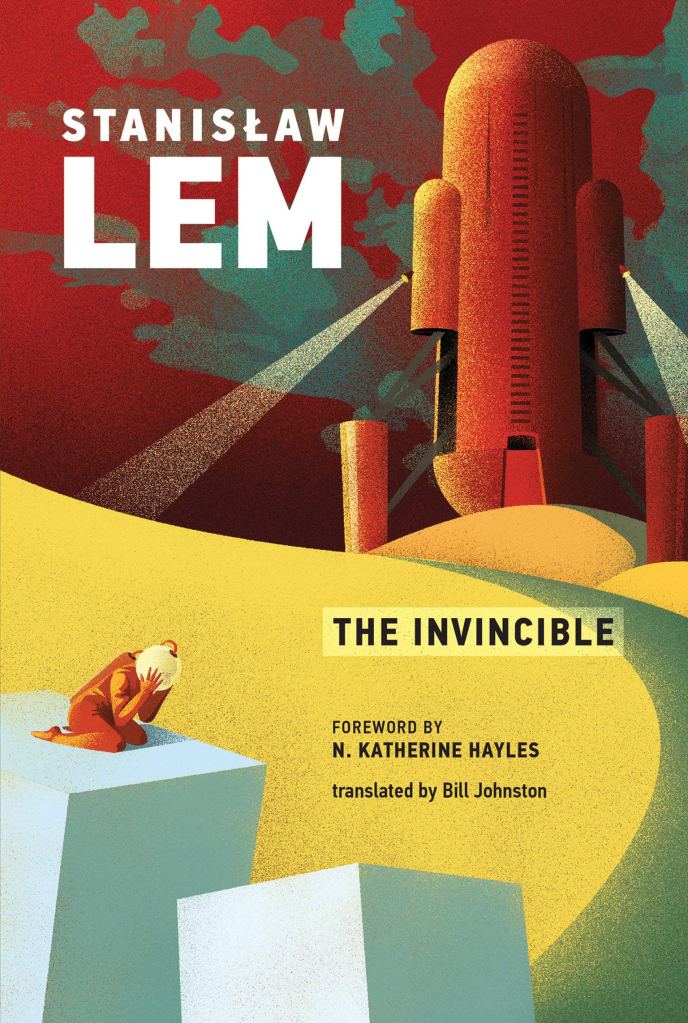
I have just finished reading a book by Stanisław Lem called The Invincible. I have long thought that the best sci-fi comes from Eastern Europe, particularly Poland and Russia. In the West, we tend to think too much along the same lines; but novels from writers like Lem and the Strugatsky brothers give us a whiff of the alien that is not necessarily tied down to traditional forms.
My Edition of Lem’s The Invincible
For another look at what might be out there, I strongly recommend you read Boris and Arkady Strugatsky’s Roadside Picnic, and see the great film that was based on it: Andrei Tarkovsky’s Stalker (1982).
Sci-fi that tries to imagine the really alien can be a little frightening, but it can be great!
Thanks to the ’rona quarantine, I have been seeing a lot of movies on television and on my computer. Today, I tipped the scales toward schmaltz by viewing all twelve episodes of a 1952 Republic Studios serial entitled Radar Men from the Moon. It starred George Wallace as the hero, Commando Cody. (It appears that Commando is his first name, not his title, as he is addressed by characters several times as “Commando.”) For me, however, the most interesting character is Clayton Moore, who both before, during, and after the serial played the Lone Ranger on TV with Jay Silverheels as Tonto.
Like the last film I recommended here (Carnival of Souls), Radar Men from the Moon is now in the public domain, so you can find it cheap or free.
Re-Release Poster for Radar Men from the Moon
The funny thing about the serial is that just about everything the would-be moon invaders try is nipped in the bud by Commando Cody. The two failed villains are Clayton Moore as Graber and Bob Stevenson as Daly. None of the Luna-tics seem to be directly involved in anything but giving Graber and Daly new orders, which they invariably fail at.
The moon forces have some spiffy ray guns made with a better-than-uranium element called lunarium (of course) which they use to blow up trains and cause general havoc, mostly in the first episode.
If you watch this serial, you might not want to watch all twelve episodes at once, unless you are very high on something. Better to break it up into multiple sessions as it was originally intended to be seen.











 Tarnmoor
You must be logged in to post a comment.