
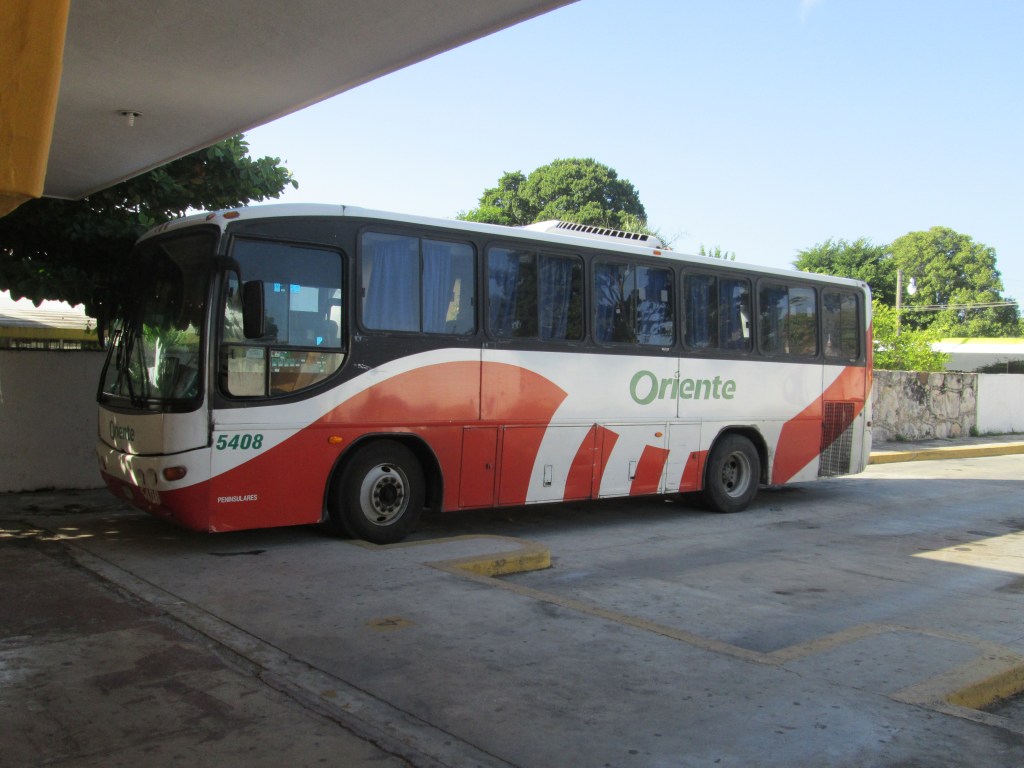
Second Class

When I went to Yucatán in 2020, I had not been to Mexico for many years. I was pleasantly surprised that even the second class buses were air-conditioned and relatively new. Back in the early 1980s, I remember the old Unión de Camioneros de Yucatán buses with their broken windows and busted seats. Now there were a whole spate of new companies, such as Oriente (shown above). This was the bus I took from Izamal to Mérida.

In all, I took six trips using second class buses:

  • Izamal to Mérida
  • Mérida to Uxmal
  • Uxmal to Campeche
  • Chichén Itzá to Valladolid
  • Mérida to Progreso
  • Progreso to Merida

The first four were on comfortable new Oriente buses. The last two were on a shabbier line that just ran every few minutes between Mérida’s Autoprogreso Station some twenty miles to the port of Progreso.

Above is the first class bus ticket I used to get from Campeche to Merida. The second class route took some 5-6 hours stopping at numerous small inland towns. The ADO (Autobuses de Oriente) line pretty much owns first class routes in Yucatán. From Campeche to Mérida, it took the coastal toll road, which took only about 2 hours.

What’s the difference between first class and second class buses in Mexico? The first class routes are theoretically point to point, not making any pickups or drop-offs along the way. I say “theoretically” because drivers are not above going out of their way for friends. On a second class route, anyone can stop a bus anywhere. When I was going from Chichén Itzá to Valladolid. I stood in the bushes across the street from the Dolores Alba motel and waved down the Valladolid bus. Piece of cake.

Autobuses de Oriente (ADO)

The Service Area of ADO First Class Buses

There have been many changes since I last visited Southeast Mexico. Among other things, Autobuses de Oriente (ADO) has merged with Ómnibus Cristóbal Colón (OCC) to pretty much monopolize first class bus service in Yucatán. I remember the days when I had to ride the rackety old Unión de Camionéros de Yucatán (UCY) second class buses with their broken seats and cracked windows. There are still a number of second class carriers, but UCY is no more.

Before going any further, allow me to clarify what first class and second class mean. First class buses directly connect larger cities and do not allow passengers to board or alight from a bus between its origin and its destination, unless the city is of a certain size. A bus from Mérida to Mexico City would typically be first class, stopping only in larger cities en route such as Campeche, Ciudad del Carmen, or Coatzacoalcos.

Second class buses connect small towns with larger cities, or with other small towns. When I go from Mérida to Izamal or Uxmal to Campeche, I will have to take a second class bus. The fare will be less per mile, the passengers poorer, and the bus less deluxe. Most importantly, the trip will take longer because passangers can board or exit anywhere they want.

There is also another class of bus usually referred to as combis. These are multi-row vans connecting even smaller cities. Typically, they do not leave until they are full.

ADO Bus at Station Platform

Instead of renting a car, I will travel around Yucatán and Campeche states almost entirely by bus. In some cases, I may join a tour organized by a local travel agency, but only to visit some ruins that are harder to get to via public transportation. When I return from Mexico, I will hopefully have some stories about bus travel in the Sureste region, as well as scads of my own photos.