
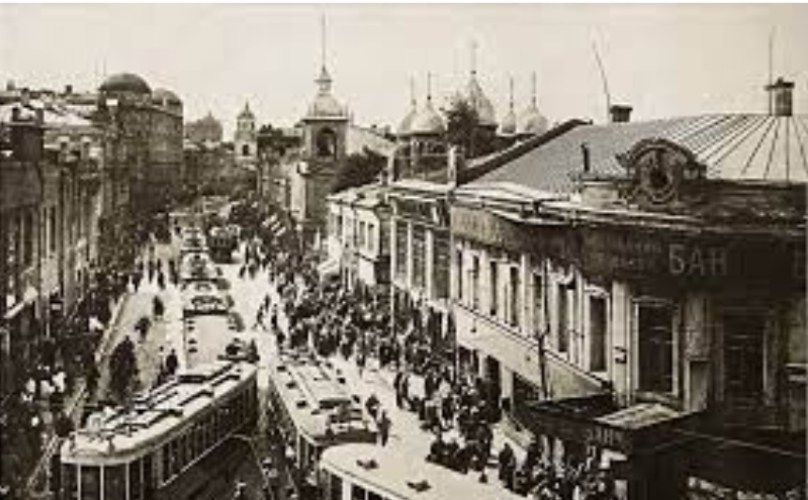
Moscow in the 1920s
Sigizmund Krzhizhanovsky (1887-1950) was a Soviet writer who, in his own words, was “known for being unknown.” Hopefully, that will no longer be true as New York Review Books releases more of his stories. I have just finished reading his Autobiography of a Corpse, which contains a prescient 1939 story titled “Yellow Coal.” Tell me if the first paragraph of the story, quoted below, reminds you of our present situation:
The economic barometer at Harvard University had continually pointed to bad weather. But even its exact readings could not have predicted such a swift deepening of the crisis. Wars and the elements had turned the earth into a waster of its energies. Oil wells were running dry. The energy-producing effect of black, white and brown coal was diminishing yearly. An unprecedented drought had swaddled the sere earth in what felt like a dozen equators. Crops burned to their roots. Forests caught fire in the infernal heat. The selvas of South America and the jungles of India blazed with smoky flames. Agrarian countries were ravaged first. True, forests reduced to ashes had given place to ashy boles of factory smoke. But their days too were numbered. Fuellessness was threatening machines with motionlessness. Even glacier snow-caps, melted by the perennial summer, could not provide an adequate supply of waterpower; the beds of shrinking rivers lay exposed, and soon the turbine-generators would stop.

 Tarnmoor
You must be logged in to post a comment.