
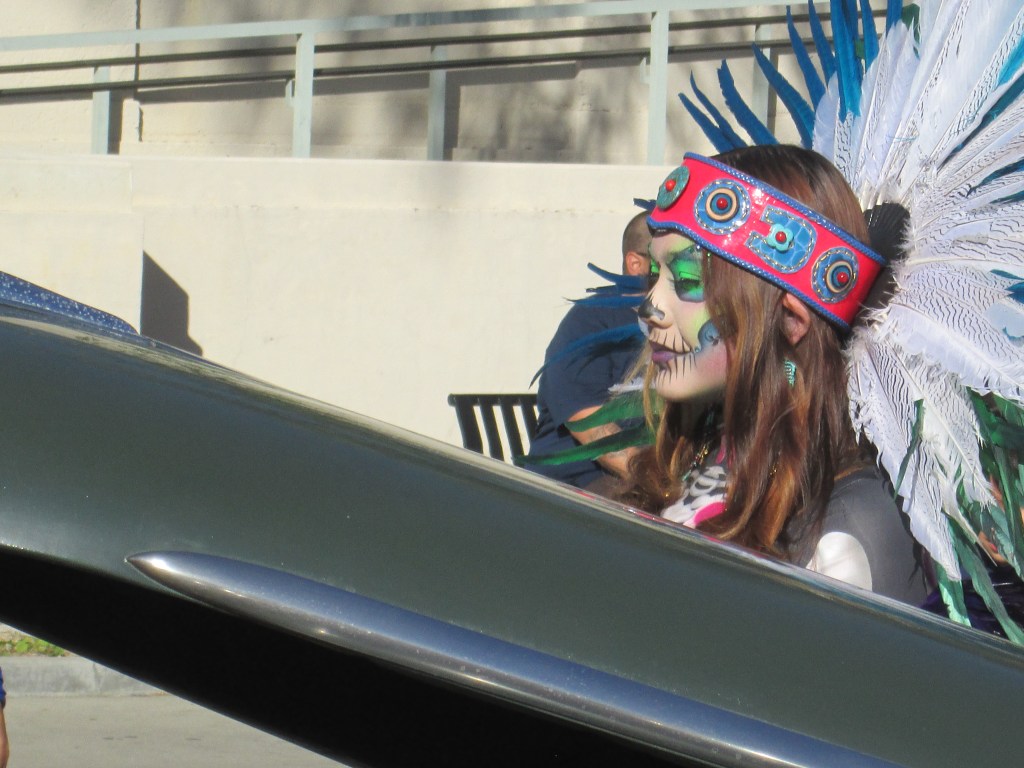
Dia de los Muertos

Although the Mexican Day of the Dead actually occurred on November 2, All Souls Day in the Catholic liturgy, the neighborhood of Canoga Park decided to hold their festival today. Martine and I were to meet a friend at the festival, but there was the usual problem with cell phones: It was too loud to here the telephone ring.

That was the first thing that set Martine off. Second was the size of the crowd. Neither of us positively like crowds, but her dislike of them approaches the realm of phobia. Thirdly, she abhors skeletons and costumes that suggest death. Finally, there were a lot of classical cars on display; but they were all tricked out as Mexican low-riders.

Only the first two things set me off, but I was interested in the costumes people wore and the cars. Many of the cars had ofrendas, little memorials to loved ones who have passed on.
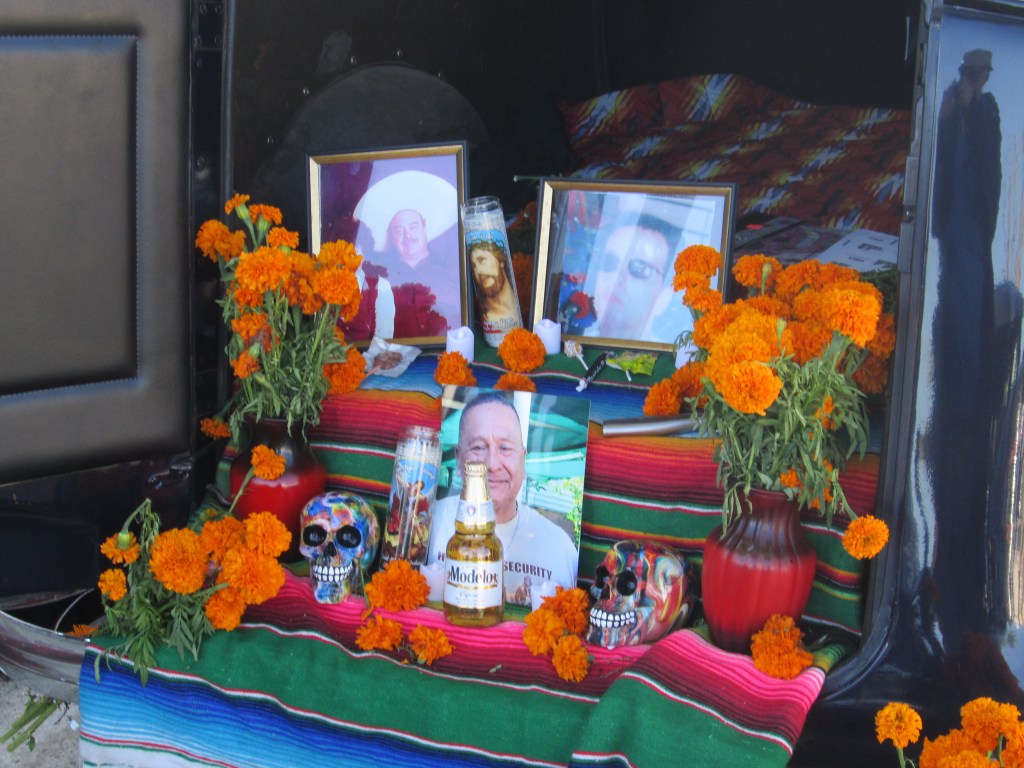
An Ofrenda Occupying the Trunk of a Low-Rider

Where Martine did not particularly like Mexican customs, I, on the other hand, have many years of traveling in the Republic and admiring from afar these same customs. I remember one bus ride I had back in the 1980s on the Dia de los Muertos between Mazatlán and Durango. The bus was filled with Mexican families on their way to have a picnic at the cemetery by the grave of their loved ones. I thought it was a splendid custom, and I helped out by holding a baby for a few miles while the young mother who sat next to me was otherwise occupied.

In the end, I knew I had to make it up to Martine. I could have made a scene and called her too thin-skinned, but instead I bought her her first cotton candy in sixty years. Then, on the way home, we stopped at Bea’s Bakery in Reseda for some of their first class pastries.So, in the end, she had some good things to remember.

Todos Somos Calaveras

Statue of Skeletal Woman at Mérida’s Hotel La Piazzetta

At some time in the 1980s—I disremember the year—I was on a long bus ride between Mazatlán and Durango over the mountains. It was November 2, the Day of the Dead, and the bus was crowded with men, women, and children headed toward distant cemeteries with baskets of food. A young mother with a baby and numerous packages sat down next to me taking the aisle seat. I helped her by holding the child or various packages for a while, until she disappeared at some small town to hold a picnic by the grave of one of her loved ones. Was it her husband? her mother? I never knew.

The following quote is from Elizabeth Sayers and Chloe Sayer’s book The Skeleton at the Feast. It throws some light on the feast day:

In Mexico—to quote Ms Sayer—the first and second of November belong to the dead. According to popular belief, the deceased have divine permission to visit friends and relatives on earth and to share the pleasures of the living. To an outsider the celebrations might seem macabre, but in Mexico death is considered a part of life. A familiar presence, it is portrayed with affection and humor by artists and crafts workers. For the Aztec, as for other ancient peoples, death signified not an end but a stage in a constant cycle. Worship of death involved worship of life, while the skull—the symbol of death—was a promise of resurrection…. The death of the individual was seen as a journey, for which numerous offerings were needed. Life is a fleeting moment—a dream—from which death awakens us.

It is all summarized in the Mexican saying “Todos somos calaveras”—“We are all skeletons.” The candy stores are full of confections shaped like skulls and skeletons. All the energy that we Gringos put into Halloween is directed toward La Dia de los Muertos. I suspect that, perhaps, the Mexican holiday is, all told, more healthy than our Halloween.