
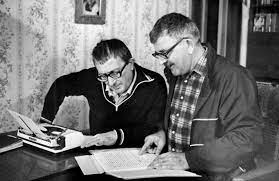
Arkady and Boris Strugatsky

Soviet Writers Arkady (1925-1991) and Boris (1933-2012) Strugatsky

They were by far the greatest science fiction authors who ever lived. The two brothers produced a string of masterpieces (the greatest being Roadside Picnic, or Пикник на обочине) that are unlikely to be surpassed, ever!

I am currently reading two of their novels whose chapters are artfully interleaved. They wrote Ugly Swans (Гадкие лебеди) in 1972; in 1986, they wrote Lame Fate (Хромая судьба) and shuffled the chapters together. Reading it is an amazing experience. I’ve finished about 40% of the nested novels at this point. I haven’t even encountered the science fiction yet, though I feel it is lurking and waiting to pounce.

Among the brothers’ works I have read are:

  • Space Apprentice (1962)
  • Far Rainbow (1963)
  • Hard to Be a God (1964)
  • The Final Circle of Paradise (1965)
  • The Second Invasion from Mars (1967)
  • Prisoners of Power (1969)
  • The Dead Mountaineers’ Hotel (1970)
  • Roadside Picnic (1972)
  • Definitely Maybe (1977)
  • Beetle in the Anthill (1980)
  • The Time Wanderers (1986)

Many of the Strugatskys’ titles have never been translated into English. I think that, ultimately, they will all be. I can think of few Soviet writers working in any genre that have such a large and consistently excellent body of work.

There are only a handful of science fiction writers I admire. After the Strugatsky brothers, there are Stanislaw Lem from Poland and, in the United States, Philip K. Dick and Clifford D. Simak.

Nothing Has To Be Done

I have been reading a rare book of humor from the old Soviet Union. It is The Anti-Soviet Soviet Union by Vladimir Voinovich, who, for his pains, was expelled from the Soviet Writers’ Union in February 1974. Unable to make a living as a writer in Russia, he naturally fled to the West. The following excerpt from the book describes an amusing visit to the KGB (Soviet State Security) in Moscow.

During my last years in Moscow, a beginning writer would visit me from time to time when he was in town from the provinces. He’d complain of not being published and gave me his novels and stories, of which there were a great number, to see what I thought of them. He was certain that his works weren’t being published because their content was too critical. And indeed they did contain criticism of the Soviet system. But they had another major flaw as well: they lacked even the merest glimmer of talent. Sometimes he would request, and sometimes demand, that I send his manuscripts abroad and help get them published over there. I refused. Then he decided to go to the KGB and present them with an ultimatum: either they were immediately to issue orders that his works be published in the USSR or he would leave the USSR at once.

Apparently, it went something like this.

As soon as he had entered the KGB building, someone walked over to him and said: “Oh, hello there. So you’ve finally come to see us.!”

“You mean you know me?” asked the writer.

“Is there anyone who doesn’t?” said the KGB man, spreading his hands. “Have a seat. What brings you here? Do you want to tell us that you don’t like the Soviet system?”

“That’s right, I don’t,” said the writer.

“But what specifically don’t you kike about it?”

The writer replied that, in his opinion, there was no freedom in the Soviet Union, particularly artistic freedom. Human rights were violated, the standard of living was steadily declining—and he voiced other critical remarks as well. Good for about seven years in a camp.

Having listened politely, the KGB man asked: “But why are you telling me all this?”

“I wanted you to know.”

“We know. Everyone knows all that.”

“But if everyone knows, something should be done about it.”

“That’s where you’re wrong. Nothing has to be done about it!”

Surprised by that turn in the conversation, the writer fell silent.

“Have you said everything you wanted to?” asked the KGB man politely.

“Yes, everything.”

“Then why are you still sitting there?”

“I’m waiting for you to arrest me.”

“Aha, I see,” said the KGB man. “Unfortunately, there’s no way we can arrest you today. We’re too busy. If the desire doesn’t pass, come see us again, and we’ll do everything we can to oblige you.” And he showed the writer out.

The writer visited me a few more times before he disappeared. I think he finally may have achieved his goal and gotten someone to give him the full treatment for dissidence.

Serendipity: Soviet High Society

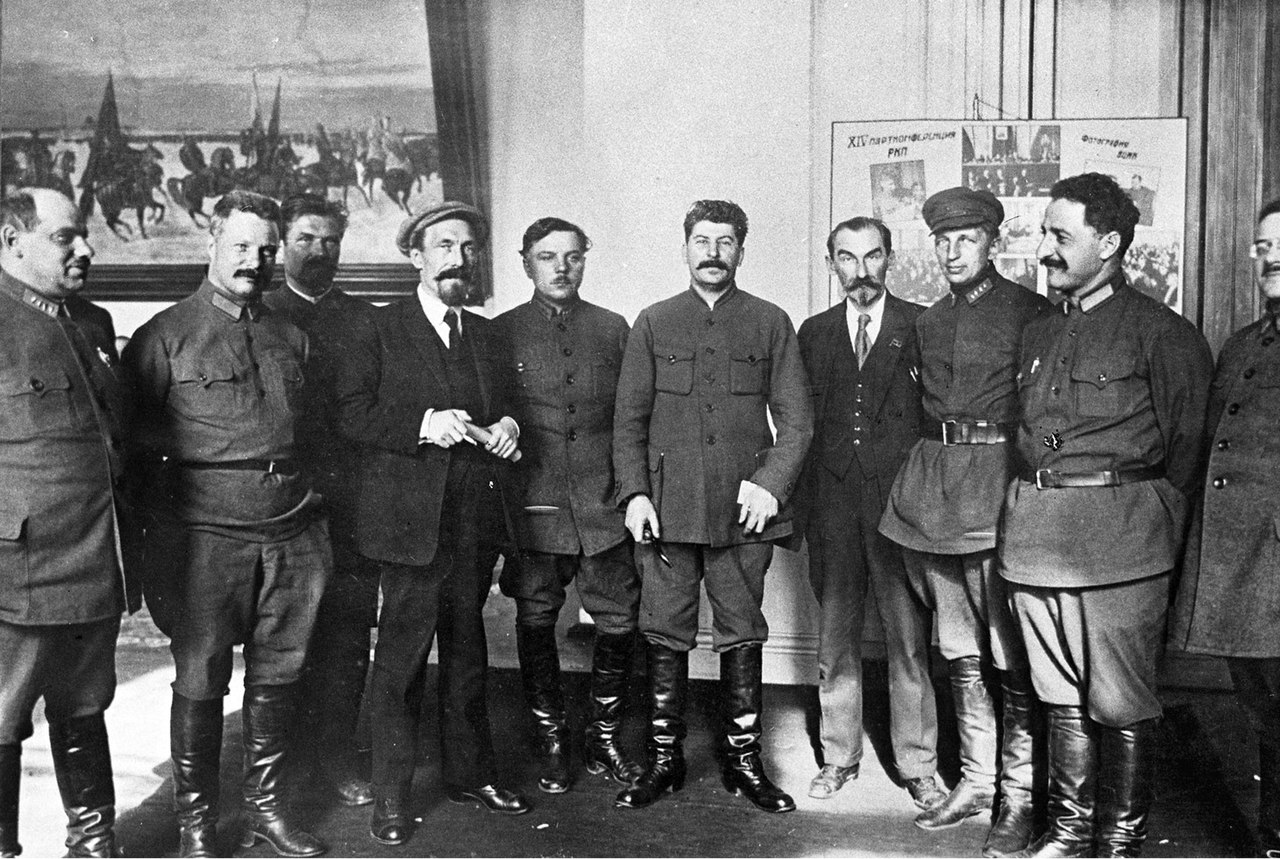
Stalin and Members of the Politburo 1925

I have just finished reading Italian writer Curzio Malaparte’s The Kremlin Ball (Material for a Novel), a book that attempts to cover the high society of the Soviet Union as if it were Marcel Proust’s fin de siècle Paris. It is a strange book, probably because Malaparte was never able to finish it after numerous visits to Russia up to 1957, when he died. It makes it a tricky read, as one is never sure exactly what period the author is talking about in a particular chapter. Still, I loved the following picture of all those figures whose lives depended on the whim of Joseph Stalin.

Of that era’s Soviet high society, corrupt, always thirsty for pleasure, greedy for money, glory, and power, proud and snobbish, capable of any infamy in order to maintain their ephemeral power, ready to betray the people, the Revolution, communism, Russia, to deny their own revolutionary past, in order not to have to renounce the honors and privileges of their position, of that Soviet nobility corrupted by Trotskyism and Bonapartism, almost no one was still alive. L’ancien régime of the Communist Revolution, the new nobility that had emerged from the communism of the war and NEP [the New Economic Plan], made up of men who believed themselves to be Marxists and were actually nothing but krasni burjui, red bourgeois, who believed that they were the guardians of Marxist and Leninist theory but were instead Bonapartists, who believed they were leaders of the proletariat but were really leaders of the Trotskyite counterrevolution, had by then given up their positions to the élites of the Stakhanovites and the Udarniks [shock workers], and to the Stalinist élites who were tough and lean but nevertheless more human and born of the Five Year Plans. Of all the merveilleuses of the communist ancien régime, of all those men corrupted by ambition, hatred, jealousy, comfort, pleasures, and privileges, all that remains is memory: the “snapshots” firing squads caught of them in their supreme, ultimate moment, their pale faces turned toward the rifle barrels, their hands clenched in fists, their eyes widened, their brows enraged, the great wind of death unobstructed in the cold, squalid, magnesium light of the camera flashes that lit up, from some invisible height, the scenes of execution in modern Europe.

NKVD Firing Squad