
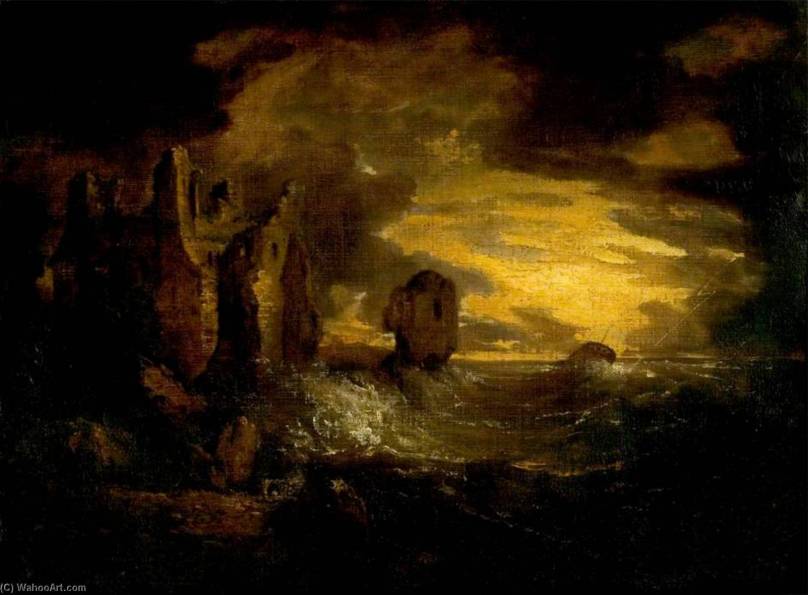
Peele Castle in a Storm

George Howland Beaumont: “Peele Castle in a Storm, Cumbria, 1800”

William Wordsworth is and always has been one of my favorite poets. The Beaumont named in the poem is the painter George Howland Beaumont (1753-1827), creator of the above painting.

Elegiac Stanzas Suggested by a Picture of Peele Castle in a Storm, Painted by Sir George Beaumont

I was thy neighbour once, thou rugged Pile!
Four summer weeks I dwelt in sight of thee:
I saw thee every day; and all the while
Thy Form was sleeping on a glassy sea.

So pure the sky, so quiet was the air!
So like, so very like, was day to day!
Whene’er I looked, thy Image still was there;
It trembled, but it never passed away.

How perfect was the calm! it seemed no sleep;
No mood, which season takes away, or brings:
I could have fancied that the mighty Deep
Was even the gentlest of all gentle things.

Ah! then, if mine had been the Painter’s hand,
To express what then I saw; and add the gleam,
The light that never was, on sea or land,
The consecration, and the Poet’s dream;

I would have planted thee, thou hoary Pile
mid a world how different from this!
Beside a sea that could not cease to smile;
On tranquil land, beneath a sky of bliss.

Thou shouldst have seemed a treasure-house divine
Of peaceful years; a chronicle of heaven;—
Of all the sunbeams that did ever shine
The very sweetest had to thee been given.

A Picture had it been of lasting ease,
Elysian quiet, without toil or strife;
No motion but the moving tide, a breeze,
Or merely silent Nature’s breathing life.

Such, in the fond illusion of my heart,
Such Picture would I at that time have made:
And seen the soul of truth in every part,
A steadfast peace that might not be betrayed.

So once it would have been,—’tis so no more;
I have submitted to a new control:
A power is gone, which nothing can restore;
A deep distress hath humanised my Soul.

Not for a moment could I now behold
A smiling sea, and be what I have been:
The feeling of my loss will ne’er be old;
This, which I know, I speak with mind serene.

Then, Beaumont, Friend! who would have been the Friend,
If he had lived, of Him whom I deplore,
This work of thine I blame not, but commend;
This sea in anger, and that dismal shore.

O ’tis a passionate Work!—yet wise and well,
Well chosen is the spirit that is here;
That Hulk which labours in the deadly swell,
This rueful sky, this pageantry of fear!

And this huge Castle, standing here sublime,
I love to see the look with which it braves,
Cased in the unfeeling armour of old time,
The lightning, the fierce wind, the trampling waves.

Farewell, farewell the heart that lives alone,
Housed in a dream, at distance from the Kind!
Such happiness, wherever it be known,
Is to be pitied; for ’tis surely blind.

But welcome fortitude, and patient cheer,
And frequent sights of what is to be borne!
Such sights, or worse, as are before me here.—
Not without hope we suffer and we mourn.

Thor the Thunderer

Storm Off the Island of Hoy, Orkney, Scotland

For many years, Scottish writer and poet George Mackay Brown wrote a column for the local newspaper of the Orkney Islands, The Orcadian. The following column from his collection Rockpools and Daffodils: An Orcadian Diary 1979-1991. describes a once-in-a-generation thunderstorm:

I think we have never had a thunderstorm like it this generation in Orkney.

We had almost forgotten what a thunderstorm was. A few warnings lingered in the memory. ‘Cover the mirrors’ … ‘Don’t take shelter under a tree’ … Someone had said to us as children, ‘The lightning won’t strike if you wear rubber boots.’ … (Old wives’ mutterings beside the fire, half-forgotten.)

I suppose we ought to have been prepared for thunder—day after day of sunshine, a still brooding loaded atmosphere, no rain for weeks.

We were so thankful for early tokens of a good summer, no-one was complaining.

It came with dramatic suddenness, between breakfast and lunch. The darkening sky, the first vfew rain-drops heavy as coins, a low growl across the sky (as if Thor wasn’t in the sweetest of tempers). But Thor, in the last two or three decades, has occasionally given a growl or two on a summer day, and turned over to sleep again.

Thor the Thunderer had urgent things to do today, it soon became obvious. He had business on his hands. His mighty hammer thudded on the hills, amid flashings.

The clouds were torn apart. Black bags of water, they emptied themselves upon the town. The gardens, at least, must have loved it, after the long drought. One could sense the roots gorging themselves.

The stones of Stromness [Brown’s home town] could do nothing with the sudden weight of water. The gutters gushed and spluttered. Down the Distillery close came a river of water, and swung south. The lightning was mostly vivid blinks, followed at once by peal upon peal. Hundreds of tons of coal were being shifted along the horizon. There was a mighty furniture removal in the sky: grand pianos and huge Victorian sideboards. And sometimes it was as if a cannon had exploded by accident in a close or down a pier, a hideous ripping of hot metal.

The cosmic electricity had quelled the little expensive electricity that man makes. I switched on the light in the eerie darkling room—nothing doing.

A candle responded with a tranquil flame.

A golden fork stabbed down and singed Hoy Sound!

After a time it seemed that Thor had finished his mighty labours for the day. The sky brightened, the thunder grumbled under the horizon.

But Thor must have forgotten some tool in his sky-smithy. Back he came and blew up his forge and struck the anvil a few more mighty blows: while we nervous earthlings below trembled. By early afternoon it was all over. We looked at each other in the cleansed air, we spoke to each other, like folk who had had some wonderful, frightening new experience.

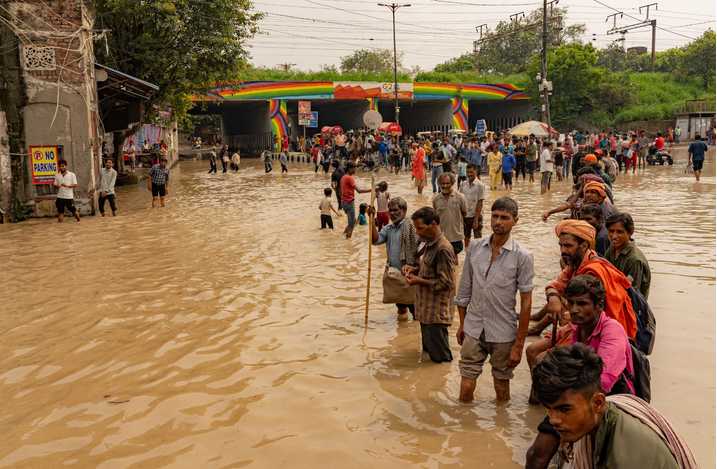
Heat » Evaporation » Clouds » Rain » Flooding

Scene of Flooding in Delhi, India

This isn’t altogether scientific, but I think I might possibly see how global warming translates into disastrous weather such as tornadoes, hurricanes, typhoons, and other types of storms associated with heavy rains and flooding.

It all begins with hot weather. According to National Geographic Magazine, the hotter it gets, the more evaporation takes place;

The National Weather Service in the United States measures the rate of evaporation at different locations every year. Scientists there found that the rate of evaporation can be below 76 centimeters (30 inches) per year at the low end, to 305 centimeters (120 inches) per year on the high end.

The variability is based on temperature. The evaporated vapors form clouds until the air in a place just can’t take any more. The article continues:

Once water evaporates, it also helps form clouds. The clouds then release the moisture as rain or snow. The liquid water falls to Earth, waiting to be evaporated. The cycle starts all over again.

Many factors affect how evaporation happens. If the air is already clogged, or saturated, with other substances, there wont be enough room in the air for liquid to evaporate quickly. When the humidity is 100 percent, the air is saturated with water. No more water can evaporate.

Then—you guessed it!—it comes down as rain. Sometimes, lots of rain. Such as Los Angeles received when a hurricane hit Southern California a couple weeks ago with record rainfall. Those record rainfalls have been happening all over the globe: Burning Man at Black Rock City in Nevada; Derma in Libya, at the edge of the Sahara Desert; and Delhi, India.

So I think that the whole cycle of drought and flood will become ever more extreme, sometimes in the most unlikely places.