
Scrawny Squirrels

Martine Trying to Feed a Squirrel

Sunday was a typical hot-and-cold day with a heavy marine layer and forecasts of rain in the eastern mountains and deserts. In other words, it was Mexican Monsoon season. Rather than break into a sweat in our apartment, I proposed we spend some hours at Chace Park in the Marina, maybe picking up a picnic lunch at the supermarket on the way.

I grabbed a book (George Mackay Brown’s Rockpools and Daffodils) and headed out with Martine to the Marina. She picked up a ready-made chicken sandwich at Ralph’s and saved bits of the crust to feed to the local squirrels and crows.

The park has a large number of scrawny squirrels who, I think, feed mostly on the leavings of picnickers. It was funny to see her approach the squirrels and try to convince them that they should take advantage of the crust she was offering them. Occasionally they did; but then, they decided to give it a pass. Martine turned away disgusted. But it was not in vain: The crows landed and grabbed the crumbs refused by the squirrels.

There was a pleasant breeze at Chace Park, and I enjoyed taking a walk that took in the statue of the helmsman at the tip of the peninsula in which the park is situated.
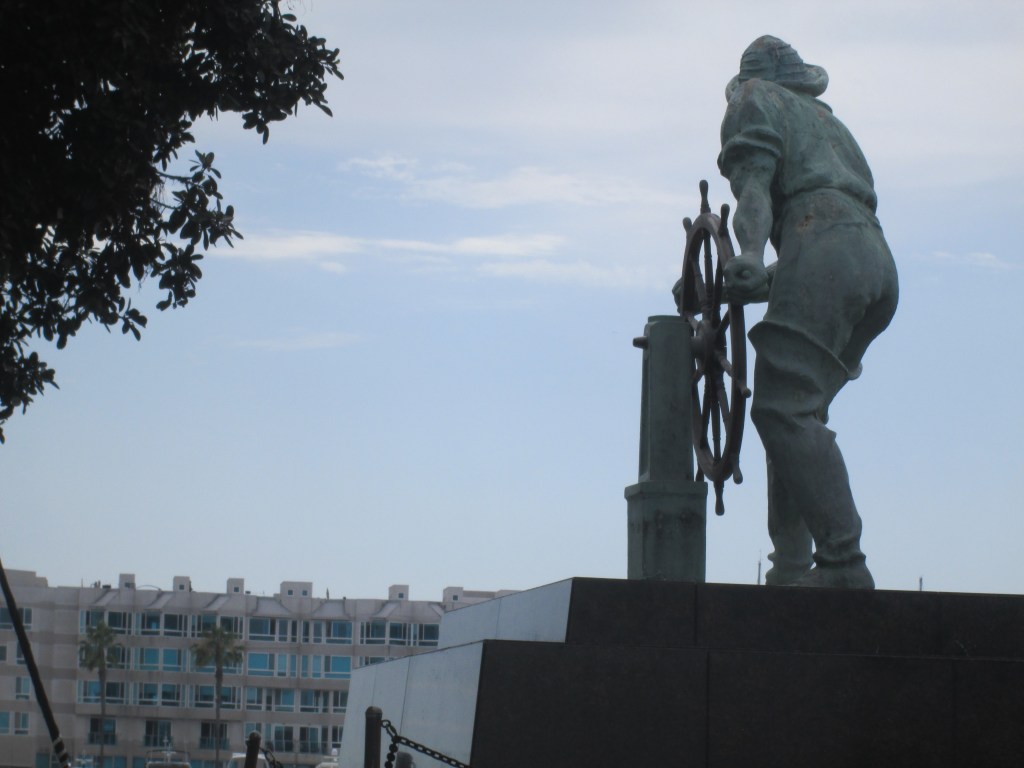
Statue of the Helmsman at Chace Park

The sun didn’t come out, but in sunny California that is no tragedy. We got fed, the crows and squirrels got fed, and I read a goodly chunk of George Mackay Brown, which is always a good thing.

Morning

The following short poem from William Blake’s MS. book and is typical of his best work early in his career (around 1800-1903).

Morning

To find the Western path
Right thro’ the Gates of Wrath
I urge my way.
Sweet Mercy leads me on.
With soft repentant moan
I see the break of day.

The war of swords & spears
Melted by dewy tears
Exhales on high.
The Sun is freed from fears
And with soft grateful tears
Ascends the sky.

Fun in the Sun?

Family On Summer Beach Vacation Run Out Of Sea Towards Camera

Ah yes, Paradise on Earth. As a people, we have traditionally viewed summer beach vacations as the closest one could get to Heaven while alive. When I first came out to California in the late 1960s, I thought so, too. While working part-time at System Development Corporation in Santa Monica, I spent many afternoons lying on a towel and reading steamy fiction like Lawrence Durrell’s Alexandria Quartet.

The water was fun to a certain extent, but I was never a board or body surfer, though I went in often enough to be savaged by the occasional rough wave. Also, I tended to burn—especially as I had no one to slather my back with sun tan lotion.

While I live only two miles from the beach at Santa Monica, I don’t spend time there any more, unless I take a walk on the boardwalk connecting Santa Monica to Venice. Part of the reason is that the water is more polluted than ever, especially because we are only 20-30 miles (32-48 km) from the nation’s largest port, where freighters and tankers regularly foul the waters with petrochemical waste.

So when Martine and I go to Hawaii in a couple months, are we planning for any beach time? Not really. Although the waters at Waikiki are less polluted, the sun is stronger; and we both have fair skin. We are more interested in visiting Honolulu as a destination rather than trying to live in a pharmaceutical commercial.

I suppose if we lived east of the Mississippi, we would yearn for sunshine; but, living in Southern California, we have sunshine on most days of the year. In fact, September tends to be one of the hottest months of the year in Los Angeles. So we are likely escaping even hotter (albeit drier) weather at home.

Solar Maximum?

An Unusual View of Our Sun Three Weeks Ago

An Unusual View of Our Sun Three Weeks Ago

As we in Southern California suffer through wildfires, desert winds, and hundred-degree temperatures, I was impressed by this view of the sun from Astronomy Picture of the Day on May 6 of this year. According to the description:

Our Sun has become quite a busy place. Taken only two weeks ago, the Sun was captured sporting numerous tumultuous regions including active sunspot regions AR 2036 near the image top and AR 2038 near the center. Only four years ago the Sun was emerging from an unusually quiet Solar Minimum that had lasted for years. The above image was recorded in a single color of light called Hydrogen Alpha, inverted, and false colored. Spicules cover much of the Sun’s face like a carpet. The gradual brightening towards the Sun’s edges is caused by increased absorption of relatively cool solar gas and called limb darkening. Just over the Sun’s edges, several filamentary prominences protrude, while prominences on the Sun’s face are seen as light streaks. Possibly the most visually interesting of all are the magnetically tangled active regions containing relatively cool sunspots, seen as white dots. Currently at Solar Maximum—the most active phase in its 11-year magnetic cycle, the Sun’s twisted magnetic field is creating numerous solar “sparks” which include eruptive solar prominences, coronal mass ejections, and flares which emit clouds of particles that may impact the Earth and cause auroras. One flare two years ago released such a torrent of charged particles into the Solar System that it might have disrupted satellites and compromised power grids had it struck planet Earth.

Kind of looks like a shaggy old tennis ball, doesn’t it?