
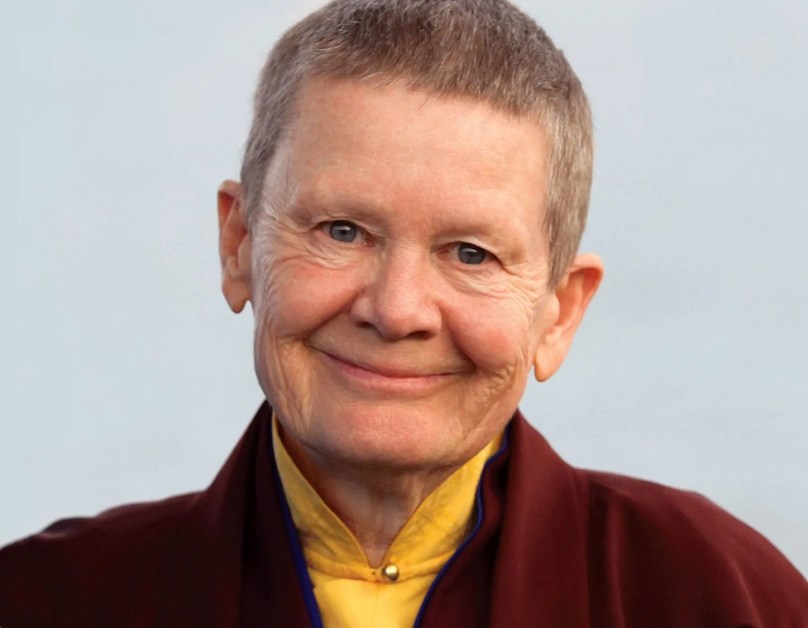
Not To Be Improved Upon

Tibetan Buddhist Nun Pema Chödrön

There I was yesterday staring at tulips at Descanso Gardens in between reading selections from The Pocket Pema Chödrön. And who is Pema Chödrön? Now retired, she is an American-born Buddhist nun practicing Tibetan Buddhism. She is a disciple of Chögyam Trungpa Rinpoche who has written a score of books on Buddhist practices. The following selection particularly interested me.

We already have everything we need. There is no need for self-improvement. All these trips that we lay on ourselves—the heavy-duty fearing that we’re bad and hoping that we’re good, the identities that we so dearly cling to, the rage, the jealousy and the addictions of all kinds—never touch our basic wealth. They are like clouds that temporarily block the sun. But all the time our warmth and brilliance are right here. This is who we really are. We are one blink of an eye away from being fully awake.

Looking at ourselves this way is very different from our usual habit. From this perspective we don’t need to change: you can feel as wretched as you like, and you’re still a good candidate for enlightenment. You can feel like the world’s most hepless basket case, but that feeling is your wealth, not something to be yjrown out or improved upon.

Two Types of Travel Books

The Blue City of Samarkand in Uzbekistan

Constantinople, Trebizond, Tbilisi, Baku, Samarkand, Bukhara, Tashkent, Lhasa—these are cities I would dearly love to know more about. So when I read Kate Harris’s Lands of Lost Borders: A Journey on the Silk Road, I looked forward to learning more about these magical places. Alas, I was disappointed: The book was more about a bicycle trip with little attention paid to destinations, and most of the attention paid to the roads connecting the destinations.

I had to remind myself that there are two types of travel books. First, there was my preferred kind, which combines personal experiences with history, literature, art, cuisine, and culture—the whole ball of wax! But there is another kind of travel book as well. Call it adventure travel or experiential travel. All mountain-climbing books fall into this category. They can be excellent reads, such as Jon Kracauer’s Into Thin Air, Alfred Alvarez’s Feeding the Rat, or any of Eric Shipton’s great books on mountains he has climbed.

Tibetan Monastery

Kate Harris and her companion Melissa Yule concentrated all their efforts in surviving a multiple-thousand-mile journey involving multiple mountain ranges and passes. It was quite an accomplishment, but it just left me hungry to learn more about Constantinople, Trebizond, Tbilisi, Baku, Samarkand, Bukhara, Tashkent, Lhasa, and points between.

Oh, well, as long as the quarantine and my health last, I’ll have the time to make up that deficit.