
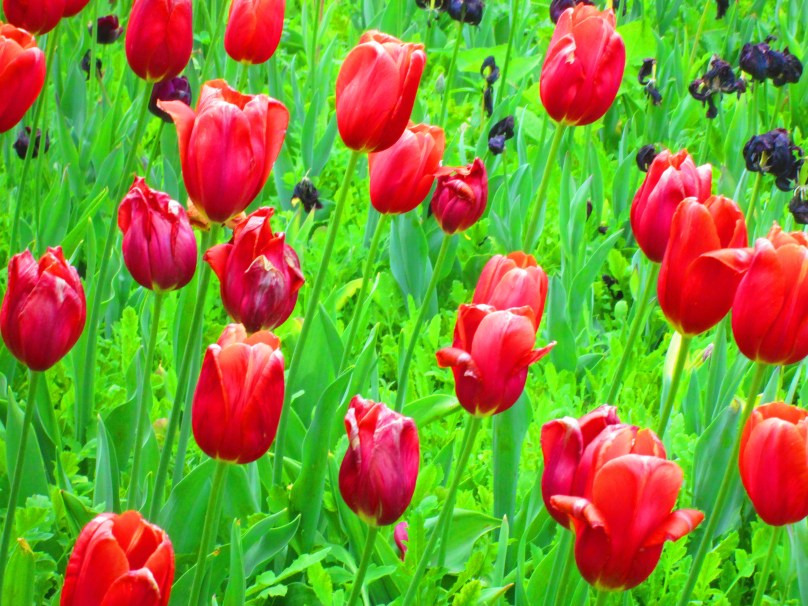
Tulips in Bloom at Descanso Gardens
This was absolutely the best time to visit Descanso Gardens in La Cañada-Flintridge: The tulips, lilacs, and camellias were all in bloom. Of the three, tulips are my favorites, followed by lilacs—mostly for their scent.
For this year, the tulip plantings were nowhere near as intensive as in previous years. One thing I noticed that was different was that the tulip garden area had cards indicating that certain plantings were in memory of some person known to the donor. My guess is that there weren’t as many donors, or volunteers, or employees as the Gardens management anticipated. Or whatever.
Still, what was there was indescribably beautiful. I spent an hour sitting on a bench in the shade just staring at the tulips or reading a book of Tibetan Buddhist teachings by Pema Chödrön. It was peaceful and sublime—even though there were visitors by the thousands to the Garden this afternoon.
Tulips are interesting to me not only because of their looks, but because there was a time almost 400 years ago when they impacted the economic history of Europe. I am talking about the tulip mania that gripped the Netherlands. According to Wikipedia, “At the peak of tulip mania, in February 1637, certain tulip bulbs sold for more than 10 times the annual income of a skilled artisan.” To this day, the term “tulip mania” is associated with an economic bubble that is not linked in any way to the actual intrinsic value of the item traded.
It also has an interesting footnote in literature. In 1850, Alexandre Dumas Père published a novel about the 17th century Dutch tulip fever entitled The Black Tulip. It is the fascinating story of a Dutchman who attempts to develop a black tulip during the period.
 Tarnmoor
You must be logged in to post a comment.