
In Love with the Twonky

Tony Randall as the Medusa in 7 Faces of Dr Lao (1964)

Oh, God, what is he on about now? Twonky? What is twonky?

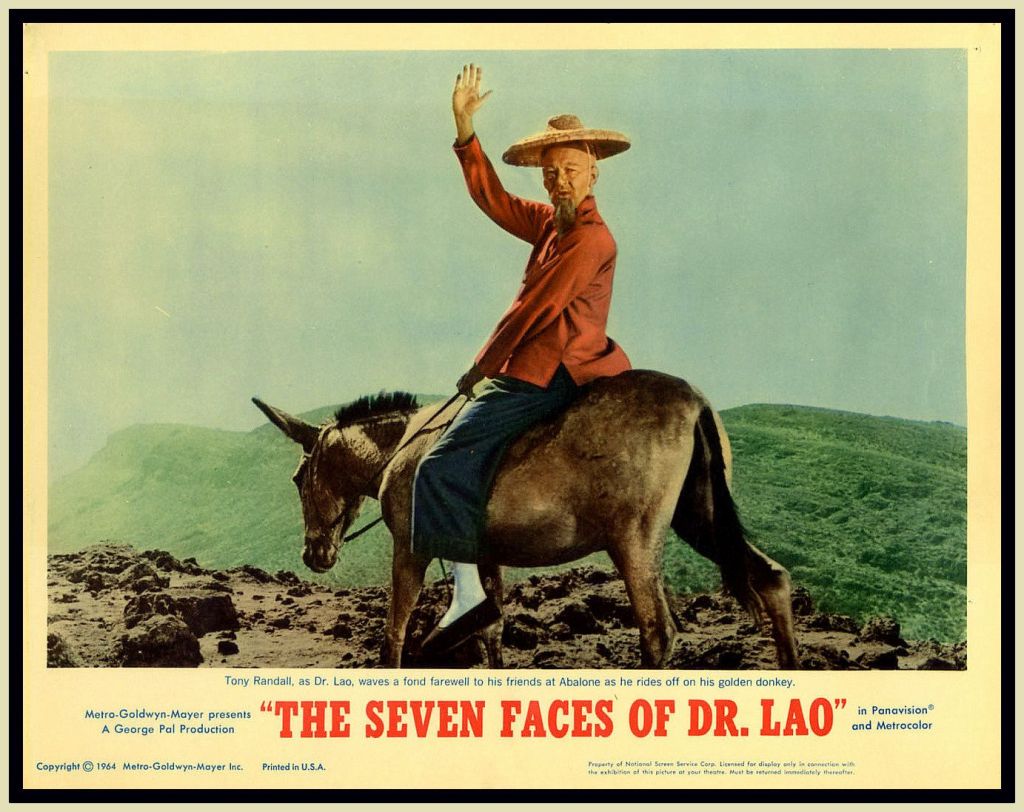
You well know that there are films that you love but to which you cannot ascribe a high level of artistic excellence. I refer to them as twonky films. For me, a perfect example is George Pal’s 7 Faces of Dr Lao, produced at MGM. In it, Tony Randall actually plays eight roles: the inscrutable Dr Lao (pronounced LOH) himself, the magician Merlin, the god Pan, the Talking Serpent, Medusa, Apollonius of Tyana, the Abominable Snowman, and (uncredited) himself as a seated member of the audience.

In the last seven years, I have seen 7 Faces of Dr Lao four times and I’m still not tired of it. I will continue to see it and enjoy it whenever I can. I even read the book it was based on: Charles G. Finney’s The Circus of Dr Lao. (As a matter of fact, I think I’ll probably re-read the book pretty soon.)

Now where does this term twonky come from? In 1953, Arch Oboler directed a science fiction film entitled The Twonky starring Hans Conried. According to the Internet Movie Database (IMDB), the plot concerns a “Tweedy college professor [who] discovers his new TV set is animate, apparently possessed by something from the future, and militantly intent on regulating his daily life.”

I have not seen the film but it sounds pretty twonky to me.

There are many other films (and, dare I say it, books) that I would consider to be twonky. I’m thinking of Ed Wood’s Plan 9 from Outer Space, Showgirls, Popeye cartoons, and virtually the entire filmography of Roger Corman and William Castle.

Interestingly, there is a generation gap between the bad films I like and the bad films a Gen Z’er would like. That’s understandable because young people were raised to love a different kind of bad film. Even my younger brother (by six years) grew up loving Clutch Cargo and Huckleberry Hound cartoons, which I considered too unsophisticated for my tastes.

In Search of the Twonky

Tony Randall as Merlin in 7 Faces of Dr. Lao (1964)

There is a category of things which one loves even if one knows they are not objectively good. This is particularly true of films, food, people, articles of clothing, and any number of things. For some reason, there is no single word in the English language that conveys the unreasoning attraction for certain things that one loves unreasoningly. (“Campy” is in the ballpark, but not close enough.)

I had been using the word twonky, though I find that my use of the term is common to no one but me. What the hell, I’ll use it anyhow.

One of my favorite twonky films is 7 Faces of Dr. Lao, directed by George Pal, better known for his sci-fi films like Destination Moon (1950) and When Worlds Collide (1951).

It is the tale of a small town in Arizona called Abalone (an odd name for a desert burg.) A little old Chinese fakir called Dr. Lao (pronounced LOW) comes to town advertising a circus. All the characters in the circus are played by Tony Randall (except for the Abominable Snowman, a nonspeaking part played by George Pal’s son Peter). The circus takes place in the desert in a small tent which, on the inside, is miraculously roomy.

Tony Randall as Dr. Lao

The odd thing about Dr. Lao’s circus is that the townspeople learn about themselves, especially Barbara Eden (Angela Benedict) and Arthur O’Connell (Clint Stark, who is trying to buy up the town for profit). Merlin, the Medusa, Pan, Apollonius of Tyana, and the serpent—all act in strange offbeat ways to bring self-knowledge to the people of Abalone. And, in the process, the circus leaves Abalone a happier town.

The Tent Where the Circus Takes Place

I will not go to my grave insisting that 7 Faces of Dr. Lao is a great film, but I will see it again if I can. It always leaves me with a warm feeling. Other films that are among my twonky favorites are:

  • Most classical old sci-fi films
  • James Bond films
  • Earth Girls Are Easy (1984)
  • Danny Elfman’s The Forbidden Zone (1980)
  • Robin Williams’s Popeye (1980) directed by Robert Altman
  • David Lynch’s Dune (1984)