Act Like It’s a Victory

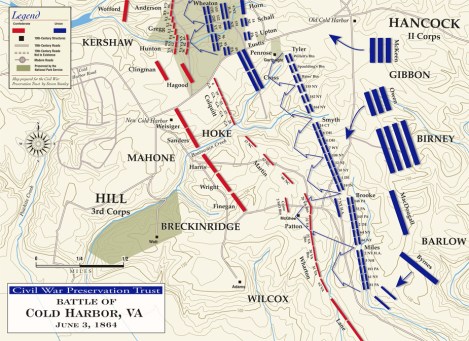
Schematic of the Battle of Cold Harbor

Schematic of the Battle of Cold Harbor

I think I am coming to the end of my Civil War enthusiasm. But then, it can suddenly be revived at a moment’s notice—so don’t count too much on it.

My chief interest has been Ulysses S. Grant, who finally figured out how to win the Civil War for Lincoln. There had been so many failures in the leadership of the Army of the Potomac. A noxious pattern was established, which consisted of rampant braggadocio followed by condign defeat followed by a retreat to lick their wounds.

Look at that schematic of the Battle of Cold Harbor. Like all the victories of Grant’s 1864 Overland Campaign, it was by no means a rout. It could even be viewed as a defeat. The Army of the Potomac suffered more casualties than the Army of Northern Virginia—except for one key difference. Grant stayed put and prepared for the next battle, and Lee inexorably backed toward the Confederate capital at Richmond. (This is exactly the opposite of Lee vs. previous commanders of the Army of the Potomac, who always backed toward Washington in case they had to defend it.)

Between the Battle of the Wilderness and the Siege of Petersburg, Grant kept applying the pressure, and Lee kept responding. Casualties almost didn’t matter. If Lee lost a man, he had great difficulty replacing him. For Grant, there was a pool of two and a half million men of military age who had not yet served (though it was difficult at times getting them to enlist).

By acting as if the battle were a victory and getting ready for the next one, Grant guaranteed a Northern victory.


Two Role Models

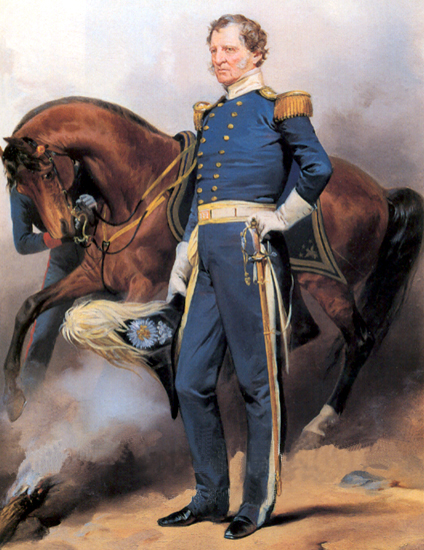
General Winfield Scott (1786-1866)

General Winfield Scott (1786-1866)

While he was a cadet a West Point, Ulysses S. Grant admired the spit and polish of General Winfield Scott, under whom he was to fight in the Mexican War that followed. For a while, Grant emulated him, but changed his mind when the local rubes would make fun of him for looking like a toy soldier.

Then, when the Mexican War began with Grant as a brevet lieutenant, he saw an entirely different kind of general. According to Bruce Catton in his book U.S. Grant and the American Military Tradition:

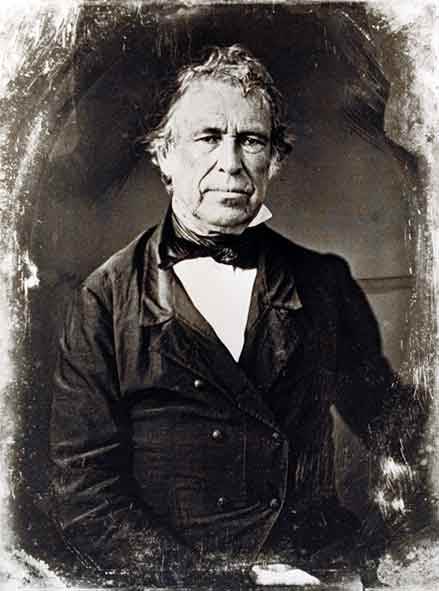
[Zachary] Taylor was a natural. A professional soldier but not a West Pointer, he had fought in the War of 1812 and subsequently in many a campaign against the Indians. He had an ostentatious and wholly sincere dislike for military formality. By custom, he wore blue jeans, a long linen duster and a floppy straw hat, and he would lounge around headquarters like a seedy backwoods farmer. On the parade ground, when he sat on his horse to review troops or to watch drill or maneuvers, he was as likely as not to sit sidesaddle, chewing tobacco and behaving like a man who casually watches the field hands harvest a crop.

General Zachary Taylor (1784-1850)

General Zachary Taylor (1784-1850)

Both Scott and Taylor wir first-rate generals. When Fort Sumter was fired on in 1861, Winfield Scott was in charge of the Federal Army, but he was too ridden with dropsy and gout—not to mention obesity—to be able to mount a horse, so he offered his command to Robert E. Lee. Of course, when Virginia seceded from the Union, Lee went over to the Rebs, and Irvin McDowell got the nod to head the Army of the Potomac.

Interestingly, Winfield Scott’s master plan for starving the Confederacy into submission was the so-called “Anaconda Plan,” which called for a naval blockade and the capture of the Mississippi. He may have been called “Old Fuss and Feathers” toward the end of his life, but Scott knew what he was doing; and Grant copied his Western strategy from him.

Grant had two excellent role models, which he needed, because the array of timid military ignoramuses who headed the Army of the Potomac before him did not have much to offer their successors other than a long string of defeats.

A Grim Secret

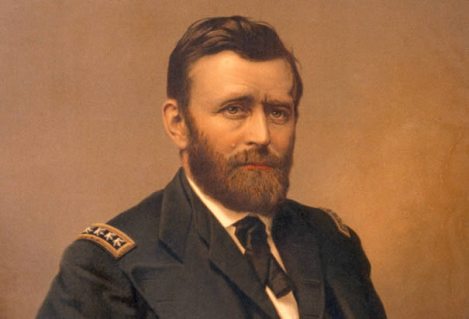
Union General Ulysses S. Grant

Union General Ulysses S. Grant

Ulysses S. Grant was an altogether unprepossessing man. He didn’t have the swagger or gravitas of such Union generals as McDowell, Pope, McClellan, Burnside, Hooker, or Meade; but on the other hand, he was not a coward, a poltroon, or pathologically cautious either. His successes were due not only to his pertinacity, but to a grim secret that he knew and made use of as head of the Army of the Potomac.

Yes, the South had the more dashing generals, but they were on the wrong side when it came to the numbers. You see, the North had a larger population of eligible males to sacrifice to death, disability, and capture than the South. The South had, for all practical purposes, 100% conscription. At the end of the war, there were still at least 2 million eligible men who hadn’t worn the blue uniform. Take a look at this website by the Civil War Trust or charts and tables on Civil War casualties.

This Chart Says It All

This Chart Says It All

The other factor was that Grant never ran. At the end of the battle, he was still there and still game for more bloodshed—not for the sake of shedding blood, but for the sake of ultimate victory.

I have been reading the second volume of Shelby Foote’s The Civil War: A Narrative. Even with his Confederate sympathies, Foote could appreciate Grant’s grand strategy at Vicksburg. If the North won Vicksburg, the whole Trans-Mississippi South would be lost. The problem was: How to get at it. The most obvious way was to invade Mississippi and take it from the rear. Unfortunately, that failed; and in any case the area was controlled by the South’s most ingenious and fierce commander of cavalry, Nathan Bedford Forrest. (After the war, Forrest was one of the founders of the Ku Klux Klan.)

Grant was not afraid to fail, and he failed a total of seven or eight times before he found a way of marshaling his army and navy forces to effect a landing on the eastern side of the Father of Waters, well out of the way of Forrest’s cavalry. He made straight for Jackson, Mississippi, where he wrecked the railroad lines that supplied the Confederates at Vicksburg. Along the way back toward Vicksburg, he fought two battles at Champion Hill and the Big Black River. Then and only then did he directly besiege Vicksburg. From then on, it was pretty much a matter of starving the rebels until they surrendered early in July.

It was right around then that the North won its decisive victory at Gettysburg.

It wasn’t long before Lincoln concluded that, in Grant, he had a general who could outfight Lee’s Army of Northern Virginia. That is exactly what he proceeded to do in what has come to be known as his Overland Campaign. It didn’t matter how many men he lost jat battles such as the Wilderness, the North Anna, Spotsylvania Court House, and Cold Harbor just so long as he didn’t fall back after each battle, as the Army of the Potomac was wont to do. He not only did not fall back: He pushed Lee’s forces step by step closer to the final showdown in front of Richmond. And by then, it was all over.

Too bad that Grant made such a terrible President. He was a smart man, and a great military leader, but none of us are perfect.