
WEC: SB on Bateson

A Very Influential Book Back Then

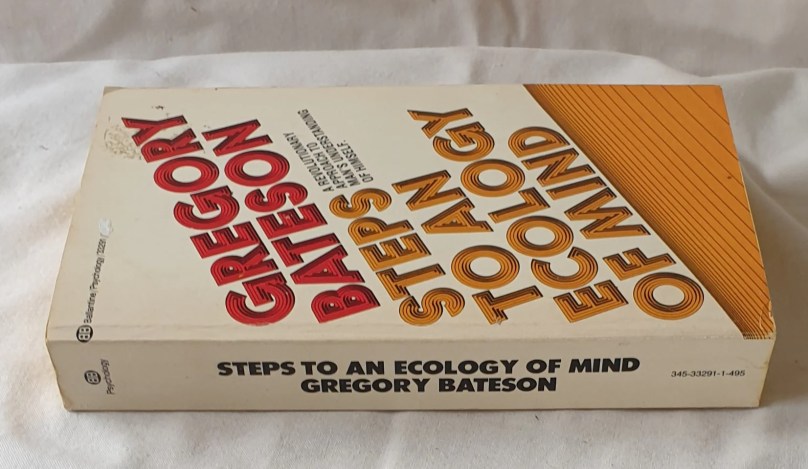
On June 15, I posted about the effect that the Whole Earth Catalog (WEC) series by Stewart Brand has had on me. And I promised that I would present a series of some of editor Brand’s more interesting comments. This is his take on Gregory Bateson’s Steps to an Ecology of Mind, which was first published in 1972. I had never read the book, but found it was influencing a number of my friends who were film historians and film critics. Now, I think I will find the book and read it.

Here is what SB (Stewart Brand) wrote about it:

Bateson has informed everything I’ve attempted since I read Steps in 1972. Through him I became convinced that much more of whole systems could be understood than I thought—that mysticism, mood, ignorance, and paradox could be rigorous, for instance, and that the most potent tool for grasping these essences—these influence nets—is cybernetics.

Bateson is responsible for a number of formal discoveries, most notably the “Double Bind” theory of schizophrenia. As an anthropologist he did pioneer work in New Guinea and (with Margaret Mead) in Bali. He participated in the Macy Foundation meetings that that founded the science of cybernetics but kept a healthy distance from computers. He has wandered thornily in and out of various disciplines—biology, ethnology,, linguistics, epistemology, psychotherapy—and left each of them altered with his passage.

The book chronicles the journey. It is a collection of his major papers, 1935-1971. In recommending the book I’ve learned to suggest that it be read backwards. Read the recent broad analyses of mind and ecology at the end of the book and then work back to see where the premises come from.

In my view Bateson’s special contribution to cybernetics is in exploring its second, more difficult realm (where the first is feedback, a process influencing itself, what Bateson calls “circuit,” and the second is the meta-realm of hierarchic levels, the domain of context, of paradox and abundant pathology, and of learning).

Strong medicine.
The Book

NASA Image of the Earth from Space

For over twenty years, I considered Stewart Brand’s Whole Earth Catalog as one of the major influences of my life. This evening, I unearthed the most recent edition I had, entitled The Next Whole Earth Catalog and published in October 1981.

In the original issue dated 1969, the following appeared on the opening page:

Function

The WHOLE EARTH CATALOG functions as an evaluation and access device. With it, the user should know better what is worth getting and where and how to do the getting.

An item is listed in the CATALOG if it is deemed:

  1. Useful as a tool,
  2. Relevant to independent education,
  3. High quality or low cost,
  4. Not already common knowledge,
  5. Easily available by mail.

CATALOG listings are continually revised according to the experience and suggestions of CATALOG users and staff.Purpose

We are as gods and might as well get good at it. So far, remotely done power and glory—as via government, big business, formal education, church—has succeeded to the point where gross defects obscure actual gains. In response to this dilemma and to these gains a realm of intimate, personal power is developing—power of the individual to conduct his own education, find his own inspiration, shape his own environment, and share his adventure with whoever is interested. Tools that aid this process are sought and promoted by the WHOLE EARTH CATALOG.

The items in the original catalog are grouped under seven main sections:

  • Understanding Whole Systems
  • Shelter and Land Use
  • Industry and Craft
  • Communications
  • Community
  • Nomadics
  • Learning

It would seem that I’m not really that self-sufficient, not even like my brother Dan, who builds homes of logs (and other materials). I am by nature a bookworm, but I would have to admit that the WEC has contributed hugely to my well being.

For years I used to order my loose tea from Murchie’s in Vancouver, British Columbia. That’s how I discovered the Darjeeling, Ceylon, and Assam teas with which I start just about every day. (Since then, I have discovered Ahmad of London teas, which are readily available at local Middle Eastern and Indian food stores.)

The WEC also pointed the way to that encyclopedic American cookbook, The Joy of Cooking by Irma S. Rombauer and Marion Rombauer Becker. I still use my 1980s edition.

The Nomadics section is largely responsible for the travel bug that has infected me since my first trip abroad in 1975. Much of my information came from Carl Franz’s The People’s Guide to Mexico. As WEC says, “Reading the book is almost like being there and going through the problems and frustrations, pleasures and wonders of dealing with a new environment, new people and new ways of doing things.”

I was not yet ready for South and Central America, but the WEC Nomadics advice influenced me. Two decades before I flew to Argentina, I religiously read editions of The South American Handbook published in America by RandMcNally.

In the coming weeks, I hope to share some of the nuggets from WEC that have influenced me.

Stewart Brand is still around, but perhaps the Internet has probably replaced WEC. The problem with the Internet, however, is that you will find great advice and terrible advice in the same session. And how are we Americans at making good decisions? Pretty crappy, I think.