The Tyger

Every time I read this poem by William Blake, I am impressed anew by its greatness. Its very simplicity is deceptive, as it hints at levels of mystery and savagery that underlie our workaday world. I have posted this poem before, but I continue to be mightily impressed by it.

The Tyger

Tyger Tyger, burning bright, 
In the forests of the night; 
What immortal hand or eye, 
Could frame thy fearful symmetry?

In what distant deeps or skies. 
Burnt the fire of thine eyes?
On what wings dare he aspire?
What the hand, dare seize the fire?

And what shoulder, & what art,
Could twist the sinews of thy heart?
And when thy heart began to beat.
What dread hand? & what dread feet?

What the hammer? what the chain,
In what furnace was thy brain?
What the anvil? what dread grasp.
Dare its deadly terrors clasp?

When the stars threw down their spears 
And water’d heaven with their tears:
Did he smile his work to see?
Did he who made the Lamb make thee?

Tyger Tyger burning bright,
In the forests of the night:
What immortal hand or eye,
Dare frame thy fearful symmetry?
Prose Poem

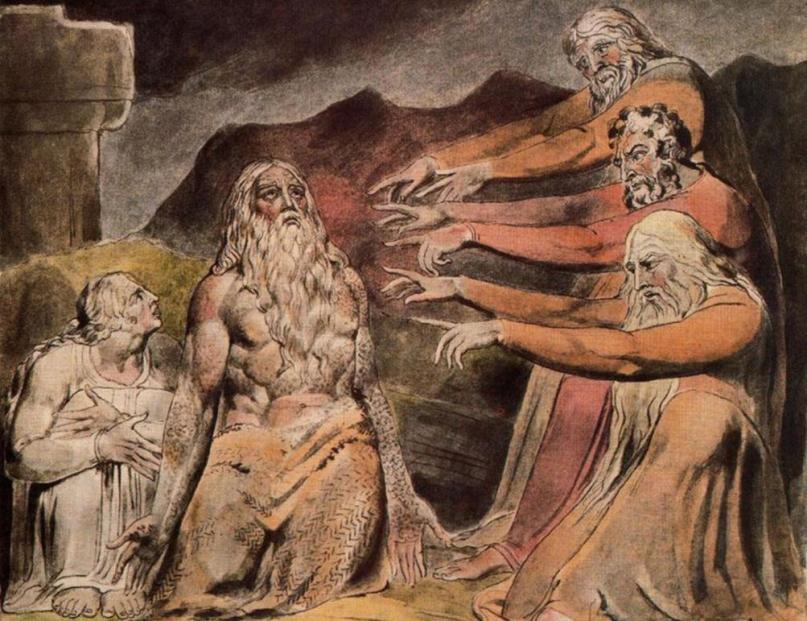
William Blake Illustration from the Book of Job

The following prose poem by Wisława Szymborska is the best treatment I have ever read of the Old Testament Book of Job.

SYNOPSIS

Job, sorely tried in both flesh and possessions, curses man’s fate. It is great poetry. His friends arrive and, rending their garments, dissect Job’s guilt before the Lord. Job cries out that he was righteous. Job does not know why the Lord smote him. Job does not want to talk to them. Job wants to talk to the Lord. The Lord God appears in a chariot of whirlwinds. Before him who had been cloven to the bone, He praises the work of his hands: the heavens, the seas, the earth and the beasts thereon. Especially Behemoth, and Leviathan in particular, creatures of which the Deity is justly proud. It is great poetry. Job listens: the Lord God beats around the bush, for the Lord God wishes to beat around the bush. Job therefore hastily prostrates himself before the Lord. Events now transpire in rapid succession. Job regains his donkeys and camels, his oxen and sheep twofold. Skin grows over his grinning skull. And Job goes along with it. Job agrees. Job does not want to ruin a masterpiece.

—Wisława Szymborska. Poems New and Collected 1957-1997

London

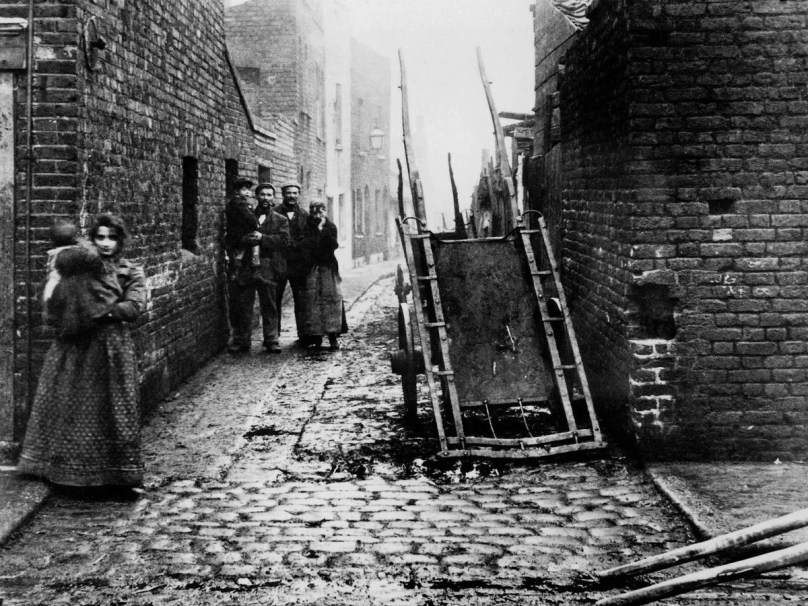
A London Slum

I was rereading some of William Blake’s Songs of Experience this evening and shuddered at the poem entitled, simply, “London”:

London

I wander thro’ each charter’d street
Near where the charter’d Thames does flow,
And mark in every face I meet
Marks of weakness, marks of woe.

In every cry of every Man,
In every Infant’s cry of fear,
In every voice, in every ban,
The mind-forg’d manacles I hear.

How the Chimney-sweeper’s cry
Every black’ning Church appalls,
And the hapless Soldier°s sigh
Runs in blood down Palace walls.

But most thro’ midnight streets I hear
How the youthful Harlot’s curse
Blasts the newborn Infant’s tear,
And blights with plagues the Marriage hearse.

How strong is that phrase “mind-forg’d manacles”! How descriptive of a particularly American form of suffering in the Age of Trump!

Morning

The following short poem from William Blake’s MS. book and is typical of his best work early in his career (around 1800-1903).

Morning

To find the Western path
Right thro’ the Gates of Wrath
I urge my way.
Sweet Mercy leads me on.
With soft repentant moan
I see the break of day.

The war of swords & spears
Melted by dewy tears
Exhales on high.
The Sun is freed from fears
And with soft grateful tears
Ascends the sky.

Where Lions Roam

Self Portrait of William Blake

William Blake was not only a visionary artist, but also a visionary poet, whose works range from simple lyrical pieces to long, complicated prophetic books redolent of the Old Testament. For these latter, he invented his own mythology, with beings named Enitharmon, Los, Urizen, Albion, and such like.

The excerpt below is taken from my favorite Blake poem, “The Marriage of Heaven and Hell.” In it the character of Rintrah appears as a personification of the just wrath of a prophet.

THE ARGUMENT

Rintrah roars & shakes his fires in the burden’d air;
Hungry clouds swag on the deep.

Once meek, and in a perilous path,
The just man kept his course along
The vale of death.
Roses are planted where thorns grow,
And on the barren heath
Sing the honey bees.

Then the perilous path was planted,
And a river and a spring
On every cliff and tomb,
And on the bleached bones
Red clay brought forth;

Till the villain left the paths of ease,
To walk in perilous paths, and drive
The just man into barren climes.

Now the sneaking serpent walks
In mild humility,
And the just man rages in the wilds
Where lions roam.

Rintrah roars & shakes his fires in the burden’d air;
Hungry clouds swag on the deep.

Here is a link to an interesting video called The Otherworldly Art of William Blake: YouTube Video.

Which Path?

Aaron Rogers: Quarterback, Trumper, Anti-Vaxxer, and All-Around Dickhead

I had a choice of two ways to go for today’s blog. Instead I took a third way. The first way was to continue writing about poet and printmaker William Blake, one of my all-time favorites. Then I was thinking about Aaron Rogers implying of ESPN that late night TV host Jimmy Kimmel was a pederast in Jeffrey Epstein’s circle of sexual deviants.

The third way turned out to analyze why I am triggered by the bad behavior of Trump and his followers. To the very core of my being, I despise what Trump and the Trumpites are doing to this country. But my political opinions are of no great interest to anyone. So many Americans, so many raw wounds that won’t heal, that keep on being re-infected!

It strikes me that my blogs about things that interest me make for better reading than blogs about my political opinions, especially when they involve the culture wars of the 21st century.

So tomorrow I return to writing about William Blake, a great artist and poet. Tomorrow, I’ll post some of his poetry. If you’d rather read about Aaron Rogers, trust me: It’s just too depressing for words. Even when I write them.

Old Testament Visionary

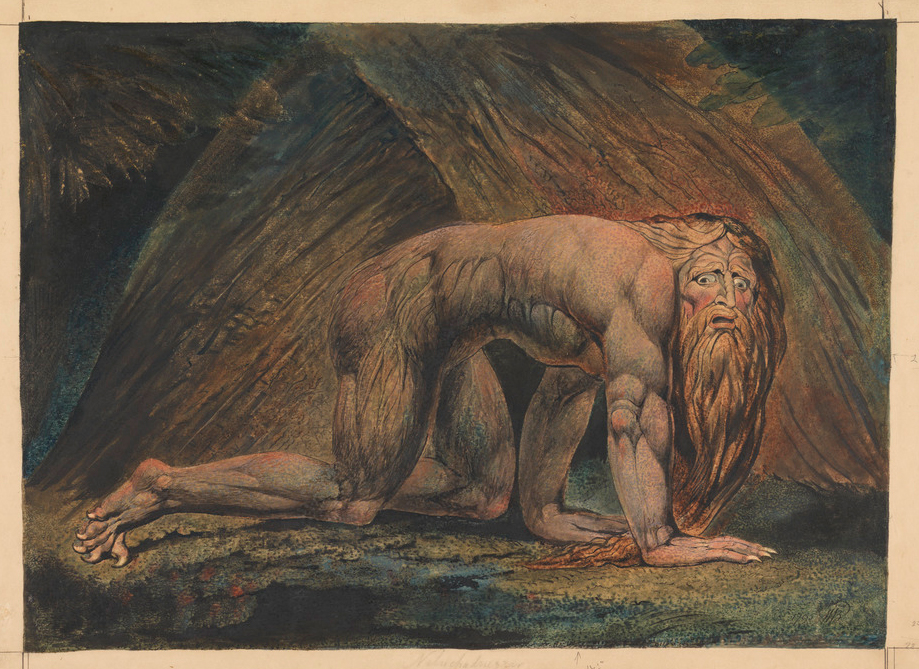
William Blake’s “Nebuchadnezzar” (1795)

As I said in yesterday’s post, William Blake (1757-1827) was that rarity who was not only a great poet but a great visual artist. What I found interesting was his predilection for Old Testament subjects, especially the books of the Old Testament prophets.

Take Nebuchadnezzar II, the subject of the above illustration. According to the Book of Daniel, the Babylonian king has a dream that is interpreted by Daniel to mean that he would be deposed and die of insanity after living like an animal for seven years. The text from the King James version of Daniel 4:31 is “And they shall drive thee from men, and thy dwelling shall be with the beasts of the field: they shall make thee to eat grass as oxen, and seven times shall pass over thee, until thou know that the most High ruleth in the kingdom of men, and giveth it to whomsoever he will.”

Satan Exults Over the Recumbent Eve After the Forbidden Fruit Incident

Here from Genesis is an image of Satan as a serpent coiled around the naked body of Eve as one of God’s angels (Michael?) points the way to the exit from Eden with his spear. It is interesting how the story from Genesis had resulted for centuries in women being held to blame for original sin and the expulsion from Eden. It’s just like the Jews unjustly being thought of as Christ-killers when it was actually the doing of Caiaphas, the Jewish high priest of the Temple and his cronies.

Blake never really took to painting, but as a print maker, he had few equals.

Tuesday at the Getty Center

On the 781 Metro Bus to the Getty Center

In my retirement years, I sometimes drive where I’m going; sometimes I just take public transportation. The two Getty museums in Los Angeles are a good example of the advantage of traveling by bus. There is no admission fee, but parking at each museum costs twenty dollars. Compare that with an outlay of seventy cents for a round trip between Sepulveda & Exposition and the Getty Center. A big plus is that the 781 Metro bus runs every few minutes, so that waiting is not a big factor.

The reason for my visit is an exhibit entitled “William Blake: Visionary,” which closes on January 14. Organized with the cooperation of London’s Tate Museum, it includes a large number of Blake’s prints. I even dished out the money for the exhibit book. It costs a fortune, but I know I would have kicked myself had I passed up the opportunity.

In the next few days, I will write several posts about my visit to the Getty, particularly relating to William Blake, who is probably the only human being who is at one and the same time a great poet and a great visual artist.

The Getty’s Cactus Garden with Westwood and the 405 Freeway in the Background

I like to visit the Getty whenever they have a special exhibit that interests me. This time, I saw only the Blake exhibit and also a large selection of great photographs by Arthur Tress. (The Getty Center always has interesting photographic exhibits.)

Later this month, I will also trek to the Getty Villa in Pacific Palisades to see an exhibit on the Egyptian Book of the Dead. Unlike the Getty Center, the Getty Villa concentrates on ancient Greek and Roman art in a building whose design is a re-created Roman country home within view of the beach.

Rintrah Roars

Cover of William Blake’s “The Marriage of Heaven and Hell”

I find myself coming back to it again and again. Ever since I was a student in college, I regarded William Blake’s “The Marriage of Heaven and Hell” one of the greatest poems in the English language. Following is the opening of it, or “The Argument”—very appropriate as we wait for a rare thunderstorm to arrive around midnight.

The Argument

Rintrah roars and shakes his fires in the burdened air;
Hungry clouds swag on the deep.

Once meek, and in a perilous path,
The just man kept his course along
The vale of death.
Roses are planted where thorns grow,
And on the barren heath
Sing the honey bees.

Then the perilous path was planted:
And a river and a spring
On every cliff and tomb;
And on the bleached bones
Red clay brought forth.

Till the villain left the paths of ease,
To walk in perilous paths, and drive
The just man into barren climes.

Now the sneaking serpent walks
In mild humility,
And the just man rages in the wilds
Where lions roam.

Rintrah roars and shakes his fires in the burdened air;
Hungry clouds swag on the deep.

I love the second last stanza about the just man raging in the wilds. As I despondently view the condition of the Republic under Trump as his brigands, the following quote from the second part of the poem gives me hope:

Without Contraries is no progression. Attraction and Repulsion, Reason and Energy, Love and Hate, are necessary to Human existence.

From these contraries spring what the religious call Good and Evil. Good is the passive that obeys Reason. Evil is the active springing from Energy.

Good is Heaven. Evil is Hell.

All we could do is grasp the hide of the Tiger that is History and try not to fall off.


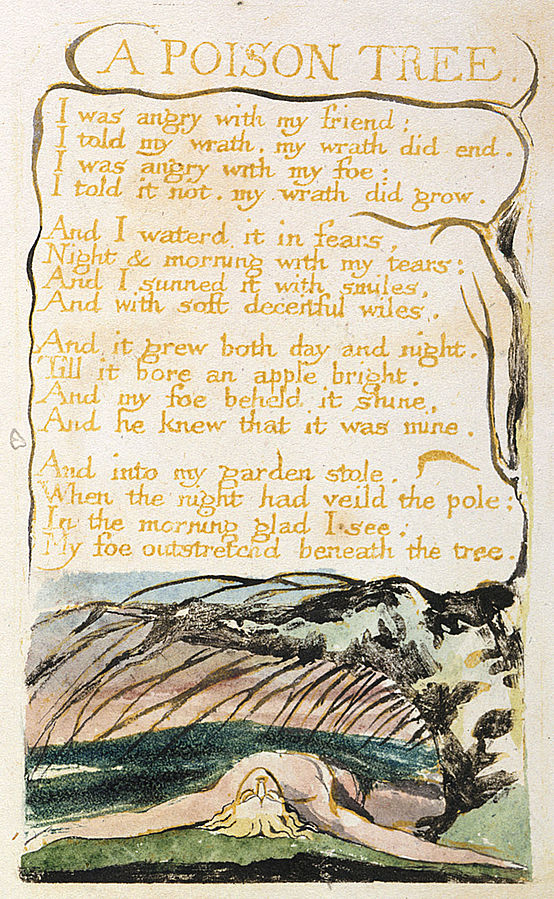
“A Poison Tree”

William Blake’s Original Art for “A Poison Tree”

William Blake’s Original Art for “A Poison Tree”

The following poem comes from William Blake’s Songs of Experience. In it, we see how repressed anger bears its own poison fruit, in this case, the death of an enemy.

A Poison Tree

I was angry with my friend:
I told my wrath, my wrath did end.
I was angry with my foe:
I told it not, my wrath did grow.

And I watered it in fears,
Night and morning with my tears;
And I sunned it with smiles,
And with soft deceitful wiles.

And it grew both day and night,
Till it bore an apple bright.
And my foe beheld it shine.
And he knew that it was mine,

And into my garden stole
When the night had veiled the pole;
In the morning glad I see
My foe outstretched beneath the tree.

I like Blake’s take on suppressed anger in this poem. The implication is that if the narrator had not “told his wrath” with his friend, it would have been his friend that suffered the dire consequences. Instead, he nurses his anger until it grows, has its dire effect on his foe, and leaves him gladdened at the results.