
Blake’s Milton

The Expulsion of Satan and His Angels from Heaven

The Expulsion of Satan and His Angels from Heaven

William Blake was not only a great poet, but he was also a great artist. When I was younger, I used to think that his art was a bit clunky—until I started reading his poetry. Then I saw that both the poetry and the art were all of a piece: they were like flames from a mind and heart on fire.

It was in his greatest poem, “The Marriage of Heaven & Hell,” that William Blake wrote this line:

The reason Milton wrote in fetters when he wrote of Angels and God, and at liberty when of Devils and Hell, is because he was a true Poet, and of the Devil’s party without knowing it.

Certainly, Book I of Paradise Lost shows a Satan who is unrepentant and verging on the magnificent:

What though the field be lost?
All is not lost; the unconquerable Will,
And study of revenge, immortal hate,
And courage never to submit or yield:
And what is else not to be overcome?
That Glory never shall his wrath or might
Extort from me.

At the same time, Milton’s God is also splendid. When he hears that Satan is loose on Earth, he foresees what is to come and sends the Archangel Raphael to explain to Adam and Eve the story of the fall of Satan and his angel followers. Blake illustrates the scene thus:
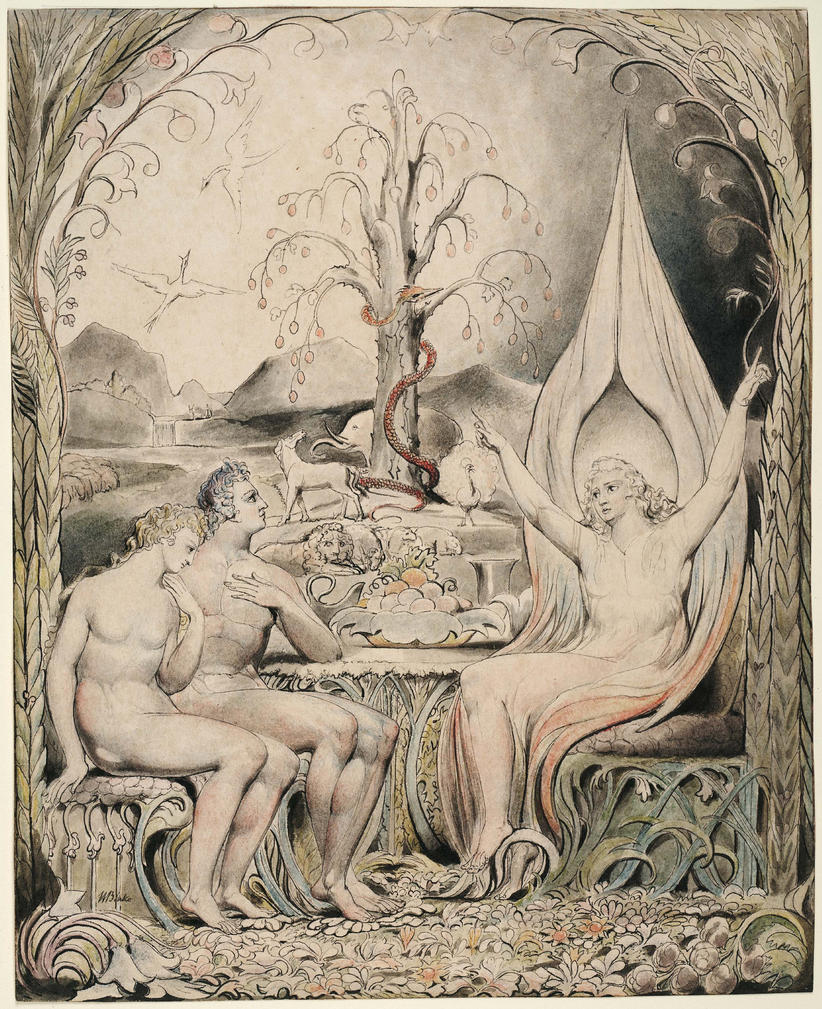
Note the Snake Wrapped Around the Tree of the Knowledge of Good and Evil in the Background

Note the Snake Wrapped Around the Tree of the Knowledge of Good and Evil in the Background

In actuality, Milton has Eve fall into a sleep while Raphael talks with Adam.

Blake’s Eden is strangely desert-like, whereas Milton gives us a verdant creation in which Adam and Eve are early agronomists who take care of the plants as part of their daily tasks. No matter, Blake is an artist in his own right and has no compunctions about creating his own Paradise Lost in pictures.
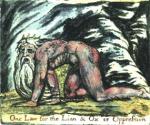
 

The Proverbs of Hell

Blake’s Illustration

Blake’s Illustration

In seed time learn, in harvest teach, in winter enjoy.
Drive your cart and your plow over the bones of the dead.
The road of excess leads to the palace of wisdom.
Prudence is a rich ugly old maid courted by Incapacity.
He who desires but acts not, breeds pestilence.
The cut worm forgives the plow.
Dip him in the river who loves water.
A fool sees not the same tree that a wise man sees.
He whose face gives no light, shall never become a star.
Eternity is in love with the productions of time.
The busy bee has no time for sorrow.
The hours of folly are measur’d by the clock, but of wisdom: no clock can measure.
All wholsom food is caught without a net or a trap.
Bring out number weight & measure in a year of dearth.
No bird soars too high, if he soars with his own wings.
A dead body revenges not injuries.
The most sublime act is to set another before you.
If the fool would persist in his folly he would become wise.
Folly is the cloke of knavery.
Shame is Prides cloke.

Prisons are built with stones of Law, Brothels with bricks of Religion.
The pride of the peacock is the glory of God.
The lust of the goat is the bounty of God.
The wrath of the lion is the wisdom of God.
The nakedness of woman is the work of God.
Excess of sorrow laughs. Excess of joy weeps.
The roaring of lions, the howling of wolves, the raging of the stormy sea, and the destructive sword, are portions of eternity too great for the eye of man.
The fox condemns the trap, not himself.
Joys impregnate. Sorrows bring forth.
Let man wear the fell of the lion. woman the fleece of the sheep.
The bird a nest, the spider a web, man friendship.
The selfish smiling fool, & the sullen frowning fool shall be both thought wise, that they may be a rod.
What is now proved was once only imagin’d.
The rat, the mouse, the fox, the rabbet; watch the roots; the lion, the tyger, the horse, the elephant, watch the fruits.
The cistern contains: the fountain overflows.
One thought fills immensity.
Always be ready to speak your mind, and a base man will avoid you.
Every thing possible to be believ’d is an image of truth.
The eagle never lost so much time, as when he submitted to learn of the crow.
The fox provides for himself. but God provides for the lion.
Think in the morning. Act in the noon. Eat in the evening. Sleep in the night.
He who has suffer’d you to impose on him knows you.
As the plow follows words, so God rewards prayers.
The tygers of wrath are wiser than the horses of instruction.
Expect poison from the standing water.
You never know what is enough unless you know what is more than enough.
Listen to the fools reproach! it is a kingly title!
The eyes of fire, the nostrils of air, the mouth of water, the beard of earth.
The weak in courage is strong in cunning.
The apple tree never asks the beech how he shall grow; nor the lion, the horse, how he shall take his prey.
The thankful reciever bears a plentiful harvest.
If others bad not been foolish, we should be so.
The soul of sweet delight can never be defil’d.
When thou seest an Eagle, thou seest a portion of Genius. lift up thy head!
As the catterpiller chooses the fairest leaves to lay her eggs, so the priest lays his curse on the fairest joys.
To create a little flower is the labour of ages.
Damn braces: Bless relaxes.
The best wine is the oldest, the best water the newest.
Prayers plow not! Praises reap not!
Joys laugh not! Sorrows weep not!—from William Blake, “The Marriage of Heaven and Hell”


“The Just Man Rages in the Wilds”

Frontispiece

Rintrah roars & shakes his fires in the burden’d air;
Hungry clouds swag on the deep

Once meek, and in a perilous path,
The just man kept his course along
The vale of death.
Roses are planted where thorns grow.
And on the barren heath
Sing the honey bees.

Then the perilous path was planted:
And a river, and a spring
On every cliff and tomb;
And on the bleached bones
Red clay brought forth.

Till the villain left the paths of ease,
To walk in perilous paths, and drive
The just man into barren climes.

Now the sneaking serpent walks
In mild humility.
And the just man rages in the wilds
Where lions roam.

Rintrah roars & shakes his fires in the burden’d air;
Hungry clouds swag on the deep.—William Blake, opening of “The Marriage of Heaven and Hell”