
Future

George Jetson’s Neighborhood

If any writer alive today has a handle on the future—what it is likely to be—that writer is William Gibson, the author of Neuromancer and the inventor of the term cyberspace. I have just finished reading his book of essays, entitled Distrust That Particular Flavor. In a talk delivered o the Book Expo America in 2010, he wrote:

But I really think [that pundits are] talking about the capital-F Future, which in my lifetime has been a cult, if not a religion. People my age are products of the capital-F Future. The younger you are, the less you are a product of that, If you’re fifteen or so, today, I suspect you inhabit a sort of endless digital Now, a state of atemporality enabled by our increasingly efficient prosthetic memory. I also suspect that you don’t know it, because, as anthropologists tell us, one cannot know one’s own culture.

The Future, capital-F, be it crystalline city on a hill or radioactive postnuclear wasteland, is gone. Ahead of us, there is merely … more stuff. Events. Some tending to the crystalline, some to the wasteland-y. Stuff: the mixed bag of the quotidia.

I think of Gibson’s capital-F Future as being more along the line of the old The Jetsons animated television program or the novels of H. G. Wells or Isaac Asimov. The future presented in those works is more a reflection of their creators’ times, and not our own.

William Gibson

I think that, because of his belief regarding the future, Gibson’s more recent novels have been less science fiction-y. Books such as Zero History are set in what appears, on one hand, to be the present—but instead are set in some not-too-distant future with multiple hooks to our present.

In a number of essays, Gibson examines our strange atemporal present, with fascinating essays on Tokyo (“My Own Private Tokyo”) and Singapore (“Disneyland with the Death Penalty”).

From My Piblokto Madness Bed

William Gibson on Our Military-Influenced Fashions

There are few novelists currently working whom I like as much as William Gibson. His science fiction doesn’t go that far into the future, yet he constantly introduces concepts, which he doesn’t explain, and yet which fascinate me. One such is the Piblokto Madness bed in which her character Hollis Henry from Zero History sleeps at a posh London hotel. Looking up Piblokto on Wikipedia, I found this definition: “A culture-bound syndrome observed primarily in female Inuit and other arctic populations. Individuals experience a sudden dissociative period of extreme excitement in which they often tear off clothes, run naked through the snow, scream, throw things, and perform other wild behaviors.” Huh?

On another topic, Gibson is spot on, namely the civilian fashion of adopting military styles in one’s apparel:

“Sleight had arranged for us to have a look at a garment prototype. We’d picked up interesting industry buzz about it, though when we got the photos and tracings, really, we couldn’t see why. Our best analyst thinks it’s not a tactical design. Something for mall ninjas.”

“For what?”

“The new Mitty demographic.”

“I’m lost,”

“Young men who dress to feel they they’ll be mistaken for having special capability. A species of cosplay, really. Endemic. Lots of boys are playing soldier now. The men who run the world aren’t, and neither are the boys most effectively bent on running it next. Or the ones who’re actually having to be soldiers, of course. But many of the rest have gone gear-queer, to one extent or another.”

“Gear-queer?”

Bigend’s teeth showed. “We had a team of cultural anthropologists interview American soldiers returning from Iraq. That’s where we first heard it. It’s not wholly derogatory, mind you. There are actual professionals who require these things—some of them, anyway. Though they generally seem to be far less fascinated with them. But it’s that fascination that interests us, of course.”

“It is?”

“It’s an obsession with the idea not just of the right stuff, but of the special stuff. Equipment fetishism. The costume and semiotics of achingly elite police and military units. Intense desire to possess same, of course, and in turn to be associated with that world. With its competence, its cocksure exclusivity.”

Sprawl

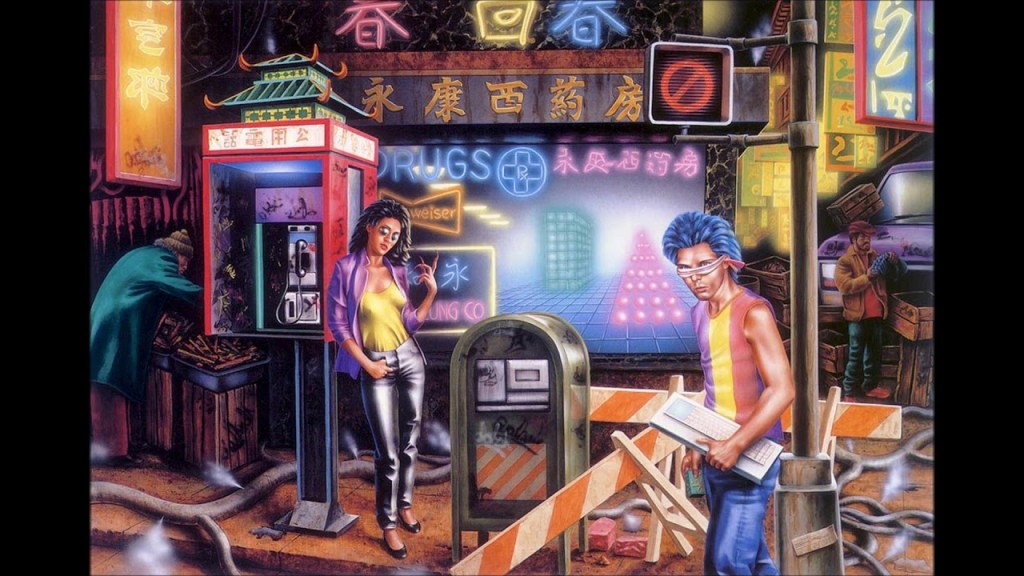
The World of William Gibson’s Sprawl Trilogy

For the last few days, I have been re-reading the last two novels of William Gibson’s sci-fi Sprawl trilogy. The Sprawl is Gibson’s take on how the Boston to Washington DC corridor will develop in time to be the largest urban area in the world. The trilogy consists of:

  • Neuromancer (1984), in which the term cyberspace was first introduced
  • Count Zero (1986)
  • Mona Lisa Overdrive (1988)

The 1980s was a time when the United States was awed by the growth of the Japanese economy. Throughout the trilogy, the yakuza, or Japanese underworld, has a presence—along with Haitian Voodoo gods such as Baron Samedi and Papa Legba, who seem to have taken up residence in cyberspace.

I do not think it is possible to reprise the plot of any of these novels in a coherent way, and I am sure I will forget most of the details within a week or two. What I will not forget, however, is the wild imagination that Gibson displays in his work. For instance, many scenes in Mona Lisa Overdrive take place in a barren New Jersey rust belt area known as Dog Solitude.

One of the difficulties of summarizing any of these novels is that, typically, the action takes place in numerous locales with numerous characters, many of whom have numerous aliases.

For some reason, I have not read any Gibson for a number of years. Now I am hooked again.