
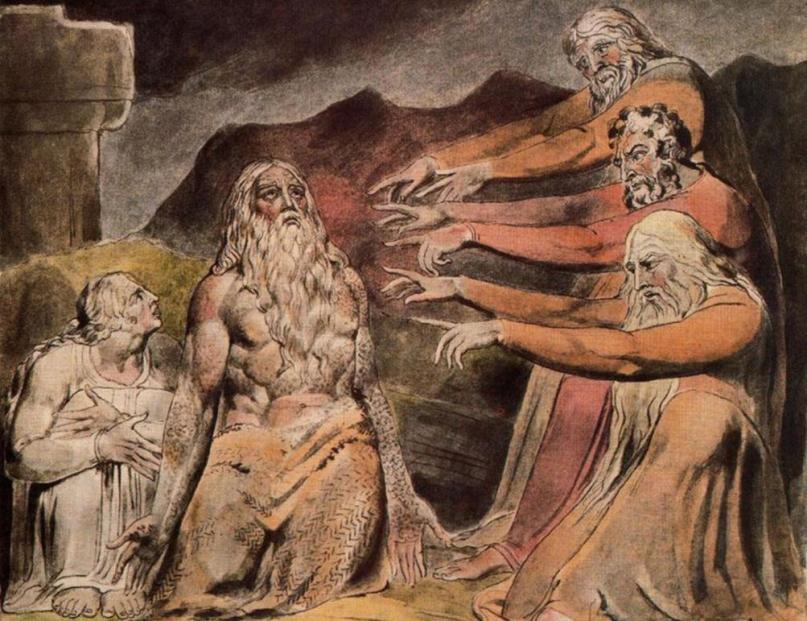
Prose Poem

William Blake Illustration from the Book of Job

The following prose poem by Wisława Szymborska is the best treatment I have ever read of the Old Testament Book of Job.

SYNOPSIS

Job, sorely tried in both flesh and possessions, curses man’s fate. It is great poetry. His friends arrive and, rending their garments, dissect Job’s guilt before the Lord. Job cries out that he was righteous. Job does not know why the Lord smote him. Job does not want to talk to them. Job wants to talk to the Lord. The Lord God appears in a chariot of whirlwinds. Before him who had been cloven to the bone, He praises the work of his hands: the heavens, the seas, the earth and the beasts thereon. Especially Behemoth, and Leviathan in particular, creatures of which the Deity is justly proud. It is great poetry. Job listens: the Lord God beats around the bush, for the Lord God wishes to beat around the bush. Job therefore hastily prostrates himself before the Lord. Events now transpire in rapid succession. Job regains his donkeys and camels, his oxen and sheep twofold. Skin grows over his grinning skull. And Job goes along with it. Job agrees. Job does not want to ruin a masterpiece.

—Wisława Szymborska. Poems New and Collected 1957-1997
“View with a Grain of Sand”

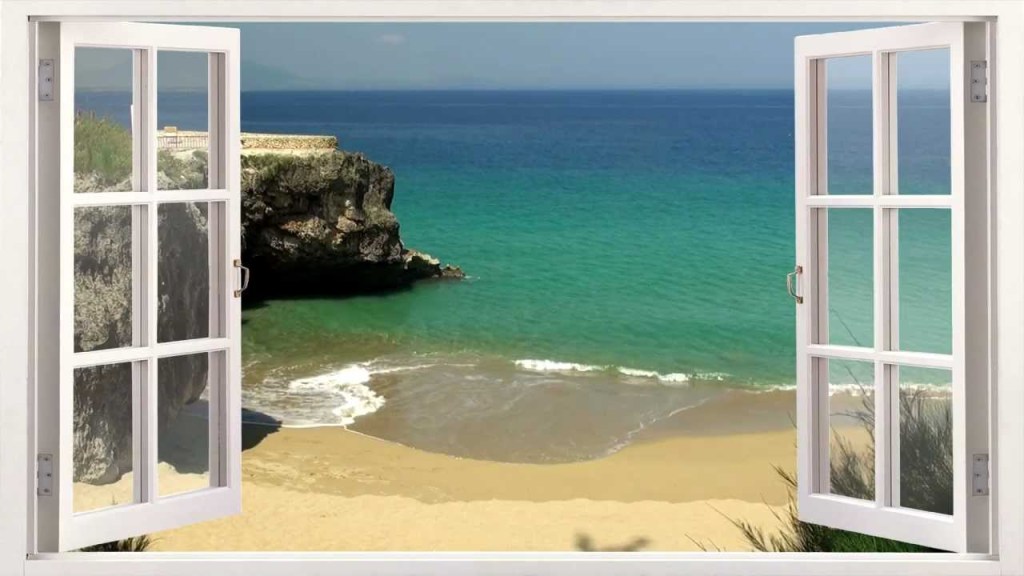
View from a Window

Here is a marvellous poem by the Nobel Prize winning Polish poet Wisława Szymborska. It is called “View with a Grain of Sand.” Never before have I seen a poem about things written from the decidedly non-human stance of the things themselves. See what you think:

View with a Grain of Sand

We call it a grain of sand,
but it calls itself neither grain nor sand.
It does just fine without a name,
whether general, particular,
permanent, passing,
incorrect, or apt.

Our glance, our touch mean nothing to it.
It doesn’t feel itself seen and touched.
And that it fell on the windowsill
is only our experience, not its.
For it, it is no different from falling on anything else
with no assurance that it is finished falling
or that it is falling still.

The window has a wonderful view of a lake,
but the view doesn’t view itself.
It exists in this world
colorless, shapeless,
soundless, odorless, and painless.

The lake’s floor exists floorlessly,
and its shore exists shorelessly.
Its water feels itself neither wet nor dry
and its waves to themselves are neither singular nor plural.
They splash deaf to their own noise
On pebbles neither large nor small.

And all this beneath a sky by nature skyless
in which the sun sets without setting at all
and hides without hiding behind an unminding cloud.
The wind ruffles it, its only reason being
that it blows.

A second passes.
A second second.
A third.
But they’re three seconds only for us.

Time has passed like a courier with urgent news.
But that’s just our simile.
The character is invented, his haste is make-believe,
his news inhuman.

“Nothing More Animal-Like”

Humor and Profundity All Mixed Together

The beginning of this year has introduced me to two great Eastern European poetesses. I think I will be reading a lot of their poems in the months to come. I have already written a couple of postings about Marina Tsvetaeva—and I am just getting started! Earlier, I posted a poem by Wisława Szymborska, but now I am starting to get serious about her as well, what with her curious mixture of humor and profundity. You can find an example of those two traits in this poem:

In Praise of Self-Deprecation

The buzzard has nothing to fault himself with.
Scruples are alien to the black panther.
Piranhas do not doubt the rightness of their actions.
The rattlesnake approves of himself without reservations.

The self-critical jackal does not exist.
The locust, alligator, trichina, horsefly
live as they live and are glad of it.

The killer-whale’s heart weighs one hundred kilos
but in other respects it is light.

There is nothing more animal-like
than a clear conscience
on the third planet of the Sun.

I am still working in the smug self-satisfaction of Republicans, but I am nowhere near Wisława in poetic ability, so I’ll just let her have her say. If you are interested in reading more of her poetry, I suggest you find a copy of Sounds, Feelings, Thoughts: Seventy Poems by Wisława Szymborska (Princeton: Princeton University Press, 1981). Szymborska won the Nobel Prize for Literature in 1996.


“Lot’s Wife”

Polish Poet Wisława Szymborska

Polish Poet Wisława Szymborska

Every once in a while, the Nobel Prize Committee makes a correct choice, and Polish poet Wisława Szymborska is certainly one—one of the few in recent years who is deserving of the honor. Here is a poem entitled “Lot’s Wife,” about a woman who, while fleeing with her husband Lot from the destruction soon to overcome Sodom, was turned into a pillar of salt for looking back:

They say I looked back from curiosity.
But I could have had reasons other than curiosity.
I looked back from regret for a silver bowl.
From distraction while fastening the latchet of my sandal.
To avoid looking longer at the righteous neck
of Lot my husband.
From sudden certainty that had I died
he would not even have slowed his step.
From the disobedience of the meek.
Alert to the pursuit.
Suddenly serene, hopeful that God had changed His mind.
Our two daughters were almost over the hilltop.
I felt old age within me. Remoteness.
The futility of our wandering. Sleepiness.
I looked back while laying my bundle on the ground.
I looked back from fear of where next to set my foot.
On my path appeared serpents,
spiders, field mice, and fledgling vultures.
By now it was neither the righteous nor the wicked—simply all living creatures
crept and leapt in common panic.
I looked back from loneliness.
From shame that I was stealing away.
From a desire to shout, to return.
Or just when a sudden gust of wind
undid my hair and lifted up my garment.
I had the impression they watched it all from the walls of Sodom
and burst out in loud laughter time and time again.
I looked back from anger.
To relish their great ruin.
I looked back for all the reasons I have mentioned.
I looked back despite myself.
It was only a rock that turned back, growling under foot.
A sudden crevice that cut my path.
On the edge a hamster scampered up on his two hind feet.
It was then that we both glanced back.
No. No. I ran on.
I crept and clambered up,
until the darkness crashed down from heaven,
and with it, burning gravel and dead birds.
For lack of breath I spun about repeatedly.
If anyone had seen me, he might have thought me dancing.
It was not ruled out that my eyes were open.
It could be that I fell, my face turned toward the city.

Salt Pillar Thought To Be Lot’s Wife

Salt Pillar Thought To Be Lot’s Wife

Perhaps Szymborska’s beloved and much beleaguered Poland was that Sodom, unjustly punished by history for being positioned between two ogres that alternately and in combination devoured it for no good reason.