
The Desert Training Center

Display at the General Patton Memorial Museum

When Germany declared war on the United States right after Japan’s Peal Harbor attack, the U.S. Army set up a Desert Training Center in the Mohave Desert, centered on the Chiriaco Summit. Only the Army called it Camp Young and even built an airstrip so that top brass could fly in.

On the trip to Arizona, Martine and I spent a couple of hours at the Summit’s General Patton Memorial Museum seeing numerous exhibits on Patton’s life and the U.S.military in the Second World War, Korea, Viet Nam, and Iraq. It was nice and cool and there were a lot of things to see. We even braved the desert heat to view the tanks and other military vehicles parked outside.
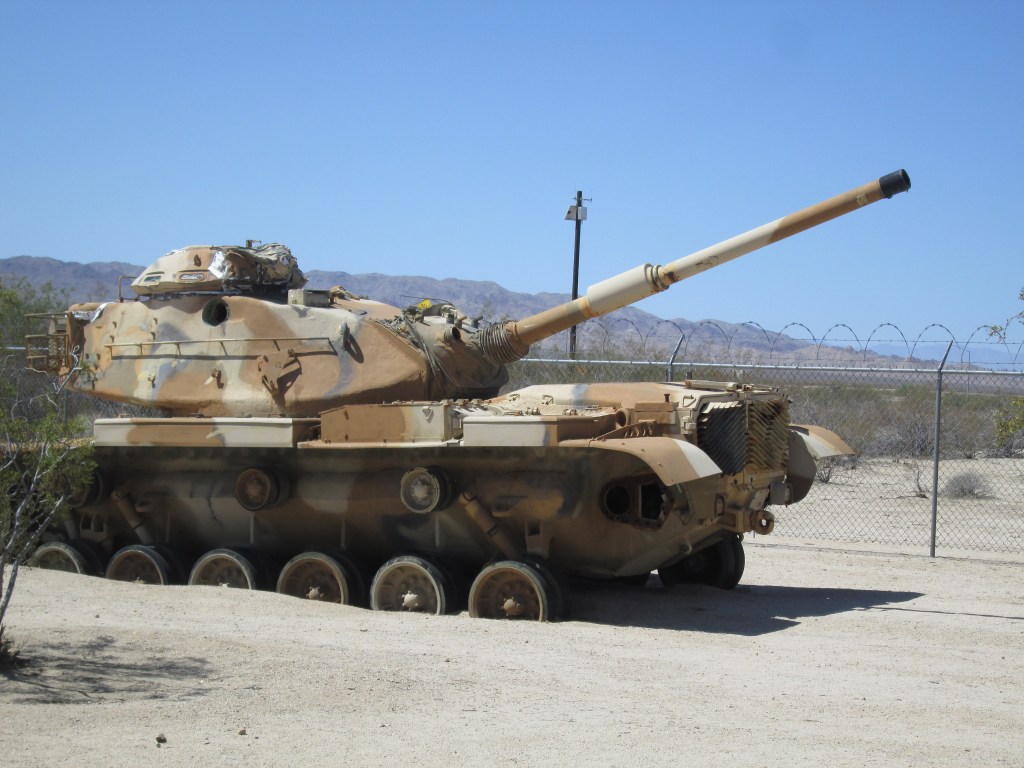
Camouflaged Tank at the General Patton Memorial Museum

Martine liked the museum so much that she talked me into stopping there on the way back from Arizona. It was all right with me, because I know that my little girl is fond of military museums, having been a civilian Army employee for many years at Fort Monmouth in New Jersey, the Sacramento Army Depot, and the Twentynine Palms Marine Combat Center.

Plus we had the opportunity of eating a yummy lunch at the Chiriaco Summit Coffee Shop and a Foster’s Freeze chocolate cone at the convenience store.

Sometimes I wonder what will happen to all the military museums scattered across the country when all the veterans who fought in WW2 have passed on. These museums are most densely distributed in areas where Veterans have made their homes after they retired from the military. These museums are a useful reminder of one of the most traumatic episodes in our country’s history.
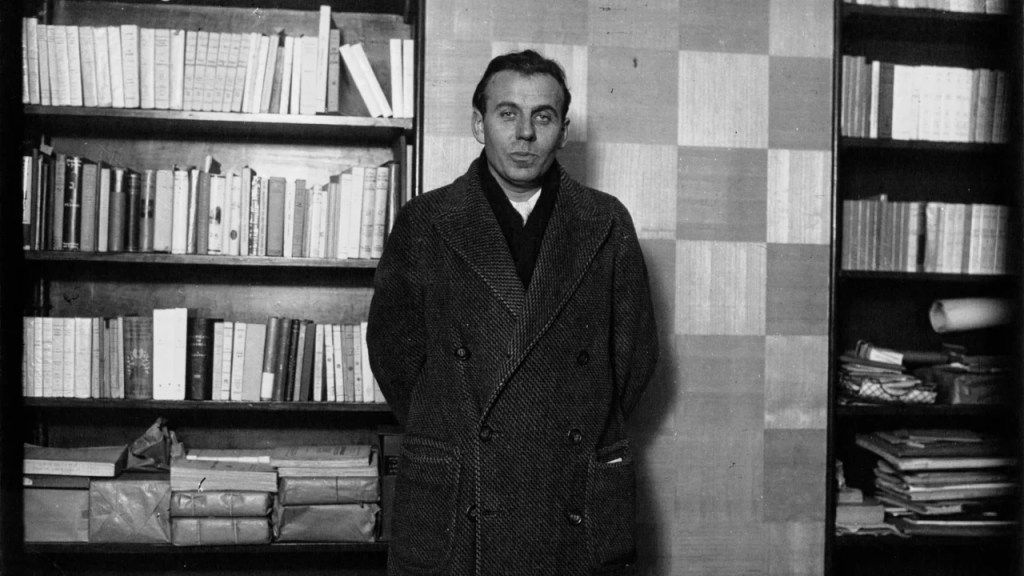
Doctor Destouches in Germany

Doctor Destouches (aka Louis-Ferdinand Céline)

He will never win any humanitarian awards, or, for that matter, any awards, but Louis-Ferdinand Céline is one of the greatest writers of the twentieth century, an anti-Semite, a Nazi sympathizer, and probably a very decent human being otherwise. Born Louis Ferdinand Auguste Destouches in Courbevoix, France in 1894, Céline became a wounded war hero at Ypres in 1914

After the war, he became a physician and toured Africa and the Americas working for the League of Nations. In 1932, he published his greatest and most approachable novel, Journey to the End of the Night (Voyage au bout de la nuit). Unfortunately, in the early 1940s, he published several anti-Semitic books urging closer ties to Hitler’s Germany.

After the Allied invasion of France, Céline fled to Germany after having been identified by the Resistance and the British as a collaborationist. It was the beginning of a long and confused period escaping Allied bombing attacks and the Russian Army that was brilliantly described in his trilogy about being a guest of the Nazis as they were being pounded to pieces:

  • Castle to Castle (D’un château l’autre) 1957
  • North (Nord) 1960
  • Rigadoon (Rigadon) 1961

Years after reading the first two volumes, I have just finished reading Rigadoon and loving it. Céline and his wife are constantly being shuttled on trains from one bombed-out city to another. At one point, he escorts a group of eighteen severely retarded children from Hannover to Hamburg and manages to transfer them to a special Swedish Red Cross train taking them to safety. Unfortunately, the same train took Céline to Copenhagen, where he served a year in prison for his collaboration with the Nazis.

He died in 1961. Although his novels were a powerful influence on other novelists, Céline was never treated with the honor that his literary and medical work deserved. He spent his last years being a doctor treating poor patients in the slums of Paris.

So fair and foul a career I have not seen. I love Céline’s novels even as I detest his racial and political views. Life can be strange.

“A Song on the End of the World”

Czeslaw Milosz (1911-2004)

Born in Lithuania, but known primarily as a Polish poet, Czeslaw Milosz is perhaps my favorite Eastern European poet of the 20th century. In 1980, he won the Nobel Prize for Literature. Here is one of my favorites among his works, written in Warsaw in 1944:

A Song on the End of the World

On the day the world ends
A bee circles a clover,
A fisherman mends a glimmering net.
Happy porpoises jump in the sea,
By the rainspout young sparrows are playing
And the snake is gold-skinned as it should always be.

On the day the world ends
Women walk through the fields under their umbrellas,
A drunkard grows sleepy at the edge of a lawn,
Vegetable peddlers shout in the street
And a yellow-sailed boat comes nearer the island,
The voice of a violin lasts in the air
And leads into a starry night.

And those who expected lightning and thunder
Are disappointed.
And those who expected signs and archangels’ trumps
Do not believe it is happening now.
As long as the sun and the moon are above,
As long as the bumblebee visits a rose,
As long as rosy infants are born
No one believes it is happening now.

Only a white-haired old man, who would be a prophet
Yet is not a prophet, for he’s much too busy,
Repeats while he binds his tomatoes:
There will be no other end of the world,
There will be no other end of the world.

WW2-Land

The USS Arizona Memorial

It’s a strange feeling to be standing on the Arizona Memorial at Pearl Harbor. Beneath your feet is a sunken battleship in which 1,277 sailors are interred. That is roughly half the total U.S. casualties from the Japanese attack on Pearl Harbor.

The island of O’ahu has numerous military and naval bases, roughly 21% of the total land area. That includes not only Pearl Harbor itself, but Fort De Russy on Waikiki, Schofield Barracks, Hickam Air Force Base, Dillingham Field, Fort Shafter, and a whole host of others.

In fact, if there is anywhere on American soil that is a center of World War Two commemoration, it would have to be O’ahu. There have been at least four films made about the attack:

  • From Here to Eternity (1953) with Burt Lancaster and Montgomery Clift
  • Tora! Tora! Tora! (1970) with an American and Japanese Cast
  • Pearl Harbor (2001) directed by Michael Bay
  • Midway (2019), which begins with the attack on Pearl Harbor

There have also been numerous books on the subject. (And there still continue to be.) No doubt about it, America is still stuck on WW2.

When Martine and I visit Honolulu later this summer, we will spend a day going over all the exhibits and taking the shuttle over to the Arizona Memorial, as we did back in 1996. No doubt a lot has changed since then.