

Japanese Film Director Yasujiro Ozu (1903-1963)
It was Horace in his “Ars Poetica” who wrote ars est celare artem, meaning that true art conceals the means by which it is achieved.
The film medium has an unusually rich variety of tools that can be used in movies, including zooms in and out, pans, wipes, tracking and dolly shots, tilts, and crane shots. And these do not include the complex technically-assisted tools such as are involved in computer generated imagery (CGI).
In Vertigo (1958), Alfred Hitchcock created a stunning visual effect by combining zooming out with tracking in. Some directors like Sergei Eisenstein, Max Ophuls, Jean-Luc Godard, and Andrey Tarkovsky have used the language of film in new and exciting ways.
Just as there are writers like Ernest Hemingway who employ a simple style. There are others, such as James Joyce, Marcel Proust, and Georges Perec who used all the bells and whistles of literature to achieve their aims.
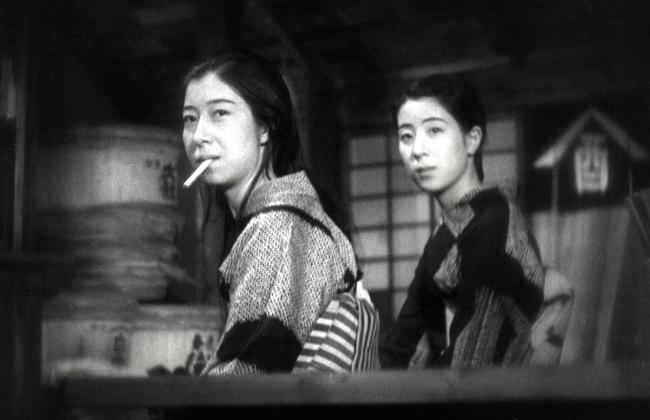
If there is an equivalent to the Hemingway style in film, I would have to say it is in the films of Yasujiro Ozu. In the dozen or so films I have seen, I remember only one camera movement, a slight pan in his Tokyo Story (1953), in which we follow an elderly couple as they walk alongside a wall at a seaside resort. With Ozu, there is, for the most part, only a succession of simple shots, most frequently at the level of a Japanese person seated on a tatami mat.
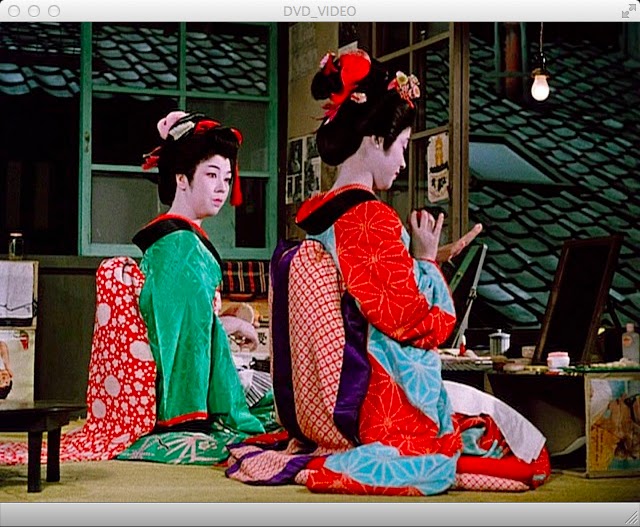
Intercut with these shots are others that are almost like stills. In the sound pictures, the music wells up, and the audience is meant to absorb what has just happened. This is referred to in Japanese as mono no aware. literally: the pathos of things. There is, for instance, this recurring shot in Floating Weeds (1959):

As one American writer put it in The Other Journal:
When I reflect on Japanese cinema, I find that one of the things that continually draws me back to it is a sort of gentle melancholy and pensive longing. Granted, this isn’t true of all Japanese films — I don’t know if you’d find it much in violent yakuza films or over-the-top kaiju films — but the ones that have stuck with me over the years are typified by this emotion and seem to contain it in large amounts.
There’s a Japanese phrase that sums up this feeling I’m describing: “mono no aware.” Roughly translated into English, it means “the sadness of things”. It’s not sadness in the sense of depression or angst, but rather, it refers to an awareness of the fragility of existence, of the transient and bittersweet nature of life, which, I’ve found, can make for incredibly beautiful and poignant cinema.
That feeling is present in all the Ozu films I have seen, which is why I regard him as one of the greatest of all film artists and perhaps the preeminent artist in the Japanese cinema.
 Tarnmoor
You must be logged in to post a comment.