
Realizing the Futility of Life

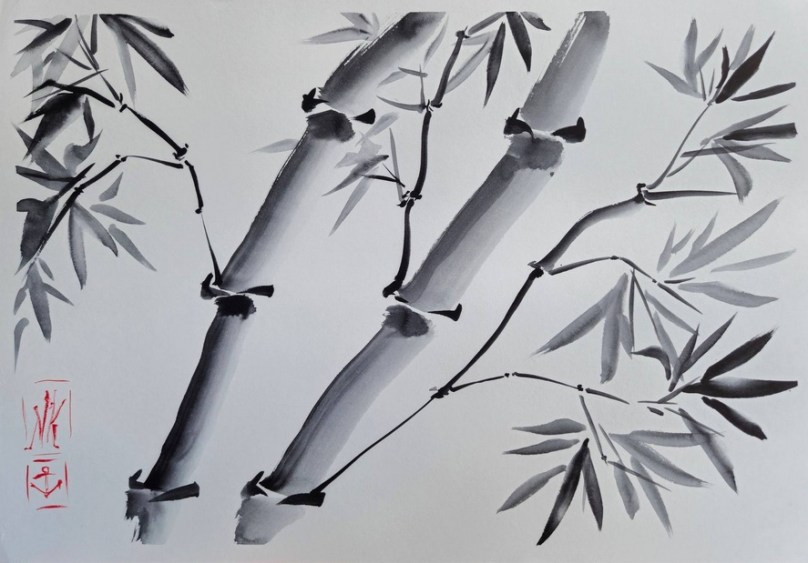
“Silent Bamboo” by Nadia Krashevska

Here is a 1,200-year-old Zen poem by Bai Juyi that was written on the walls of a priest’s cell circa 828. Translated by Arthur Waley, it appears in Peter Harris’s Zen Poems, published by Knopf Everyman’s Library. According to the biographical endnotes:

BAO JUYI (772-846). Also known as Bo Juyi … Bai Juyi was a mid-Tang poet of great versatility. He lived through troubled times, including an official attack on Buddhism that led to the closure of monasteries in 842-5. His own lifelong devotion to Buddhism was eclectic rather than relating to one particular sect. In his admiring biography of Bai the translator Arthur Waley remarked on Bai’s extraordinary compassion, reflected in the tone of much of what he wrote, including his popular ballad, “The Song of Lasting Sorrow.”

Realizing the Futility of Life

Ever since the time I was a lusty boy
Down till now when I am ill and old,
The things I have cared for have been different at different times,
But my being busy, that has never changed.
Then on the shore,—building sand-pagodas;
Now, at Court, covered with tinkling jade.
This and that, equally childish games,
Things whose substance passes is a moment of time!
While the hands are busy, the heart cannot understand;
When there are no Scriptures, then Doctrine is sound.
Even should one zealously strive to learn the Way,
That very striving will make one’s error more.

I have always admired Arthur Waley. There was a period half a century ago when I sought out his translations of various Oriental texts. In my library are a number of his titles.

Discovering the Long Scroll

Excerpt from the Long Scroll of Sesshū Tōyō

For the first time in my life, I away away from home, alone. I was seventeen years old when I found myself at Dartmouth College. The only person I knew from before was Frank Opaskar, with whom I had gone to Chanel High School in Bedford, Ohio. But I quickly found myself becoming estranged from Frank because of his anxiety about his complexion. I had the top bunk in our dorm room, and Frank insisted in smearing himself with Noxzema. Every night, I was wafted into sleep by the medicated stench of his facial preparation.

Naturally, I was desperate to lift my mind from the humdrum life of study and Noxzema. Fortunately, I found several ways of escape. One of them was art….

In my first year at Dartmouth, the Hopkins Center for the Arts opened. One of the first shows in the art gallery was of the Long Landscape Scroll by Sesshū Tōyō (1420-1506), a Zen Buddhist master whose art work made me feel at home. I don’t know why: I had had no previous exposure in my Catholic education to Zen ink and wash paintings of the Muromachi school.

But what I saw was magical. It was a landscape of mists and rocks and water in which pilgrims were trekking from one place to another. I loved it at once. Did I see a sudden paradigm of my own life, wrenched from a close Hungarian family into the wide world? I followed the scroll from left to right—not just once, but many times in numerous visits while the exhibit lasted.

If you want to see what I saw, you can see an image by clicking here. Scroll about a third of the way down and scroll slowly to the right. The image doesn’t allow you to get close, but you get the general idea. I bought a copy of the scroll from Tuttle, the Japanese-American publishing house then located in nearby Rutland, Vermont.

You can say it was Sesshū Tōyō  who introduced me to Zen Buddhism. It was a splendid introduction.