Art and Courage

Opening Oneself Up to Create Art

Opening Oneself Up to Create Art

The reader walks away from real art heavier than she came to it. Fuller. All the attention and engagement and work you need to get from the reader can’t be for your benefit; it’s got to be for hers. What’s poisonous about the cultural environment today is that it makes this so scary to try to carry out. Really good work probably comes out of a willingness to disclose yourself, open yourself up in spiritual and emotional ways that risk making you look banal or melodramatic or naive or unhip or sappy, and to ask the reader really to feel something. To be willing to sort of die in order to move the reader, somehow. Even now I’m scared about how sappy this’ll look in print, saying this. And the effort actually to do it, not just talk about it, requires a kind of courage I don’t seem to have yet. … Maybe it’s as simple as trying to make the writing more generous and less ego-driven.—David Foster Wallace, Conversations with David Foster Wallace


Spiritual Testing

Machu Picchu

Machu Picchu

What gives value to travel is fear. It is the fact that, at a certain moment, when we are so far from our own country (a French newspaper acquires incalculable value. And those evenings when, in cafés, you try to get close to other men just to touch them with your elbow.) We are seized by a vague fear, and an instinctive desire to go back to the protection of old habits. This is the most obvious benefit of travel. At that moment we are feverish but also porous, so that the slightest touch makes us quiver to the depths of our being. We come across a cascade of light, and there is eternity. That is why we should not say that we travel for pleasure. There is no pleasure in traveling, and I look upon it more as an occasion for spiritual testing. If we understand by culture the exercise of our most intimate sense—that of eternity—then we travel for culture. Pleasure takes us away from ourselves in the same way as distraction, in Pascal’s use of the word, takes us away from God. Travel, which is like a greater and a graver science, brings us back to ourselves.—Albert Camus, Notebooks 1935-1942

“The Divine Felicity of His Style”

Marcus Tullius Cicero

Marcus Tullius Cicero

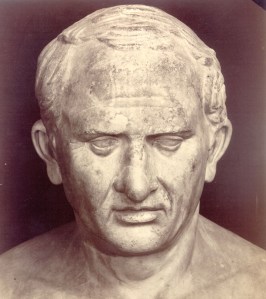
When I was a boy, I was fonder of Seneca than of Cicero, and till I was twenty years old could not bear to spend any time in reading him; while all the other writers of antiquity generally pleased me. Whether my judgment be improved by age, I know not; but am certain, that Cicero never pleased me so much when I was fond of those juvenile studies as he does now when I am grown old; not only for the divine felicity of his style, but the sanctity of his heart and morals: in short, he has inspired my soul, and made me feel myself a better man. I make no scruple, therefore, to exhort our youth to spend their hours in reading and getting his books by heart, rather than in the vexatious squabbles and peevish controversies with which the world abounds. For my own part, though I am now in the decline of life, yet as soon as I have finished what I have in hand, I shall think it no reproach to me to seek a reconciliation with my Cicero, and renew an old acquaintance with him, which for many years has been unhappily intermitted.—Erasmus, Letter #499 to Johannes Ulattenus

No Atheists in the Foxholes

David Foster Wallace

David Foster Wallace

In the day-to-day trenches of adult life, there is actually no such thing as atheism. There is no such thing as not worshipping. Everybody worships. The only choice we get is what to worship. And the compelling reason for maybe choosing some sort of god or spiritual-type thing to worship—be it JC or Allah, be it YHWH or the Wiccan Mother Goddess, or the Four Noble Truths, or some inviolable set of ethical principles—is that pretty much anything else you worship will eat you alive.

If you worship money and things, if they are where you tap real meaning in life, then you will never have enough, never feel you have enough. It’s the truth. Worship your body and beauty and sexual allure and you will always feel ugly. And when time and age start showing, you will die a million deaths before they finally grieve you. On one level, we all know this stuff already. It’s been codified as myths, proverbs, clichés, epigrams, parables; the skeleton of every great story. The whole trick is keeping the truth up front in daily consciousness.—David Foster Wallace, “This Is Water”


On Being a Grown-Up

David Foster Wallace

David Foster Wallace

I am now 33 years old, and it feels like much time has passed and is passing faster and faster every day. Day to day I have to make all sorts of choices about what is good and important and fun, and then I have to live with the forfeiture of all the other options those choices foreclose. And I’m starting to see how as time gains momentum my choices will narrow and their foreclosures multiply exponentially until I arrive at some point on some branch of all life’s sumptuous branching complexity at which I am finally locked in and stuck on one path and time speeds me through stages of stasis and atrophy and decay until I go down for the third time, all struggle for naught, drowned by time. It is dreadful. But since it’s my own choices that’ll lock me in, it seems unavoidable—if I want to be any kind of grownup, I have to make choices and regret foreclosures and try to live with them.—David Foster Wallace, A Supposedly Fun Thing I’ll Never Do Again

True Heroism

Superman

Superman

The truth is that the heroism of your childhood entertainments was not true valor. It was theatre. The grand gesture, the moment of choice, the mortal danger, the external foe, the climactic battle whose outcome resolves all–all designed to appear heroic, to excite and gratify an audience. Gentlemen, welcome to the world of reality–there is no audience. No one to applaud, to admire. No one to see you. Do you understand? Here is the truth–actual heroism receives no ovation, entertains no one. No one queues up to see it. No one is interested.

True heroism is minutes, hours, weeks, year upon year of the quiet, precise, judicious exercise of probity and care — with no one there to see or cheer. This is the world.—David Foster Wallace, The Pale King


The Poets and the Horse Collar

A Horse Collar

A Horse Collar

Cottle, in his life of Coleridge, relates the following amusing incident:–’I led my horse to the stable, where a sad perplexity arose. I removed the harness without difficulty; but, after many strenuous attempts, I could not remove the collar. In despair, I called for assistance, when Mr. Wordsworth brought his ingenuity into exercise; but, after several unsuccessful efforts, he relinquished the achievement as a thing altogether impracticable. Mr. Coleridge now tried his hand, but showed no more skill than his predecessor; for, after twisting the poor horse’s neck almost to strangulation, and the great danger of his eyes, he gave up the useless task, pronouncing that the horse’s head must have grown since the collar was put on; for he said,“it was a downright impossibility for such a huge os frontis to pass through so narrow an aperture.” Just at this instant, a servant-girl came near, and understanding the cause of our consternation, “Ha! master,” said she, “you don’t go about the work in the right way: you should do like this,” when, turning the collar upside down, she slipped it off in a moment, to our great humiliation and wonderment, each satisfied afresh that there were heights of knowledge in the world to which we had not yet attained.—William Evans Burton, The Cyclopædia of Wit and Humor, 1898

A Polish Poet Learns Latin

Zbigniew Herbert

Zbigniew Herbert

In my interest in Latin and my admittedly mediocre progress in that sphere there lay an element I might call personal. In the apartment building across the road from us there lived a young person, whose full shape, auburn hair, and dimples stirred my senses and gave me vertigo. She was the daughter of a Latin professor—not from our gymnasium, it is true, but known to us as the author of the book of adapted texts over which we labored; he also published articles in the monthly Philomat, to which Grzesio obliged us to subscribe through him. I used to sit on the balcony with my Auerbach & Dąbrowski Latin grammar and pretend that reading this exceptionally dull tome put me in ecstasy.

It was in fact an act of despair. If the object of my passionate feelings appeared on the balcony, it was not for my sake. She sometimes brushed me with a distracted look, as one glances at clouds moving across the sky. She was waiting for an older colleague of mine from the lyceum, a tall youth with a wavy blond crop, undeniably handsome (he was the standard-bearer of our school and wearing a sash and white gloves at celebrations he really did present well)—but I knew he could never make her happy. Every day around five in the afternoon she would leave the house with my mortal enemy and disappear around the corner into a little street shaded by chestnut trees, where (my feverish imagination told me) terrible things happened: he would take her arm (against the severest injunctions of the middle school rules) and perhaps press a fiery kiss on her silken glove. A storm of contradictory feelings in my tormented heart:

Odi et amo. Quare id faciam, fortasse requiris.
Nescio, sed fieri sentio et excrucior.

What did I think to achieve, holding my Auerbach & Dąbrowski Latin grammar on the balcony so that its cover would be visible from afar? I thought that one day her father—the classical philologist—would notice me and shout across to me: “I have been observing you for a while now, my boy. Your modesty and industry, your love for the Roman tongue are a warranty that you are a proper candidate for my daughter’s husband. I therefore grant you her hand.” And from then on things would proceed as in a fairy tale.

They didn’t. On the other hand, I learned many examples of the use of the more complicated grammatical forms by heart and was able to shine in class, even winning a cordial look from Grzesio.

We labored in the sweat of our brows. The time to reap drew near: the next year we were to proceed to the poetry of Catullus and Horace. But then the barbarians invaded.—Zbigniew Herbert, “A Latin Lesson,” Collected Prose

NOTE: Translated, the above Latin quote reads:

“I hate and I love. Why do I do it, perchance you might ask?
I don’t know, but I feel it happening to me and I’m burning up.”

The lines are from Catullus.
If Only This Were True!

Hilarious!

Hilarious!

ST. PETERSBURG (The Borowitz Report)—Hopes for a positive G20 summit crumbled today as President Obama blurted to Russia’s Vladimir Putin at a joint press appearance, “Everyone here thinks you’re a jackass.”

The press corps appeared stunned by the uncharacteristic outburst from Mr. Obama, who then unleashed a ten-minute tirade at the stone-faced Russian President.

“Look, I’m not just talking about Snowden and Syria,” Mr. Obama said. “What about Pussy Riot? What about your anti-gay laws? Total jackass moves, my friend.”

As Mr. Putin narrowed his eyes in frosty silence, Mr. Obama seemed to warm to his topic.

“If you think I’m the only one who feels this way, you’re kidding yourself,” Mr. Obama said, jabbing his finger in the direction of the Russian President’s face. “Ask Angela Merkel. Ask David Cameron. Ask the Turkish guy. Every last one of them thinks you’re a dick.”

Shortly after Mr. Obama’s volcanic performance, Mr. Putin released a terse official statement, reading, “I should be afraid of this skinny man? I wrestle bears.”

After one day of meetings, the G20 nations voted unanimously on a resolution that said maybe everyone should just go home.—The Borowitz Report

Hot Spark Plugs—and Rats?

An Apocryphal Story?

An Apocryphal Story?

Peru is a wonderful place. It is also wonderfully weird. The first time I visited, in 1997, several people I met in Lima warned me to take extra care when driving, because local thieves had perfected an ingenious new robbery technique. Near isolated intersections, street urchins heated discarded spark plugs over fifty-five-gallon drum fires. When a car stopped at a traffic light, the young thieves pressed a white-hot plug against its passenger-side window, causing it to shatter. Before the driver realized what was happening, a live rat was tossed into his or her lap. During the ensuing wrestling match with the (presumably agitated) rodent, the thief helped himself to handbags or anything else that looked inviting. If the driver understandably chose to exit the vehicle, the thief hopped in and drove off with his bewhiskered accomplice.—Mark Adams, Turn Right at Machu Picchu: Rediscovering the Lost City One Step at a Time