The Hundred Days of Hell

Nothing But H-E-Double Toothpicks!

Nothing But H-E-Double Toothpicks!

Between now and April 15, the IRS deadline for tax submissions, we in the accounting profession are trying to survive what I call the Hundred Days of Hell. It will be more so this year because of the dilatory tactics of the baboons in Congress over the so-called fiscal cliff. They not only dragged that out, but the process led to a delay in the final design of hundreds of tax forms, with the result that the IRS cannot even process tax returns right now. Many will not be ready until March 1—and March 15 is a tax deadline for corporate tax returns.

At least we will not have as many days in tax season as last year. 2012 was a leap year, so we had February 29 to contend with. And then the tax deadline date was April 17, because April 15 fell on a Sunday, and April 16 is a holiday in the District of Columbia (“Emancipation Day”).

There will be days I will not be able to post any blogs because I am too busy at work and too tired once I step into my apartment. (Because I feel a furor scribendi virtually every day, I will try anyhow.)


Feature Attractions

4.2.3

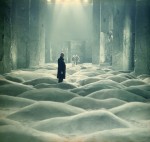
Tarkovsky’s Stalker

This long tracking sequence, following the trolley as it clanks and clangs along, is the most straightforward journey imaginable—horizontal, flat, right to left, in a straight line—and full of all the promised wonders of cinema. That’s what we are being sold in the trailers that precede what used to be called the “feature presentation”. Unfortunately, this has become the most debased wonder in the history of the earth. It means explosions, historical epics in which the outcome of the Battle of Hastings is reversed by the arcane CGI prowess of Merlin the Magician, it means five-year-old children turning suddenly into snarling devils, it means wrecking cars and reckless driving, it means a lot of noise, it means I have to time my arrival carefully (twenty minutes at least) after the advertised programme time if I am to avoid all this stuff which, if one were exposed to it for the full hour and a half, would cause one’s capacity for discernment to drop by fifty percent (or, conversely, one’s ability to tolerate stuff like this to increase a hundredfold). It means sitting there shaking one’s middle-aged head; it means that one is wary about going to the cinema. It means that there are more and more things on the street, in shops, on-screen and on telly from which one has to avert one’s ears and eyes.—Geoff Dyer, Zona

44

Another Birthday, Already? Jeez!

Another Birthday, Already? Jeez!

Again I survived! Today is my 44th birthday. Before you smirk, I now measure my age strictly in the hexadecimal numbering system, which counts 0, 1, 2, 3 and on to 9, A, B, C, D, E, and F. I think you will agree that it’s a much more flattering number, until the letters of the alphabet start showing up, making people say, “Hold on thar!” Of course, I won’t get to be 4A years old for another six years. By then, I may have to find a still more flattering number system—perhaps vigesimal (to the base twenty).

If you are not a computer wonk and want to find out how old I really am now—in the decimal numbering system— you just follow these simple steps:

  1. Take the number of Muses in Ancient Greek mythology.
  2. Add the number of the current Baktun in the Long Count of the Mayan Calendar.
  3. Multiply the result by the number of Theological Virtues in Catholic dogma.
  4. Add the number of scoops of raisins in every box of Kellogg’s Raisin Bran cereal.

There, that wasn’t so very difficult, was it? Easy as pi!

“All Things Are Their Own Prophecy of Dust”

Death Mask from Mycenae

Death Mask from Mycenae

Perhaps of all the writers I have read in my long and checkered life, none has had such an outsize influence on me as Jorge Luis Borges. Even at this late date, years after he has left us, he still guides my thinking. Here is a wonderful poem about mutability by the Argentinian poet:

Adam Is Your Ashes

The sword will die just like the ripening cluster.
The glass is no more fragile than the rock.
All things are their own prophecy of dust.
Iron is rust. The voice, already echo.
Adam, the youthful father, is your ashes.
The final garden will also be the first.
The nightingale and Pindar both are voices.
The dawn is a reflection of the sunset.
The Mycenaean, his burial mask of gold.
The highest wall, the humiliated ruin.
Urquiza, he whom daggers left behind.
The face that looks upon itself in the mirror
Is not the face of yesterday. The night
Has spent it. Delicate time has molded us.

What joy to be the invulnerable water
That ran assuredly through the parable
Of Heraclitus, or the intricate fire,
But now, on this long day that doesn’t end,
I feel irrevocable and alone.

José Justo Urquiza was President of the Argentinian Confederation between 1854 and 1860. In 1852, he defeated the dictator Juan Manuel de Rosas at the Battle of Caseros.

Heraclitus was the Pre-Socratic Greek philosopher who said that one never crosses the same river twice: “We step and do not step into the same rivers, we are and we are not.”

The “long day that doesn’t end” could refer to his blindness. Unfortunately for all of us, that long day finally did end on June 14, 1986. (Could it have been that long ago?)

Even as I read this poem, my heart yearns for a return to Argentina. Last night, on a cold January day with my apartment heater blasting away, I drank a steaming cup of mate cocido and thought of that remote land at the tip of South America—a land that produced so many of my favorite writers (in addition to Borges, César Aira and Adolfo Bioy-Casares) and so many wonderful experiences. Even when I broke my shoulder by falling on the ice in Tierra del Fuego back in 2006—an event that would usually be seen as a bad sign—I loved the place and wanted to return. I did in November 2011. Now I am only marking time until my return.

What Does It Really Say?

Your Unfriendly Neighborhood Gun Freak

Your Unfriendly Neighborhood Gun Freak

Since we will soon be embroiled in a shouting match with the gun crazies of America, let’s see what the Second Amendment really says. The full text is as follows: “A well regulated militia being necessary to the security of a free state, the right of the people to keep and bear arms shall not be infringed.”

Let me begin by saying that I literally think this is correct. (Many other quotes the gun lobby uses to support their arguments are notoriously bogus.)

My interpretation of the Second Amendment is simple: The people who have guns should constitute a “well regulated militia,” complete with uniforms and officers. My suggestion for the uniform would consist of neon colors with shooting targets covering the vital organs. Every 4th of July, we should celebrate this amendment by organizing the militia into circular firing squads and having them engage in target practice with live ammunition. For this purpose, they could use assault weapons if they wish.

There should be a special Medal of Honor struck for militia members who fall during this drill with a pink ribbon with a spent shell casing dangling from it.

If you should run into some gun nut, keep trying to pin him down on the whole “well regulated” concept, because I do believe that must NRA fanatics are seriously in need of heavy and binding regulation.

Spirit Voices

Gobi Desert

Gobi Desert

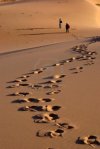
When a man is riding through this desert by night and for some reason—falling asleep or anything else—he gets separated from his companions and wants to rejoin them, he hears spirit voices talking to him as if they were his companions, sometimes even calling him by name. Often these voices lure him away from the path and he never finds it again, and many travelers have got lost and died because of this…. Even by daylight men hear these spirit voices, and often you fancy you are listening to the strains of many instruments, especially drums, and the clash of arms. For this reason bands of travelers make a point of keeping very close together. Before they go to sleep they set up a sign pointing in the direction in which they have to travel, and round the necks of all their beasts they fasten little bells, so that by listening to the sound they may prevent them from straying off the path.—Marco Polo, Travels


The Man from Stalingrad

Vasily Grossman (1905-1964)

Vasily Grossman (1905-1964)

Over the last year, I have been participating in a European History Meetup Group that, for a while anyway, turned into a Russian history group. We did readings and discussions on Peter the Great, Catherine the Great, Napoleon’s invasion of Russia, the Russian Revolution and Civil War, Stalin’s purges beginning in 1937, and two sessions on the Russian contribution to the Second World War.

Vasily Grossman was a loyal supporter of Stalin and, as such, served as a war correspondent for Krasnaya Zvezda, the official Red Army newspaper. He was in Moscow, Stalingrad, Kursk, and Berlin during the battles for those cities; and he provided eyewitness accounts of the liberation of the Nazi extermination camp at Treblinka.

Only toward the end of Stalin’s rule, when the dictator began to persecute the Russian Jews, did Grossman begin to rue his former attachment to the State. His great 900-page novel, Life and Fate, shows the actual change of mind taking place.

His extended Jewish family of Shaposhnikov women and their in-laws both suffer and are rewarded for their contributions to the State. Mostly, though, they suffer. Even the heroic tank commander, Nikolov, who leads the first Soviet armored units into the Ukraine, ends the book with an order to report to the stavka (General Staff) in Moscow. His scientist/academician, Viktor Shtrum, receives a congratulatory call from Stalin just when he thinks he is about to be arrested and interrogated—but then he is pressured into signing a statement that two physicians he respects were responsible for murdering the writer Maxim Gorky.

Stalin gives with one hand and takes away with the other. At the end of the Siege of Stalingrad, Grandma Shaposhnikov walks through the ruins and ponders:

And here she was, an old woman now, living and hoping, keeping faith, afraid of evil, full of anxiety for the living and an equal concern for the dead; here she was, looking at the ruins of her home, admiring the spring sky without knowing that she was admiring it, wondering why the future of those she loved was so obscure and the past so full of mistakes, not realizing that this very obscurity and unhappiness concealed a strange hope and clarity, not realizing that in the depths of her soul she already knew the meaning of both her own life and the lives of her nearest and dearest, not realizing that even though neither she herself nor any of them could tell what was in store, even though they all knew only too well that fate alone has the power to pardon and to chastise, to raise up to glory and to plunge into need, to reduce a man to labour-camp dust, nevertheless neither fate, nor history, nor the anger of the State, nor the glory and infamy of battle has any power to affect those who call themselves human beings. No, whatever life holds in store—hard-won glory, poverty and despair, or death in a labour camp—they will live as human beings and die as human beings, the same as those who have already perished; and in this alone lies man’s eternal and bitter victory over all the grandiose and inhuman forces that ever have been or will be …

Life and Fate is one of the great novels of twentieth century Russia, on a par with (and perhaps even a little bit better than) Anatoli Rybakov’s Arbat trilogy (Children of the Arbat, Fear, and Ashes and Dust).

As I wrote in my review of the book for Goodreads.Com:

I rather doubt that most readers will have the sitzfleisch to attack either Grossman or Rybakov. Unless one is somewhat familiar with the history and with Russian character names and patronymics, one is not likely to stray too far from the tried and true and excessively familiar. But, know this, there are rewards for those who do.

For an interesting perspective on Grossman, check out this site from the Jewish Daily Forward.

“Fun With Substance”

David Foster Wallace

David Foster Wallace

At first, you have:

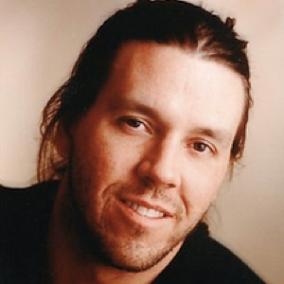
“fun with substance, then very gradually less fun, then significantly less fun because of like blackouts you suddenly come out of on the highway going 145 kph with companions you do not know, nights you awake from in unfamiliar bedding next to somebody who doesn’t even resemble any known sort of mammal, three-day blackouts you come out of and have to buy a newspaper to even know what town you’re in; yes, gradually less and less actual fun but with some physical need for the Substance, now, instead of the former voluntary fun; then at some point suddenly just very little fun at all, combined with terrible daily hand-trembling need, then dread, anxiety, irrational phobias, dim siren-like memories of fun, trouble with assorted authorities, knee-buckling headaches, mild seizures, and the litany of what Boston AA calls Losses … then more Losses, with the Substance seeming like the only consolation against the pain of mounting Losses, and of course you’re in Denial about it being the Substance that’s causing the very Losses it’s consoling you about—”—David Foster Wallace, Infinite Jest

A Sense of Loss

Huell Howser (1945-2013)

Huell Howser (1945-2013)

Every evening after dinner, I usually get on the computer and enter my income and expenditures on QuickBooks. During that time, about twelve feet from me, Martine watches one of Huell Howser’s TV shows on KCET, usually California’s Gold, California’s Green, or Visiting. What all three shows have in common is the amiable host paying homage to some locale or event or person connected with California.

People have made fun of Huell’s Tennessee drawl and his seeming naiveté in doing his interviews. There’s even a drinking game in which the participants have to take a swig every time Huell says “Wwwwwooooowwww!” or or “Gooooolllllllyyyyyy!” or “That’s amazing” or “historic” or any number of other of his habitual expressions.

Many were the times I would walk away from my computer and sit next to Martine because I found myself getting interested in one of his interviews. Over the years, Huell and I have visited many of the same places—because Huell got me hooked.

But now we no longer have Huell Howser, because he died yesterday in Palm Springs at the age of sixty-seven. He had retired in September from his show, sparking rumors that he was being forced out. Despite his approachability, however, the Tennessean was a private person who was fighting a long illness which was getting the upper hand.

Both Martine and I feel a sense of loss. In a city where there are not many really likeable public figures, everybody loved Huell. And he loved California and delighted in introducing interesting sidelights of his adopted state to anyone who would listen. And listen we did. For KCET, insofar as I’m concerned, he was the whole station’s raison d’être. When some people leave us, they leave behind a gaping hole. Who can replace someone so amiable, so knowledgeable, so adventurous, and withal such a character as Huell?

I know that his shows will continue to be watched in reruns. He will continue to influence our road trips through the State of California, especially in our Southern California neck of the woods. A neck of the woods that somehow has gotten more lonely without Huell to appreciate them.

To get a flavor of his shows, watch this video on YouTube (about a dog that eats avocados). And read this tribute that appeared in today’s Los Angeles Times.

A Chinless Villain

Do Chins Matter in Assessing Villainy?

A Cladistic Apomorphy?

We don’t tend to know much about chins, except that we are the only hominid which seems to have one. (Elephants have chins, but it is by no means clear why.)

Chins are classified as a cladistic apomorphy, according to Wikipedia, “partially defining anatomically modern humans as distinct from archaic forms.”

Now there are several myths extant about chins which result in our being prejudiced against males who are deficient in the size or shape of their chins. We tend to emphasize a strong chin with overall strength and decisiveness.

Which brings us to the subject of this blog, the embattled President of Syria—for the time being anyway—who is responsible for the deaths of some 60,000 of his people in an attempt to hang on to his power. Every time I see a picture of him, such as the one above (which makes him look somewhat like an ostrich), I keep saying to myself, “There’s something wrong here: The man has no chin whatsoever.”

We tend to hold many superstitious beliefs about people based on their superficial appearance. Because of the size of her Adam’s apple and her hands, I would naturally infer, for example, that Ann Coulter is actually a guy in drag. If so, that would explain a lot of things; but I am not absolutely sure that I’m right. Another example: American corporations like to choose as CEOs men who are taller than the average, perhaps because their size makes them look stronger and more decisive. But then, many of the CEOs who have been vilified for their role in fomenting the current recession fit this profile.

Maybe being tall doesn’t really make you stronger. Take Napoleon Bonaparte, Adolph Hitler, and Josef Stalin for example. The tallest of the three was Hitler at 5 feet 8 inches.

It would be interesting to make a study bringing together all these superficial observations and our myth making based on our perception of them. None of us are immune, particularly when it comes to choosing a mate. But then that’s an entirely different kettle of fish.