
Edward Snowden
On one of his last days in office as President of the United States in 1961, Dwight D. Eisenhower warned us against what he called “the military-industrial complex”:
In the councils of government, we must guard against the acquisition of unwarranted influence, whether sought or unsought, by the military-industrial complex. The potential for the disastrous rise of misplaced power exists and will persist.
We must never let the weight of this combination endanger our liberties or democratic processes. We should take nothing for granted. Only an alert and knowledgeable citizenry can compel the proper meshing of the huge industrial and military machinery of defense with our peaceful methods and goals, so that security and liberty may prosper together.
Akin to, and largely responsible for the sweeping changes in our industrial-military posture, has been the technological revolution during recent decades.
In this revolution, research has become central; it also becomes more formalized, complex, and costly. A steadily increasing share is conducted for, by, or at the direction of, the Federal government.
Today, the solitary inventor, tinkering in his shop, has been overshadowed by task forces of scientists in laboratories and testing fields. In the same fashion, the free university, historically the fountainhead of free ideas and scientific discovery, has experienced a revolution in the conduct of research. Partly because of the huge costs involved, a government contract becomes virtually a substitute for intellectual curiosity. For every old blackboard there are now hundreds of new electronic computers.
Well, we didn’t follow his advice, and so now the military-industrial complex pretty much rules this country. As you can see from the headlines, the United States is involved in all kinds of activities that make us the global bad guys, from the NSA spying on the phone calls of U.S. citizens to drones at home and abroad.
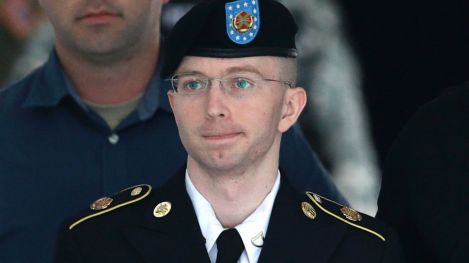
Private Bradley Manning
A new kind of “traitor” has sprung up—not a traitor to the nation, but a traitor to the military-industrial complex and what it is doing to make us feel as if we were no longer “the city on the hill,” but rather pirates cavorting on the Dry Tortugas. Private Bradley Manning and Edward Snowden are now threatened with dire penalties for the crime of letting us in on what our government is doing.
In my book, that makes them heroes. And I think it will not be long before the rest of the country comes around to my way of thinking. It may take years, even decades, for that to happen; but I think in tomorrow’s history books, they will not be discussed under the same heading as Benedict Arnold or Edward Everett Hale’s Philip Nolan, “The Man Without a Country.”


 Tarnmoor
You must be logged in to post a comment.