

In this context, some people continue to defend trickle-down theories which assume that economic growth, encouraged by a free market, will inevitably succeed in bringing about greater justice and inclusiveness in the world. This opinion, which has never been confirmed by the facts, expresses a crude and naïve trust in the goodness of those wielding economic power and in the sacralized workings of the prevailing economic system. Meanwhile, the excluded are still waiting. To sustain a lifestyle which excludes others, or to sustain enthusiasm for that selfish ideal, a globalization of indifference has developed. Almost without being aware of it, we end up being incapable of feeling compassion at the outcry of the poor, weeping for other people’s pain, and feeling a need to help them, as though all this were someone else’s responsibility and not our own. The culture of prosperity deadens us; we are thrilled if the market offers us something new to purchase; and in the meantime all those lives stunted for lack of opportunity seem a mere spectacle; they fail to move us.—Pope Francis, Evangelii Gaudium
Daily Archives: November 26, 2013
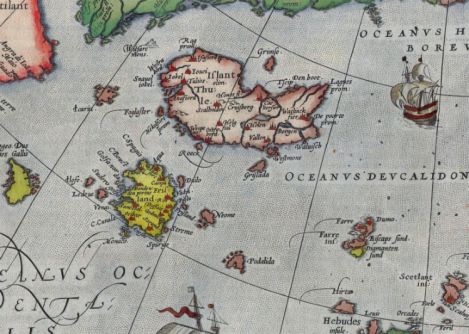
Where on Earth Is Frisland?
Until late in the Sixteenth Century, maps of Europe had a largish island called Frisland (also called Frischlant, Friesland, Frislandia, or Fixland) situated south of Iceland. It is thought that an Italian mapmaker named Nicolo Zeno was first responsible for the placement of the imaginary island on his charts in 1558. Then, in 1573, the Fleming Abraham Ortelius picked it up for his maps, followed by Gerard Mercator (he of the projection) of Duisburg. In 1576, Martin Frobischer thought he was in Frisland when, actually, he had overshot it and found himself in Greenland.
I am indebted to Benedikt Jóhannesson of the Iceland Review for turning me on to this existence of this cartographic canard. I remember standing on the farthest southern point of the Westmann Islands in Iceland and looking south. I saw quite a few small, rather volcanic rocks to the south—but nothing as large as Frisland is represented to be. Perhaps it’s the original Fantasy Island.
Curiously, this part of the ocean lies along the Mid-Atlantic Ridge. There have been volcanic islands that arose from the bottom of the sea, only to subside or be eroded away after the eruption that created them spent its fury. Perhaps someone reported some such island—though no way that large—and some mapmakers picked it up and embellished it a bit. A good example of such an island is Ferdinandea, between Sicily and Tunisia, which appeared and disappeared several times. It lasted long enough for several countries in the Nineteenth Century to dispute its ownership.


You must be logged in to post a comment.