Sumardagarinn Fyrsti

In Iceland, This Is the First Day of Summer

In Iceland, This Is the First Day of Summer

If you can find a place in Iceland that looks like this, let me tell you, my friend, you are not in Iceland. In today’s Iceland Review, there was a brief article about today’s being the first day of summer, or, in Icelandic, Sumardagarinn fyrsti. This holiday falls annually on the first Thursday following April 18 and is a bank holiday throughout the island. The article continues:

According to the science website of the University of Iceland, the first day of summer was also considered the first day of the year, which is why people used to count their ages, and their animals’ ages, in winters rather than years.

It was common to distribute summer gifts on Sumardagurinn fyrsti, four centuries before Christmas presents became a tradition, and the summer gift tradition is still practiced in some households. People celebrated with a feast, often finer than on Christmas Eve.

Farmers took a break from their hard work and children were allowed to play with their friends from the neighboring farms. The day was dedicated to young women and to children (it’s also known as Children’s Day). On this day young men would often reveal whom they fancied.

Another tradition on the First Day of Summer, called húslestur, involved people getting together and listening to readings from the Icelandic sagas, poems or other literature.

If the weather was summery, farmers would let their cattle and rams out, to allow the animals to greet summer, and to also entertain themselves by watching the animals play.

People used to go to mass on Sumardagurinn fyrsti until the mid-18th century when the inspectors of the Danish church authority discovered that mass was being held on this heathen day and banned the practice.

According to legend, people considered it a good sign if summer and winter ‘froze together’ (if there was frost on the last night before summer).

People would put a bowl filled with water outside to check whether it had frozen in the early hours of the next morning, before the morning sun could melt it. If the water had frozen, the summer would be a good one.

As I prepare for my vacation in Iceland, little stories like this help motivate me to learn even more about where I’m going. The idea of spending New Years Day reading sagas, poetry, and other great literature out loud is a welcome change from watching bowl games and merging with one’s inner couch.

Two Wild & Crazy Guys from Dagestan

Not Understanding American Culture Can Be Dangerous

Not Understanding American Culture Can Be Deadly

You may recall those two Wild & Crazy guys from Czechoslovakia, the brothers Yortuk and Georg Festrunk, on Saturday Night Live. As they shimmied across the stage in search of “foxes, ” they displayed an exquisite misunderstanding what the United States was all about. In the case of Steve Martin and Dan Aykroyd, the result was comedy. In the case of Tamerlan and Dzhokhar Tsarnaev, two Chechen brothers from Dagestan, the result was death and disorder.

In the years to come, one of the greatest dangers to America will be the failure of immigrants from cultures vastly different from our own to adapt to the prevailing culture of the U.S. Even the mother returned to Russia, leaving several arrest warrants for shoplifting in her wake. The streets of America are not paved with gold. They are fraught with dangers not understood by people who have been influenced by our popular culture without understanding the particular demons that we in the States have to contend with in our daily lives.

After the Hungarian Revolution of 1956, my parents took in two sets of refugees. The first was a mother and son who thought that, now they were in America, everything would be golden. That ended badly when Feddike, the son, was sent to a juvenile correctional facility. Next was Lászlo, a young man in his twenties, who also quickly fell afoul of the law—whereupon my mother and father resolved not to take in any more refugees from the Mother Country.

I do not mean to imply that immigration is bad, but that American culture sends misleading vibes to the rest of the world. People who are not thoughtful and who think that just being on American soil is the solution to all their problems are more likely to go astray. No, they must be ready to roll up their sleeves and start working long and hard toward their goals.

The Tsarnaev brothers should be an object lesson to American officials that they have to probe more deeply than mere external circumstances when opening the doors of the henhouse to potential predators.

Islands of Peace

The Church at Mission Santa Barbara

The Church at Mission Santa Barbara with Martine in the Foreground

The California Missions are probably the state’s best claim to a rich history going back to the eighteenth and nineteenth centuries. I find it nothing less than amazing that most if not all of Franciscan Father Junipero Serra’s missions are still in existence, after all the earthquakes, fires, and other disasters to which California is prone.

Mission Santa Barbara is one of four missions dedicated to converting and regimenting the Chumash Indians of the area (the others are La Purisima in Lompoc, Santa Ynez in Solvang, and San Buenaventura in Ventura). Although Father Serra was declared beatified by Pope John Paul II in 1988, there are still unresolved issues regarding mistreatment of the Indians. Each of the missions also contained Spanish military barracks for troops enforcing the political dictates of the Spanish Viceroys. So it is not uncommon to find stories where the Indians were both helped and repressed by the Missions and their dual religious and political functions.

Chumash Painting of St. Francis

Chumash Painting of St. Francis

Whatever really happened at these missions, today they are, collectively, a cultural treasure—islands of peace dotted along the California coast from San Diego to San Francisco Solano in Sonoma. I have visited perhaps ten of them so far and hope to see the rest of them eventually.

Martine and I visited Mission Santa Barbara (for the third or fourth time) on Saturday during our recent trip to the area.


Native Greenery

A Trail Through the Santa Barbara Botanic Garden

A Trail Through the Santa Barbara Botanic Garden

It’s remarkable how many of the plants we regard as being typical of California are actually imports. For instance, there is the jacaranda tree, which originally hails from Bolivia and Argentina, and the eucalyptus, an import from Australia.And it’s not only the trees, but also wildflowers, “weeds,” grasses, and other plants which came from elsewhere and spread like wildfire. Did you know, for instance, that the Tumblin’ Tumbleweed of song is actually called the Russian Thistle and comes from, you guessed it, the steppes of Eurasia.

On a hot Saturday last weekend, Martine and I took a circular trail through the Santa Barbara Botanic Garden, which is dedicated to preserving and promoting native California plants. We went through some forty ounces of cold Dasani water as we took every opportunity to sit down on shady benches and look around us.

We had tried to visit the Botanic Garden once before, but that was at the time of the Jesusita Fire of May 2009, which actually consumed part of the gardens. In fact, part of the gardens that were affected are shown in the photo above. In four years, the grasses and shrubbery bounced back quickly, though many of the tree trunks are scarred with burn marks.

The wilder parts of Southern California, such as the Botanic Gardens, which are in the foothills of the mountains around Santa Barbara, have a distinctive look and feel. They are not as “friendly” as Eastern forests. Mainly, that is because so many of the plants are somewhat prickly. In the spring at least, there is ample greenery everywhere; but once the fall months approach, much of it dries out and turns light brown until the next rainy season starts the whole cycle over again.

The road to the Botanic Gardens is tricky. You head uphill past the Santa Barbara Mission and take three or four roads to get to your destination. Fortunately, there are helpful directional signs along the way. Although the Gardens don’t get that many visitors, it is a worthwhile place to visit and good for soothing the soul of someone who has just survived a brutal tax season.


Penguin Feeding Time

Friday Afternoon Penguin Feeding

Friday Afternoon Penguin Feeding

I have always loved penguins. They are at one and the same time naive and well able to defend themselves with their razor-sharp beaks. The penguins on display at the Santa Barbara Zoo, which Martine and I visited last Friday, are Humboldt Penguins from around Peru, close to the Equator.

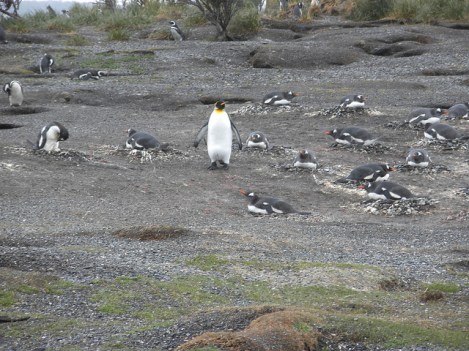
Never have I seen any emperor penguins, though I did see one disconsolate king penguin in Tierra Del Fuego in 2011 who got lost from his group and wound up with a colony of Magellanic and Gentoo Penguins on Isla Martillo in the Beagle Channel. (See picture below.)

Lost King Penguin in Argentina

Lost King Penguin in Argentina

That King Penguin was making a nuisance of himself by trying to mate with the smaller local penguins, who were having none of that particular type of miscegenation.

Why do Martine and I like the Santa Barbara Zoo instead of the much larger one at Griffith Park in Los Angeles? It seems that every time we go to the L.A. Zoo, they are undergoing major construction, forcing large crowds of people into narrow walkways past some upcoming future attraction. Until that future attraction arrives in the sweet by-and-by, we would be assailed by countless strollers wielded by desperate parents pushing their progeny through a surly mob. The future is nice, but I usually make my judgments based on the present.

There is some construction going on at the Santa Barbara Zoo, but it is small-scale compared to the pharaonic scale of L.A.

I’ve always loved zoos. We had a good time in November 2011 at the Buenos Aires Zoo, and I am toying with the idea of visiting the small Reykjavik Zoo in Iceland this June.

It was pretty hot the two days we were in Santa Barbara, but there are always a lot of shady benches for us to rest and re-hydrate ourselves.

A Change of Leeches

Ambrose Bierce

Ambrose Bierce

That I should give my hand, or bend my neck, or uncover my head to any man in mere homage to, or recognition of, his office, great or small, is to me simply inconceivable. These tricks of servility with the softened names are the vestiges of an involuntary allegiance to power extraneous to the performer. They represent in our American life obedience and propitiation in their most primitive and odious forms. The man who speaks of them as manifestations of a proper respect for “the President’s great office” is either a rogue, a dupe or a journalist. They come to us out of a fascinating but terrible past as survivals of servitude. They speak a various language of oppression and the superstition of man-worship; they carry forward the traditions of the sceptre and the lash. Through the plaudits of the people may be heard always the faint, far cry of the beaten slave.

Respect? Respect the good. Respect the wise. Let the President look to it that he belongs to one of these classes. His going about the country in gorgeous state and barbaric splendor as the guest of a thieving corporation, but at our expense—shining and dining and swining—unsouling himself of clotted nonsense in pickled platitudes calculated for the meridian of Coon Hollow, Indiana, but ingeniously adapted to each water tank on the line of his absurd “progress,” does not prove it, and the presumption of his “great office” is against him.

Can you not see, poor misguided “fellow citizens,” how you permit your political taskmasters to forge leg-chains of your follies and load you down with them? Will nothing teach you that all this fuss-and-feathers, all this ceremony, all this official gorgeousness and brass-banding, this “manifestation of a proper respect for the nation’s head” has no decent place in American life and American politics? Will no experience open your stupid eyes to the fact that these shows are but absurd imitations of royalty, to hold you silly while you are plundered by the managers of the performance?—that while you toss your greasy caps in air and sustain them by the ascending current of your senseless hurrahs the programmers are going through your blessed pockets and exploiting your holy dollars? No; you feel secure; power is of the People, and you can effect a change of robbers every four years. Inestimable privilege—to pull off the glutted leech and attach the lean one!—Ambrose Bierce, Antepenultimata (1912)

I Get Scammed

Doesn’t Look Like a Crime Scene, Does It?

Doesn’t Look Like a Crime Scene, Does It?

If I haven’t posted the last couple of days, it’s because Martine and I took the weekend off and drove to Santa Barbara. We were staying at the idyllic-looking Marina Beach Motel on Bath Street right near the coast in Santa Barbara. It was an ideal location, midway between the marina and Stearns Wharf with their seafood eateries.

Unfortunately, Martine is still not feeling up to par with the traveling pains around her back and shoulder blades (fibromyalgia?). She got tired quickly, and she wasn’t able to sleep comfortably on the king-sized bed in the motel because the mattress was too mushy for her. Also, she was still too exhausted to do much walking at the tourist attractions we visited, about which you will be hearing over the next few days.

More seriously, last night as I was dozing off in the motel room, I received a phone call purportedly from the front desk. It was one “Stacy Anderson” to tell me that the registration records for eighteen rooms in the motel had been lost because of a computer glitch, and would I dictate the relevant info to her over the phone? Because I was groggy and my critical faculties were not operating at par, I complied—including giving “Stacy” my credit card info.

As Bugs Bunny, would say, “Whatta maroon!” Just after I gave this info, I was given an 8-digit “confirmation number” (94184437) and told that I would get 40% off my bill for helping them out. It was at that point that I said the big “Uh oh!” and threw my clothes on.

Naturally, the night crew, who were sitting around sharing a pizza, had no idea of who “Stacy Anderson” was, nor had they called, nor was there anything wrong with their computer. I ran back to my room, picked up my cell phone, and called U.S. Bank to report a credit card fraud. Sure enough, they had already run up a $320 charge with Access Secure Deposits, which I denied having initiated. My credit card was promptly canceled, and I scissored it and distributed the pieces across a wide swath of Southern California.

If you are staying at a hotel or motel, you would do well to distrust any communications over the land line telephone in your room. If it is from the “front desk,” tello them you’ll be right there—and hang up! Don’t be a fool like me.

God Hates Westboro Baptist Church

Gonzo Picketer for So-Called “Westboro Baptist Church”

Gonzo Picketer for So-Called “Westboro Baptist Church”

The “Westboro Baptist Church” is no more a church than I am the Pope of Islam. They are a right-wing group that delights in fomenting outrage by picketing events where the vast majority of people attending are against their believes. That doesn’t bother the folks at WBC, who say on their website: “0 – nanoseconds of sleep that WBC members lose over your opinions and feeeeellllliiiiiings.” Also on the same page is a counter of the number of souls God has cast into hell since the web page was loaded. (Yeah, like they know!)

At a time when so much that is called political discourse is actually nothing but grandstanding in front of the media, WBC holds down a particularly odious niche. After all, their website is called GodHatesFags.Com. Whenever some disaster occurs, you can count on these hucksters to tell us all that we had it coming because of our tolerance of gays or something else these misguided white people hate or feel threatened by.

I do not think that WBC will be around for much longer: How much further can they go without bringing peoples’ wrath down on their heads or violating the law in some gross way?

So enjoy them while you can.

Dribbling Dritskers and Elf-Frighteners

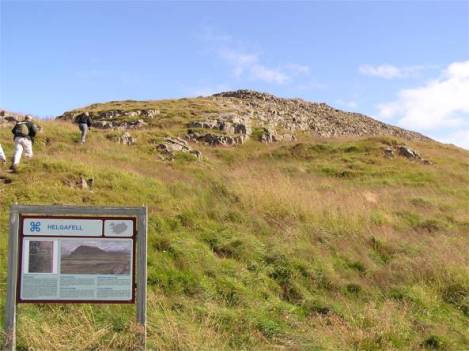
The Hill of Helgafell Just South of Stykkisholmur

The Hill of Helgafell Just South of Stykkishólmur

The old Vikings had a word for it. I learned about it last night as I was reading the thirteenth century Saga of the People of Eyri (also known as the Eyrbyggja Saga).In it, we learn about Thorolf Moster-Beard who dedicated a temple to his namesake god, Thor, atop Helgafell, a smallish hill near his farm at Thorsnes (now called Stykkishólmur) along the south shore of Breidafjórd. Let’s use the words of the skald who wrote the saga:

He named this mountain Helgafell and believed that he and all his family on the headland would go there when they died. At the place where Thor had come ashore, on the point of the headland, Thorolf held all court sessions and he established a district assembly there. He considered the ground there so sacred that he would not allow it to be defiled in any way, either by blood spilt in rage, or by anybody doing their elf-frighteners there—there was a skerry [small rocky islet] named Dritsker (Shit-Skerry) for that purpose.

Now this is a longish lead-in to the point I am trying to make, which is that television and the other news media are so full of people saying such ridiculous things leading variously to outrage (on the part of all right-thinking people) or pride (on the part of American Conservative wing-nuts). I am referring to people such as Wayne LaPierre; the “Reverend” Pat Robertson; Ted Nugent; Senators Lindsay Graham of South Carolina, Jim Imhofe of Oklahoma, and Rand Paul of Kentucky; Michele Bachmann; Sarah Palin; and Rush Limbaugh. Whenever they move their lips, all that comes out are various shapes and scents of dritskers and elf-frighteners.

Perhaps there should be a skerry someplace to which they can all be transported and where they can practice their creativity without scaring the dogs and children.

If you want to see more pictures of the area around Helgafell, where I will be visiting this June, check out The Magic of Iceland, from where I hijacked the above pic, which is actually one of the least interesting of the bunch.

“Grassed Down and Forgotten”

tess

Cover of Tess of the D’Urbervilles

The past was past; whatever it had been it was no more at hand. Whatever its consequences, time would close over them; they would all in a few years be as if they had never been, and she herself grassed down and forgotten. Meanwhile the trees were just as green as before; the birds sang and the sun shone as clearly now as ever. The familiar surroundings had not darkened because of her grief, nor sickened because of her pain.

She might have seen that what had bowed her head so profoundly—the thought of the world’s concern at her situation—was founded on an illusion. She was not an existence, an experience, a passion, a structure of sensations, to anybody but herself. To all humankind besides Tess was only a passing thought. Even to friends she was no more than a frequently passing thought. If she made herself miserable the livelong night and day it was only this much to them—’Ah, she makes herself unhappy.’ If she tried to be cheerful, to dismiss all care, to take pleasure in the daylight, the flowers, the baby, she could only be this idea to them—’Ah, she bears it very well.’ Moreover, alone in a desert island would she have been wretched at what had happened to her? Not greatly. If she could have been but just created, to discover herself as a spouseless mother, with no experience of life except as the parent of a nameless child, would the position have caused her to despair? No, she would have taken it calmly, and found pleasure therein. Most of the misery had been generated by her conventional aspect, and not by her innate sensations.—Thomas Hardy, Tess of the D’Urbervilles