The Thirty Plus Years’ Quest

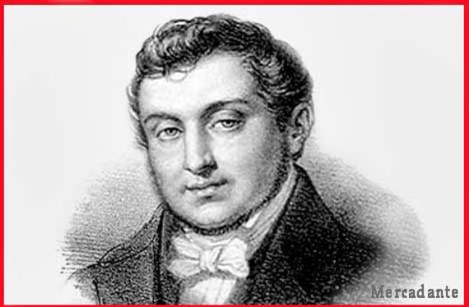
Saverio Mercadante (1795-1870)

Saverio Mercadante (1795-1870)

It was over a third of a century ago. I was preparing to go to work at Urban Decision Systems and listening to a classical music station on the radio, probably KUSC-FM. Suddenly, a piece of music came on called “Variations on a Theme on Stabat Mater by Rossini” by the Neapolitan composer Saverio Mercadante.

I have been looking for that piece of music at record stores (when there used to be such things), eBay, even iTunes—without a shred of luck. Then today I just happened to Google “Mercadante Rossini Stabat Mater” and got two hits on YouTube. Needless to say, I played both clips. One was an Italian recording entitled Sinfonia Sopri i Motivi dello Stabat Mater de Rossini, and the other was a recording conducted by Claudio Scimone with the L’Orchèstre National de l’Opéra de Monte Carlo and entitled Sinfonia sur des thèmes du Stabat Mater du célèbre Rossini (1843).

The musical phrase I loved came in at around the 7:50-minute mark on both recordings and lasted for a little over a minute.

It was nice, but it didn’t impress me as much as it did back in the 1970s or 1980s. Perhaps what I heard on the radio was a better recording. I just don’t know. Or perhaps my taste in music has changed. I am no longer like Swann and Odette de Crécy at the Verdurins oohing and aahing over that little phrase of Vinteuil’s.

What amazed me is that so many things that were impossible to find just twenty years ago can now be Googled and brought up in mere seconds. Technology is wonderful. Sometimes.


“Relevance”

The Importance of History

The Importance of History

Contemporary ideas need to be weighed not against others of the same period but against those of the past, and it is here that the average, modern student is defenceless. His interests and leisure reading are confined to an alarming extent to contemporary writers and thinkers who, despite their apparent individualism, are all really working in the same direction. It is ironic that the current demand at universities is for more relevance (that is to say, contemporaneity) in the curriculum. If acceded to, this will result in a still larger degree of temporal provincialism and an even more profound ignorance of the history of ideas than now prevails.—Duncan Williams, Trousered Apes

Mind, Matter and the Great Unknown

Sometimes Philosophy Ignores the Most Important Subjects

Sometimes Philosophy Ignores the Most Important Subjects

Sometime around a hundred years ago, philosophers decided not to talk about anything that they couldn’t prove. Over the decades, biology was reduced to chemistry, which in turn was reduced to physics, which in turn was reduced to mathematical formulas.

In the meantime, what was ignored was the whole subject of mind.

It reminds me of an old joke:

“What is mind?”

“It doesn’t matter.”

“What is matter?”

“Never mind!”

And yet, mind exists. There is this thing we have called consciousness. It is that consciousness which, from time immemorial, prompted talk about the human soul. Whether the soul exists apart from consciousness, I don’t know. Whether consciousness can exist unhooked from the whole material superstructure that is the human body, I do not know.

I tend to think that because of my sense of my own consciousness—the thing that makes me who I am—that I say I believe in God. Certainly I am not beholden to any organized religion for my belief: I think that all the scriptures are merely metaphorical attempts to create a myth around a belief in the deity.

In his recent book Mind and Cosmos: Why the Materialist Neo-Darwinian Conception of Nature Is Almost Certainly False, Thomas Nagel writes:

I would like to defend the untutored reaction of incredulity to the reductionist neo-Darwinian account of the origin and evolution of life. It is prima facie highly implausible that life as we know it is the result of a sequence of physical accidents together with the mechanism of natural selection. We are expected to abandon this naive response, not in favor of a fully worked out physical/chemical explanation but in favor of an alternative that is really a schema for explanation, supported by some examples. What is lacking, to my knowledge, is a credible argument that the story has a non-negligible probability of being true. There are two questions. First, given what is known about the chemical basis of biology and genetics, what is the likelihood that self-reproducing life forms should have come into existence spontaneously on the early earth, solely through the operation of the laws of physics and chemistry? The second question is about the sources of variation in the evolutionary process that was set in motion once life began: In the available geological time since the first life forms appeared on earth, what is the likelihood that, as the result of a physical accident, a sequence of viable genetic mutations should have occurred that was sufficient to permit natural selection to produce the organisms that actually exist?

Nagel does not provide the answers, but he asks the right questions. Is my consciousness of myself an accident? And why is my consciousness of myself so different from everyone else’s consciousness of themselves?

What has dictated that mind across so many billions of instances should be so rich, so incredibly diversified, so beautiful (and sometimes so heinous)?

The answer, my friend, is blowing in the wind.


A Jesuit Paradise?

Stamps Commemorating the Jesuit Missions of Paraguay

Stamps Commemorating the Jesuit Missions of Paraguay

It is interesting to me that, for the first time in its history, the papacy is in the hands of a Jesuit, from South America no less. In southeastern Paraguay and in the Argentinean state of Misiones, there are numerous ruins attesting to the 17th and 18th century Jesuit missions—missions that were so powerful that they were, in effect, in control of the Guarani Indians of the area. If you ever saw Roland Joffe’s 1986 movie, The Mission, with Robert DeNiro, Liam Neeson, and Jeremy Irons, you have some idea of what the Jesuit government of Paraguay was like.

You can find out even more by reading the forgotten classic history by R. B. Cunninghame Graham entitled A Vanished Arcadia: Being Some Account of the Jesuits in Paraguay 1607 to 1767.

It even finds its way into Voltaire’s Candide, but its author being such an anticlerical cuss, he has his hero kill the Jesuit commandant of one of the missions. Yet he writes in Histoire Politique et Philosophique des Indes:

When in 1768 the missions of Paraguay left the hands of the Jesuits, they had arrived at perhaps the highest degree of civilization to which it is possible to conduct a young people, and certainly at a far superior state than that which existed in the rest of the new hemisphere. The laws were respected there, morals were pure, a happy brotherhood united every heart, all the useful arts were in a flourishing state, and even some of the more agreeable sciences: plenty was universal.

I have long thought that, if my thoughts had ever taken a turn toward the Catholic priesthood, I would have become a Jesuit. My teachers at St. Peter Chanel in Bedford, Ohio, wanted me to become one of them, a Marist. But, in the end, I became neither.

So now Pope Francis is a Jesuit from Argentina. He, I am sure, is quite aware of the history of the Jesuits in the southern cone of South America. It would be nice if he did for the Catholic Church what the Jesuits did for the Guarani in Paraguay and Argentina. Benedict XVI was a good man, but not strong enough for the task of making his faith relevant to a world that is falling away from the Church.


Habemus Puellam

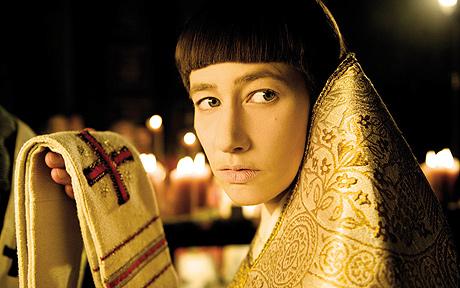
Pope Marigold I

Pope Marigold I

At first, the pink smoke pouring from the chimney set up over the Sistine Chapel stunned the thousands of faithful, as well as an equal number of reporters, as to what it meant.

In the end, it was inevitable that the One, Holy, Catholic, and Apostolic Church would eventually elect a female pope. Tradition was overturned in other ways as well: the new pope is not an ordained Catholic priest. (Nor can she be one according to canon law, to which she replies, “We’ll fix that!”.) And she is a lesbian, complete with tattoos and piercings.

Marigold I, originally Marigold Lilibeth Rathbun of Pepper Pike, Ohio, is also the first pope in several hundred years to still be in her twenties. “Yeah!” she comments; “That means I’ll be around for a while, so you all had better be good.”

Naturally, Pope Marigold’s election was not quite unanimous. Silvestro Silvestrini, Cardinal Archbishop of Ercolano, thinks there were some voting irregularities. “Something is fishy around here.” At least, he admits that she is certifiably free of any accusations regarding the molestation of underage altar boys. His colleague, Grandissimo Pipi, Cardinal Archbishop of Gomorrah, chimed in with his broken English: “I resemble that!”

Of one thing we can be sure, Holy Mother the Church is taking a slightly different course. She reminds us, “And remember, youse guys, I’m the pope; and that means I’m inflammable!”


Bad Times Are Gonna Come

Our Lives Are All Subject to Reverses

Our Lives Are All Subject to Reverses

I remember a story that one film industry friend told me several years ago. A family was so solicitous about the health of their son that they raised him on an organic and vegetarian diet. When he grew up, he wanted to go into the movies as a technician like his Dad. That first day on the job, he ate a McDonald’s hamburger and became deathly ill. He had to be hospitalized for weeks.

You can’t stay entirely out of the way of troubles that are sure to come. One of your loved ones could sicken and die, your health could take a turn for the worse, you could be forced out of your home, your investments could disappear as a result of fraud, your best friend could turn on you, your lover could prove unfaithful to you … the list is endless. How are you going to avoid all of those pitfalls, plus the ones not mentioned? Are you going to be like the vegetarian child for whom the world is toxic?

I would like to think that encountering troubles is a powerful inducement for having greater sympathy for your fellow man. It is not easy when your fellow man cuts you off on the street and leaves you with an upraised middle finger and the exhaust from his BMW; but if your response is nothing but rage, you will only hurt yourself.

Look around you. The world is full of people who need a little help. Even when their gratitude is not what you would hope for, you will feel better about yourself.


William of Lugos

BelaLugosiHeadstone

Headstone of Bela Lugosi at Holy Cross Cemetery in Culver City

His real name was Béla Ferenc Dezsö Blaskó, but that didn’t sound cool enough for the title role in Universal Pictures’ new film Dracula (1931). Béla, or William as it’s translated into English, was born in Lugos in then Austro-Hungarian Empire. Now it is known as Lugoj and is located in Rumania. And, just so you know, in Transylvania, near Timisoara, known by the Hungarians as Temesvár. So Béla Lugosi is none other than William of Lugos.

By the way, his name is really pronounced BAY-lah LOO-gauche-ee, with the accent on the first syllable of first and last name.

Martine has always loved Lugosi’s acting. In fact, on her favorite sweater, she wears a metal pin of a 32¢ stamp issued in his honor, as shown below:

1997 USPS Stamp Commemorating Famous Monsters of Hollywood

1997 USPS Stamp Commemorating Famous Film Monsters of Hollywood

Martine has a set of DVDs for Lugosi’s films; and when we visit Holy Cross Cemetery, we always check out his grave on a hillside near a grotto.

It always surprises me how many famous people don’t have any flowers or other marks of family or fan affection by their graves. Note, however, that there is a little votive candle by the bottom right of Béla’s headstone.

An Afternoon at LACMA

One of My Two Favorite Paintings at LACMA: Jan de Heem’s “Still Life with Oysters and Grapes”

One of My Two Favorite Paintings at LACMA: Jan de Heem’s “Still Life with Oysters and Grapes”

Today was the last day that I don’t have to show up for work until Friday, April 19: That’s thirty-nine consecutive days that I will have to work. (We have a three-day weekend after the April 15 tax deadline).

Martine and I took advantage of the last free day by visiting the Los Angeles County Museum of Art (LACMA) right near the famed La Brea Tar Pits by Wilshire & Fairfax. Over the years, LACMA has grown like Topsy: It now occupies a campus of some eight buildings, only three of which I visited. Scattered as the museum’s collections are, it is now much more difficult to find particular paintings or particular periods of art. There are two paintings I always look for. The first (shown above) is Jan Davidszoon de Heem’s “Still Life with Oysters and Grapes,” from the Dutch Golden Age of the 17th century.

The other, shown below, is a delightful Auguste Renoir painting of two girl’s reading from a book.

Pierre Auguste Renoir’s “Two Girls Reading”

Pierre Auguste Renoir’s “Two Girls Reading”

I am not always fond of the Impressionist painters, because I think some of them, such as Monet and Cézanne, can be too sterile in their search for effects (though not always). But in the above painting, the whole world revolves around the two girls. Displayed right next to it at the museum is a portrait of the artist’s son Jean portrayed as a huntsman. Because Jean grew up to be one of my favorite film directors, I have always been fond of that portrait as well.

Because Martine and I have different tastes in art, we split up and met later in the afternoon at the museum café, where I was drinking a cup of English Breakfast tea. In the meantime, on my own I visited the exhibits of Chinese and Korean art. Particularly interesting was a small traveling exhibit of Ming Dynasty Masterpieces from the Shanghai Museum. Many of them depicted members of the Taoist Immortals, often with a great sense of humor, such as the ink wash drawing showing one of them flying up to the heavens on the back of a giant carp.

There was also an excellent exhibit of ancient Meso-American art, showing the typical Mayan, Totonac, and other peoples’ sense of humor depicting gods, men, and animals—especially the latter.

Support Your Local Bookseller

Alpine Village, Central Europe at the Edge of the Desert

Alpine Village, Central Europe at the Edge of the Desert

Today I got off early from tax work, so I suggested to Martine that we go to Captain Kidd’s Fish Market in Redondo Beach for a seafood lunch, followed by a visit to Alpine Village in nearby Torrance. At Alpine Village is not only an excellent European food market with great meats, but an excellent used bookstore that goes under the names of Collectible Books and Michael Weinstein, Bookseller.

Since tax season will get only worse as April 15 approaches, my food preparation will now eschew the fanciful and time-consuming. This next week, we will have knockwurst or German wieners with Brussels Sprouts, cauliflower, or other steamed vegetables. Perhaps the week after, it will be Hungarian Gyulai kólbasz sausage sautéed with onions, potatoes, and paprika—a dish my mother frequently cooked for us back in Cleveland when she was pressed for time.

I was a little disingenuous with Martine because I didn’t mention until later that I also wanted to visit the little used bookstore at Alpine Village, various called Collectible Books and Michael R. Weinstein, Bookseller. There I purchased three items:

  • R. R. Palmer’s Twelve Who Ruled: The Year of the Terror in the French Revolution. I had read this before, but made the mistake of selling it when I wanted to re-read it.
  • Percy Bysshe Shelley’s Selected Poems in a compact hardbound Oxford World Classics edition, suitable for travel.
  • A lovely Lakeside Press edition of William S. Hart’s My Life East and West, the autobiography of the silent cowboy star whose house in Newhall we visit two or three times a year. It is now a museum administered by the Los Angeles Museum of Natural History.

Not a bad haul for thirty bucks. I know, I know: I have too many books. But reading great books is what puts the light in my eyes. Martine knows that, so she forgives me my little vice.

A Tarheel in the Big Apple

Joseph Mitchell (1908-1996)

Joseph Mitchell (1908-1996)

In America, fiction writers get all the love. Because I know I can never write good fiction, I have a particular appreciation of nonfiction writers, particularly essayists. And one of my favorites was Joseph Mitchell, who came up from North Carolina to become a writer for The New Yorker, and stayed for most of his life.

Today, while I was munching on some curried vegetables at lunchtime, I read an unfinished article by Mitchell in the February 11 and 18 issue of The New Yorker about the author’s peregrinations through the five boroughs of the big city looking for architectural oddities. Entitled “Street Life,” it begins with interesting architectural features and ends up looking at church services at Catholic and other Christian churches (including various Eastern Orthodox), synagogues, and mosques:

I used to feel very much at home in New York City. I wasn’t born here, I wasn’t a native, but I might have well have been: I belonged here. Several years ago, however, I began to be oppressed by a feeling that New York City had gone past me and that I didn’t belong here anymore. I sometimes went on from that to a feeling that I had never belonged here, and that could be especially painful. At first, these feelings were vague and sporadic, but they gradually became more definite and quite frequent. Ever since I came to New York City, I have been going back to North Carolina for a visit once or twice a year, and now I began going back more often and staying longer. At one point, after a visit of a month and a half, I had about made up my mind to stay down there for good, and then I began to be oppressed by a feeling that things had gone past me in North Carolina also, and that I didn’t belong down there anymore, either. I began to feel painfully out of place wherever I was. When I was in New York City, I was often homesick for North Carolina; when I was in North Carolina, I was often homesick for New York City.

I know that feeling. Things have gone past me in Los Angeles, too, but I suspect that the reason is that my age cohort has passed into a gray area (referring mostly to the color of our facial hair). In no way am homesick for Cleveland, the land of my youth. All that remains of Cleveland for me is buried in several scattered cemeteries in Cleveland and in Pembroke Pines, Florida. My great-grandmother, my mother, my father, my uncle and my aunt. I have been away from there now for more than forty years.

The last time I was there was for my mother’s funeral in 1998. My brother Dan and I drove around the areas where we played as children. What surprised us the most was that our barren post World War Two suburban development in the Lee-Harvard area was now covered with large, stately trees. Even my old High School, St. Peter Chanel in Bedford, is shuttering its doors this year.

Getting back to Joseph Mitchell, I find, reading him, that I become nostalgic for places I have never seen, experiences I have never lived through. That is the mark of a great writer: He can make you feel that you are experiencing these places and events through his eyes.

Some day, if you want a good read, you might want to try one of his books:

  • My Ears Are Bent (1938)
  • McSorley’s Wonderful Saloon (1943)
  • Old Mr. Flood (1948)
  • The Bottom of the Harbor (1959)—My favorite.
  • Joe Gould’s Secret (1965)

I hope that The New Yorker can dig up some more of his old stories. His complete oeuvre is rather small, but it is choice.

The drawing of Joseph Mitchell shown here is by Nick Sung.