“Power Without Wisdom Collapses Beneath Its Own Weight”

Jan Amos Komensky

Jan Amos Komensky

Almost three hundred and fifty years ago, one of the greatest minds of the Renaissance and the founder of modern pedagogy, Jan Amos Komensky (Comenius) wrote in a letter to the Prefects of the Dutch Navy:

“Your homeland has entrusted you with its bounty, that you protect it against all foreign foes, but you must not be ignorant of the art of defending it from foes within, to wit, the obscuring of the mind, loosening of morals and desecration of life. And not only protect it for the present time but also to take wise care how in the future the generations that will rise after you, your sons, may successfully protect the happy state you have prepared for them and then pass it on to their offspring until the end of time. It is therefore necessary that you bequeath to them not only the strength and determination to maintain it themselves but also wise counsel, otherwise power without wisdom collapses beneath its own weight.”

How is wise counsel being passed on within the family, the school, the mass media or the other institutions concerned with it in some way?—Ivan Klíma, Between Security and Insecurity

The Man Who Chased Earthquakes

Vladimir Keilis-Borok (1921-2013)

Vladimir Keilis-Borok (1921-2013)

Last year, my neighbor Luis had knee surgery at St. John’s Hospital in Santa Monica. Because he is in his eighties and lives by himself, he spent several days recuperating at a nursing care facility across the street from the hospital. His roommate turned out to be a famous Russian scientist by the name of Vladimir Keilis-Borok, whose life work was trying to find a way of predicting earthquakes using mathematical data culled from data about faults and previous tremors.

Martine and I had seen Vladimir only twice during our visits to Luis and found him to be brilliant and engaging. He spent much of his time at the nursing facility working on mathematical models on his laptop computer. During one of my visits, he asked if I could recommend someone to help him with his computerwork. I immediately thought of my friend Mikhail, who spoke Russian and knew many computer people in L.A.’s Russian community. Somehow, it never went anywhere. Perhaps the funding just wasn’t there.

I was saddened to see that the Russian scientist passed away last week. A glowing obituary appeared in the Los Angeles Times commemorating his accomplishments and his pursuit of that Holy Grail of earthquake prediction. If somehow someone could put it all together, his work could be responsible for saving the lives of untold millions of people who, like myself, live near major fault zones.

Victorian Genre Fiction

Sherlock Holmes Was Not the Only Game in Town

Sherlock Holmes Was Not the Only Game in Town

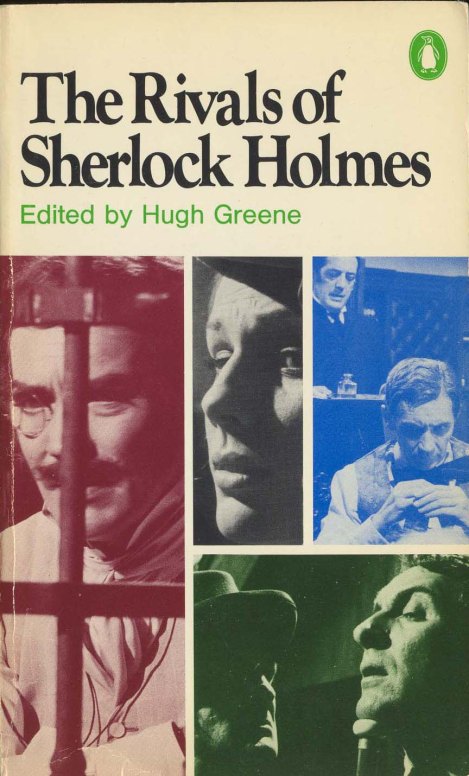
The paperback whose cover is illustrated above first came out in 1972, followed by three other volumes of non-Sherlock detective stories written during the same period. Edited by Hugh Greene, brother of Graham Greene, the books were a revelation to me. I started Reading Richard Austin Freeman’s Dr. Thorndyke stories; Ernest Bramah’s Max Carrados stories (Carrados was blind, and could read the London Times by feeling the elevation of the ink on the paper); the novels and stories of the vastly underrated Arthur Morrison; Jacques Futrelle’s “Thinking Machine” stories (Futrelle died on the Titanic); and Baroness Orczy’s The Old Man in the Corner Stories.

And that was only the beginning! I also noticed that the Victorians and Edwardians wrote excellent horror stories as well, and that many of them were available from Dover Publications, including such luminaries as Algernon Blackwood, M. R. James, Arthur Machen, Mrs. J. H. Riddell, and Wilkie Collins. Now, in the age of the Kindle and other e-books, one could pick up virtually all of Blackwood’s short stories in two “megapacks” for a mere $1.98. There are even two well-known “psychic detectives” investigating hauntings and possessions, namely Algernon Blackwood’s John Silence, the self-styled “psychic doctor,” and William Hope Hodgson’s Max Carnacki, the ghost detective.

The stories are, for the most part, available readily and inexpensively now that their copyright protection expired years ago. It may still be difficult to find some Arthur Morrisons such as the Martin Hewitt detective stories and the stories in The Dorrington Deed-Box.

Even G. K. Chesterton got into the act somewhat later with his Father Brown stories, which are in a slightly different vein, but which owe much to Arthur Conan Doyle and his “rivals.”

A good way to start is to find Hugh Greene’s collections on eBay or Amazon.Com and, if you like them, dig around in used book stores, or, if you are on a budget, Amazon Kindle and its “rivals.”

Halloween at the Grier Musser Museum

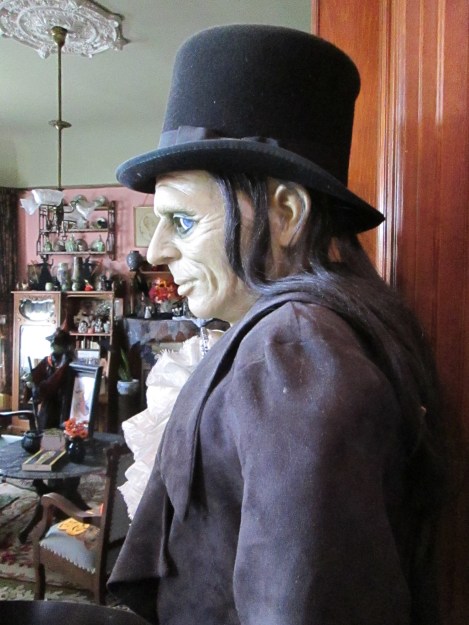
We Are Welcomed at the Door

We Are Welcomed at the Door

Today, Martine and I visited the Grier Musser Museum near downtown Los Angeles for their annual Halloween display. Susan Tejada, the museum’s curator, has gathered together an incredible collection of memorabilia relating to All Hallows Eve, from paper to dolls to battery-powered moving skeletons. (The most frightening is one in a cage above a toilet in the bathroom screaming that he wanted out.) Almost every inch of the rooms open to view is crammed with Victorian memorabilia (the house on Bonnie Brae Street goes back to the 19th century) and exhibits relating to Halloweens past and present.

In addition, there is a room with television and film exhibits relating to The Wizard of Oz (about to celebrate the 75th anniversary of its release), The Nightmare Before Christmas, and Monster High. If it weren’t for the fact that the tour is guided by Ms. Tejada, one could spend hours among the thousands of items on display.

The late Huell Howser, whose PBS television show visited the Grier Musser Museum twice over the years, had a sure knack for highlighting the very best of California, especially the Los Angeles area. Two visits was a singular mark of recognition.

A Rare Victorian Beauty: The Curator’s Grandmother

A Rare Victorian Beauty: The Curator’s Grandmother

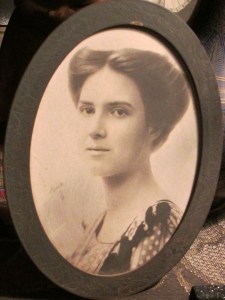
In a room on the second floor, we saw the above photograph of Susan Tejada’s grandmother. I am always stunned when I see a photograph from over a century ago of a young woman who, even today, would be accounted a great beauty.

For some reason, this year we are spending more time getting into the Halloween spirit. In my case, it involves reading several books of spooky stories and visiting the Grier Musser Museum. Unfortunately, children have not come here to trick-or-treat for almost twenty years now. The schools have attempted to replace door-to-door trick-or-treating with school parties—especially in neighborhoods such as mine consisting mostly of multistory apartment buildings. Neighborhoods of posh single family homes still are inundated with lisping ghosts and monsters of short stature.

Charon the Boatman

Back and Forth Across the River Styx

Back and Forth Across the River Styx

I haven’t printed any poems lately, so I paid a visit to the work of America’s Serbian-born poet, Charles Simic.

Charon’s Cosmology
By Charles Simic

With only his dim lantern
To tell him where he is
And every time a mountain
Of fresh corpses to load up

Take them to the other side
Where there are plenty more
I’d say by now he must be confused
As to which side is which

I’d say it doesn’t matter
No one complains he’s got
Their pockets to go through
In one a crust of bread in another a sausage

Once in a long while a mirror
Or a book which he throws
Overboard into the dark river
Swift and cold and deep

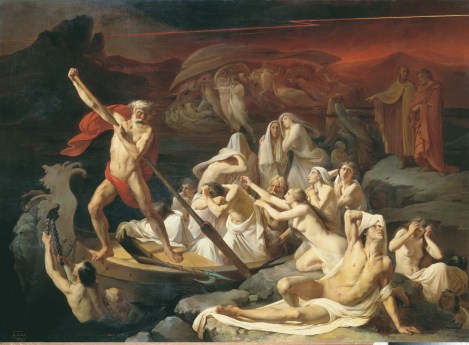
Now, why, I wonder, would Charon toss books into the Styx? God knows, if I were one of his fares, I would probably have a book on me. Eternity lasts a long time, and there’s plenty of time to read Tolstoy, Dostoyevsky, and everything else. There exists some doubt, however, that at that point it would do me any earthly good.

Merricat Introduces Herself

The Opening Lines of the Book

The Opening Lines of the Book

My name is Mary Katherine Blackwood. I am 18 years old, and I live with my sister Constance. I have often thought that with any luck at all I could have been born a werewolf, because the two middle fingers on both my hands are the same length but I have had to be content with what I had. I dislike washing myself, and dogs, and noise. I like my sister Constance, and Richard Plantagenet, and Amanita phalloides, the death-cup mushroom. Everyone else in my family is dead.—Shirley Jackson, We Have Always Lived in the Castle

The Power of Magical Thinking

Author Shirley Jackson

Author Shirley Jackson

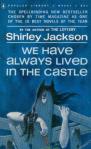
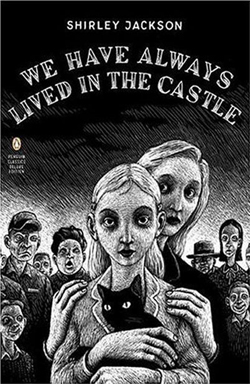
As of two days ago, all I read of Shirley Jackson (1916-1965) was a single short story, “The Lottery.” That should have told me something about the author, except it was so many decades ago that I read it. Then, last night I finished reading We Have Always Lived in the Castle (1962), a novel about a family in a small town that is hated by the townspeople because of a murder by poisoning that had taken place there six years before.

The inhabitants of the house include Constance and Merricat (Mary Katherine) Blackwood, and their aging Uncle Julian, who is in a wheelchair. It was the 29-year-old Constance who was suspected of poisoning her mother and father by adding arsenic to the sugar. She was tried and acquitted for lack of evidence. The mutual suspicions remaining after the trial have isolated the Blackwoods in their old gothic house: Only Merricat goes into town twice a week to do the grocery shopping. Although the townspeople are presented as curious and mostly hateful, the Blackwoods themselves live a serene life—until something happens to disturb their peace.

That something is the arrival of Charlie Blackwood, their cousin, who has eyes on Constance and what he imagines is the family money. There quickly develops a mutual animosity between Merricat and Charlie. Here is what the former thinks:

I was thinking of Charles. I could turn him into a fly and drop him into a spider’s web and watch him tangled and helpless and struggling, shut into the body of a dying buzzing fly; I could wish him dead until he died. I could fasten him to a tree and keep him there until he grew into the trunk and bark grew over his mouth. I could bury him in the hole where my box of silver dollars had been so safe until he came; if he was under the ground I could walk over him stamping my feet.

A Book Worth Reading

A Book Worth Reading

As much as she would like to be able to do these things, Merricat has no supernatural powers. (If she did, no one would be safe.) But she decides that a particular day would be the last day of Charlie’s unwelcome visit. At that point, all hell breaks loose. I will not divulge the ending, which is strange and curiously satisfying, but I will add Shirley Jackson to the list of horror story authors I discussed in my post of two days ago entitled Thirteen More Horrors.

In addition to “The Lottery” and We Have Always Lived in the Castle, Shirley Jackson wrote The Haunting of Hill House. I highly recommend that you give her work a try.

The Lion’s Share

Lion
Lion

A lion, an ass, and a fox entered into a partnership whereby they would share in common whatever they caught by hunting. When they got their prey, the lion ordered the ass to divide it. Stupid as he was, the ass divided it into three equal parts. Wherefore at once the lion, outraged that he was made equal with the others, attacked the ass and tore him to pieces. The fox was left; the lion ordered her to make the division anew; she gave almost all of the prey to the lion, keeping for herself only a few meager scraps. The lion approved the division and asked the fox who had taught her the art of dividing. The fox answered, “The fate of the ass.”—Erasmus, Adages

We Have Nothing to Fear But …

Someone Needs to Tell This to the Tea Party

Someone Needs to Tell This to the Tea Party

Conservatives are people who are addicted to fear. They fear for the “sanctity” of marriage. They fear what else homosexuals might be planning to discomfit them and their way of life. They fear that liberals are coming to take away their guns. They fear their children will grow up hating their values. They fear that poor people will vote in large numbers to bump them out of office. They fear America will be inundated by immigrants from Third World countries. They fear for the Purity of Essence of their Precious Bodily Fluids.

I take my cue from a great Republican President by the name of Calvin Coolidge. At one point, he said, “If you see ten troubles coming down the road, you can be sure that nine will run into the ditch before they reach you.” I often think of that saying when I am twisting and turning in bed at night because I fear that something will happen.

If you should ever find yourself in Plymouth, Vermont, as I did on one day in 2005. You should visit the Coolidge homestead, which is run by the Calvin Coolidge Memorial Foundation. You will find the former President buried in the local cemetery without an ostentatious monument slathered with grandiose sentiments. You will see the humble home in which he was born and the village where he grew to maturity. And finally, you will see a Republican who could be admired by future generations—as the present crop of Republicans will most certainly not be.

A subsequent President, FDR, told us during his first inaugural address that we had nothing to fear but fear itself:

So, first of all, let me assert my firm belief that the only thing we have to fear is…fear itself — nameless, unreasoning, unjustified terror which paralyzes needed efforts to convert retreat into advance. In every dark hour of our national life a leadership of frankness and of vigor has met with that understanding and support of the people themselves which is essential to victory.

Is the United States going to be paralyzed by the fear of elderly white people who think they are the last generation that supports the values that made this country great? Or will change continue to take place—as it always has and always will—leading to a world that is different, better in some ways and worse in others?

Thirteen More Horrors

These Are My Favorite Horror Novels and Stories

These Are My Favorite Horror Novels and Stories

Three weeks ago, I posted a list of my thirteen favorite scary films. You can catch it by clicking here. This time, I will give you a list of equivalent novels and short stories that are guaranteed to send chills up your spine. They are presented here in alphabetical order by the last name of the author:

Algernon Blackwood: Just about anything by this prolific author is great. My favorites are “The Willows” and “The Wendigo.”

Ray Bradbury: Something Wicked This Way Comes and The October Country.

Wilkie Collins: I am particularly partial to The Woman in White.

Henry James: The Turn of the Screw. Utterly brilliant!

M. R. James: I like the collection entitled The Ghost Stories of an Antiquary. Be sure to read “Casting the Runes.”

Sheridan Le Fanu: This Irish writer wrote my favorite vampire novel, Carmilla.

H. P. Lovecraft: Read just about anything by this great short story writer. The Library of America edition of his works is your best starting point.

Richard Matheson: I Am Legend combines sci fi and vampires in a curiously effective mix.

Edgar Allan Poe: You can’t beat the original. Try his only complete novel, The Narrative of Arthur Gordon Pym of Nantucket, which isn’t read much these days, but which I love. His short stories are, of course, brilliant.

Mary Shelley: Everyone reads Frankenstein, but I think The Last Man is even better.

Robert Louis Stevenson: What else but The Strange Case of Dr. Jekyll and Mr. Hyde?

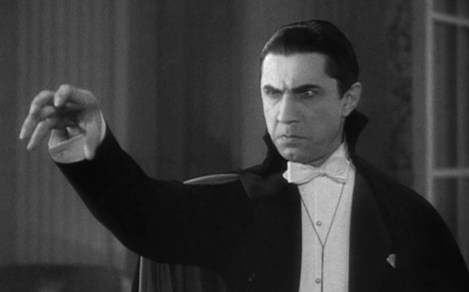
Bram Stoker: I liked Dracula, though it can be a bit tedious at times. See Le Fanu and Matheson above for better vampire novels.

John Wyndham: Another sci fi and horror combo worth reading is The Day of the Triffids, which is not at all like the movie.

You may have noticed the omission of several prominent names, especially such current purveyors of horror as Stephen King, Clive Barker, Dean Koontz, William Peter Blatty, and so on ad infinitum. I just don’t happen to like any of them. I used to like Anne Rice, but lost interest in her years ago. The above writers will, I think, outlast many of the current practitioners.

For some writers I must admit ignorance: I suspect Shirley Jackson is great, but I haven’t read any of her works yet. (Note to self: Maybe now’s the time to start.)