Shock and Awe

So Easy To Get In ... So Hard To Get Out

So Easy To Get In … So Hard To Get Out

If we weren’t born yesterday, we know by now that it is so much easier to start a war than to end one. Our military talks about going into a war with an “exit strategy,” but what makes us think that we know enough about the situation in the country we are invading to devise an exit strategy that is based on any kind of reality, Take Iraq, for example. We stepped into that tar baby (or was it something equally sticky, but more pungent?) with a display of what George W. Bush called “shock and awe.” It made for good newsreel photography, but don’t you think that once people figured out was happening, they burrowed deep into their warrens and, except for a few unlucky souls, managed to survive.

For a while, things looked pretty good. But then something happened that the Pentagon never imagined: The invasion forced the irreconcilable elements of Iraqi society to splinter apart so quickly that, before we knew what was happening, we found ourselves in a civil war. After the first victories, we bottled ourselves up in the Green Zone. Whenever our boys ventured out, they risked being blown to smithereens by Improvised Explosive Devices (IEDs). Wars tend to accelerate the rapid transformation of societies. Take a look at what happened with all the displaced persons who found themselves stateless at the end of the Second World War.

We are not the only ones to find ourselves in this situation. Take Hitler’s Operation Barbarossa—the invasion of Russia—in 1941. Hitler and his General Staff thought that after some quick one-sided victories, Stalin would sue for peace. After all, the Soviet leader had no idea what was coming. When a Nazi deserter crossed into Russia to warn of an impending mass invasion the day before Barbarossa, Stalin casually had him executed as a spy attempting to sow disinformation. The Germans won their rapid victories and, for two years, came close to taking it all. They had an exit strategy, however, that bore no relation to reality. They thought Stalin would quickly sue for peace. Hitler would then take over Belarus and the Ukraine, send the Slavic riff-raff to death camps, and re-settle the area with prosperous German farmers. So ingrained was this image in the Germans’ minds that they made three slight errors:

  1. They did not plan to repair or replace the tanks, trucks, artillery, and other war machinery that would bog down on muddy Russian roads.
  2. They did not equip their troops with winter clothing.
  3. They did not have enough gasoline and oil to power their working war machinery.

When the Russians began their counter-offensive, they found the roads littered with frozen Wehrmacht corpses. Only 10-20% of the vaunted Nazi tanks were still working. And Paulus’s Sixth Army could not take Stalingrad because they didn’t have the fuel to get a sufficient number of their war machines into battle.

And as for the transformations wrought in Russian society, they were extensive. The war unified the Russians behind Stalin: They called it the Great Patriotic War. They moved their manufacturing capabilities out of range of the German bombers. Unlike Hitler, Stalin actually listened to his generals … in the long run, anyhow. On the negative side, Stalin assumed that every Russian who was ever behind German lines was suspected of collaboration: Hundreds of thousands were sent to the Gulag.

Japan’s exit strategy was to form a Greater East Asian Co-Prosperity Sphere consisting of China, Korea, Indonesia, Burma, the Philippines, and whatever other country they were able to overcome. No one told the Imperial Japanese Army, however, to be nice to the conquered peoples of East Asia. The net result was that no one voluntarily wanted in to Japan’s scheme.

Even Germany’s Schlieffen Plan (see Barbara Tuchman’s book The Guns of August) in the First World War was defective. It was no longer 1870, when Bismarck and von Moltke crushed France in a cakewalk. They forgot to consider that this might turn out to be a long war which they were not sufficiently endowed with the natural wealth to endure.

And so it goes. I am grateful that we did not take the opportunity to invade Syria. I can just see it now: After both sides whine for American help, no sooner would we show up than both sides would say, “Let’s get ’em” and proceed to blow us into kingdom come.

Metaphor

Polish Poet Adam Zagajewski

Polish Poet Adam Zagajewski

Increasingly often and striking powerful chords, Eastern Europe calls to me. While I was looking for something else on my shelves, I pulled out Adam Zagajewski’s Unseen Hands and started scanning it. Here is a poem of his called “Metaphor”:

Metaphor

Every metaphor is a failure, said
the very old poet in the hotel bar,
turning to his rapt pupils.
The very old poet was in fine form
and said, with a wineglass in his hand:
It’s the fundamental problem of incarnation,
the things we love, the unseen things,
take flesh, of course, in what can
be seen and said, though never
absolutely, one to one,
so it follows that there’s always a little too much
or a little too little, the seams remain on the surface,
fingers jut, buttons, umbrellas, fingernails,
uncollected letters in azure airmail envelopes,
the sense of shortfall or excess remains,
someone is ominously silent, someone else
summons help, the ice cracks, the ambulance
arrives, too late, alas, but just wait,
thanks to this, thanks to this incongruity,
thanks to this inexplicable rupture,
we may keep chasing the chimera of metaphor,
all our lives we walk in darkness,
in a dim forest, we track the trail of simile,
imperfect, just like my
speech, just now reaching
its conclusion, although there is
no doubt much more to add,
but I fear that I’m already
growing weary and seem
to hear sleep calling.

I can just imagine the very old poet beginning to nod off, somewhat dismayed by the imperfection of language. Just as, I might add, I am beginning to nod off as my bedtime hour approaches. I like the use of the word “incarnation” to describe metaphor, an “unseen thing taking flesh.”

Some Things Get Better

The Rare Ballantine Adult Fantasy Edition

The Rare Ballantine Adult Fantasy Edition

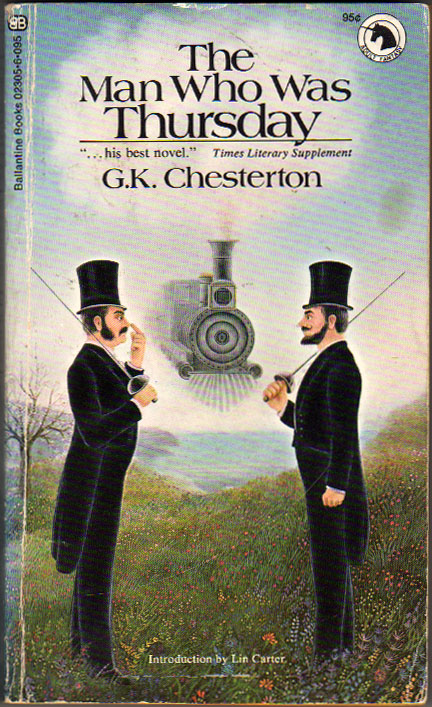
I am currently re-reading G. K. Chesterton’s The Man Who Was Thursday, perhaps his best work of fiction. I came to it first some forty years ago, and since then have read it two or three times. After going through all the Chesterton volumes at the Santa Monica Public Library—that took all of ten years—I decided to start collecting his work. At the outset, there weren’t many works in print. Fortunately, Ignatius Press of San Francisco started coming out with an edition of his Collected Works. To date, I have all the volumes that have been released so far: I say “so far” because they are still dribbling out at a rate of one or two a year.

Currently, all of Chesterton’s major works are in print, sometimes in multiple editions. It is only in some of the more abstruse titles such as GKC as MC, The Victorian Age in Literature, Sidelights of New London and Newer York, and William Cobbett that require some digging around. But Gutenberg.Com has full texts of more than forty of his works, including fiction, plays, essays, journalism, and poetry. (Click here and scroll about 40% of the way down.)

It isn’t easy to compile the complete works of someone who was so prolific as GKC. His short pieces appear in newspapers and magazines from all over the English-speaking world, many in publications which no longer exist. Fortunately, most of his books are still around. In fact, I would have been delighted (and bankrupted) if such were the case in 1986. I regularly scour the listings in eBay, but only once or twice a year can a find a title I don’t have on my shelves in some form.

In addition, Chesterton is also widely available cheap or free for readers of Kindles and other e-books.

Before I go any further, let me answer one question that might be hovering at the back of your mind if you’ve gotten this far: What is the point of reading Chesterton at all? I mean, didn’t he convert to Catholicism and write a whole lot of religious books?

Yes, he did—among scores of books not relating to religious subjects—despite the fact that the Catholic Church is considering canonizing him as a saint. Having read widely in both his religious and secular works, I think they are equally of value. His biographies of Saints Francis and Thomas Aquinas are well worth a read, as well as The Everlasting Man. He is probably most famous for the Father Brown stories, in which the hero/detective is a Catholic priest. Although his Catholicism certainly enters into the stories, it is not in an obtrusive way. (There is also an excellent 1954 British comedy called The Detective, starring Alec Guinness as Father Brown.)

What I like most about Chesterton is the way he exorcised his own demons, and he had a few. The early years of the Twentieth Century were an anxious time in Europe, with a nasty arms race between Britain and Germany, and the prospect of a war looming in the near horizon. At the same time, it was the high water mark of both anarchism and international socialism. And that was not to mention any personal demons lurking in the writer’s heart. GKC faced his demons with optimism, humor, and style. He did it so successfully that even today I will read an obscure Chesterton if I am feeling down in the dumps. In his own way, he is much like P. G. Wodehouse in that regard—but that is another story.


“A Man of Great Personal Integrity”

Efrain Rios Montt and Henchmen

Efrain Rios Montt and Henchmen

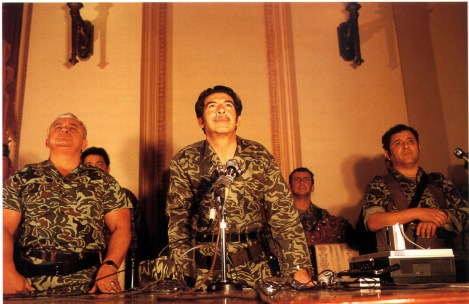
For many years, between 1975 and 1992, I traveled across Southern Mexico in search of Mayan ruins. Friends have asked me whether I have seen the ruins at Tikal in Guatemala, but all I could do was sadly shake my head. The closest I came to Guatemala was the Mexican State of Quintana Roo on the Yucatán Peninsula. I would dearly love to have crossed the border into Belize, and from there proceeded to Tikal, but it was not to be. The reason was the ugly stories filtering across the border of massacres, torture, rape, and genocide, especially of the native Mayan population. The perpetrator? One Efrain Rios Montt (pictured in the center above), who had staged a rightist coup in 1982.

It was only when President Ronald Reagan called Rios Montt “a man of great personal integrity” who had been given a “bum rap” as a human rights abuser when I knew that we were dealing here with a world-class criminal rat. Out of a population of some seven million in 1980, Rios Montt and his death squads were responsible for some 200,000 extra-judicial murders in Guatemala, “the land of the eternal spring.” Over a million natives fled the country for safety in the United States and elsewhere. Yet the Reagan administration continued to support the man and offer him aid.

In 2012, Rios Montt was charged with genocide and was convicted. But then his daughter Zury warned other of the nation’s leaders that, if Rios Montt served any time, they would be next. The verdict was repudiated by the Constitutional Court, and Rios walked a free man. The people of Guatemala are still trying, however, to have him called to account for his crimes against his people, either at home or at The Hague. Rios might be in his eighties, but he should not be allowed to die as a free man.

Zsofi Sebek Returns to Cleveland

My Mother Before She Married

My Mother Before She Married

My mother was actually born in Cleveland, Ohio, but was raised by her grandparents, Daniel and Lidia Toth. Her own mother and father were too feckless to be trusted with the care of a child, and the mother eventually became an alcoholic and ended up at the State Mental Hospital in Pontiac, Michigan. Daniel and Lidia decided that it would be best to bring up their little Zsofi in the Old Country, so they went back to their little farmstead in Felcsut, just southwest of Budapest.

It was not until 1937, when Zsofi was nineteen, that the three returned to Cleveland. Hitler was threatening, and Austria had already fallen. So the Toths and Zsofi sailed on the Queen Mary from Cherbourg to Southampton, England, and from thence to New York. Below is the cover of the passenger list for that sailing:

The Title Page of the Passenger List

The Title Page of the Passenger List

And here, below, is my mother’s name on the passenger list:

Not Quite Spelled Right

Not Quite Spelled Right

The Cunard Lines people who signed her in misspelled her name, as if she were German. In Hungarian, the letter “s” by itself is pronounced as if it were “sh” or “sch” if you’re of the German persuasion.

One would think that my Mom was able to hit the ground running, inasmuch as she was born here. Not quite. She didn’t speak a word of English, and neither did my great grandparents Daniel and Lidia. She had to work as a maid and take night school classes in English before she was able to get hired for a better job. Years later, Mom got a professional certification by a humorous white lie on her application. When asked about her college education, she penciled in, “University of Hakapeszik.” That’s Magyar for “School of Hard Knocks.” P.S.: She got the job.

Osagyefo

O Brave New World!

O Brave New World!!

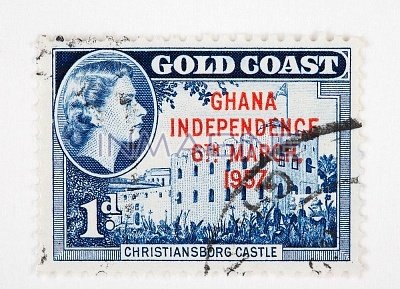
Like many American boys at the time, I was a “serious” stamp collector. The quotes are because I was enthusiastic, but I probably had nothing in my collection worth more than eighty cents. I remember going to a stamp show at one of the downtown Cleveland hotels where the big event was the release of stamps from a newly independent African country. The former Gold Coast was now Ghana.

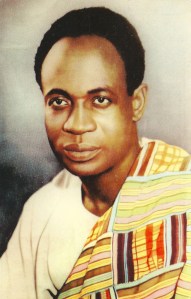
There were already several independent nations which had shed their colonial mantles by that time, including Egypt and Sudan. But that was “before my time.” I was frantic to find everything I could about the new nation, with its heroic leader, Kwame Nkrumah, who called himself the “Osagyefo” (see below).. In English, that meant “The Redeemer.”

Kwame Knrumah, the Osagyefo

Kwame Knrumah, the Osagyefo

I had been someone weary of all the British colonial stamps with their profile of Queen Elizabeth II, who at that time was certainly the cutest monarch with which I was acquainted, but I was ready for some novelty.

It didn’t take long for me to be disabused of the Osagyefo. Right around then, Egypt’s Gamel Abdel Nasser tried to rally the leaders of independent (and, presumably, soon to be independent) states to join his movement of non-aligned countries. As Nasser himself was leaning more and more toward the Communists (Oh Horrors!), it wasn’t long before I began to see him as a fellow traveler. Sure enough, after roiling the waters of West Africa for a few years with his increasingly authoritarian rule, he ended up in Romania, where he died in 1972.

Ghana was just the beginning of a rush to independence of former British colonies. After disillusionment with Nkrumah I became a bit more leery about wishing them well. But then I was only a twelve-year-old stamp collector. What did I know?


A Thai Christmas

Martine at the Sala Thai in Chinatown

Martine at the Sala Thai in Chinatown

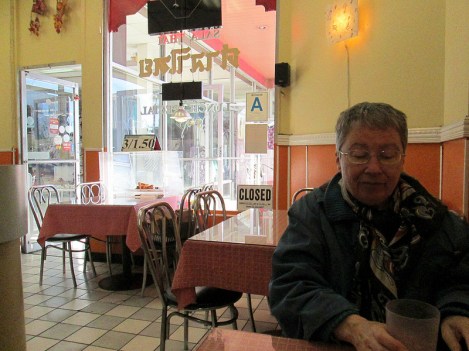
I had forgotten all about this photo. Although I cook four or five days a week, we didn’t have anything in the refrigerator on Christmas Day, so we had to go out to eat. Now on that Holiest of Holidays, most restaurants of the Euro-American variety are shut tight; so I suggested that we go to Chinatown, where we were sure to find some good restaurants that were open. (It kind of reminds me of that last scene in The Christmas Story, when the whole family goes out to have Peking Duck after the Bumpus’s dogs had demolished their dinner.) Martine and I have always been partial to a little Thai restaurant called the Sala Thai at the corner of Alpine and New High Streets. It is one of the rare Chinatown restaurants that sports an “A” health department inspection rating (see above). Once you step inside, though, it feels as if you were on a side street in Bangkok.

Fortunately, it was open. So while Martine has a chicken pad see ew with broccoli, I had some spicy fish filet with veggies. It was not quite what one thinks about for a holiday dinner, but it was good. Afterwards, we strolled through several souvenir shops and Chinese bakeries in the Chungking Plaza area.

That evening, we also had an interesting dinner experience. The only place we could find open was a Denny’s in Santa Monica. There was a long line—about three quarters of an hour—before we were seated. Apparently, both the waitstaff and the kitchen were short-handed, not having anticipated a high demand for their food on Christmas Day.

I was ready for New Year’s Day. I had cooked a big pot of a vegetarian curry for the week. It was Monica Dutt’s recipe for Gobi Alu aur Matar ki Tarkari, or, as it is also known, Curried Cauliflower, Potatoes, and Green Peas. I had bought some delicious (and spicy) tomato chutney and garlic pickle at India Sweets and Spices in Culver City the Saturday before, and added it to make a delicious entrée. The recipe can be found on page 126 of The Art of Indian Cooking (if you can find a copy of this now rare item).


Italy West

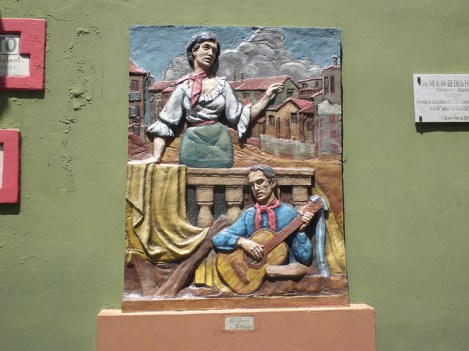
Tourists Wandering the Caminito

Tourists Wandering the Caminito

I was thinking today of Buenos Aires, especially that colorful—but fetching—tourist trap known as La Boca with its short Caminito, a diagonal street about a block long. La Boca (“The Mouth”) was literally the mouth of the now polluted Ria Chuelo. It was also the center of life for the thousands of Italian immigrants who found their way to Argentina between the 1870s and the early 1900s. At one point, the residents declared their independence of their new homeland and raised the flag of Genoa. But President Julio Argentino Roca personally ripped it down.

The bright colors originally were marine paints left over from the shipping that docked here. The neighborhood has an edgy blue collar vibe that finds its center in the soccer football stadium known as La Bombonera (“The Chocolate Box”), home of the Boca Juniors, one of Buenos Aires’s premier football teams.

In 2011, Martine and I took a hop-on, hop-off bus tour of BA that included La Boca, where we stopped for a couple of hours to take pictures and take in all the tacky souvenirs.

Art on the Caminito

Art on the Caminito

Because it is so far distant from the United States, not many Americans find their way 6,000 miles south to Argentina. In our case, we went even farther south, all the way to Tierra Del Fuego and the southernmost city in the world, Ushuaia.

I would dearly love to go back there some time and see some of the places we missed. And I’d even like to hang around La Boca some more.


The Brotherhood of Silence

Saint G. K. Chesterton?

Saint G. K. Chesterton?

G. K. Chesterton has for many years been one of my favorite writers. And now I hear there is a movement to have him canonized as a saint. That would be all right with me. In the current issue of Gilbert, the publication of the American Chesterton Society (of which I am a member), there is even a jocular article entitled “Why G. K. Chesterton Ought to be Canonized,” in which eighteen reasons which some cite against his canonization are turned around by author Peter Kreeft into reasons espousing his sainthood.

At the bottom of the second and last page of his article was this slight poem, which is typical of the man:

Love’s Trappist

There is a place where lute and lyre are broken,
Where scrolls are torn and on a wild wind go,
Where tablets stand wiped naked for a token,
Where laurels wither and the daisies grow.

Lo: I too join the brotherhood of silence,
I am Love’s Trappist and you ask in vain,
For man through Love’s gate, even as through Death’s gate,
Goeth alone and comes not back again.

Yet here I pause, look back across the threshold,
Cry to my brethren, though the world be old,
Prophets and sages, questioners and doubters,
O world, old world, the best hath ne’er been told!

I will write more about Chesterton soon. When I first started reading him, only a few of his works were in print. Now, partly thanks to the Ignatius Press’s edition of his complete works (which is slowly coming out one or two volumes a year), and to a resurgence of interest in works in the public domain, virtually all of his published books are available. Because he was a prolific journalist as well as a poet, novelist, and essayist, much of his works in newspapers and more obscure magazines has not yet been collected.


Auld Lang Whatever

Time to Change Your Calendar

Time to Change Your Calendar

In the accounting profession, we are apt to view New Years Day with a jaundiced eye. It is the beginning of the 100-day Bataan death march that is tax season. For a while, we will have weekends. Then, at some point in February, we begin to work Saturdays. In March, Sundays are also added. That is in a high-rise building with no weekend air-conditioning, unless we pay for it. To add insult to injury, the two national holidays during this period—Martin Luther King Day and Presidents’ Day—are just two more workdays. (The company makes up the time lost later.)

Every year, our clients tend to be later and later in supplying us the information we need to file the returns, and gradually increasing pressure is applied between February 1 and April 15, until the last week is a nightmare of running around, making last-minute changes, and printing numerous copies of multiple hundred page returns.

Not a pleasant prospect.

So, auld lang whatever. Put up a new calendar, start paring away at your social life (such as it is), be sure to get some exercise, and read some good books.