Fade to Black

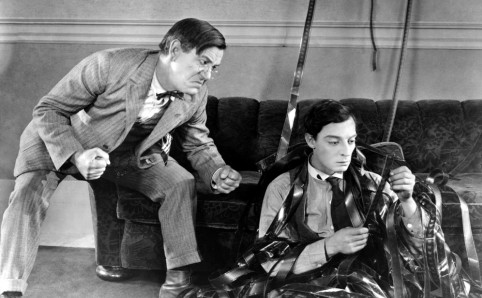
Buster Keaton in Sherlock Jr. (1924)

Buster Keaton (Right) in Sherlock Jr. (1924)

I lost a good friend of forty-six years yesterday morning. Lee Sanders died of pancreatic cancer in a hospice only two blocks from my apartment. Since he was admitted a week and a half ago, Martine and I had taken to visiting him at least every other day.

Searching through my vast archive at Yahoo! Flickr, I am dismayed to find I have no photos of him. I realize now why this is so: Lee was a motion picture projectionist and an avid film goer, so I only ever saw him indoors where I would have had to use flash, which I hate. So I’ll reproduce this scene from the 1924 film Sherlock Jr., with Buster Keaton as a projectionist. I did not want to take any pictures of Lee at the hospice, because he deteriorated so markedly from visit to visit that it saddened me to have to document it. The last day, just hours before his passing, he was barely able to talk articulately; and he was obviously in great discomfort with his swollen left arm, which was elevated on pillows.

Lee had been not only a projectionist, but an officer in IATSE Local 33. He was frequently interviewed about the art of projection and the plight of that art now that digital projectors were being installed in theaters around the country. In a website entitled A Hollywood Job Fades to Black: Film Projectionist, you can hear his voice saying that he intended to be “the last projectionist alive.” Unfortunately, he didn’t make it.

I know union people because my father was a shop steward for MESA in Cleveland. Lee did not quite fit the image: He was articulate, soft-spoken, and scholarly. He spent his spare time seeing great films. His favorites included F. W. Murnau’s Sunrise (1927), John Ford’s The Searchers (1956), and Carl Theodor Dreyer’s Gertrud (1964). You can see a list of Lee’s favorite American films, to which I’ve added my own in the rare cases where we disagreed:

In fact, Lee was a major influence on my film-going. I could never hope to have seen as many pictures as he had—though there was a time in the late Sixties and early Seventies when I could match him film by film.

Something of a renaissance man, Lee was also an avid reader and aficionado of classical music. He frequently drove up to Carmel for the Bach Festival. And he was not only active in the Culver City Democratic Club, but honored by them with a plaque appreciating his efforts that he had hung on his hospice room wall.

Although he never married and had a family, Lee was well liked. I remember his telling me he took a date to a quadruple feature and was surprised to find that she couldn’t (and wouldn’t) sit through the whole show. Martine liked him better than all my other friends.

In all our years of friendship, I never remember him getting angry. He was like a Bodhisattva among people pretending (badly) to be wrathful deities. But then he was a graduate of the Besant Hill School of Happy Valley in Ojai. The school was co-founded by Annie Besant, J. Krishnamurti and Aldous Huxley. His time there was a happy one, and he remained close to the school all his life.

Now there is a hole in my life with Lee’s passing, and I am not sure how to fill it.
 

The Guano Economy

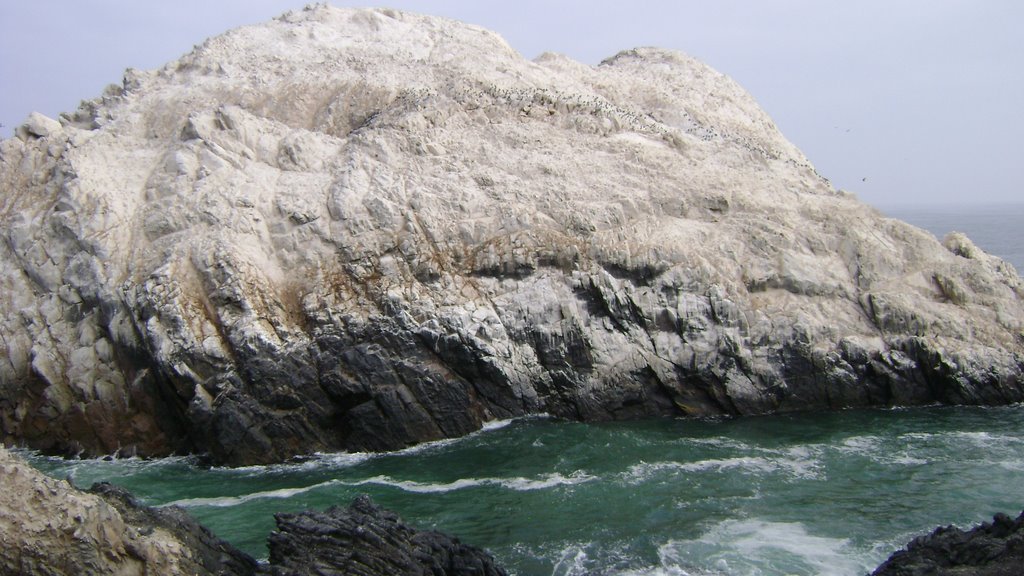
Guano Island Off Peru

Guano Island Off Peru

When Peru finally won its independence from Spain in the 1820s, there was no short quick route to prosperity. Much of South America’s economy was primarily agricultural, based on large haciendas, many of which had just changed hands from Spanish loyalists to officers of the revolution. It took about twenty years before Peru discovered that its primary source of wealth was actually bird sh*t. There were a number of islands off the coast of the Atacama Desert in the south that were covered to a depth of several meters with a centuries’ long accumulation of guano. Europe, which was trying to recover from the ravages of the Napoleonic Wars, needed the fertilizer to insure rich crops.

Mining the guano was no picnic. Peru imported thousands of laborers from China to dig up and bag the guano for shipment to a customer base that was willing to pay top dollar for the … stuff. Native Peruvians did not breathing in the noxious particles, so it was mostly immigrants who worked the islands. For about thirty years, Peru was sh*tting pretty, until it hit the fan. (Had enough of the puns yet?)

After much of the guano was shipped overseas, it was discovered that the Atacama Desert was rich in nitrate fertilizers, which were a good substitute for the organic stuff. At this point, the main actors in the business were Peru, Bolivia (which then had a seacoast), and Chile. Bolivia arbitrarily raised the taxes on mining nitrates. As many of the companies supervising the mines and transporting the fertilizer were Chilean, they demanded tax relief. Bolivia refused, and Peru backed Bolivia.

What Kind of Bird Izzat?

What Kind of Bird Izzat?

In 1879 began the War of the Pacific, with Chile arrayed against both Peru and Bolivia. As Chile had better military leadership and weaponry, it won handily after a number of bloody sea and land battles. The upshot was that Bolivia lost its access to the sea (though they still have admirals for some reason), and Peru lost its State of Tarapacá, including Tacna, Arica, Iquique, and Pisagua. (Eventually Tacna was ceded back to Peru some years later.)

In the end, the British took over the nitrate mining industry, with most of its associated profits. Bolivia suffered the most, as it lost all access to the Atacama Desert. Peru was outraged at having been occupied by Chile, though it fought a fairly successful guerrilla insurgency. Nonetheless, it had suffered a humiliating defeat with repercussions lasting to the present time.

As to the profits from fertilizer mining, they dwindled rapidly; and Peru went from being a wealthy country to being an economic basket case.

For more information, click here for a good illustrated review of the 19th century guano mining industry.


Supreme Competence and Moral Probity

In at the Beginning of the Western Film Genre

In at the Beginning of the Western Film Genre

There were cowboy films before William S. Hart. As early as 1903, there was Edwin S. Porter’s The Great Train Robbery, which was filmed in the wilds of New Jersey. Then there were the films of Broncho Billy Anderson who was the first film western star—those his films were also shot back East and were redolent of New Jersey.

No, it was William S. Hart who really got the ball rolling back in 1914 when he teamed up with Producer Thomas H. Ince to produce a series of oaters at Santa Ynez Canyon just a few miles from where I live. (John Ford got started around 1917 with Harry Carey, Sr. in Straight Shootin’, but Hart quickly became the better known of the two stars.)

The Hart hero was almost always a loner, half-civilized if at all, but radiating an awakening sense of moral probity. While he was in the process of making his decision, God help any bad guys who tried to do him in in the meantime.

A Still from Travelin’ On: Hart with Monkey

A Still from Travelin’ On: Hart with Monkey

This was certainly true of Travelin’ On (1922), which I saw this morning at Cinecon. He is simply J.B., an illiterate loner who rides into a crude Arizona town run by Dandy Dan McGee, a saloon keeper who runs all the vices from his Palace of Chance. When a preacher, his wife and daughter pull into town in their wagon, they witness a fight between two toughs, which the preacher tries to stop. Some time later, Hart rides into town and runs afoul of Gila, one of McGee’s cronies, whom he makes short work of.

Both McGee and J.B. fall in love with the preacher’s wife. When Hart sees McGee make a move on her, he threatens to kill him the next time he sees him. Of course, he does, but not before he takes the rap for a stage robbery committed by, of all people, the preacher—and then he rides off alone, after saving the preacher from being justly hanged for his crime.

I never seem to tire of seeing Hart’s films. I visit his ranch in Newhall once or twice a year and see to some extent how his character was formed. He married a younger star named Winifred Westover and had a son named William S. Hart Jr. (whom I knew). He never remarried and lived on his ranch with his sister until his death in 1948.

It was around the time this film was made that Hart was upstaged by other Western stars, most notably Tom Mix. Mix was good, but there was something about Hart that was unique.


The Land of Mordor, Minus the Shadows

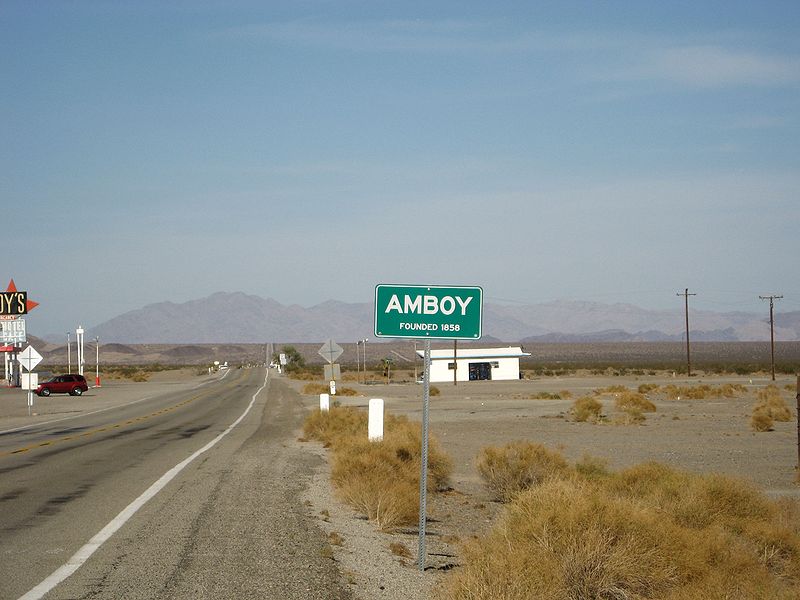
Beautiful Downtown Amboy

Beautiful Downtown Amboy

There are several places in Sunny California which I would compare to J.R.R. Tolkien’s Mordor. You know he place I mean:

Three Rings for the Elven-kings under the sky,
Seven for the Dwarf-lords in their halls of stone,
Nine for Mortal Men doomed to die,
One for the Dark Lord on his dark throne
In the Land of Mordor where the Shadows lie.
One Ring to rule them all, One Ring to find them,
One Ring to bring them all and in the darkness bind them
In the Land of Mordor where the Shadows lie.

Except the places I would liken to Mordor are singularly without shadows. Curiously, they are all connected to dry lake mining operations. The grimmest of all is Amboy, on the original Highway U.S. 66. It lies a few miles east of Barstow, a hellhole in its own right, which is a rail junction and the gateway to Fort Irwin.

Today the population of Mordor—I mean Amboy—is perhaps four. Roy’s Coffee Shop and Cabins is no longer a going concern, unless someone is filming in the neighborhood. (Bagdad Cafe was filmed in Bagdad, a few miles west on 66.)

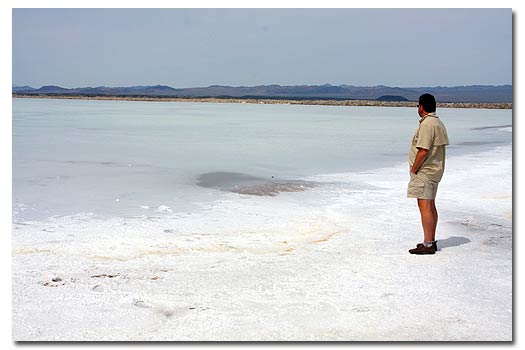
Amboy owes its existence to Route 66, but also to Bristol Dry Lake, which contains some 60 million tons of salt for your French fries.

Bristol Dry Lake

Bristol Dry Lake

Also in the area are mines containing Boltwoodite, a relatively rare form of uranium, along with gypsum, calcite, and fluorite.

I got to know Amboy when Martine used to work at Twentynine Palms at the U.S. Marine Base there (she was a clerical worker at the Naval Hospital there). A couple of times, I would pick her up, drive through the ghastly “community” known as Wonder Valley settled by veterans of gas attacks in World War I along a road which terminated at Highway 66 in Amboy. From there we headed to Las Vegas using the Kelbaker Road and the Morningside Mine Road. It’s a desolate area with sand dunes (near Essex) and some spectacular stands of Joshua Trees.

What are the other places in California I liken to Mordor? They’re right next to each other on the road from Ridgecrest and China Lake to Death Valley: namely, Trona and Borosolvay. Both are desolate but more habitable than Amboy. Yes, hell can be sunny sometimes.

“Are You Comfortable in Bed?”

I’m More Comfortable Than HE Is, As I Don’t Sleep on Rocks

I’m More Comfortable Than HE Is, As I Don’t Sleep on Rocks

In my last batch of spam e-mail, I got one entitled “Are You Comfortable in Bed?” As my answer is yes, I did not see fit to open the e-mail, which probably sold vigara [sic] or cialas [sic] or something like that. Thankfully, I am not suffering from electoral dysfunction. Which is to say, I usually vote Democratic.

Getting eight hours of sleep a night is important to me. That is challenged by my massive intake of iced Baruti Assam tea this time of year, but I usually manage to sink back into sleep quickly after draining my lizard. Occasionally Martine and I make like buzz saws, but curiously it doesn’t bother us much. I actually feel reassured that Martine is asleep next to me; and she graciously refrains from kicking me when I start sawing wood.

Every once in a while, I have a difficult time dropping off to sleep because my mind is racing in an infinite loop. I find that the only way to deal with that is to get up and either a bit of a TV movie (the only time I watch TV) or read a book. That somehow closes the infinite loop and allows me to doze. The one thing that does not work in that case is to twist and turn for hours. Better not to even try!

I am appalled when I hear of people getting by on five or fewer hours a night. Sometimes Martine can’t sleep because of her back pain. Frequently she wakes at five in the morning and twists and turns until morning light (or later).

We have an extra firm mattress which helps Martine somewhat. And our living room sofa is similarly firm. These things help (and they don’t bother me at all), but I would be happier if Martine’s back pain abated to the point that she could accompany me on my travels. It’s a lot more fun having her with me.

Serendipity: Dreams of Prisons

One of Giambattista Piranesi’s Carceri Prints

One of Giambattista Piranesi’s Carceri, or Prison Etchings

I am currently reading Thomas De Quincey’s Confessions of an English Opium-Eater (1822). Although I remember starting it some twenty years ago, I never finished it. Turning to it once again, I am delighted by his elegant prose combined with his large-scale surrealistic dreams as a result of ingesting opium. At the same time, I love what he has to say about Giambattista Piranesi (1720-1778), whose etchings of vast imagined prisons are among my favorite prints.

When I started at UCLA in 1967 as a graduate student in the film program, I rented one of the originals of the above print for three months as part of a special program. (I can’t imagine anything so valuable being rented out to students under present circumstances.)

Here is what De Quincey wrote:

Many years ago, when I was looking over Piranesi’s, Antiquities of Rome, Mr. Coleridge, who was standing by, described to me a set of plates by that artist, called his Dreams, and which record the scenery of his own visions during the delirium of a fever.  Some of them (I describe only from memory of Mr. Coleridge’s account) represented vast Gothic halls, on the floor of which stood all sorts of engines and machinery, wheels, cables, pulleys, levers, catapults, &c. &c., expressive of enormous power put forth and resistance overcome.  Creeping along the sides of the walls you perceived a staircase; and upon it, groping his way upwards, was Piranesi himself: follow the stairs a little further and you perceive it come to a sudden and abrupt termination without any balustrade, and allowing no step onwards to him who had reached the extremity except into the depths below.  Whatever is to become of poor Piranesi, you suppose at least that his labours must in some way terminate here.  But raise your eyes, and behold a second flight of stairs still higher, on which again Piranesi is perceived, but this time standing on the very brink of the abyss.  Again elevate your eye, and a still more aërial flight of stairs is beheld, and again is poor Piranesi busy on his aspiring labours; and so on, until the unfinished stairs and Piranesi both are lost in the upper gloom of the hall.  With the same power of endless growth and self-reproduction did my architecture proceed in dreams.  In the early stage of my malady the splendours of my dreams were indeed chiefly architectural; and I beheld such pomp of cities and palaces as was never yet beheld by the waking eye unless in the clouds.  From a great modern poet I cite part of a passage which describes, as an appearance actually beheld in the clouds, what in many of its circumstances I saw frequently in sleep:

The appearance, instantaneously disclosed,
Was of a mighty city—boldly say
A wilderness of building, sinking far
And self-withdrawn into a wondrous depth,
Far sinking into splendour—without end!
Fabric it seem’d of diamond, and of gold,
With alabaster domes, and silver spires,
And blazing terrace upon terrace, high
Uplifted; here, serene pavilions bright
In avenues disposed; there towers begirt
With battlements that on their restless fronts
Bore stars—illumination of all gems!
By earthly nature had the effect been wrought
Upon the dark materials of the storm
Now pacified; on them, and on the coves,
And mountain-steeps and summits, whereunto
The vapours had receded,—taking there
Their station under a cerulean sky.  &c. &c.

The quoted poem is from William Wordsworth’s “The Excursion.”


Why the Arab Spring Failed

With Islam, You Have to Buy the Whole Package

With Islam, You Have to Buy the Whole Package

If a religion is pervasive enough to tell you which hand to use to wipe your butt, the chances are that things won’t improve when you throw out that dictator, such as Mubarak, Assad, or Gaddafi. Instead of a thousand flowers blooming, what you are likely to get in his place is a bunch of ragged bearded men brandishing AK-47s and insisting on more radical forms of religious fundamentalism. Since politics and then whole subject of governance is dictated by the Quran, there is no such thing as democracy or a constitution that does not comply with Sharia law. There is only religious fundamentalism or dictatorship: the dial does not go in any other direction.

My comments here are primarily restricted to the Arab countries and a few North African countries. For over half a century, Turkey has been a largely secular democracy (though with some Islamist leanings). The Muslims of Southeast Asia run the gamut from Pakistan as the most fundamentalist to Malaysia and Indonesia as more permissive.

With most flavors of Islam, there is no hierarchy: There are just a lot of imams contradicting one another. (The only exception is Iran, where there is a hierarchy of Ayatollahs with Khamenei in charge.)

When many of the Arab (and some North African) countries erupted two years ago, most Americans (myself included) had some foolish notion that the result would be an ultimate victory for liberal democracy. As it turned out, it was anything but!

The Slow (or No) Road to Fame

The All-Too-Easy Road to Mediocrity

The All-Too-Easy Road to Stultifying Mediocrity

My congratulations to Brian Gordon of FowlLanguageComics.Com for a very funny cartoon.

I have gotten thousands of Spam e-mails offering cheap (pseudo-)pharmaceutical products and Louis Vuitton and other fashion knockoffs. Interspersed among them were comments that my website needed improvement. I was supposed to have a lot more pictures and a lot fewer words. And I was supposed to load much faster on Safari—whatever that is—than I currently do. Also I get a lot of questions from people asking for help setting up their own websites. (Good luck, guys!)

This website as it is is a reflection of who and what I am, not an attempt to get thousands of “likes” and “favorites” from people who not only do not mean anything to me, and with whom I do not necessarily care to interact.

Let’s face it: I’m a dinosaur. I don’t watch television, follow sports teams, listen to pop music, or give a flying f*ck about celebrities. Life is so pitifully short that I do not care to waste any of it going into the clickbait business. I have seen great websites fall into the click trap. When I feel I don’t have anything else to say, you can bury me. Until then, I will follow my different drummer to wherever he leads me.


Post Hoc Ergo Propter Hoc

A Particularly Persistent Superstition

A Particularly Persistent Superstition

If you’ve never heard this Latin phrase before, you might want to remember it. It describes a logical fallacy which, translated into plain English, is “after that, therefore because of that.”

Let me give you an example. You are a little boy who, for the first time in his life, kisses a girl the in school playground. That same day, your teacher decides to land hard on you—even though she does not know about the kissing incident—and makes you sit in the corner all afternoon with a dunce hat on your head while the whole class taunts you. Using a very common form of magical thinking, you blame the punishment on the kiss, even though it is totally unrelated. Because the punishment came after the kiss, you assume it is because of the kiss. Result: you think that girls must not be kissed, or else terrible things will happen.

In September 1966, to give an example from my own life, I had a terrible headache. I was during my summer vacation just a few days away from starting graduate school in film at UCLA. I managed to cook a hot dog for myself as well as a can of corn. On the hot dog, I smeared some ketchup. Within an hour, the headache became unbearable. I managed to crawl into bed, but the pain kept ramping up. I realized I had to contact my parents and tell them that something was wrong. It took me over an hour to crawl to the kitchen phone, blacking out from the pain several times in the process. Finally, I managed to get my mother at work. Having told her what was happening, I collapsed on the kitchen floor.

And Then There Was the Canned Corn

And Then There Was the Canned Corn

The next thing I knew, I was in the emergency room at Fairview General Hospital in Cleveland being asked questions by physicians. Within minutes, I fell into a deep coma. Somehow, my doctor figured it was a pituitary tumor; and, when I came to after having been wrapped in ice to keep my temperature down, I was operated on. I might add the operation was a glittering success.

However, gone from my diet were hot dogs, ketchup, and canned corn. The one time I had that lunch, terrible things happened. It is only forty-eight years later that I can now eat those three items—though not together. And I put mustard on my hot dogs now instead of ketchup.

In a smaller way, I still see the same logical fallacy at work in my life. The last time I ate at the Yamadaya Restaurant, I suffered what looked to be (but wasn’t) a stroke: It was a transient ischemic attack (TIA). Only today was I brave enough to go back. Somehow, at the back of my mind, I still fear something bad will happen to me today. And I didn’t even get to kiss a girl this time!


Two Christs for Modern Man

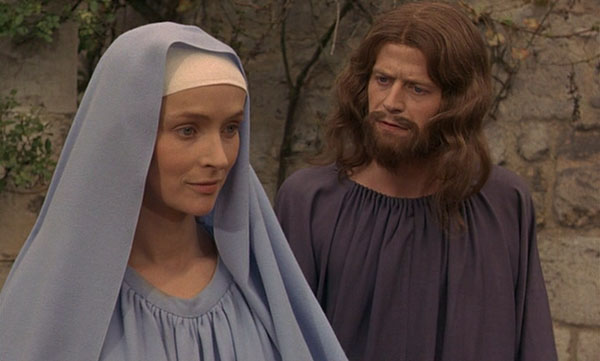
Bernard Verley as Christ and Edith Scob as Mary in Buñuel’s The Milky Way (1969)

Bernard Verley as Christ and Edith Scob as Mary in Luis Buñuel’s The Milky Way (1969)

After two centuries of Christian art,the West has produced thousands of images of Jesus Christ—almost none of which connects to people who are alive today. The Son of God is usually portrayed as a man who was born to be tortured to death on a cross, but not as a man who could gather around him twelve apostles and hundreds of followers.

One notable exception are the vignettes with Bernard Verley (above) as Christ in Luis Buñuel’s film The Milky Way (1969). The scene pictured above is at the marriage ceremony in Cana, when the Redeemer performed his first public miracle.

The other image is one I saw at the Getty Center today: It is the Italian painter Correggio’s “Head of Christ,” pictured below:

Correggio’s “The Head of Christ” (1530)

Correggio’s “The Head of Christ” (1530)

I like the look of consternation on Christ’s face as he contemplates what lies ahead while he is wearing the crown of thorns. This is the Christ who, the previous night at Gethsemani, had said: “My Father, if it be possible, let this cup pass from me; nevertheless, not as I will, but as you will.” He may be God, but the look on His face is 100% pure human.