Tarnmoor’s ABCs: Marcel Proust

He Went As Far As One Could Go with a Cookie

           He Went About As Far As One Could Go with a Cookie

I was so very impressed by Czeslaw Milosz’s book Milosz’s ABC’s. There, in the form of a brief and alphabetically-ordered personal encyclopedia, was the story of the life of a Nobel Prize winning poet, of the people, places, and things that meant the most to him. Because his origins were so far away (Lithuania and Poland) and so long ago (1920s and 1930s), there were relatively few entries that resonated personally with me. Except it was sad to see so many fascinating people who, unknown today, died during the war under unknown circumstances.

My own ABCs consist of places I have loved (Iceland), things I feared (Earthquakes), writers I have admired (Chesterton, Balzac, and Borges); things associated with my past life (Cleveland and Dartmouth College), people who have influenced me (John F. Kennedy), and things I love to do (Automobiles and Books). This blog entry is my own humble attempt to imitate a writer whom I have read on and off for thirty years without having sated my curiosity. Consequently, over the months to come, you will see a number of postings under the heading “Tarnmoor’s ABCs” that will attempt to do for my life what Milosz accomplished for his. To see my other entries under this category, hit the tag below marked “ABCs”. I don’t guarantee that I will use up all 26 letters of the alphabet, but I’ll do my best. Today, we’re at the letter “M,” for Marcel Proust, whose In Search of Lost Time I am now reading for the third time.

There are many literary giants of the Twentieth Century—writers such as James Joyce, Fernando Pessoa, William Faulkner, Jorge Luis Borges, Gabriel García Marquez, Graham Greene, G. K. Chesterton, Ryonosuke Akutagawa, Eugene O’Neill, Bertolt Brecht, Thomas Mann, Italo Svevo, Mikhail Bulgakov … the list stretches on and on. One who has had a particular role to play in my life is Marcel Proust. It seems I cannot let a year pass by without re-reading another installment of his massive In Search of Lost Time, which consists of seven full-sized novels:

  • Swann’s Way
  • In the Shadow of Young Girls in Flower (originally translated as Within a Budding Grove)
  • The Guermantes Way
  • Sodom and Gomorrah (originally translated as Cities of the Plain)
  • The Prisoner
  • The Fugitive (originally translated as The Sweet Cheat Gone)
  • Finding Time Again (originally translated as The Past Recaptured)

The first four volumes were completely edited by Proust during his lifetime. The last three received their final proofing from others (but are still great).

Quite frankly, it is not easy to read Proust. Some sentences seem to go on for pages. It requires intense concentration not to go astray, even within an individual paragraph. One old friend, who is a high school English teacher, abandoned Swann’s Way in the first section.

Why do I so highly regard a not-particularly-successful gay social climber whose world has so little in common with mine? For one thing, Proust writes about not so much memory as of the shimmering obsessions that monopolize so much of our attention yet, in the long run (the series spans decades), fall by the wayside as life goes on.

I have already had my fourth reading of Swann’s Way. When I return from Peru, I plan to re-read In the Shadow of Young Girls in Flower for the third time. If God is good to me, there will be a fourth and—who knows—maybe even a fifth reading of the series in the time that remains to me.
Ring of Fire

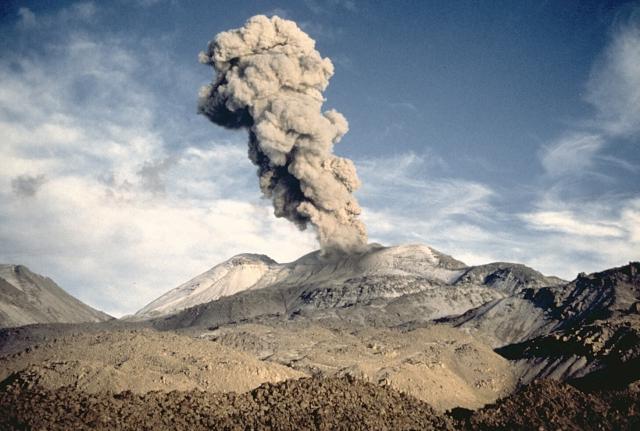
The Volcano Sabancay: Erupting Again

The Volcano Sabancaya: Erupting Again

The Pacific Ring of Fire stretches from Indonesia and the Southwest Pacific in a massive arc around Asia, North America, down to the West Coast of South America. According to Peru This Week, this zone “is the site of 85% of global seismic activity caused by friction between shifting tectonic plates.”

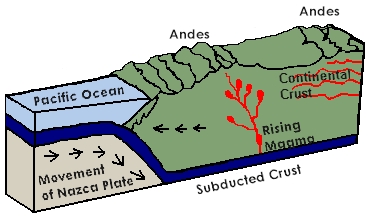
In South America, the culprit is the Nazca Plate, which borders the Pacific side of the continent, and which features a convergent boundary subduction zone and the South American Plate, which action has formed the Andes. Hardly a day passes by when I don’t hear of another earthquake in Peru (usually in the Richter 4.0-5.5 range); and hardly a month passes by without a new volcanic eruption. Today, it is reported that Sabancaya (see above) in the State of Arequipa has begun to spew ash. If it continues, I will probably be there to see it in person next month at this time.

Below is an illustration of how the Nazca Plate (in light brown) subducts the South America Plate (in green), thereby causing all these dire events (and, by the way, over the millennia, causing much of the beauty of the Andes as well):

The Nazca Plate Takes a Dive, Wrinkling the Face of the Earth

The Nazca Plate Takes a Dive, Wrinkling the Face of the Earth

Last year, I visited Iceland, through which runs the boundary between the Eurasian Plate and the North American Plate, resulting in several dozen active volcanoes and frequent earthquakes. In fact, the boundary runs right through the middle of Thingvellir National Park, where it is expanding the size of Iceland (and the park) year by year.

What is it with me and volcanoes? Is it because I live in multiply cross-faulted Southern California with its own history of earthquakes? Maybe in future I should visit Krakatoa and Mount Vesuvius?


Letting Entertainers Control Your Thinking?

They Make Money from Your Indecision

They Make Money from Your Indecision

We live in a country in which we increasingly let paid entertainers do our thinking for us. As a result, we are advocating our favorite stand-ins against the entertainers we don’t like. It could be as simple as watching Jon Stewart or Stephen Colbert, laughing, and leaving the whole argument as, “What you said!” Or it could be as nefarious as chewing our fingernails in fear listening to Glenn Beck (above) or Sean Hannity and going to bed angry.

Remember: These people are all well-paid entertainers. They aim at a particular demographic and work on them so as to keep them coming back for more.

I used to be very upset with these fake pundits, particularly those on the right. If you go back and look at my earlier postings are the tags “conservatives,” “republicans,” or “tea-party,” you will find that I had spent a lot of time getting exercised by people who were just doing what they were paid to do. Rush Limbaugh doesn’t care whether I hate his guts, no more than the actors who played James Bond villains like Auric Goldfinger or Ernst Stavro Blofeld care whether audiences detested them. These guys are all paid villains. It’s what they do for a living.

To uneducated yokels who have been “left behind” in dying rural areas, they are calls to action coming as if from the mouths of angels. Scores of our fellow Americans have been killed because people with a tenuous grasp on their sanity have decided to pick up their guns and take direct action. Rush didn’t tell them to shoot anybody. Glenn didn’t do it, nor did Sean. Even Wayne La Pierre of the NRA didn’t give his blessing. They’re innocent of all wrongdoing, while these poor loonies are surprised that people not only hate and fear them (instead of showering them with candy and flowers) but want to see them receive the maximum punishment.

The danger of using stand-ins to do all our thinking for us is that we could make the mistake of thinking the whole world believes in what their particular set of entertainers say. When they suddenly discover how divided we are, it could come as a serious shock.

So, Democrats, watch Faux News for a while just to see the snake oil that is being sold to the feeble-minded. And wingnuts, stay up late and watch Stephen Colbert or Bill Maher just to see that people may think differently from you.

Take away those blinders, and see the mess we’re in!


Imagining Argentina

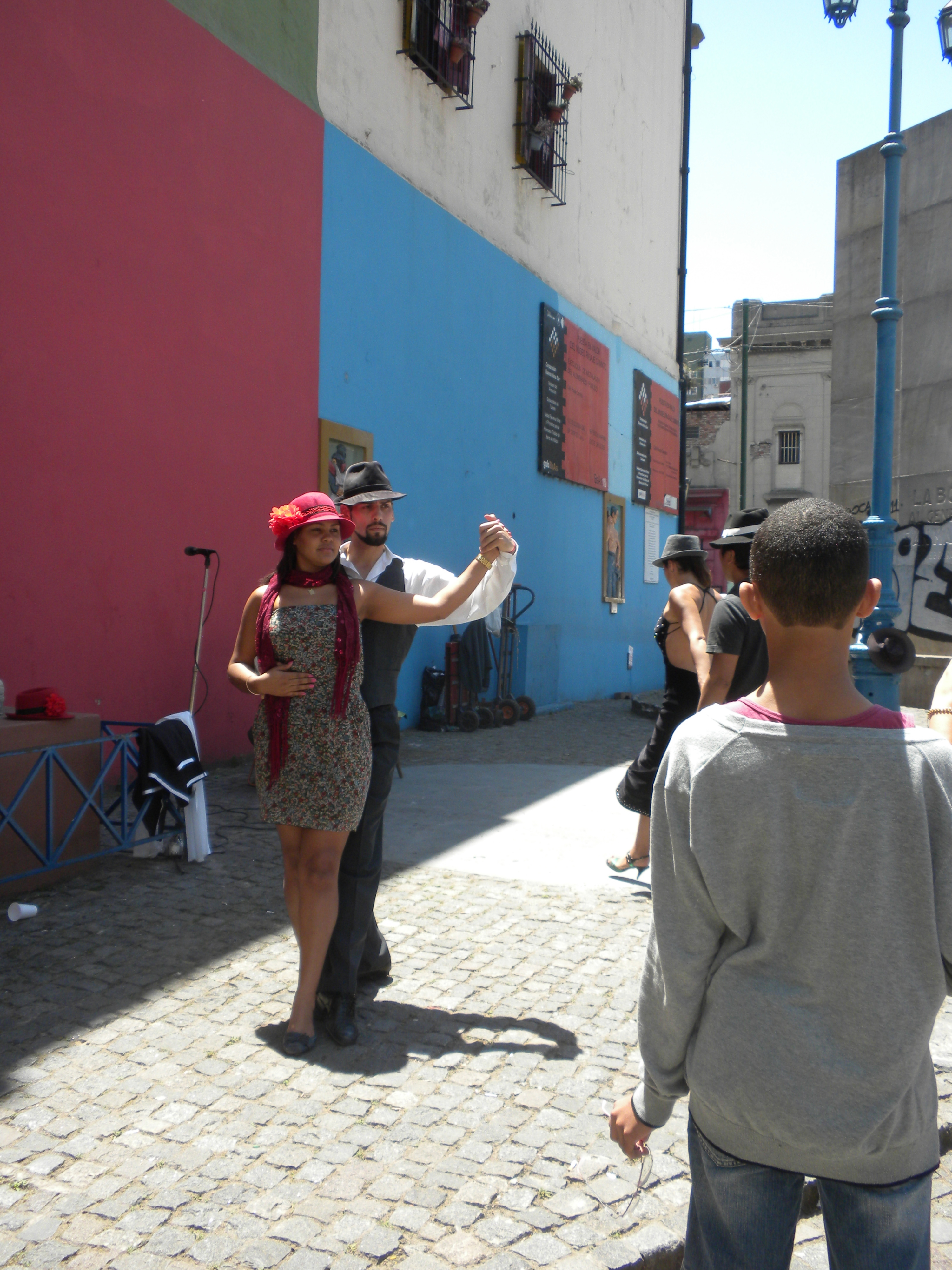
Tango Dancers in La Boca

Tango Dancers in La Boca

Even though I’ll be in Arequipa, Peru, a month from today, I still look back fondly to Argentina, which I visited in 2006 and 2011. In fact, today Martine and I ate dinner at Empanadas Place at Sawtelle and Venice Boulevards in Mar Vista. I had an entraña (skirt steak) sandwich and iced mate cocido, while Martine had two empanadas, one stuffed with spinach and the other chopped beef. It is probably one of our favorite places to eat on L.A.’s West Side; and, according to Martine, the empanadas there were better than what we were served in Argentina. (Of course, the place for empanadas is in Northwest Argentina around Salta and Tucumán.)

In addition to Empanadas Place, there is a very good Argentinean restaurant on Main Street in Culver City: the Grand Casino Bakery & Café. We go there several times a year.

I have come to love drinking yerba mate tea and—very occasionally—sneaking some alfajores cookies filled with dulce de leche. My two visits to the Southern Cone of South America have resulted in a series of cravings I have yet to fill. Although we saw a good part of Patagonia, I have yet to go to Carmen de Patagones, Viedma, San Carlos de Bariloche, and Esquel. (In 2011, there was a major volcanic eruption at Puyehue and Cordon Caulle in the Chilean Andes which covered several whole states of Patagonia with ash—so we went to El Calafate instead to see the glaciers.)

To be sure, when I return from Peru, I will be haunted by my desire for Peruvian food. Fortunately, there are also Peruvian restaurants in L.A.; but I am sure it is but a pale shadow of what I will be eating next month. Plus, I will no doubt miss interacting with the Quechua and Aymara peoples of the Peruvian altiplano.

Is This Necessarily a Good Thing?

“If It Doesn’t Get All Over the Place, It Doesn’t Belong in Your Face”

“If It Doesn’t Get All Over the Place, It Doesn’t Belong in Your Face”

The motto that serves as the caption to the above photograph comes from the Carls Jr. Restaurant Chain in the 1990s. Ads showed children trying to eat giant burgers that dripped all over the table and their clothes.

I myself am not partial to the idea of unmanageable food. I would rather convey my meal directly from the plate via a fork or spoon into my mouth, and thence to my esophagus. Much to Martine’s dismay, however, there are three things that lead to indelible food stains on my shirtfronts:

  1. When I eat alone, I am always reading a magazine or newspaper;
  2. There is a protuberance that juts out over my belt line that serves to catch whatever falls off my utensils; and
  3. I like Asian and Latino foods that are served with sauces that attack me when I am not super-careful.

I am not going to stop reading when I eat alone: That would be unthinkable. Of course, I could lose eighty pounds, but that’s even more unthinkable. Perhaps my forks or spoons should come equipped with a high-gravity force field that would keep food on it until it is suctioned off by my mouth.

Many times, when I call Martine from work, she complains about stains that she is using various chemical means to eradicate, but with mixed success. I talk about replacing the shirts with new ones, but that just tends to upset her.

A former girlfriend bought a gold lamé bib for me which I think looks slightly effeminate. Perhaps I should wear a poncho or raincoat whenever I eat. At least, it wouldn’t raise any more eyebrows than that damned gold lamé bib.


So You Think You Know American History?

Who Was the First U.S. President?

Who Was the First U.S. President?

That doesn’t look a whole lot like George Washington, does it? George became President in 1789, but the United States was already a going concern (to some extent) by 1781. So what did the country do for the intervening eight years? Did it engage in anarchy?

Not quite. Before the Constitution was adopted, the law of the land of the United States consisted of the Articles of Confederation. As students, we didn’t study that eight-year period in depth, except maybe to note that these same Articles of Confederation were a condign failure.

Yet, there were eight U.S. Presidents of the Continental Congress, and therefore of the More-or-Less-United States, serving one-year terms under those same articles. They were, in order:

  1. John Hanson of Maryland (1781-1782, pictured above), who wanted to resign immediately because he had neither any compensation or power, but he manage to stick it out.
  2. Elias Boudinot of New Jersey (1782-1783) was next.
  3. Thomas Mifflin of Pennsylvania (1783-1784)
  4. Richard Henry Lee of Virginia (1784-1785), who wound up disapproving of the Constitution because it concentrated too much power—an early Tea Partier
  5. John Hancock of Massachusetts (1785-1786)—he’s the one with the oversized signature on the Declaration of Independence
  6. Nathaniel Gorham of Massachusetts (1786-1787)
  7. Arthur St. Clair of Ohio (1787-1788), born in Scotland
  8. Cyrus Griffin of Virginia (1788 only)

Only after Griffin’s presidency did the U.S. Constitution become formally ratified and George Washington elected the “first” President under the new rules.

For an interesting discussion of these eight presidents, who have become more or less lost to history, click here.


Funny Peculiar

Poet Mark Ford

Poet Mark Ford

I cracked up yesterday at lunch while I was reading a New York Review of Books article about British poet Mark Ford. In it was a poem called “Funny Peculiar” which I present for your enjoyment:

I sit down here drinking hemlock
While terrible things go on
   upstairs.

Sweat creeps like moss outward to
   the palms,
And time itself seems a strange,
   gauze-like medium.

Sleep will leave still newer scars
   each night, or,
Infuriatingly, is a curtain that
   refuses to close.

On the horizon, bizarre
   consolations make themselves
Known—a full fridge, a silent
   telephone.

The television quiet in its corner
Everything and nothing have
   become a circular

Geometrical figure, seamlessly
   joined,
To be wrestled innocently
   this way and that

Into the most peculiar almost
   whimsical shapes.

In the meantime, do enjoy your bizarre consolations!

Gliese 832c

Could It Be the Closest Inhabitable Exoplanet?

Could It Be the Closest Inhabitable Exoplanet?

From NASA comes a photo comparing Earth with the planet Gliese 832c. According to the Astronomy Picture of the Day website:

This planet is only 16 light years away—could it harbor life? Recently discovered exoplanet Gliese 832c has been found in a close orbit around a star that is less bright than our Sun. An interesting coincidence, however, is that Gliese 832c receives just about the same average flux from its parent star as does the Earth. Since the planet was discovered only by a slight wobble in its parent star’s motion, the above illustration is just an artistic guess of the planet’s appearance—much remains unknown about Gliese 832c’s true mass, size, and atmosphere. If Gliese 832c has an atmosphere like Earth, it may be a super-Earth undergoing strong seasons but capable of supporting life. Alternatively, if Gliese 832c has a thick atmosphere like Venus, it may be a super-Venus and so unlikely to support life as we know it. The close 16-light year distance makes the Gliese 832 planetary system currently the nearest to Earth that could potentially support life. The proximity of the Gliese 832 system therefore lends itself to more detailed future examination and, in the most spectacularly optimistic scenario, actual communication—were intelligent life found there.

Since Neil deGrasse Tyson very effectively demonstrated that none of the other planets or planetoids in our solar system is inhabitable, I guess I’ll have to cancel my vacation plans for the Big Red Spot on Jupiter. (You really should see the video clip that comes with this link: He’s really quite good.)

By the way, you’ll notice in the above quote that NASA fudged a bit on the “photo” of Gliese 832c. If you’ll look closely you’ll see Spain, France, and North Africa through the clouds. I guess the point was to make Gliese 832c a more welcoming destination than, say, Syria, Pakistan, the Gaza Strip, or anywhere Ken Ham chooses to call home.

Historical Shoe Shine

Paris 1838: Do You See the Man at the Lower Left?

Paris 1838: Do You See the Man at the Lower Left?

This is one of my favorite firsts: In 1838, Louis Daguerre photographed a man getting a shoeshine on the Boulevard du Temple. Is it strange that no one else is around? Actually, the street is crowded with vehicles and pedestrians; but because they’re all in motion, the long exposure time (ten minutes) required for the first daguerrotypes didn’t pick them up. The man at the lower left getting a shoeshine, on the other hand, is standing still. Because the shoe shiner’s arms are in motion, they don’t show up in the image, making him look armless, like a fire hydrant. Neither person has ever been identified.

Below is a close-up of the man getting his shoeshine:

The Red Arrow is Pointing at the First Man Photographed

The Red Arrow is Pointing at the First Human Being Ever To Be Photographed

See PetaPixel, my source for this posting.

Beyond the Master Forger’s Ability

Giovanni Bellini’s “The Transfiguration” (1480)

Giovanni Bellini’s “The Transfiguration” (1480)

Yesterday, I was drawn to the television by a segment on “Sixty Minutes” about the noted German art forger, Wolfgang Beltracchi. When Bob Simon of CBS asked him what painters he couldn’t forge, Beltracchi, without hesitation, answered Bellini. I took him to mean Giovanni Bellini (1430-1516) and not his brother Gentile (they were both brothers-in-law of the great Andrea Mantegna). The only time I remember ever seeing or original Giovanni Bellini was at the Frick Collection in New York City, which has a superb “St. Francis in Ecstasy” also painted in 1480. I have included an image below.

There is such an incredible sense of detail in a Bellini oil that I feel as if I could pick a background segment (say 1/64th of the total) and enlarge it to full size without losing anything. And the detail would be almost as fascinating as the foreground. Look at that fence following the upward path in “The Transfiguration” (above), and note the minor variations from post to post.Look at that dead tree at the lower left, or that couple meeting in the upper right near the tree.

I can almost imagine Bellini in an ecstasy such as St. Francis in the painting below.


St. Francis in Ecstasy (1480) at the Frick Collection

St. Francis in Ecstasy (1480) at the Frick Collection

Some people I know are put off by the Christian religious themes of Renaissance painting. The great ones would be great even if they were depicting a shoelace or a dirty dish. It’s almost as if the subject were irrelevant.