Bloody Wars of the Americas


Political Cartoon Regarding the Chaco War

Political Cartoon Regarding the Chaco War

This post is about three wars fought in South America between1864 and 1935—wars that most people in the United States have never heard of. Yet withal they were extremely bloody, involved transfers of large amounts of territory between the combatants, and set some of the participants back for decades.

The War of the Triple Alliance

Here’s one that’s difficult to even imagine, considering the unevenness of the sides. Arrayed on one side was Paraguay under dictator Francisco Solano López, one of the more imbecilic caudillos in South America’s bloody history. Arrayed against it was Brazil. But wait, there’s more. Argentina and Uruguay jumped in on the side of Brazil. This is also referred to as the Paraguayan War. Before López and 1.2 million Paraguayans, or 90% of the pre-war population, was killed. You can read about it in John Gimlette’s wonderful book about Paraguay called At the Tomb of the Inflatable Pig. After this war, Paraguay pretty much disappeared from the world scene—until it was time for the next war it fought.

The War of the Pacific

We move ahead to period 1879-1884. Bolivia actually had a seacoast with seaports back then, and its lands in the Atacama Desert were a rich source of nitrates. These were mined by a Chilean company called the Antofagasta Nitrate & Railway Company. The adjacent parts of Peru around Tacna and Arica were also being mined for nitre, which was at the time the number one export of Pacific South America. But then Hilarion Daza, the idiot caudillo of Bolivia, decided to levy a tax against the Chileans, and the nitre hit the fan. Chile invaded the Bolivian. Unfortunately for Peru, it had a mutual defense alliance with Bolivia, so it joined the fray.

Although the armies of Peru and Bolivia greatly outnumbered the Chileans, the Chileans were better officered. As William F. Sater wrote in his excellent Fighting the War of the Pacific, 1879-1884:

Peruvian intellectual Ricardo Palma said of the officer corps that “for every ten punctilious and worthy officers, you have ninety rogues, for whom duty and motherland are empty words. To form an army, you have to shoot at least half the military.”

In addition, there was one commissioned officer and one non-commissioned officer for every three privates. That’s not a terribly good ratio.

Anyhow, Bolivia and Peru lost the war and huge amounts of territory, and Bolivia became a landlocked country.

The Chaco War

This one is between the only two landlocked countries in South America, Bolivia and Paraguay—two losers if there ever were any. It was fought over the Gran Chaco, an area that was thought to harbor vast oil reserves. Typically, Royal Dutch Shell supported Paraguay; and Standard Oil backed Bolivia. This war is also called La Guerra de la Sed, or “The War of Thirst,” because so many of the combatants died of thirst fighting among the cacti of the arid region.

Between 1932 and 1935, the Chaco War led to lots of casualties, and a gain for Paraguay, which surprisingly won the war:

By the time a ceasefire was negotiated for noon June 10, 1935, Paraguay controlled most of the region. In the last half-hour there was a senseless shootout between the armies. This was recognized in a 1938 truce, signed in Buenos Aires in Argentina and approved in a referendum in Paraguay, by which Paraguay was awarded three-quarters of the Chaco Boreal, 20,000 square miles (52,000 sq km). Two Paraguayans and three Bolivians died for every square mile. Bolivia did get the remaining territory that bordered Paraguay’s River, Puerto Busch.

Over the succeeding 77 years, no commercial amounts of oil or gas were discovered in the portion of the Chaco awarded to Paraguay, until 26 November 2012, when Paraguayan President Federico Franco announced the discovery of oil reserves in the area of the Pirity river….  The President claimed that “in the name of the 30,000 Paraguayans who died in the war” the Chaco will become the richest oil-bearing region in South America. Oil and gas resources extend also from the Villa Montes area and the portion of the Chaco awarded to Bolivia northward along the foothills of the Andes. Today these fields give Bolivia the second largest resources of natural gas in South America after Venezuela. (Wikipedia)

Again, Gimlette’s At the Tomb of the Inflatable Pig is a good source of the only war that Paraguay could be said to have won, though it was only a booby prize for decades.

The cartoon above is taken from Poliical Cartoon Gallery by Derso and Kelen, which is well worth a look.

What Does a Tea Drinker Do … ?

This Is What Gets Me Going in the Morning

This Is What Gets Me Going in the Morning

If one is not a coffee drinker—as I certainly am not—occasionally one needs something to administer a matutinal kick in the butt in order to get moving. For most of the year, I’ll drink a nice mellow tea like a good grade of Ceylon or, if I’m feeling rich, a Darjeeling. But during tax season, when it’s still dark at 6:30 in the morning, I need something that will keep me from pouring my body back into bed.

I buy most of my tea loose and prepare a whole pot using one heaping tablespoon measure per 1.5 liter pot. A pound of tea, which lasts me for four to six months, costs somewhere between $5.00 and $10.00. (Compare them with coffee prices, if you will!)

The Assam teas available from Ahmad of London are Barooti and Ghalami. Curiously, neither are featured on the company’s U.S. website, probably because they’re packaged for the Persian market; and I buy all my tea at the local Persian markets. Since I live and work in a neighborhood that is joking referred to as Tehrangeles, it’s not difficult to find a number of well-stocked Persian markets, such as, for instance, Star Market on Santa Monica Boulevard and the Jordan Market on Westwood Boulevard.

Every time I’ve ever written about tea, I make the point that tea has far less caffeine than coffee—even the stronger Assam blends—because a pound of tea makes infinitely more tea than the equivalent weight of coffee beans makes coffee.


Tarnmoor’s ABCs: G. K. Chesterton

Chesterton with Admirer

Chesterton with Admirer

I was so very impressed by Czeslaw Milosz’s book Milosz’s ABC’s. There, in the form of a brief and alphabetically-ordered personal encyclopedia, was the story of the life of a Nobel Prize winning poet, of the people, places, and things that meant the most to him. Because his origins were so far away (Lithuania and Poland) and so long ago (1920s and 1930s), there were relatively few entries that resonated personally with me. Except it was sad to see so many fascinating people who, unknown today, died during the war under unknown circumstances.

This blog entry is my own humble attempt to imitate a writer whom I have read on and off for thirty years without having sated my curiosity. Consequently, over the next few months, you will see a number of postings under the heading “Tarnmoor’s ABCs” that will attempt to do for my life what Milosz accomplished for his. I don’t guarantee that I will use up all 26 letters of the alphabet, but I’ll do my best. Today, we’re at the letter “G”:

This is my first ABC entry about the writers who have most influenced me. Interestingly, I discovered all of them right around the same time, just after 1970. Gilbert Keith Chesterton (1874-1936) is the only one of them who might very well be declared a saint of the Catholic Church during my lifetime—or not. Roman Catholic Bishop Peter Doyle of Northampton, England, has ordered an examination into the life of the author, which is the usual first step on the road to beatification and, eventually, canonization. Feeling is strong both for and against his sainthood, some alleging that he was anti-Semitic, though I have never seen any evidence to that effect.

GKC was incredibly prolific, writing journalism, fiction, essays, poetry, plays, biography, and political and religious works. I started by reading his essays (mostly published as journalism), then moved on to his fiction, and in the end reading as much of everything as I could find. He is probably one of the most quotable writers of the Twentieth Century. The following is from my favorite of his novels, The Man Who Was Thursday:

He knew that each one of these men stood at the extreme end, so to speak, of some wild road of reasoning. He could only fancy, as in some old-world fable, that if a man went westward to the end of the world he would find something—say a tree—that was more or less than a tree, a tree possessed by a spirit; and that if he went east to the end of the world he would find something else that was not wholly itself—a tower, perhaps, of which the very shape was wicked. So these figures seemed to stand up, violent and unaccountable, against an ultimate horizon, visions from the verge.

And again:

Syme had for a flash the sensation that the cosmos had turned exactly upside down, that all trees were growing downwards and that all stars were under his feet. Then came slowly the opposite conviction. For the last twenty-four hours the cosmos had really been upside down, but now the capsized universe had come right side up again.

Following is a poem called “A Ballad of Abbreviations,” making fun of how Americans replace simple Anglo-Saxon terms with clumsier circumlocutions:

A Ballad of Abbreviations

The American’s a hustler, for he says so,
And surely the American must know.
He will prove to you with figures why it pays so
Beginning with his boyhood long ago.
When the slow-maturing anecdote is ripest,
He’ll dictate it like a Board of Trade Report,
And because he has no time to call a typist,
He calls her a Stenographer for short.

He is never known to loiter or malinger,
He rushes, for he knows he has ‘a date’ ;
He is always on the spot and full of ginger,
Which is why he is invariably late.
When he guesses that it’s getting even later,
His vocabulary’s vehement and swift,
And he yells for what he calls the Elevator,
A slang abbreviation for a lift.

Then nothing can be nattier or nicer
For those who like a light and rapid style.
Than to trifle with a work of Mr Dreiser
As it comes along in waggons by the mile.
He has taught us what a swift selective art meant
By description of his dinners and all that,
And his dwelling, which he says is an Apartment,
Because he cannot stop to say a flat.

We may whisper of his wild precipitation,
That it’s speed in rather longer than a span,
But there really is a definite occasion
When he does not use the longest word he can.
When he substitutes, I freely make admission,
One shorter and much easier to spell ;
If you ask him what he thinks of Prohibition,
He may tell you quite succinctly it is Hell.

You can find many of Chesterton’s best works available for free from Gutenberg.Com or for cheap from E-Book vendors.

Scofflaws

I Have Nothing But Problems with These Guys

I Have Nothing But Problems with These Guys

There is a problem with always holding the high moral ground. It means that everyone else is one of the damned.

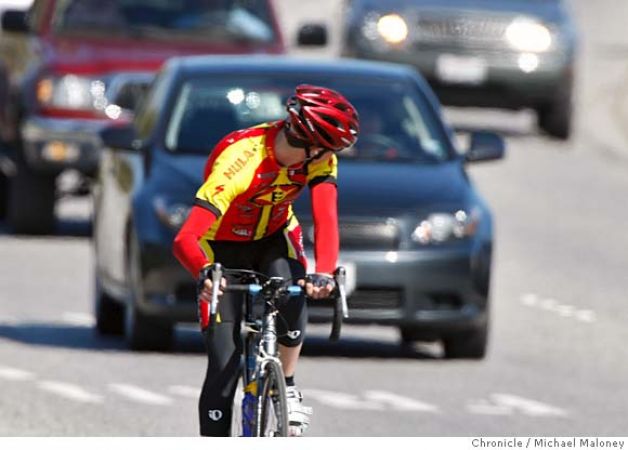
I live and work close to the UCLA campus with its population of 29,000 students, many of whom travel back and forth from home on their bicycles. In this part of Los Angeles, there are a limited number of east/west roads suitable for cyclists. It is dispiriting for me as a motorist to have to deal with the attitudes of cyclists who do not feel that they have to follow traffic signals and stop signs, and who could suddenly morph from vehicular traffic to pedestrian traffic and crossing at crosswalks and scaring the Bejeezus out of little old ladies with their shopping carts.

There are two types of cyclists: the ones who are law abiding and those who insist on showing their contemptuous attitude. Usually this second group wears expensive brightly-colored racing designs and fancy helmets. These scofflaws treat automobile drivers as pond scum. A few weeks ago, I made a right turn going eastbound while a westbound cyclist made a left turn into my lane without any hint of a turning signal. He chased me down for almost a mile just so that he could verbally abuse me. He said that he was not required to signal a turn. (They don’t appear to be required to follow any laws.)

That’s why, today, as I exited the parking lot of the main Santa Monica Library, my heart was cheered by seeing a police officer cite a group of cyclists who had violated some law. When I told her about this, Martine was incredulous: She had never a cyclist stopped by the police. She is furious with cyclists who zigzag back and forth from the street to the sidewalk and brush by pedestrians.

I Would Like to Have Been Him, Part 2

Patrick Lee Fermor (1915-2011)

Sir Patrick Leigh Fermor (1915-2011)

A long time ago—certainly before I moved my blog to WordPress—I wrote about Sir Richard Francis Burton, how I would like to have lived his life.(I’ll look it up for you and re-post it sometime in the next week or two.) The other person whom I admire so much that I would like to have been him is Sir Patrick Michael Leigh Fermor. Both were knighted; both were world travelers; both had superb intellects; and both were superb writers.

At the age of eighteen, Fermor decided to walk the length of Europe, starting from Holland and ending up in Constantinople. Most of his trip was covered by two volumes he wrote years after the fact: A Time of Gifts (1977), covering from Holland to the Hungarian Border, and Between the Woods and the Water (1986), covering Hungary and Romania. When he died in 2011 at the ripe old age of 96, he will still working on the third volume. I was heartbroken at the loss, feeling I would never find out how his trip ended.

Thanks to his good friends Artemis Cooper and Colin Thubron—himself no mean travel writer—the third volume has finally come out. It bears the title The Broken Road: From the Iron Gates to Mount Athos (2013). Fortunately, enough of the text is pure Fermor, which is quite a complement. Take this passage, for example, describing Romanian Orthodox art:

I was fascinated, and slightly obsessed, by these voivodes and boyars as they appeared in frescoes on the walls of the monasteries they were always piously founding — crowned and bearded figures holding up a miniature painted facsimile of the church itself, with their princesses upholding its other corner, each with a line of brocaded, kneeling sons and daughters receding in hierarchical pyramids behind them. Still more fascinating, later portraits,hanging in the houses of their descendants—some by unknown local artists who travelled through the principalities early in the nineteenth century—showed great boyars of the princely divans, men who bore phenomenal titles, most of them of Byzantine origin, some of them Slav: Great Bans of Craiova, Domnitzas, Bayzadeas, Grant Logothetes, hospodars, swordbearers and cupbearers, all dressed in amazing robes with enormous globular headdresses or high fur hats with diamond-clasped plumes, festooned with necklaces, and jewel-crusted dagger hilts.

What a whiff of Eastern Christianity is in this passage from pages 183-184! It is typical of Fermor’s obscurely beautiful lists that can pop up anywhere in the text.

As if his travel and writing were not enough, Paddy Fermor was a legitimate war hero. During the Nazi occupation of Crete, as a member of the Special Operations Executive (SOE), he helped organize the Greek resistance and carried off the German commandant, General Heinrich Kreipe, over several mountain ranges to a waiting British submarine. At one point, the captive Kreipe was so impressed by the scenery, that he quoted some lines by Horace in Latin. Fermor finished the quote, also in Latin, at which the astonished Kreipe could only mutter, “Ah, so!” Fermor commented that both he and Kreipe had “drunk at the same fountains” of learning.

Other books by Fermor include the following titles which I have read:

  • The Violins of Saint-Jacques (1953)
  • A Time to Keep Silence (1957)
  • Mani: Travels in the Southern Peloponnese (1958)
  • Roumeli: Travels in Northern Greece (1966)
  • Three Letters from the Andes (1991)

All are travel books except the first, which is a novel. The only book of his I have not yet read is The Traveller’s Tree (1950), about his sojourn in the Caribbean. Also well worth reading is his wartime colleague W. Stanley Moss’s Ill Met by Moonlight: The Abduction of General Kreipe (1950). Most of Fermor’s books are available in attractive paperback editions from the New York Review of Books.

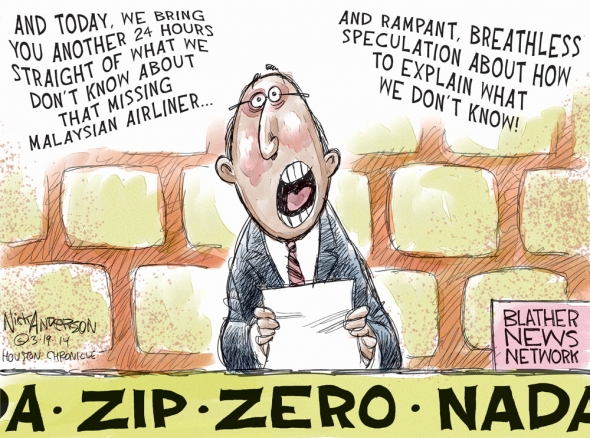
Breaking News—Floating Debris in Ocean!

... And Still They Go On and On and On

… And Still They Go On and On and On

The death of all those passengers and crew on Malaysia Airlines Flight 370 is a legitimate disaster. And trust me, they are all dead. No one’s going to call the news services that they landed safe and sound in Timbuktu, Kathmandu,  or the Rings of Saturn. Something happened, and we won’t know what for some time to come. In the meantime, we are bombarded by the media noise machine which is using the event to sell us soap. By the time we find out what happened, there’ll be a different news orgy: Perhaps another Kaylee, or another Scott Peterson, or another Michael Jackson. It almost doesn’t matter. To re-use the name of a bygone, late-lamented series, TV News is the ultimate Short Attention Span Theater.

You may want to resolve not to watch the news on TV. After all where does it get you? Well, for one thing, floating in the Indian Ocean 1,500 miles southwest of Australia.

“Her Impact Was … Very Slight”

Politkovskaya

Anna Politkovskaya

I would like to say a few words on this subject [of Anna Politkovskaya’s murder]. First of all, I would like to say that no matter who committed this crime and no matter what the motives behind it, it was a horribly cruel crime and it cannot go unpunished. There could have been a number of different motives. This journalist was indeed a fierce critic of the current authorities in Russia. But, as the experts know, and as journalists should realise, I think, her impact on Russian political life was only very slight. She was well known in the media community, in human rights circles and in the West, but her influence on political life within Russia was very minimal. The murder of someone like her, the brutal murder of a woman and mother, was in itself an act directed against our country and against the Russian authorities. This murder deals a far greater blow to the authorities in Russia, and in Chechnya, to which she devoted much of her recent professional work, than did any of her publications. This is very clear to everyone in Russia. But, as I said, no matter what the motives behind the perpetrators’ actions, they are criminals and they must be identified, caught and punished. We will do everything necessary to ensure that this is done.—Vladimir Putin, News Conference in Germany, 2006

Revisiting: Anna Politkovskaya

Anna Politkovskaya: Read Her Books to Understand Today’s Russia

Anna Politkovskaya: Read Her Books to Understand Today’s Russia

This is an article I wrote for the old Yahoo! 360 back in 2008. Currently, I am reading Is Journalism Worth Dying For? Final Dispatches.

I have just had a harrowing experience, having finished reading Anna Politkovskaya’s A Dirty War: A Russian Reporter in Chechnya. We don’t hear much about Chechnya these days: Vladimir Putin has succeeded in muddying the waters by getting us all to regard the entire civilian population of the province as Muslim terrorists. Based on Politkovskaya’s reportage, there are actually four groups of terrorists in Chechnya:

  1. The actual terrorist bands themselves, highly mobile groups widely dispersed in the mountains of Chechnya, Ingushetia, and Daghestan.
  2. The Chechen civilian government under the Russians, which cynically exploits the suffering of the local population for financial gain.
  3. Contract soldiers, the Russian equivalent of Blackwater, which is a force on its own. They maintain pseudo-checkpoints which are simply an excuse for mayhem.
  4. The Russian Army itself, which authorizes local “cleansing” operations, consisting of robbery, torture, rape, and murder without being held responsible to anyone. Also, Russian soldiers themselves are frequently the victims of other units which have a bone to pick with them.

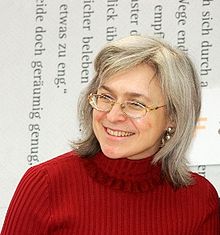
Running through the book are a series of stories about the Grozny Old Peoples’ Home. Most of the sick, elderly tenants are Russians, not Chechens; Russian Orthodox, not Islamic. Yet the residents are treated by all parties as the enemy. Politkovskaya (photograph above) wrote several articles explaining their plight, checking back with them every few months. They had no food or medical care, and were afraid to venture outside for fear of running afoul of armed parties of any description.

The only hospital in bombed-out Grozny had a few volunteer doctors, but no medicines. Such medications as were sent from Moscow were intercepted by the Chechen [pro-Russian] civilian government and sold on the black market.

When there were too many casualties in a Russian army operation, it was not unusual for the wounded to be taken not to a nearby military hospital, but to a more distant civilian hospital where there was no electricity, no medications, and only a skeleton staff. Whether they live or die, they are considered as deserters and therefore do not adversely affect any Russian officer’s military reputation. Many of the wounded soldiers die without identification, leading their families to spend years and a small fortune trying to find out what happened to their sons. (I wonder if this sort of thing was also going on [during the Soviet occupation of] Afghanistan.)

If you leave your apartment in Grozny, be very careful. You might find well-hidden anti-personnel mines at your doorstep or even within the apartment. This is a common cause of death throughout Chechnya.

When Politkovskaya encountered particularly obnoxious politicians or generals, she would publish their cell phone numbers in the Novaya Gazeta, for whom she worked at that time, and urge people to say to their face what they thought of them.

As one could expect, a woman like this makes lots of powerful enemies. On October 7, 2006, the crusading journalist was shot to death in the elevator on the way to her apartment in Moscow. After an “investigation” of sorts, no guilty party was found. Vladimir Putin, who most likely ordered the assassination, points the finger at some unnamed gunman from the West. After all, he says, she had no influence in Russia: Her audience were mostly liberals in Europe and America.

Politkovskaya was a singularly brave journalist and paid the ultimate price for it. Compare them to American journalists who were supinely complicit in the atrocities of the Bush-Cheney administration. No awards for courage there.

He’ll Probably Get Away With It

Vladimir Putin Shows Us He’s a Man’s Man

Vladimir Putin Shows Us He’s a Man’s Man

As far as the Crime of the Crimea is concerned, Vladimir Putin will probably not only get away with it: He’ll come out ahead in the hearts and minds of the Russian voters. He stood up for the poor Russian majority in the Crimea, where they were being harassed by Ukrainian thugs, such as the notorious Svoboda Party skinheads, who are actually part of the government in Kiev.

We are dealing with a part of the world where good guys are few and far between. All the leaders of the Ukraine, including the somewhat cute Yulia Tymoshenko, were corrupt to varying degrees, with the deposed Viktor Yanukovych bidding fair to be the worst. Admittedly, we’re not talking about people who are as bad-ass as Putin himself. (If you want some background about Putin’s crimes, read whatever you can find by Anna Politkovskaya, the Novaya Gazeta reporter who investigated the Chechen War and who Putin had assassinated at the door of her flat.)

If you go back a few years to the Second World War, you will see some strange things happening: there were guerrillas who were simultaneously fighting Hitler and Stalin, and conducting their own pogroms just for fun. (These are the goons who morphed into the Svoboda Party.)

So was it “right” for Russia to annex the Crimea? Strictly speaking, no. But then, the Crimea was a gift to the Ukrainian SSR from Nikita Khrushchev, himself a Ukrainian, some fifty years ago. Before then? It was a part of Russia. Demographically, it’s heavily Russian; so it was perhaps inevitable. But do I think well of Putin for pulling his strong man act? Not really, he is to my mind a contemptible cur, a murderer at arm’s length, and quite possibly a Dick Tracy villain. (But then, that is true of many of our politicians as well, no?)

One final note: Two days of a run-up in the stock markets of Europe and the United States indicates to me that most of the talk about sanctions is pure swamp gas. It would only strengthen Putin.

The Digital Divide

With Every New Technology, There Is a Die-Off

With Every New Technology, There Is a Massive Die-Off

Little by little, I am becoming aware of a tendency in our culture to downplay everything that is before the Internet. Wikipedia and Google are so convenient that we tend to ignore older sources of knowledge. And now that libraries are trashing many of their old books and periodicals and replacing them with computers, there is a real danger that many of the old sources that used to pass for knowledge are slowly disappearing.

For example, I have many books that pre-date the ISBN code. When I read one of them, I have some difficulty describing the book to GoodReads.Com because the likelihood is that there is no reference to the edition I have. And when I try to sell the books on Half.Com (which is owned by eBay), I can’t enter the book because it lacks the ISBN code used to identify the edition. It’s actually keeping me from reading my essays by Sainte-Beuve or many of the hundreds of Oxford World Classics I own in hardbound. Ever since I got in the habit of reviewing everything I read, I tend to hesitate with some of my older editions. Just in front of me, for example,  is a 1926 Alfred A. Knopf edition of Arthur Machen’s The Canning Wonder. I could review the book on Goodreads only if I answer a questionnaire about the edition. If I wanted to sell it on Half.Com, I’d be out of luck.

Most at risk is the history of our civilization based on original archival materials that date back to the Middle Ages. Fortunately, the Europeans are willing to spend the money (in most cases) to protect their history. But what about the Americans? All it would take is for some idiot like Ted Cruz or Rand Paul to sniff at supporting libraries, and millions of words of our country’s history would go by the wayside.

But what about Google Books, you might ask? It is a noble effort, but only a small percentage of old books have been scanned. I collect the works of Sir Richard F. Burton (no relation to the actor). He’s not exactly a popular item, but he is one of the most exciting explorers and travelers of the Nineteenth Century. I can find Burton’s Two Trips to Gorilla Land and the Cataracts of the Congo, but only Volume I has been scanned. The same is true for his Exploration of the Highlands of Brazil. Oh, the books will still be around, but they will be fabulously expensive. (On the other hand, I have been able to find some Burton titles on Gutenberg.Com that I could never afford to buy in print—so the argument cuts both ways.)