“A Half-Open Door”

Pieter de Hooch’s The Mother

Pieter de Hooch’s The Mother

In Marcel Proust’s Swann’s Way, Charles Swann uses his knowledge of art and music to convince himself that the love of his life is Odette de Crécy. First, he discovers a musical phrase by the composer Vinteuil which Odette also loves. Then there is the matter of the paintings. Listening to Vinteuil, his mind wanders to the work of a Dutch painter:

He would begin with the sustained violin tremolos that are heard alone for a few measures, occupying the entire foreground, then all of a sudden they seemed to move away and, as in those paintings by Pieter de Hooch, which assume greater depth because of the narrow frame of a half-open door, away in the distance, in a different color, in the velvet of an interposed light, the little phrase would appear, dancing, pastoral, interpolated, episodic, belonging to another world. It rippled past, simple and immortal, distributing here and there the gifts of its grace, with the same ineffable smile….

From my own past, I know well that one makes use of bogus comparisons to crystallize one’s growing love for a young woman. I remember one whose facial expression kept bringing the Latin word claritas to mind. It turned out that, like Swann, I was deceiving myself with someone whose motivations were anything but clear. But, such is life.

I am fascinated by Proust’s references to art and would like to recommend Eric Karpeles’s excellent book, Paintings in Proust, to anyone venturing into In Search of Lost Time.

Re-Orienting Myself to Peru

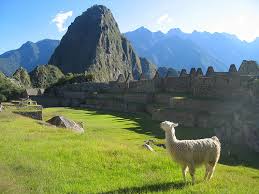
Spanish Colonial Architecture in Peru

Spanish Colonial Architecture in Lima, Peru

Because I place such a high value on traveling with Martine, I thought nothing last December of ditching my plans in an instant to visit Peru so that we could go to France and Italy. At that point, nothing was firm yet—I planned to go in September or October. (I frequently plan in advance by so many months that all my friends think that I have already gone and returned.) But continuing problems with her back, especially where soft beds are concerned, induced her to cancel the European trip.

There is never any guarantee when staying at strange hotels that your bed will be firm or mushy. Fortunately, I can tolerate a fairly wide range; but Martine’s range of acceptability is much narrower. It’s a pity, because her half-sister Madeleine in St-Lô (near the D-Day Beaches of Normandie)  is ailing and cannot travel herself.

In the meantime, I am resuming my Peru reading program, which consists primarily of:

  • Novels by Mario Vargas Llosa, Peru’s only Nobel Prize winner in literature
  • Novels and poems by other Peruvian literary notables, such as César Vallejo
  • Histories of the Spanish conquest of the Incas
  • Other Peruvian histories on subjects including the War of the Pacific, which Peru lost to Chile in the late 19th century
  • A biography of Simon Bolivar and possibly José de San Martín, the two principal liberators of South America

I don’t know how much I can read before the departure date, which has not  been set yet, but I will do my best.

All this preparation is, for me, a kind of courtesy. I do not believe in visiting another country without knowing enough of its language, culture and history to be conversant with the locals. That has helped me considerably in Argentina and Iceland. Plus, it is a pure pleasure for me to prepare a trip far enough in advance—especially during tax season, when there is little else to forward to. I have little truck with those travelers who believe in being “spontaneous” at the cost of making their fellow Americans look like dunces.

Half Life

How Do I Survive the Rigors of Tax Season?

How Do I Survive the Rigors of Tax Season?

This is not my favorite time of the year. I have to work longer hours in a more stressful atmosphere, and I no longer have the weekends during which to unwind. My life becomes what I refer to as a “half life”—not to be confused with a radioactive isotope.

I still have dinner with Martine every evening, though the dishes I prepare (yes, I am the cook, even at this time of year) are usually simpler. After we eat, however, I disappear into my library and read until it’s time for bed, usually around 10:30 pm. At this time, however, I am more careful about the books I read: I insist on works that absorb and enthrall me. Right now, I am reading Lydia Davis’s masterful translation of Marcel Proust’s Swann’s Way, here called The Way by Swann’s. At my side is a useful volume showing all the many paintings mentioned by Proust: Paintings in Proust by Eric Karpeles.

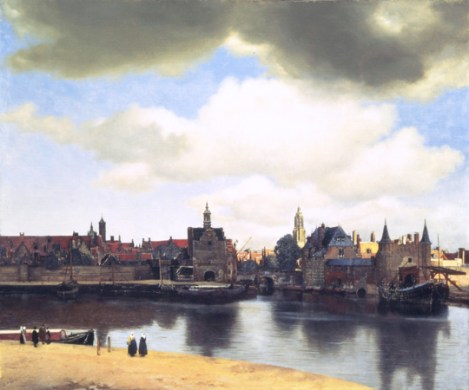
The above painting, Vermeer’s “A View of Delft,” plays a major part in The Captive, the fifth volume in Proust’s In Search of Lost Time. I present it here in its entirety:

The circumstances of his [the writer Bergotte’s] death were as follows. A fairly mild attack of uraemia had led to his being ordered to rest. But, an art critic having written somewhere that in Vermeer’s View of Delft (lent by the Gallery at The Hague for an exhibition of Dutch painting), a picture which he adored and imagined that he knew by heart, a little patch of yellow wall (which he could not remember) was so well painted that it was, if one looked at it by itself, like some priceless specimen of Chinese art, of a beauty that was sufficient in itself, Bergotte ate a few potatoes, left the house, and went to the exhibition. At the first few steps he had to climb, he was overcome by an attack of dizziness. He walked past several pictures and was struck by the aridity and pointlessness of such an artificial kind of art, which was greatly inferior to the sunshine of a windswept Venetian palazzo, or of an ordinary house by the sea. At last he came to the Vermeer which he remembered as more striking, more different from anything else he knew, but in which, thanks to the critic’s article, he noticed for the first time some small figures in blue, that the sand was pink, and, finally, the precious substance of the tiny patch of yellow wall. His dizziness increased; he fixed his gaze, like a child upon a yellow butterfly that it wants to catch, on the precious patch of wall. “That’s how I ought to have written,” he said. “My last books are too dry, I ought to have gone over them with a few layers of colour, made my language precious in itself, like this little patch of yellow wall.” Meanwhile he was not unconscious of the gravity of his condition. In a celestial pair of scales there appeared to him, weighing down one of the pans, his own life, while the other contained the little patch of wall so beautifully painted in yellow. He felt that he had rashly sacrificed the former for the latter. “All the same,” he said to himself, “I shouldn’t like to be the headline news of this exhibition for the evening papers.”

He repeated to himself: “Little patch of yellow wall, with a sloping roof, little patch of yellow wall.” Meanwhile he sank down on to a circular settee whereupon he suddenly ceased to think that his life was in jeopardy and, reverting to his natural optimism, told himself: “It’s nothing, merely a touch of indigestion from those potatoes, which were undercooked.” A fresh attack struck him down; he rolled from the settee to the floor, as visitors and attendants came hurrying to his assistance. He was dead. Dead for ever? Who can say? Certainly, experiments in spiritualism offer us no more proof than the dogmas of religion that the soul survives death. All that we can say is that everything is arranged in this life as though we entered it carrying a burden of obligations contracted in a former life; there is no reason inherent in the conditions of life on this earth that can make us consider ourselves obliged to do good, to be kind and thoughtful, even to be polite, nor for an atheist artist to consider himself obliged to begin over again a score of times a piece of work the admiration aroused by which will matter little to his worm-eaten body, like the patch of yellow wall painted with so much skill and refinement by the artist destined to be for ever unknown and barely identified under the name Vermeer. All these obligations, which have no sanction in our present life, seem to belong to a different world, a world based on kindness, scrupulousness, self-sacrifice, a world entirely different from this one and which we leave in order to be born on this earth, before perhaps returning there to live once again beneath the sway of those unknown laws which we obeyed because we bore their precepts in our hearts, not knowing whose hand had traced them there—those laws to which every profound work of the intellect brings us nearer and which are invisible only—if then!—to fools. So that the idea that Bergotte was not dead for ever is by no means improbable.

They buried him, but all through that night of mourning, in the lighted shop-windows, his books, arranged three by three, kept vigil like angels with outspread wings and seemed, for him who was no more, the symbol of his resurrection.

There have been many scholarly analyses of the little patch of yellow wall mentioned in The Captive, such as the one to be found by clicking here and scrolling down halfway.

The past translations by C. K. Scott-Moncrieff are still widely available, but they suffer from a stiffness and even prissiness that does not encourage new readers. I have many literate friends who have been so put off by the beginning of Swann’s Way that they laid the book aside and deprived themselves of the payoff to be found by sticking it out.

How I intend to survive the rest of this tax season—the most difficult part—is by holding fast to what moves me the most in literature. And Proust is very near the top.

“The Best Solitary Company in the World”

I Mean the Book

I Mean the Book

Here is the best solitary company in the world, and in this particular chiefly excelling any other, that in my study I am sure to converse with none but wise men; but abroad it is impossible for me to avoid the society of fools. What an advantage have I, by this good fellowship, that, besides the help which I receive from hence, in reference to my life after this life, I can enjoy the life of so many ages before I lived! — that I can be acquainted with the passages of three or four thousand years ago, as if they were the weekly occurrences! Here, without travelling so far as Endor, I can call up the ablest spirits of those times, the learnedest philosophers, the wisest counsellors, the greatest generals, and make them serviceable to me. I can make bold with the best jewels they have in their treasury, with the same freedom that the Israelites borrowed of the Egyptians, and, without suspicion of felony, make use of them as mine own. I can here, without trespassing, go into their vineyards and not only eat my fill of their grapes for my pleasure, but put up as much as I will in my vessel, and store it up for my profit and advantage.—William Waller, Divine Meditations: Meditation Upon the Contentment I Have in My Books and Study

Traveling Alone

It Looks As If I’ll Be on My Own

It Looks As If I’ll Be on My Own

Martine and I had decided that, if she felt well enough to travel, we’d go together to France and Italy. If she felt unable to travel, I would go by myself to Peru and possibly Bolivia. At the end of January, we took a little test trip to the Anza-Borrego Desert in San Diego County. Although we had a firm bed, it wasn’t firm enough for Martine’s back. Fortunately, we had an air mattress that was firmer, so Martine slept on the floor. This option would not work as well for overseas travel, as both of us travel light.

On the plus side, Martine is getting better slowly; but she still depends heavily on a super firm couch and a super firm mattress for her comfort. Without these, she would be awake most of the night for all the days of our trip. Understandably, under those circumstances she would prefer to remain behind in Los Angeles.

I, on the other hand, have this great yearning for travel. The pity of it is, I will be deprived of my favorite traveling companion. I am used to this, as I have been alone in Iceland twice (2001 and 2013) and in Argentina once (2006). We will probably travel together to Southern Arizona by car—with the firm air mattress—so that Martine doesn’t get a case of cabin fever.

In the meantime, I am continuing my Peru reading program in preparation for a three week vacation there in September and October. As Rudyard Kipling wrote in his poem, “The Winners”:

Down to Gehenna or up to the Throne,
He travels the fastest who travels alone.

Most memorably, in Josef von Sternberg’s film Morocco (1930), Marlene Dietrich, writes these lines with her lipstick on a hotel room mirror before ditching Adolphe Menjou.

So I will travel faster, but I’d rather not be alone.


Robots, TED Talks, and Butchers’ Thumbs

Don’t Believe Everything You Hear!

Don’t Believe Everything You Hear!

Coming home from work today (yes, now I’m working Saturdays), I heard something that made me sit bolt upright while listening to a National Public Radio program dedicated to TED talks. You may recall that TED (short for Technology, Entertainment, Design) is the dernier cri when it comes to spreading dubious notions. This one was a talk by Cynthia Breazeal of MIT entitled “The Rise of Personal Robots.”

Ms. Breazeal dreamed of a day when robots would solve many of our societal and personal problems. What makes me suspicious is what I call the Butcher’s Thumb Paradox. A good electronic scale makes weighing cuts of meat easy and accurate—except for one thing. I am referring to the butcher’s thumb, which, resting on the scale, adds several ounces to your purchase.

In the world of robotics, what would serve as the butcher’s thumb are the corporations that build the robots. The robots will serve you, the purchaser, to some extent; but, even more, they serve the marketing goals of the corporations that build them. That’s why robots have been used extensively to kill manufacturing jobs, because they are cheaper than humans, don’t ever unionize, and don’t require expensive health or workmen’s compensation insurance.

Remember how many technical support problems the telephone was supposed to solve. Now, when you call a major corporation for tech support, you get what’s called an automated attendant, which walks you through a script. Now I don’t know about you, but the option you are looking for doesn’t exist about 50-60% of the time. Why? Because it is never in the corporation’s best interest to explain anything to you which may require follow-up questions and answers. They’ll connect you to sales right away, but God help you if they accidentally billed you for a left-handed sky hook or delivered a device that was, in effect, a non-functioning paper weight. In fact, many vendors will now charge you to answer questions. Questions are quite simply unprofitable. Too bad about your needs!

Before we ever get a personal robot to help us with the housework or carry out the garbage, we will have robot bill collectors, robot parking police, and robot callers. (Wait a minute! We already have those! And aren’t they fun?)

So when TED speakers promise great money and time saving advances for us plain folks, keep looking for the butcher’s thumb. It’s there somewhere….

Against Oligarchy

Can’t Be Bribed?

Can’t Be Bribed?

You will hear everlastingly, in all discussions about newspapers, companies, aristocracies, or party politics, this argument that the rich man cannot be bribed. The fact is, of course, that the rich man is bribed; he has been bribed already. That is why he is a rich man. The whole case for Christianity is that a man who is dependent upon the luxuries of this life is a corrupt man, spiritually corrupt, politically corrupt, financially corrupt. There is one thing that Christ and all the Christian saints have said with a sort of savage monotony. They have said simply that to be rich is to be in peculiar danger of moral wreck. It is not demonstrably un-Christian to kill the rich as violators of definable justice. It is not demonstrably un-Christian to crown the rich as convenient rulers of society. It is not certainly un-Christian to rebel against the rich or to submit to the rich. But it is quite certainly un-Christian to trust the rich, to regard the rich as more morally safe than the poor. A Christian may consistently say, “I respect that man’s rank, although he takes bribes.” But a Christian cannot say, as all modern men are saying at lunch and breakfast, “a man of that rank would not take bribes.” For it is a part of Christian dogma that any man in any rank may take bribes.—G. K. Chesterton, Orthodoxy

Getting the Joke 55 Years Later

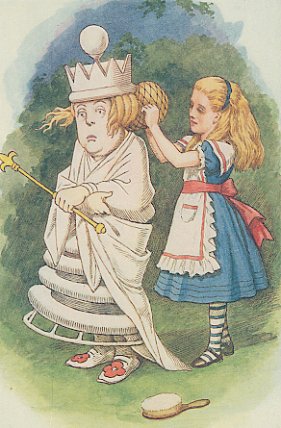
Tenniel’s White Queen in Through the Looking Glass

Tenniel’s White Queen in Through the Looking Glass

I was a mere fourteen years old, a Freshman in Latin 1 at Chanel High School in Bedford, Ohio. My instructor was the Rev. Seamus MacEnri, S.M., from Dungannon, County Tyrone, Northern Ireland. One day, he archly drew the following on the chalkboard:

Jam tomorrow, jam yesterday, but never jam today

Our reaction was a uniform, “Whaaa?” But then, we were all a bunch of hayseed kids from the southeastern suburbs of Cleveland and didn’t have Father MacEnri’s breadth of experience. It took quite a while before the whole joke became clear to me. Today, in this post, I will analyze the joke, effectively forestalling any laughter or snickers.

First, let’s take a look at this from Lewis Carroll’s Through the Looking Glass:

“I’m sure I’ll take you with pleasure!” the [White] Queen said. “Two pence a week, and jam every other day.”

Alice couldn’t help laughing, as she said, “I don’t want you to hire me – and I don’t care for jam.”

“It’s very good jam,” said the Queen.

“Well, I don’t want any to-day, at any rate.”

“You couldn’t have it if you did want it,” the Queen said. “The rule is, jam to-morrow and jam yesterday – but never jam to-day.”

“It must come sometimes to ‘jam to-day’,” Alice objected.

“No, it can’t,” said the Queen. “It’s jam every other day: to-day isn’t any other day, you know.”

“I don’t understand you,” said Alice. “It’s dreadfully confusing!”

And so were we all confused. Now, why would a teacher of Latin spring this rather arcane joke on a bunch of high school freshmen. It took a while to swirl around in my mind before I got the picture. It all comes down to something that Medieval copyists started doing in the 13th century:

Sometimes one will see a “j” in Latin. Technically Latin has no letter J. It was introduced in the 13th century or thereabouts to differentiate between the vowel i and the consonant i. The consonantal i is like our y. “Major” in Latin is pronounced as MAH-yor. Until this last century, most printed Latin texts used the j to indicate the different sounds. Today the j’s are usually replaced with the more classical i’s.

That’s why we have words like juvenile and justice, which come from the Latin iuvenilis and iustitia respectively.

Now, what does jam—or should I say iam?—mean in Latin? It means nothing less than now. Jam tomorrow, jam yesterday, but never jam now.

Well, Father MacEnri, I finally got the joke—and damned near killed it, too.

Front Lawns and Drought

Where Does Our Obsession With Front Lawns Come From?

Where Does Our Obsession With Front Lawns Come From?

There is something wrong with our obsession with front lawns. Other than serving to set back a house a little further from the noise of the street, what purpose does it serve? Kids don’t play on front lawns so much as they do with back yard lawns. (Actually, in this era of video games, they are not likely to play outside at all.) Yet it seems that manicuring a front lawn is one of the badges of middle class life in the suburbs.

We are now experiencing a terrible drought in California, probably the worst in recent history. Although we are now between rainstorms after receiving a good drenching last night, we are so far from normal that March would have to be the wettest on record to move the water gauge any appreciable amount. Perhaps now is the time to consider front yards that are more in line with the flora of our tropical savanna climate, such as succulents and other xerophytic plants that typically grow in desert regions. As a simple matter of aesthetics, I don’t see why a green lawn such as the one shown above is preferable to a mix of desert plants, which can be quite beautiful, especially when they flower.

Please note that my comments are directed more to the apparently decreasing rainfall of the American Southwest than to other parts of the country, where desertification is less of an issue. If you are currently under water, feel free to sow those grass seeds wherever you can.


Tarnmoor’s ABCs: Dartmouth College

Dartmouth Hall

Dartmouth Hall

It was a beautiful place to spend four years, even if I had never really been more than a few miles away from home by myself before then. I went from being a valedictorian who had won all the non-sports-related honors at Chanel High School to one of hundreds of similar people from all around the country, including those famous prep schools that have sprouted up over all of New England.

At that time, Dartmouth College was isolated by the fact that the Interstate Highway system had not yet made its way into New Hampshire and Vermont. Today, Hanover, New Hampshire, is less than two hours from Boston via I-89. During the months of January and February, we were at times cut off from all supplies until the snow plows could cut a channel for cars and trucks. All four years, I stayed in Middle Wigwam Hall, which was later renamed to McLane Hall. My dorm stood a mile from the center of campus. To get to class, I had to trudge past the eerie old Hanover cemetery, with its tombs dating back to the Eighteenth Century, often on a sidewalk that had obligingly turned into a sheet of ice.

During those years, I suffered frequently from severe frontal headaches, which were the result of a pituitary tumor (chromophobe adenoma) pressing on my optic nerve. The attacks occurred on 50% of all days, with the “penumbra” of the headache beginning around 11 am and reaching a crescendo around midnight. That’s why I did most of my homework before midnight and 3 am. It was not until after I graduated that I was properly diagnosed: Until then, doctors did not know what to think—especially since MRIs and CT Scans had not yet been invented.

Pain and all, I loved Dartmouth. The quality of the instructors was, for the most part, incredibly high. Particularly in the English department, I had a succession of professors I will never forget: men like Chauncey Loomis, Peter Bien, and Thomas Vance.

At first, I hoped to become an English professor, until the movies turned by head. The Dartmouth Film Society screened great films, including a huge year-round Alfred Hitchcock festival. Plus I made the acquaintance of Arthur L. Mayer, the former “Merchant of Menace” from New York’s Rialto Theater and the author of Merely Colossal (1953). It was while at Dartmouth that I decided to go to graduate school in film history and criticism at UCLA—and that’s how I wound up in La La Land.

Dartmouth College had been founded as a missionary school for Indians in 1769 under the patronage of the Earl of Dartmouth. In 1819, the school made legal history when Daniel Webster argued before the Supreme Court in Trustees of Dartmouth College vs. Woodward, better known as the Dartmouth College Case. President Franklin “Handsome Frank” Pierce graduated from there and went on to become one of the most mediocre presidents in U.S. history.

I will leave you with the official seal of Dartmouth:

“A Voice Crying in the Desert”

“A Voice Crying in the Desert”

The motto was most appropriate considering the school’s winter isolation.