Don’t Fall For His Poor Old Blind Man Act

Jorge Luis Borges

Jorge Luis Borges

It is easy to be fooled by Jorge Luis Borges (1899-1986). He spent the last couple decades of his life giving out interviews, some of them book-length. The damned thing of it all is that he was a devious interview subject. He would insist that he was apolitical:

I am not politically minded. I am aesthetically minded, philosophically perhaps. I don’t belong to any party. In fact, I disbelieve in politics and in nations. I disbelieve also in richness, in poverty. Those things are illusions. But I believe in my own destiny as a good or bad or indifferent writer.

Yes, but, at the same time he irked one Swedish literary critic that he single-handedly prevented Borges from receiving the Nobel Prize in Literature because, at one time, he accepted an honor from Chile’s dictator General Pinochet Ugarte. Also, he so burned up Juan Peron that he derisively appointed the Argentinean to be the poultry inspector for Buenos Aires.

In an article for the L.A. Review of Books that was reprinted by Salon.Com, Filipina writer Gina Apostol has an interesting perspective on Borges, who, as you may or may not know, is one of my favorite authors:

As a writer from the colonized world, I find Borges’s work almost intolerably revealing, as if spoken directly to the political debates that beset my country. Borges’s postcolonial critique and analysis in his ficciones are obscured by his philosophical sleights of hand, startling plots, and narrative wizardry, but though buried, his critique is powerful. In particular, I am struck by his logic of the inverse. His use of doppelgangers (sometimes triplegangers) and mirrors and refractions and texts within texts — spies that become victims, heroes that are villains, detectives caught in textual traps of their own making, translators who disappear in puffs of smoke in someone else’s writer’s block — in Borges’s stories, these astonishing mutations force us to see reality from new perspectives, force us to question our own encrusted preconceptions. While questions of ontology and Berkeleyan illusion and all those philosophical games beloved of Borges are paramount, the constant revisiting of the problems of fictionality and textuality in these stories have profound echoes for the postcolonial citizen, bedeviled by and grappling with questions of identity and nation, questions seething always under our every day, our working hours, our forms of art.

What I find interesting is that Borges himself claims he is an unreliable interviewee. He instructs his interviewers to doubt everything he says. Because he was an old blind man, we tended too often to give him the benefit of the doubt, when he was very artfully putting us on.

Because he lived through so many dictatorships, such as those of Peron and the juntas of the 1930s and 1970s, Borges has learned to be what Eastern Europeans used to call an aesopic writer. According to Dr. Gerd Reifahrt:

One possibility is for [authors] to seek refuge in the realm of the Aesopic. Aesop is said to have written fables in the sixth Century B.C. to veil his opinions, and writers 26 centuries later continue to use and develop his method. In symbolic and coded terms, they write fairy tales and fables, and employ myths and elements of folklore. New forms of discourse emerged, where political realities and social truths were referred to in symbolic and coded terms rather than explicitly mentioned, and where, concurrently, these realities and truths were re-framed and re-contextualized. Protest and subversion found a new voice.

So all those tricks with mirrors and identity that Jorge Luis Borges employs represent a sophisticated method of confronting what some dire realities were for Argentinians in the not too distant past. Apostol writes, “Borges’s writing was always, to some degree, a creative form of reading, and many of his best fictions were meditations on the condition of fictionality: reviews of invented books, stories whose central presences were not people but texts.” Behind the invented lay the unvarnished reality, which he confronted indirectly.


The Earth Is 6,000 Years Old? Really?

Apparently Old Enough to Have Eaten All of Ken Ham’s Ancestors

Apparently Young Enough to Have Eaten All of Ken Ham’s Ancestors

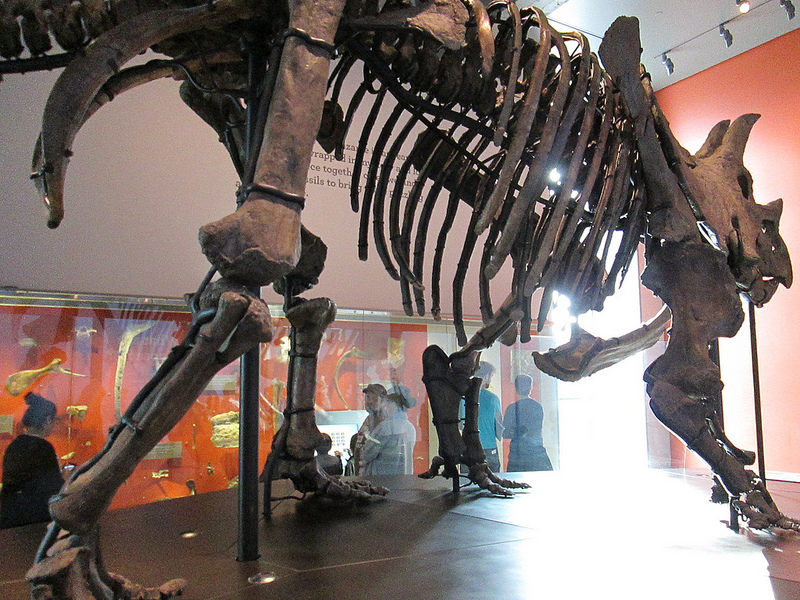
On February 4, Bill Nye the Science Guy debated a Creationist moron named Ken Ham on the subject of evolution. Of course, Mr. Ham treated the Book of Genesis (and whatever he thought about it) as his primary source. Apparently, according to the Creationist, all of creation is about 6,000 years old. What’s the point of even trying to debate a fundamentalist Christian troglodyte? I believe with Shakespeare in Hamlet (III:1):

Let the doors be shut upon him
That he may play the fool nowhere but in’s own house.

I am referring to Mr. Ham here, not Bill Nye. I mean, even Pat Robertson—no mean troglodyte himself—reproved the half-baked Ham for his beliefs:

There ain’t no way that’s possible….To say that it all came about in 6,000 years is just nonsense and I think it’s time we come off of that stuff and say this isn’t possible. We’ve got to be realistic that the dating of Bishop Ussher [who merely added the ages of the generations in the Bible] just doesn’t comport with anything that’s found in science, and you can’t just totally deny the geological formations that are out there.

“Let’s be real!” he added. “Let’s not make a joke of ourselves.”

Big Surprise!

Big Surprise!

Why do even the more stupid religious fundamentalists believe such arrant nonsense? I think that, if anyone should debate a fool like Ken Ham, it should be a comedian, not a sincere scientific figure like Bill Nye. This was in no way a victory for the Hammites, nor for the followers of scientific evolution. It was just another sad episode of rural stupidity in the former Confederacy.


Cuddly-Looking, But Don’t Touch!

Backlit Cholla Cactus

Backlit Cholla Cactus

It’s hard to believe that Martine and I left for the Anza Borrego Desert two weeks ago today. Thanks to the multiple daily crises of a tax season, it’s almost as if it never happened. Except, the desert does something to me: Somehow I feel better able to tolerate the mess and the tension. Last year, I wanted to leave for a few days to the Owens Valley—another prime desert locale—but we couldn’t find the time.

One of the most beautiful plants in the deserts of California is the cholla cactus. It is also one of the most deadly, because its spines are slightly barbed. They detach easily if one brushes against the plant and can usually be removed safely only with the help of a comb.

There are many different species of the Cylindropuntia genus, including the aptly named teddy bear cholla and the jumping cholla (the latter because the spines seem almost to jump at you).

When backlit, cholla cactus plants are luminescent, as in the picture above.


Not To Be Trusted

It’s No Longer Just a Problem With Faux News

It’s No Longer Just a Problem With Faux News and Their Barbie Doll Megyn Kelly

Oh what a mighty fall has television news suffered! We are decades away from the “good” news programs from the likes of Walter Cronkite, Huntley/Brinkley, Eric Sevareid, Peter Jennings, and others. That’s when the news was the news, and not just a subsidiary of a corporate egomaniac who wants his own opinions reflected in the stories that are presented. Faux News is the classic example of news that is so colored by Rupert Murdoch and his hand puppet Roger Ailes that it is all but useless if someone wants something other than right-wing nut-job agitprop.

Today, anyone who wants to know what is truly happening must avoid most television and radio news media like the plague. I still rely somewhat on National Public Radio (NPR), but even they are being chipped away at by the forces of GOP/Tea. To get my news, I use a variety of sources, including some left-leaning ones which, in their own way, are not always trustworthy (as for example RawStory.Com). TruthDig.Com is pretty good, especially in the articles by Chris Hedges, but I think their views are too progressive for me.

I am indebted to Jackhole’s Realm for the Megyn Kelly picture above.


On Being Always Right

Benjamin Franklin

Benjamin Franklin

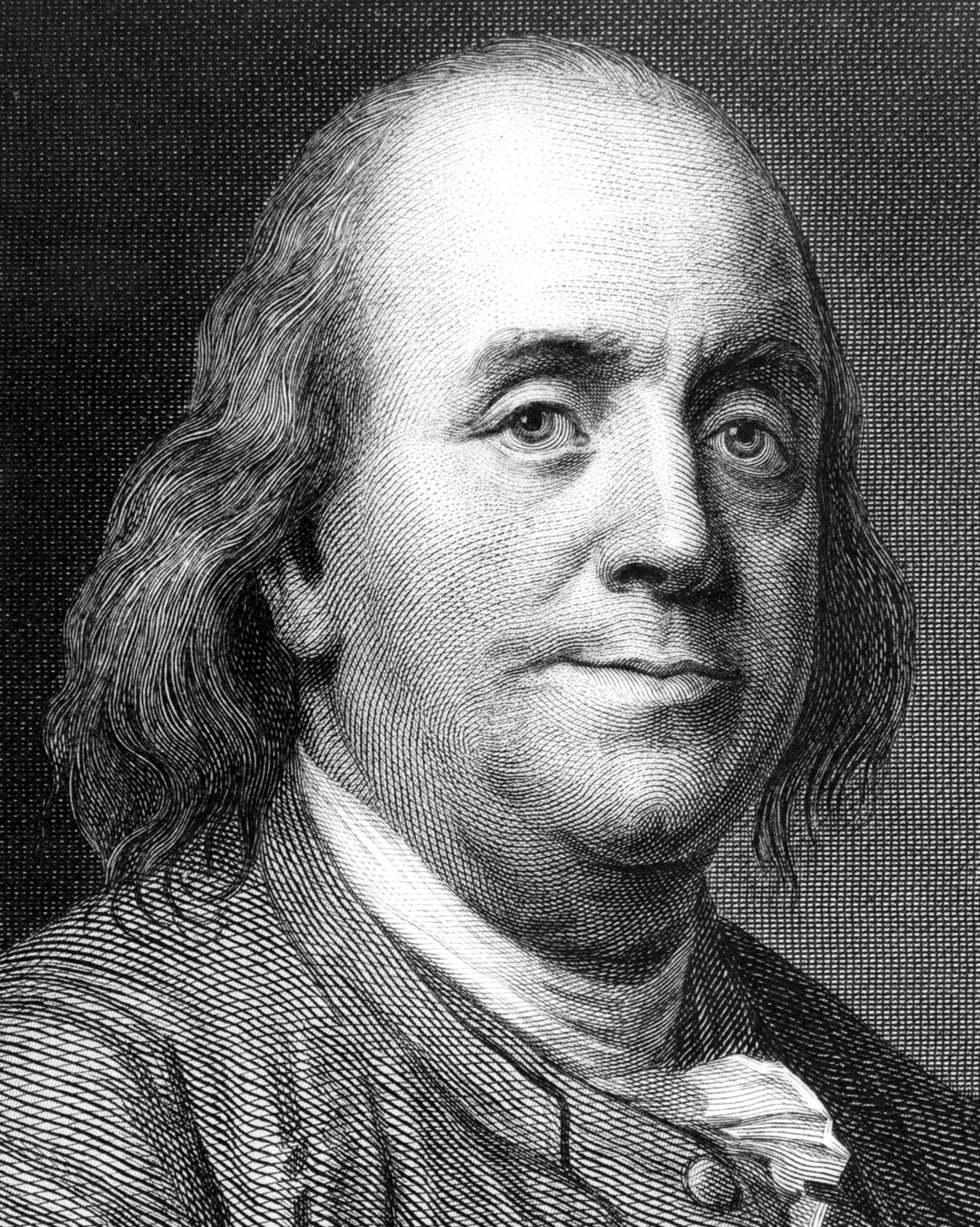
[H]aving lived long, I have experienced many instances of being obliged, by better information or fuller consideration, to change opinions, even on important subjects, which I once thought right, but found to be otherwise. It is therefore that, the older I grow, the more apt I am to doubt my own judgment, and to pay more respect to the judgment of others. Most men, indeed, as well as most sects in religion, think themselves in possession of all truth, and that wherever others differ from them, it is so far error. Steele, a Protestant, in a dedication, tells the Pope, that the only difference between our churches, in their opinions of the certainty of their doctrines, is, ‘the Church of Rome is infallible, and the Church of England is never in the wrong.’ But though many private persons think almost as highly of their own infallibility as of that of their sect, few express it so naturally as a certain French lady, who, in a dispute with her sister, said, ‘I don’t know how it happens, sister, but I meet with nobody but myself that is always in the right — il n’y a que moi qui a toujours raison.’—Benjamin Franklin, speech to the Constitutional Convention (September 17, 1787), in Debates on the Adoption of the Federal Constitution in the Convention Held at Philadelphia in 1787

On the Butterfield Overland Trail

Reconstructed Vallecito Stage Station

Reconstructed Vallecito Stage Station

Along the edges of the Anza Borrego State Park are a couple of San Diego County Parks on Highway S-2: One is the Vallecito Regional Park and, a little further down the road, a natural hot springs park at Agua Caliente. After taking our hike down to what remains of the Butterfield Stage Route at Box Canyon, we headed to Vallecito for lunch.

At Vallecito is a reconstruction of the original stage station that served as a place to rest and change horses on the Butterfield Overland Trail between 1858 and 1861. One traveler in 1859 referred to the station as being located in “a beautiful green spot—a perfect oasis in the desert.” (In fact, it’s the first real green spot on the trail west of Yuma, Arizona.) And so it was for Martine and me. We picked out a shady picnic table and reached into our bags for the groceries we had bought that morning in Borrego Springs, looked around at the exhibits in the stage station, and hung around until we were ready for our next hike.

The Butterfield Overland Trail was in use for such a short time primarily because of the Civil War. The route between San Antonio, Texas, and San Diego went through too much Confederate territory; and, besides, a transcontinental railroad was already in the works. Once that was completed in 1869, stagecoaches were on their way out, at least for long distance transport.

One of the few descriptions of the experience of stage travel comes from Mark Twain in Roughing It (1859), which tells of a journey by stagecoach between Missouri and Carson City, Nevada Territory:

Our coach was a great swinging and swaying stage, of the most sumptuous description—an imposing cradle on wheels. It was drawn by six handsome horses, and by the side of the driver sat the “conductor,” the legitimate captain of the craft; for it was his business to take charge and care of the mails, baggage, express matter, and passengers. We three were the only passengers, this trip. We sat on the back seat, inside. About all the rest of the coach was full of mail bags—for we had three days’ delayed mails with us. Almost touching our knees, a perpendicular wall of mail matter rose up to the roof. There was a great pile of it strapped on top of the stage, and both the fore and hind boots were full. We had twenty-seven hundred pounds of it aboard, the driver said—“a little for Brigham, and Carson, and ’Frisco, but the heft of it for the Injuns, which is powerful troublesome ’thout they get plenty of truck to read.”

Of Celtic Cats and Consonants

What Do They Do With All Those Consonants?

What Do They Do With All Those Consonants?

The other day, I was browsing through Compton Mackenzie’s classic novel Whisky Galore when I ran into a passage that confused me mightily:

I remember my mother once sat down on the cat, because you’ll understand the plinds were pulled down in our house every Sabbath and she didn’t chust see where she was sitting. The cat let out a great sgiamh and I let out a huge laugh, and did my father take the skin off me next day? Man, I was sitting down on proken glass for a week afterwards. [No words have been misspelled: The novel is in Hebridean Scottish dialect]

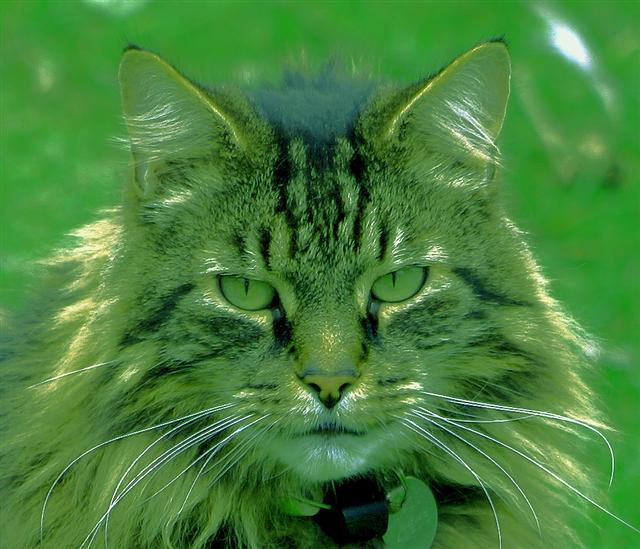
What made me sit up is that cat cry: sgiamh. Can someone please pronounce that for me? I have never heard any creature, human or otherwise, make a sound like that; and, not being of the Celtic persuasion, I have not the slightest idea how that is sounded.

Incidentally, Mackenzie’s book was turned into a delightful film variously called Whisky Galore or Tight Little Island by Alexander Mackendrick in 1949. Starring were Basil Radford and the delightful Joan Greenwood. No cats were harmed in the making of that film, and none were coached into crying sgiamh!

Looking for the Way Down

Error
This video doesn’t exist

“Well, How the Hell Did They Get Through Here, Then? … They Couldn’t Have!”

Apparently, my Canon PowerShot A1400 camera can shoot videos—especially when I don’t recall ever hitting the Record button. Here, you can see Martine and my attempt to get down to the remnants of the Butterfield Stage Route as it cut through Earthquake Valley in Anza Borrego. We were walking along the edge of Highway S-2 looking for a trail that would lead us down to the bottom of the canyon. Unfortunately, there did not look to be any easy way, considering that we didn’t have our hiking staffs with us, and that Martine was not wearing hiking shoes.

Eventually, we got down there by a commodious vicus of recirculation, but by then I had discovered that my camera was shooting video.

Anza Borrego is a do-it-yourself type of hiking locale. Trails are not as well marked as in the national Parks, and sometimes they are not marked at all. You just turn off the road and look for what might be a trail. Sometimes you find one. Sometimes you don’t. No matter: The whole place is magical.

The Waxman Goeth

Henry Waxman (D-CA)

Henry A. Waxman (D-CA)

He may not be much to look at, but Henry Arnold Waxman has been my congressional representative since 1975 and one of the few members of the House of Representatives whom I would NOT grind into dog food to feed to rabid dogs. Eschewing the limelight, he has been an exemplary hard worker dedicated to  passing legislation that actually helped people. Because of the demographic make-up of California’s 33rd district, I don’t expect we’ll be seeing him replaced by some tea party type who aims to collect $174,000 a year to sabotage everything near and dear to the voters who elected him, her, or it.

Probably best known for his contributions to health and environmental issues, Waxman will be sorely missed by people who care.

Over the last four years, the House of Representatives has been justly reviled for the white trash that has taken over, using the Congress as a bully pulpit to make stupid statements, such as the recent campaign by Darrell Issa (R-CA) to gut the U.S. Postal Service. I still think most Republican Congressman should be made to don orange jumpsuits and be hauled off to Guantanamo. Now that Waxman, won’t be there, the IQ of Congress has dropped by several whole percentage points.


Mischa the Penguin

A Lone King Penguin Among Magellanic Penguins on Isla Pajaros

A Lone King Penguin Among Magellanic Penguins on Isla de Pájaros

Serendipity strikes again. I just read an obscure Ukrainian crime story by Andrey Kurkov entitled Death and the Penguin. The narrator is one Viktor Akelseyevich Zolataryov who writes for publication what his editor refers to as obelisks. These are obituary essays written about living people so that, when death comes to them, the newspaper is not caught short for materials to publish quickly. Oddly, though, it seems that all too many of the individuals Andrey memorializes in his deathless prose wind up … dead.

My favorite character is Viktor’s pet and companion, the King Penguin Mischa. When the zoo in Kiev was suffering a financial meltdown, they sold their penguins; and Viktor bought the one he called Mischa.

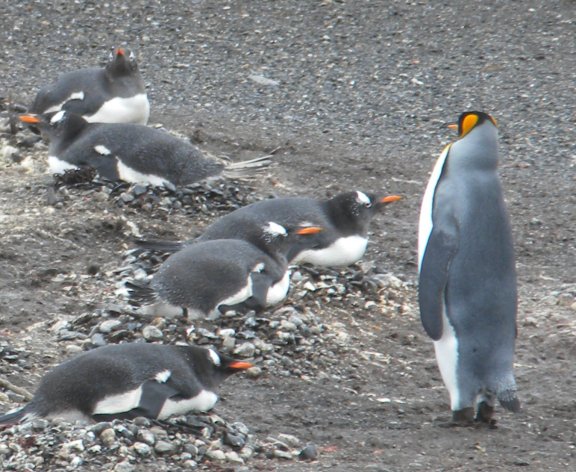
Mischa is very like the King Penguin at the right in the above picture, which was taken on the Isla de Pájaros on the Beagle Channel in Tierra Del Fuego. The largish penguin took a wrong turn into the Beagle Channel and wound up in a rookery consisting mostly of Magellanic Penguins and some Gentoos. It was obviously very lonely and disappointed. Every once in a while, he would try to mate with one of the Magellanic females, but caused uproars every time he tried.

Viktor’s Mischa shambles around the apartment, looking into the mirror, establishing a kind of hiding place behind some furniture, and displaying all the symptoms of a morose and puzzled disposition occasionally verging on depression. Even while Viktor worries that his writing job is connected with an assassination ring, Mischa slowly keeps getting worse. At the same time, he winds up taking care of Sonya, the daughter of one “Mischa-non-penguin,” who was associated with the editor who hired the writer, and who disappears after leaving money and a pistol. He also hires a teenage girl, the niece of his friend Sergey (who dies mysteriously) as a nanny for Sonya, who lethargically enters into a relationship with him.

I loved Death and the Penguin for its mellow strangeness. For a man surrounded by violent death, to which he may be contributing in some unexplained way, Viktor is relatively cool. Eventually, the situation changes rapidly. Mischa becomes ill and gets a heart transplant; and Viktor, well, let us say he takes action of an unexpected kind.