“A Web of Cigarette Smoke and Revery”

This Could Have Been the Place

Could This Have Been “Hotel Insomnia”?

I have just finished reading a strange surrealistic novel—one which made me want to find a poem to match. Here it is: “Hotel Insomnia” by Serbian-American poet Charles Simic.

Hotel Insomnia by Charles Simic

I liked my little hole,
Its window facing a brick wall.
Next door there was a piano.
A few evenings a month
a crippled old man came to play
“My Blue Heaven.”

Mostly, though, it was quiet.
Each room with its spider in heavy overcoat
Catching his fly with a web
Of cigarette smoke and revery.
So dark,
I could not see my face in the shaving mirror.

At 5 A.M. the sound of bare feet upstairs.
The “Gypsy” fortuneteller,
Whose storefront is on the corner,
Going to pee after a night of love.
Once, too, the sound of a child sobbing.
So near it was, I thought
For a moment, I was sobbing myself.

He received a Pulitzer Prize in 1990; and, in 2007, he was appointed Poet Laureate Consultant in Poetry to the Library of Congress.

The Melancholy of Departure (and Arrival)

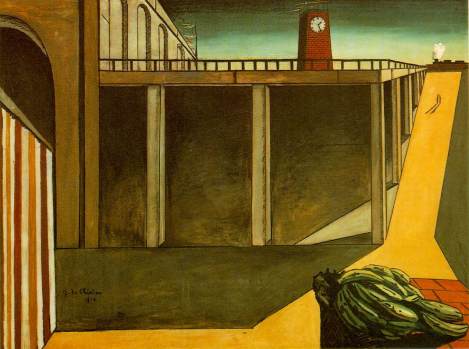
Giorgio di Chirco’s “Gare Montparnasse: The Melancholy of Departure”

Giorgio di Chirco’s “Gare Montparnasse: The Melancholy of Departure”

I usually do not write about a book until I have finished reading it, but I decided that I had to post this while the ideas were still fresh in my mind. Geoff Dyer’s novel The Search (1993) started out as a genre mystery/detection novel, but has transformed into a Giorgio di Chirico painting.

We are in a non-specific country in an area known as The Bay. A man named Walker (no first name given) winds up at a party with his brother and meets an alluring woman known as Rachel Malory and asks him to track down er ex-husband in order to get some papers signed. Walker finds Rachel seductive, but she does not allow herself to be seduced, which only spurs Walker on. Although he does it ostensibly for money, it is really she who is the goal of his endeavors.

So far, so good. But it is not long before strange things begin to happen. First of all, he meets a man named Carver who wants badly to compare notes with him about Malory. When he refuses, Carver threatens to kill him. So while he is chasing Mallory, he is being chased by Carver. Then even stranger things begin to happen:

There was something strange about the city but he was unable to work out what. Then it came to him. There were no trees or pigeons or gardens. Yet all around were the sounds of leaves rustling and the beating of wings, the cooing of departed birds. He was so shocked that he stood at a street corner, listening.

Then there was a closed bridge that was actually vibrating like a plate of Jello in the wind. Walker goes through a series of tatty cities in this strange nondescript landscape. In one, there are no people; and he is able to get a suit and a car without paying for them. In another, there doesn’t seem to be much of a city, but whatever there is is surrounded by a network of wide freeways on which all the motorists are speeding furiously.

There don’t seem to be any clues about Malory, but Carver or some unknown assailant is still chasing him through a series of random cities.
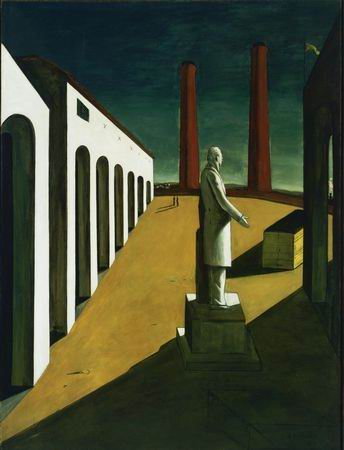
“Enigma of a Day”

“Enigma of a Day”

That’s when I thought of di Chirico, that painter of mysteriously nonspecific cities. Cities like Meridian, Port Ascension, Eagle City, Usfret, Kingston, Monroe, Durban, Iberia, Friendship—the list stretches on. Each town is different from the other, in a sort of alternate United States with black and Latino ghettos. In one unnamed city, he even finds what looks to be a picture of Malory with Rachel.

As the surrealism grows, I almost want to ration the rest of the book so that I don’t finish it too soon.


The Phantom Republic

It Lasted for Less Than 24 Hours

It Lasted for Less Than 24 Hours

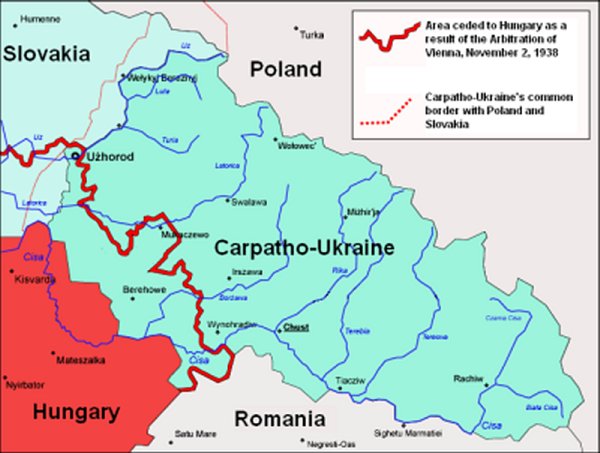
The darker green area on the above map marked Carpatho-Ukraine declared its independence from Czechoslovakia on March 15, 1939. Within less than 24 hours, it has been absorbed by Hungary with Nazi Germany’s blessing.I guess, from Germany’s point of view, it didn’t matter because it was inhabited by a bunch of Slavs, who were deemed to be of inferior racial stock. And Hungary by this time was an ally of Germany: My people were not only Aryans, they were Hung-Aryans. (In actuality, Hungary’s ruler, Admiral Horthy was intimidated into joining the Axis powers when he saw what happened to leaders of adjoining countries—such as the assassinated Engelbert Döllfuss of Austria—who were not part of Hitler’s program.)

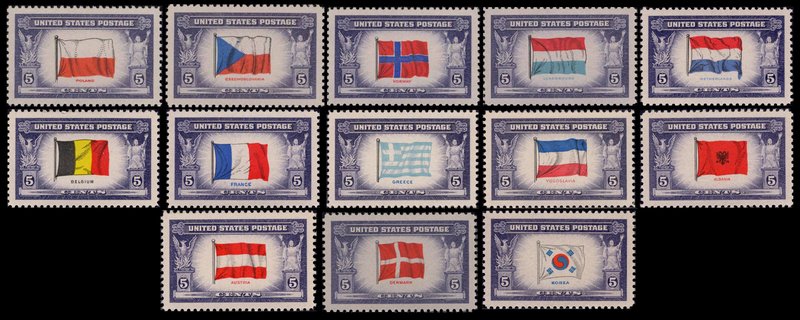
When I was a young stamp collector, I was surprised to find that Hungary was not in the Overrun Countries commemorative series of 1943-1944. It was only later I found out that Hungary was part of the Axis.

The Overrun Countries: I Guess Hungary Was Part of the Bad Guys

The Overrun Countries: I Guess Hungary Was Part of the Bad Guys

Hungary paid dearly for being part of the Axis. Although we “got” the short-lived Republic of Carpatho-Ukraine, we lost thousands at Stalingrad when the Nazi 6th Army was surrounded by the Russians.

And, after World War Two, the Carpatho-Ukraine territories were made part of the Ukrainian Soviet Socialist Republic. And, as they say, that was that!

The Most Scenic Highway in America

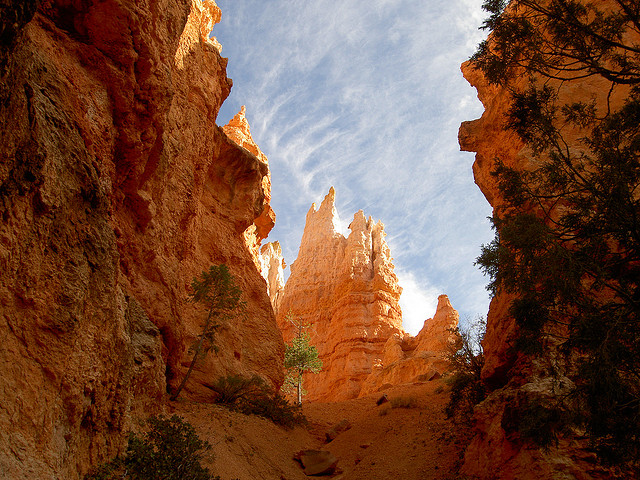
Bryce National Park

Bryce National Park

Of all the road trips I have ever taken in the Western United States, the most spectacular is Utah Route 12, which runs from a point along U.S. 89 between Hatch and Panguitch to the town of Torrey. Along the way, you will find Red Canyon, Bryce Canyon National Park, Kodachrome Basin State Park, Grand Staircase-Escalante National Monument, a scenic stretch known as “The Hogback,” Anasazi State Park, and Capitol Reef National Park. Nowhere else in the U.S. will you find 122 miles of concentrated scenic beauty equivalent to what you will find here. And, what is more, you are within hailing distance of the Grand Canyon, Zion National Park, Canyonlands National Park, Arches National Park, the Glen Canyon National Recreational Area, and Hovenweep National Monument.

Below is a map of the route:

Map of Utah Scenic Byway 12

Map of Utah Scenic Byway 12

For the full detail, you can consult a 23-page Adobe Acrobat PDF file by clicking here. In it, you will find that I left out at least half of your destination options.

Martine and I took this highway about six years ago. We considered it probably one of our best trips within the U.S., and certainly the best in the Southwest. Along the way, we visited several other National Parks and Monuments and tourist sites, including a spectacular museum of taxidermy (of all things) just outside of Bryce. We even stopped to see the “original” London Bridge in Lake Havasu City, Arizona.


Tarnmoor’s ABCs: Patagonia and Penguins

Killing Two Birds with One Stone

Killing Two Birds With One Stone, So To Speak

I was so very impressed by Czeslaw Milosz’s book Milosz’s ABC’s. There, in the form of a brief and alphabetically-ordered personal encyclopedia, was the story of the life of a Nobel Prize winning poet, of the people, places, and things that meant the most to him. Because his origins were so far away (Lithuania and Poland) and so long ago (1920s and 1930s), there were relatively few entries that resonated personally with me. Except it was sad to see so many fascinating people who, unknown today, died during the war under unknown circumstances.

My own ABCs consist of places I have loved (Iceland), things I feared (Earthquakes), writers I have admired (Chesterton, Balzac, Proust, and Borges); things associated with my past life (Cleveland and Dartmouth College), people who have influenced me (John F. Kennedy), foods I love (Olives), and things I love to do (Automobiles and Books). This blog entry is my own humble attempt to imitate a writer whom I have read on and off for thirty years without having sated my curiosity. Consequently, over the months to come, you will see a number of postings under the heading “Tarnmoor’s ABCs” that will attempt to do for my life what Milosz accomplished for his. To see my other entries under this category, hit the tag below marked “ABCs”. I don’t guarantee that I will use up all 26 letters of the alphabet, but I’ll do my best. Today the letter is “P” for both Patagonia and Penguins, which kind of go together in my mind.

Above is a photo I snapped on Isla Martillo, which lies on the Beagle Channel in Argentina’s Tierra Del Fuego. I had always wanted to go to Patagonia, ever since I read Paul Theroux’s The Old Patagonian Express and, even more, Bruce Chatwin’s In Patagonia. It was one of those places at the end of the earth. About six hundred miles south of Isla Martillo lies the Antarctic Peninsula. Even farther north lies Buenos Aires and the heavily populated temperate territories of Argentina.

Martine and I have always loved penguins. There was something helpless and cute about them, even though their fishy smell made them somewhat less than huggable. I think I was only able to get Martine to come with me to Patagonia if I could take her to places where she could walk among penguins in the wild. Although past “expeditionary” vacations in search of puffins and moose turned up a blank, I was able to deliver on the penguins—in spades. Isla Martillo was a small penguin rookery that was fascinating, and Punta Tombo in the State of Chubut was even more spectacular. We were there right around the time, to the day, that the Magellanic penguins were hatching. Our trip there was one of the happiest experiences of my life.

Do I want to go back to Patagonia? Absolutely. I’ve been there twice: The first time, on my own, I broke my shoulder by slipping on the ice in Ushuaia … but the second time was a charm.

Life always seems brighter when you could go to far places that you love.


Aun Aprendo

Not for Me the Stupor Bowl!

Not for Me the Stupor Bowl!

Instead of watching professional wife- and girlfriend-abusers concuss each other today, I did something that was a thousand times more satisfying: I attended a memorial service for my late friend Lee Sanders at the Besant Hill School of Happy Valley in Ojai, of which he was an active alumnus. Gathered there were members of his family, old friends (of whom I am one), and his former associates in the IATSE Projectionists Union Local 33 and the Culver City Democratic Club.

Lee lived several lives about which I knew relatively little, especially his activities in music and science. The side of him I saw was a brilliant and gentle soul who was politically active as well as an internationally known collector of film memorabilia and prints for projection. As I said in my short speech to the audience, he never had a bad word to say about anyone. He was something of a bodhisattva. (I, on the other hand, daily consign my perceived enemies to the deepest pit of hell, especially when I’m behind the wheel.)

What I found interesting—and new to me—was that to his family, Lee was better known as Guy Sanders. I knew he frequently showed up at his old school to help out; and it showed, because there was a great outpouring of love for him at the school. I was awestruck.

The Besant Hill School of Happy Valley was co-founded by several individuals, two of whom were great influences on my own life: J. Krishnamurti and Aldous Huxley. In fact, the last book Lee was reading was Volume V of The Collected Essays of Aldous Huxley, which I had given him.

Now that my own school—St. Peter Chanel in Bedford, Ohio—blinked out of existence last year, I would like, if possible, to do something for Besant Hill.

By the way, aun aprendo is the school’s Latin motto. It means, “I’m still learning.” That¹s a good motto, and I might adopt it for my own.