Not Enough Panem, Too Many Circenses

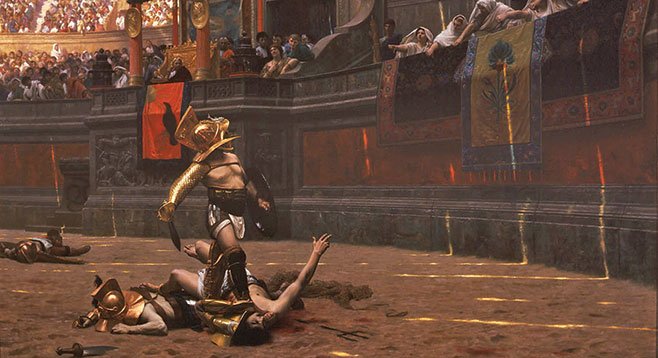
Gladiatorial Combat: A Giant Distraction?

Gladiatorial Combat: A Giant Distraction?

The phrase “bread and circuses” (in Latin, panem et circenses) comes from the Roman poet Juvenal’s Tenth Satire: “Already long ago, from when we sold our vote to no man, the People have abdicated our duties; for the People who once upon a time handed out military command, high civil office, legions—everything, now restrains itself and anxiously hopes for just two things: bread and circuses.”

Politics in America has become a costly form of entertainment. Costly because, as a society, we put so much time and money into the process—at the expense of what we should be doing to insure justice and polling access to all Americans, shore up our sagging infrastructure, feed our poor, and begin transitioning to technologies that protect us from the vagaries of climate change.

The 2016 presidential campaign is in full gear, with scores of wannabes who intend on becoming Sarah Palins. It’s a splendid career: Serve half a term in office and make big money giving occasional speeches to people who are outraged about … about … oh, well, you name it! And with very little effort! Donald Trump will spend untold millions, but he will become a hero to the feeble-minded who want to hear what he has to say. Ditto Scott Walker, Rick Santorum, Jeb Bush, and even some of the Democratic candidates.

You might call them political clickbait. They promise much, but in true American political style, deliver little—and certainly nothing that’s to the point.

I urge you not to be entertained by the whole process. Elections are a serious business, not a gladiatorial combat. If we vote in a lot of people who will spend their entire terms posturing and japing, we’re through as a nation.


Me and the Rainbow

John Dorr (1944-1993)

John Dorr (1944-1993)

I am not quite sure how to word this post, but I’ll give it a try anyhow: It’s about my dealings with gay males from high school days to the present. At this point, I’m not sure of my conclusions, or even if there is one. I guess, ultimately, I am dealing with an alternate form of behavior that, while viewed by many as being on the fringes, is becoming more acceptable as time goes on. While I am not among their number, I have occasionally been influenced by them.

In high school, the drum major of our marching band at Chanel High School was Ernie Horvath. A brilliant dancer, he went on to Broadway, changing his name to Lawrence Horvath. One day, he came in and showed me what he called his “fag shoes.” At the age of sixteen, I didn’t know what he was talking about. I understand he succumbed to AIDS.

At Dartmouth College, I remember one gay couple that was being demonstrative about their affections. They were chased across the campus by a bunch of fraternity types. I didn’t join the chase and don’t know how it ended.

UCLA film school brought me into an environment which was much more varied. One of my fellow grad students in the film department was John Dorr, a brilliant film scholar with whom I enjoyed conversing. At the time, I was somewhat dismissive of silent films, except for the great comedians, but John convinced me that they were great in a different way and were worth a second look. In the end, I agreed with him.

During the school strike after the Kent State shootings in 1968, we were putting together a schedule of “relevant” film screenings. John’s contribution was that we should show The Revolt of Mamie Stover. I still crack up when recalling that one with some of my old film friends.

Around this time, I went into group therapy. Among the participants were male and female gays. What I was there for was the feeling that my medical history made me feel isolated, like a Martian. I still looked like a teenager at the age of twenty-five and wondered whether any woman, ever, could take me seriously. What I found out was that, far from being a Martian, I was very much an Earthling. This was an important lesson for me: Irrespective of sexual leanings, isolation and fear of rejection were more universal than I suspected.

I dropped out of the film program in 1972 and went into computer programing. In the meantime, John Dorr went on to have a brilliant career, founding EZ Films and exploring the potential of video as an art medium. At this point we were not in touch, but I was greatly saddened to hear of his death from AIDS in 1993.

My one negative gay encounter was with my landlord Tony F. For many years, I was against gay marriage because I did not want to see Tony married to one of his typical rough-trade ex-con boyfriends and be subjected to their bullying and panhandling. He was actually considering turning our apartment building into a halfway house. But then he died—of AIDS and multiple other causes, mostly relating to negligence—about three years ago.

As I thought, there really is no conclusion. There’s good, there’s bad, and there’s indifferent. Just like the rest of life.


The West Cork Flying Column

IRA Re-Enactors 2014

IRA Re-Enactors 2014 at Old Fort MacArthur

At the Old Fort MacArthur Days military re-enactments, I always enjoyed stopping over to visit with the West Cork Flying Column, named after one of the most active and successful Irish Republican Army (IRA) units during the struggle for independence between 1919 and 1921. For one thing, they always had the best music; for another, this era has always been one of the biggest gaps in my historical knowledge.

This time, I picked up a list of recommended books from the group and proceeded to read Tom Brady’s Guerilla Days in Ireland about his command of the actual West Cork Flying Column in combating British regular army units, as well as the Auxiliary Division and the much-hated Black and Tan mercenaries.

Tom Brady During the Troubles

Tom Brady During “The Troubles”

Brady’s unit was perhaps the largest, most active, and most successful unit of the IRA fighting against the British-led units. Where many other parts of Ireland were relatively quiescent, the West Cork Flying Column conducted large scale attacks on barracks, burning houses of British loyalists in retaliation for British burnings of IRA sympathizer houses, attacks on patrols, as well as sabotage of railroads and bridges. And this with a maximum armed strength of approximately 150 men against the thousands fighting under the Union Jack.

Unlike many guerrilla leaders today, Brady cared deeply for the welfare of his men. He was always careful to identify and praise the fallen both in the description of the action fought and in a lengthy Appendix at the back of the book where he lists them alphabetically and identifies their origin.

Now my appetite for more background on recent Irish history has been whetted, and I plan to read more.


The Real Story

Chapo Guzman

Chapo Guzman

By now, you’ve all heard about the mile-long tunnel that drug cartel jefe Chapo Guzman used to escape from Altiplano Federal Prison in Mexico. Well, I’ve done a bit more research and have the actual sad tale for you with all its gory details.

I suppose when one has a weak government and a strong criminal class, one can expect spectacular prison escapes such as that of Señor Guzman—and spectacular it was!

Not only was the tunnel high enough that “Shorty” (that’s what El Chapo means) would walk out without bending over, but it was air-conditioned and had a chauffeured golf cart at the ready to evacuate the prisoner, who was wearing a tuxedo. At quarter mile intervals, there were mariachi bands to welcome Guzman to freedom, as well as ladies offering fresh tortillas de maiz with selected toppings for tacos, such as Beluga caviar and truffles. Aged Gran Patrón Platinum Tequila was available to quench his thirst.

Prison guards who had collaborated in the escape—in effect, all of them—were given new cars with glove compartments filled with crack cocaine.

Contrast that with the New York State prisoners who met a bad end within the last week or two. They just weren’t rich enough to “grease” their way out of stir.


On a Clear Day, You Can See Catalina

Saturday Was That Perfect Day

Saturday Was That Perfect Day

When Martine and I were at Old Fort MacArthur on Saturday, we had a perfect view of Catalina. It was the first time in all my years in Southern California that I was able to see the entire island at once from the mainland. That indentation toward the right of the island is the Two Harbors area, which came across crystal clear.

The island not only looked clearer, but also closer, almost ten miles closer than it usually does. The point from which I took the above picture is probably the closest point on the mainland, give or take a few hundred feet, to the island, which is some twenty-odd miles off shore.


Four Warriors

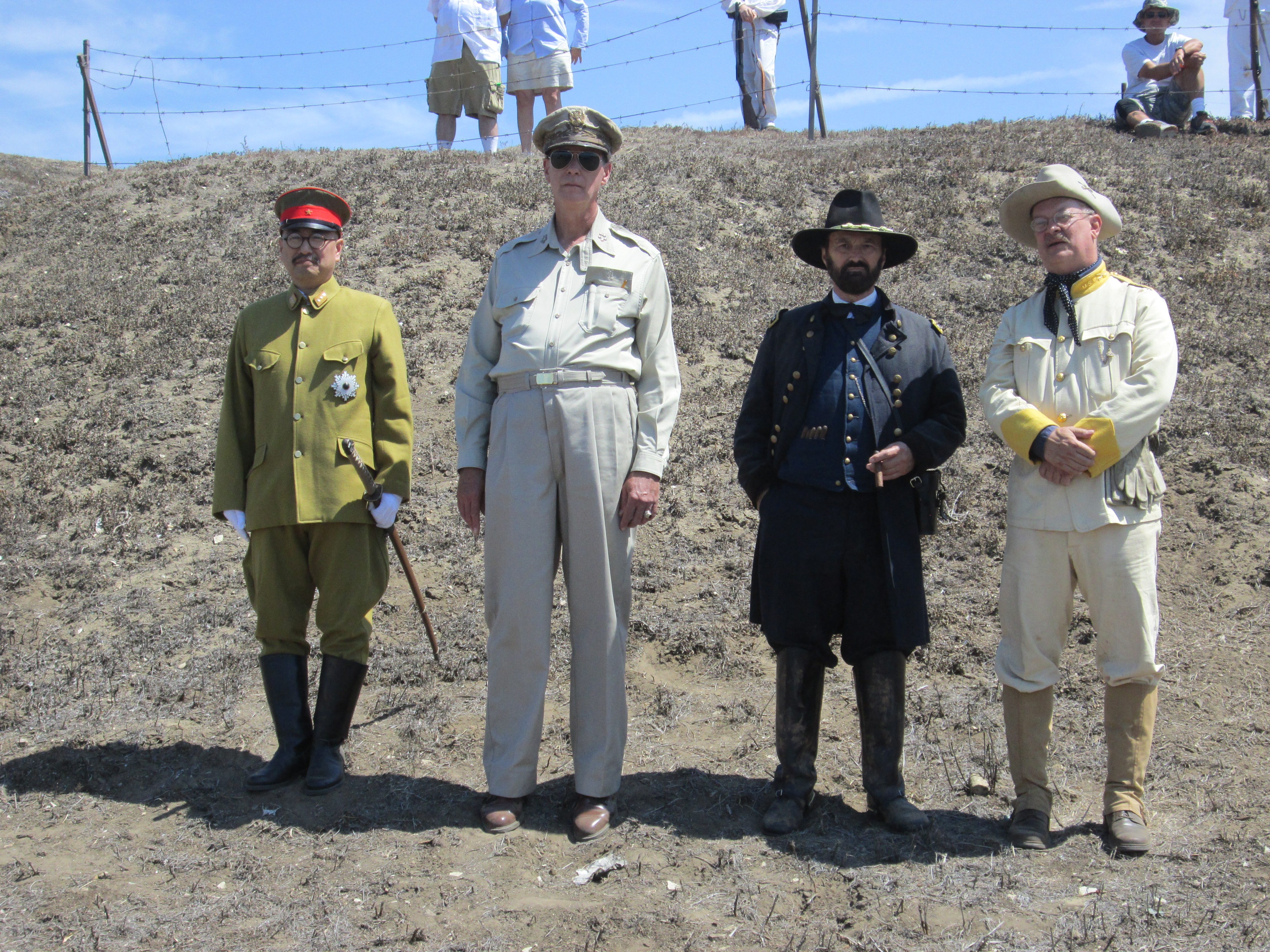
From Left to Right: Hideki Tojo, Douglas MacArthur, Ulysses S Grant, and Teddy Roosevelt

From Left to Right: Hideki Tojo, Douglas MacArthur, Ulysses S Grant, and Teddy Roosevelt

One would never expect to run into the above four gentlemen in 2015 unless it were at a military re-enactment such as the annual one at Old Fort MacArthur Days in San Pedro, California.

There are several reasons why I am interested in attending this event:

  1. I am a history aficionado who delights in learning. As a result of a visit to the West Cork Flying Column of the IRA, I have begun reading Tom Barry’s Guerilla Days in Ireland (1949).
  2. Many of the units impersonating groups before the days of heavy armaments in war also practice ironwork, weaving, herbal medicine, obscure musical instruments, and other arts that have disappeared in this post-industrial world … with interesting results.
  3. Many of the groups really get into the role they are supposed to be playing, such as the World War Two Russian troops with their cans of CPAM (Spam) from Lend-Lease and the various Roman legion groups, one with the Emperor Hadrian and the other with the Emperor Vespasian.

What I do not like are the actual battle re-enactments, which are noisy, smelly, and not terribly realistic. But then I would not like to see real bodies littering the hillside. Instead, Martine and I like to circulate among the different groups and talk to the enactors at their encampments.

Martine, for instance, spent some time talking to the ladies from the Salvation Army, circa 1917-1918, as they offered donuts to the doughboys. I spent much of my time with the Clan MacColin (about which more in a future posting), the West Cork Flying Column (from the Irish Rebellion), and various Civil War groups.


Weasel Words and Glittering Generalities

What Does “Heritage” Mean?

What Does “Heritage” Mean?

It’s words like “liberty” and “patriotism” that get my hackles up because they mean little but try to enforce agreement with some person or organization’s political stance. “Heritage” is one of them. Originally,it meant birthright, or something inherited such as values. It is used particularly by conservatives who want to convince people that the old values are best and worth preserving. You will find it most heavily used in the South, particularly in connection with the antebellum South in the good old days of slavery. That Confederate battle flag that was recently brought down in South Carolina stands for a whole congeries of values that many people outside the South would find repellent, such as nigras staying in their “rightful place” and local governments taking precedence over the Federal Government.

Today, you will find Southern apologists saying that the Civil War was fought over “States’ Rights,” not over slavery. All that “States’ Rights” really means is that those powers not specifically reserved by the Federal Government in the U.S. Constitution may be exercised by the individual states. The wording from the 10th Amendment of the Bill of Rights reads as follows: “The powers not delegated to the United States by the Constitution, nor prohibited by it to the States, are reserved to the States respectively, or to the people.” In actual practice, the term has been used as a code word advocating racial segregation.

George Orwell

George Orwell

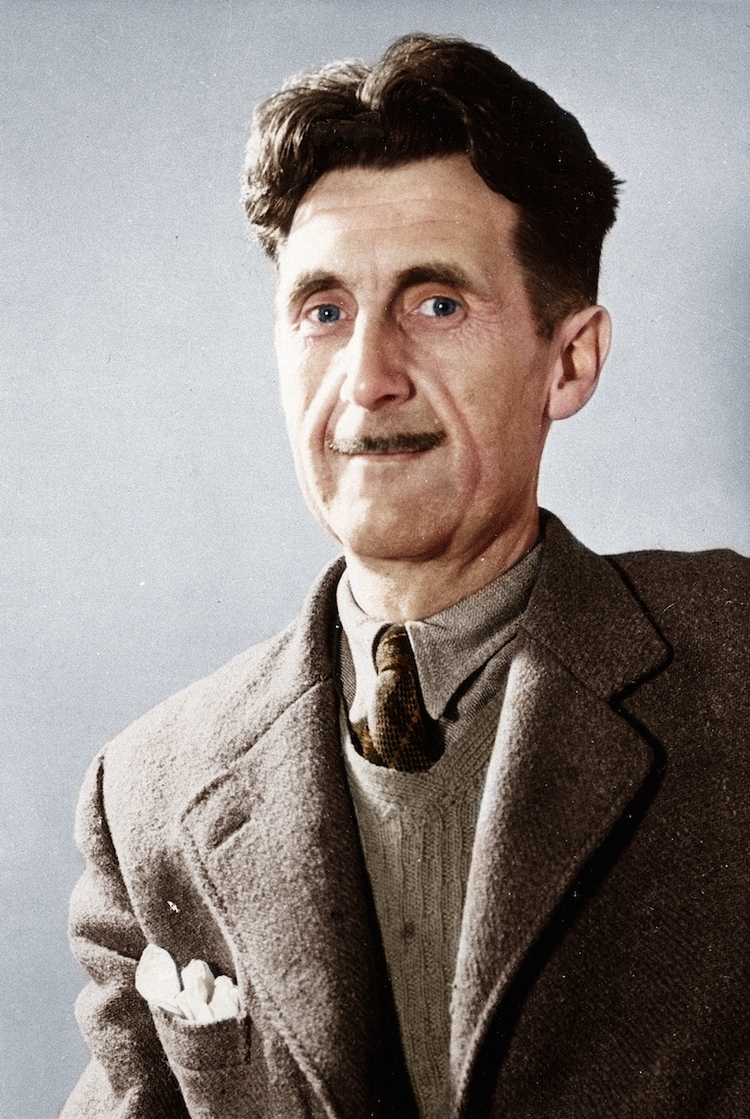
Perhaps the best statement of how language is used to confuse political issues is a 1946 essay by George Orwell entitled “Politics and the English Language.” It is so applicable even today that I urge you to take a few minutes to read it on this website. Under the heading of Meaningless Words, Orwell wrote:

In certain kinds of writing, particularly in art criticism and literary criticism, it is normal to come across long passages which are almost completely lacking in meaning. Words like romantic, plastic, values, human, dead, sentimental, natural, vitality, as used in art criticism, are strictly meaningless, in the sense that they not only do not point to any discoverable object, but are hardly ever expected to do so by the reader. When one critic writes, ‘The outstanding feature of Mr. X’s work is its living quality’, while another writes, ‘The immediately striking thing about Mr. X’s work is its peculiar deadness’, the reader accepts this as a simple difference opinion. If words like black and white were involved, instead of the jargon words dead and living, he would see at once that language was being used in an improper way. Many political words are similarly abused. The word Fascism has now no meaning except in so far as it signifies ‘something not desirable’. The words democracy, socialism, freedom, patriotic, realistic, justice have each of them several different meanings which cannot be reconciled with one another. In the case of a word like democracy, not only is there no agreed definition, but the attempt to make one is resisted from all sides. It is almost universally felt that when we call a country democratic we are praising it: consequently the defenders of every kind of regime claim that it is a democracy, and fear that they might have to stop using that word if it were tied down to any one meaning. Words of this kind are often used in a consciously dishonest way. That is, the person who uses them has his own private definition, but allows his hearer to think he means something quite different. Statements like Marshal Petain was a true patriot, The Soviet press is the freest in the world, The Catholic Church is opposed to persecution, are almost always made with intent to deceive. Other words used in variable meanings, in most cases more or less dishonestly, are: class, totalitarian, science, progressive, reactionary, bourgeois, equality.

Particularly in the political sphere, one must be vigilant about the definitions of words, especially when they border on the meaningless. So celebrate your “heritage” if you must—whatever it is—but don’t try to bludgeon us over the head with it.

Beware of Dihydrogen Monoxide (DHMO)

DHMO Can Be Found Virtually Everywhere!

DHMO Can Be Found Virtually Everywhere!

I don’t usually do this, but I am hijacking a hilarious post from the Today I Found Out website in its entirety. If I can’t improve on the material or the wording, I’m not going to try and pretend. Enjoy!

A major component of acid rain, an accelerator of corrosion and the rusting of metals, found in the tumors of cancer patients, a contributor to the greenhouse effect, fatal if inhaled, and capable of causing serious burns in the right circumstances, colorless, odorless and tasteless dihydrogen monoxide (DHMO) is responsible for thousands of deaths each year.

An exercise in perspective, by focusing simply on the negative, we can easily be tricked into thinking just about anything is bad, even something as necessary to life as water, made of two hydrogen atoms and one oxygen atom, hence dihydrogen monoxide. And thanks to a few precocious people, at different times over the last few decades, that is precisely what happened.

One of the earliest dihydrogen monoxide hoaxes was printed on April 1, 1983, in the Durand Express, a weekly newspaper in Shiawassee County, Michigan. The article warned the populace that inhaling the chemical “nearly always results in death,” and its “vapors … cause severe blistering of the skin which can be fatal if extensive.” By the end of the article, however, it was revealed that the dangerous chemical was, in fact, just water.

So Simple, and Yet So Potentially Deadly!

So Simple, and Yet So Potentially Deadly!

With the dawn of the internet, the chemically savvy continued to prey on the ignorant, and by 1994, internet jokers pretended to have serious conversations about the dangers of dihydrogen monoxide. One of the earliest fake organizations, eventually called the Coalition to Ban Dihydrogen Monoxide, was formed by students at the University of California, Santa Cruz, in 1989.

Early claims included: “Millions of gallons of the stuff are sprayed on fruits and vegetables. Do you want your children eating that stuff?” It was an “invisible killer” that was “found in almost every stream, lake and reservoir in America,” and that the U.S. Navy was “designing multi-billion dollar devices to control and utilize it during warfare situations [and even that] research facilities receive tons of it through a highly sophisticated underground distribution network.”

These early sites also noted that this “hazardous chemical” was used “as an industrial solvent and coolant . . . in many forms of animal research . . . in the distribution of deadly pesticides . . . [and] as an integral part of the operation of nuclear power plants.” They also claimed that although it could damage concrete, erode natural landscapes and interfere with the operation of automobile brakes, it was still used “as a fire retardant” and “an additive in certain junk foods and other food products.”

Funny now, at the time, some people were truly deceived. In fact, one hoax in 1997 was so convincing, its four teenage masterminds were arrested and nearly faced criminal charges.

The young men, aged 14 to 16, distributed fliers in the Wylie Heights neighborhood outside of Pittsburgh, Pennsylvania, that carried warnings that dihydrogen monoxide was responsible for “severe hydration, frequent urination and possible death.” They included an 800 number on the flier (that directed the caller to a telephone sex business) and listed the name of the father of a classmate as a “county health inspector.” After the “health inspector” received several calls from distraught people, some of whom got mad at him, he called the police. The teens were eventually identified when they blabbed to his son, their classmate. Although they were not ultimately charged, they were forced to go door-to-door to apologize.

Also in 1997, Nathan Zohner, a 14-year-old student at Eagle Rock Junior High in Idaho Falls, Idaho, as part of a science project called “How Gullible Are We?” warned 50 of his classmates of the “dangers” of DHMO and asked them to join his effort to ban DHMO. He was able to get 43 to sign his petition.

Besides average citizens and middle school students, sometimes even public officials have been fooled. In March 2004, the City Council of Aliso Viejo, California, had planned to take up a ban on foam cups because of “environmental concerns . . . [of] the danger posed by dihydrogen monoxide, described as a chemical used in production of the [foam cups] that can threaten human health and safety.” Blaming the initiative on “a paralegal who did bad research,” the city’s manager pulled the proposed law from the agenda prior to any vote.

The Antiquarian

It’s Funny How Times Change....

It’s Funny How Times Change….

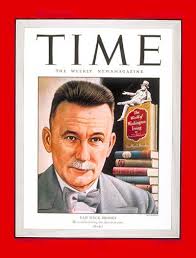
In the 1940s, Van Wyck Brooks’s reputation was riding high. There he is in 1944 on the cover of Time magazine, along with an inset photo of his book which I have just finished reading: The World of Washington Irving. Go to a used book store, and you won’t have much trouble finding nice hardbound copies of his best books, titles like The Flowering of New England, The Times of Melville and Whitman, and New England: Indian Summer. Go to a new book store, and you are not likely to find any of his work.

I guess it’s all a matter of fashion. I read The World of Washington Irving and The Flowering of New England with rapt attention, Brooks’s knowledge of his subject matter was nothing less than awesome. But the tone is different from today’s literary critics. Brooks was an antiquary: He worshiped and celebrated the past, which for him was a pageant from beginning to end.

Take, for example, this quote from a letter written by Philip Pendleton Cooke to Edgar Allan Poe, about how rural Southerners were no longer as literate as they used to be:

My wife enticed me to visit her kinspeople in the country, and I saw more of guns and horses and dogs than of pens and paper. Amongst dinners, barbecues, snipe-shooting, riding parties, etc., I could not get my brains into humour for writing to you or to anybody else.

And yet, Brooks had, I felt, a better of understanding of Poe than any other writer I have read:

Meanwhile, the tales Poe was writing had much in common with [his poems],—and they were sometimes as musical in the beauty of their prose,—and there one also found dim tarns, wild and dreary landscapes and phantom figures flitting to and fro. Evil things in robes of sorrow presided over some of these tales, with their strange effects of horror, the macabre and the grotesque, a world of the phantasmagoric, suggesting the dreams of an opium-eater and reverberant with Thomas de Quincey’s “everlasting farewells.”

Brooks is one of those writers who sends me looking for new authors. The Flowering of New England introduced me to Francis Parkman, and I suspect that The World of Washington Irving will send me on a similar voyage of discovery with its eponymous writer as well as William Bartram, John James Audubon, William Cullen Bryant, and James Fenimore Cooper.

Not coincidentally, I want to read more Brooks. Perhaps I, too, am an antiquarian of sorts, but nowhere in his league!

Surprise: They’re Not All Blondes

Some Surprising Results from Gene Studies

Some Surprising Results from Gene Studies

All the people in the above photograph are Icelanders. What you are looking at are some of the contestants in the Irish Days festival in Akranes, a small city just north of Reykjavík. Now why would Iceland be having an Irish Days festival?

Apparently Iceland was first settled by Irish hermit monks for about a century before Ingólfur Arnarson became the first Scandinavian settler in A.D. 874. These papar (“Papists”), as they were called, did not stick around once they were surrounded by hyper-aggressive heathens. And, being celibate, they probably did not add their genes to the population of Iceland; but the Vikings did raid Ireland for slaves, and that’s where things suddenly become interesting.

Genetic studies taken of the Icelandic population show that 20% of the males and 63% of the females have Irish ancestry. I find that statistic to be interesting, but I have some trouble wrapping my head around it. Even if the Vikings preferred Irish redheads to the Scandinavian blondes, the Irish women would give birth to as many if not more males than females (the ratio is 21:20 in the U.S.). Perhaps the male Irish slaves had a harder life and were not permitted to mate, while the women were encouraged to bear children, whether within or outside of wedlock. If so, it’s just another instance of the hard life that the Irish have suffered through the ages.

Prizewinner at Akranes

Prizewinner at Akranes

By the way, the winner of the Akranes competition was one Laufey Heiða from the Westfjords. Runner-up was Vígdis Birna, who is shown above receiving her prize.

One thing I can say with certainty is that Icelandic women tend to be beautiful, whether they are blondes or redheads.