Tarnmoor’s ABCs: Yucatán

Temple of the Dwarf at Uxmal

Temple of the Dwarf at Uxmal

All the blog posts in this series are based on Czeslaw Milosz’s book Milosz’s ABC’s. There, in the form of a brief and alphabetically-ordered personal encyclopedia, was the story of the life of a Nobel Prize winning poet, of the people, places, and things that meant the most to him.

My own ABCs consist of places I have loved (Iceland, Patagonia, Quebec, Scotland), things I feared (Earthquakes), writers I have admired (Chesterton, Balzac, Proust, Borges, and Shakespeare); locales associated with my past life (Cleveland, Dartmouth College, and UCLA), people who have influenced me (John F. Kennedy), foods I love (Olives and Tea), and things I love to do (Automobiles and Books). This blog entry is my own humble attempt to imitate a writer whom I have read on and off for thirty years without having sated my curiosity. Consequently, in the next couple of weeks, you will see one remaining posting under the heading “Tarnmoor’s ABCs.” To see my other entries under this category, hit the tag below marked “ABCs”. We are approaching the end of the alphabet today with “Y” for “Yucatán.”

It was the start of my travels: November 1975. Before then, all my traveling was at the behest of my parents or schools. That year, I suddenly decided I wanted to see Mayan ruins—on my own. My parents were appalled. They were sure I would be captured by bandidos, roasted and eaten. It didn’t turn out that way: I had the time of my life. Over a period of two and a half weeks, I saw the ruins at Dzibilchaltún, Uxmal, Chichén Itzá, Kabah, Acanceh, and Mayapan. I went to a Mexican tourist agency called Turistica Yucateca and arranged, in Spanish, for tour guides. (When did I ever learn Spanish? I just winged it and have been winging it ever since.)

From the moment I landed at Manuel Crescencio Rejón Airport in Merida, I was in a world of wonders. It was a warm evening, and I saw shops open to the street and people sitting outside drinking beer and sodas and chatting with their friends and neighbors. I had great food at places like the Restaurant Express on Calle 60 and Alberto’s Continental Patio and Los Tulipanes. I stayed at fascinating hotels, including the crumbling old Gran Hotel, which dated back to the late 1800s when Yucatán was the hemp (rope fiber, not marijuana) capital of the world.

I was hooked. So hooked that, ever since, I insisted on people saying just Yucatán, not “the” Yucatán. I knew. I was there. And not once, but many times.I would no more say “the” Yucatán than I would say “the” California or “the” Poughkeepsie.

I loved the tropical ambiance of Merida and the surrounding country. And people were friendly, probably more friendly then than they are now.

So that’s when I caught in travel bug. The next year, I went to England, Scotland, and Wales. Then on to Hungary and Czechoslovakia. But during the 1980s, at several points I returned to Mexico and Yucatán, sometimes for a month at a time. I rode the rickety old buses, held babies for overwrought young mothers, snacked on strange foods, and felt myself growing as a person, and perhaps as a citizen of the world.

 

Carlos Gardel

He Died Eighty Years Ago Today in a Plane Crash

He Died Eighty Years Ago Today in a Plane Crash

Perhaps the greatest singer Argentina ever produced died eighty years ago today in a plane crash near Medellín, Colombia. The following is a re-post from Multiply.Com dated July 4, 2011:

The most enduring popular music of Argentina and Uruguay is tango. Both countries lay claim to have originated it, though from our point of view, some six thousand miles north of the Pampas, it hardly matters. Suffice it to say that there was one master of the form who from 1917 to 1935 made such a mark that he will never be forgotten.

I am referring to Carlos Gardel (1890-1935), who died in a plane crash near Medellín, Colombia, at the height of his career. According to the Argentina Independent, Gardel’s story comes replete with all the makings of a folk hero: immigrant origins, a middle class upbringing, musical genius, and a tragic death. As is typical of an artist as high profile as Gardel, controversy lingers surrounding the location of his birth: though his lawyer recently presented an original birth certificate of Charles Romuald Gardés, born in Toulouse, France, any Uruguayan will remind you that Gardel often affirmed that he was born in Tacuarembó, Uruguay: “My heart is Argentine, but my soul is Uruguayan, because that is where I was born,” he once declared.

Gardel grew up in the Abasto neighborhood of Buenos Aires, where he attained the affectionate nickname ‘Carlitos’ and learned to sing operas and Argentine folk music while working as a professional applauder in opera houses. He recorded his first tango, ‘Mi Noche Triste’ (My Sad Night) in 1917. Until then, tango had been an almost entirely instrumental form of music. Gardel’s music revolutionised the genre by bringing tango from underground dance salons to upper class and international popularity. His name continues to serve as a synonym for tango, and his songs live on as classics of the modern era.

Perhaps his most famous tango is ‘Por una Cabeza’ (By a Head), which tells the story of a horse-track gambler who is addicted to excitement and romance. Just by happenstance, Gardel recorded his most famous tango on film. You can see it by clicking here.

Whether he was born in France or Uruguay doesn’t matter any more. What matters is what he did to a musical form that took the world by the storm in the 1920s. It all started when Rudolph Valentino made his silent film The Four Horsemen of the Apocalypse in 1921. Audiences wanted to know more about the music that their screen idol was dancing to, and so from the piano score of a silent film it spread like wildfire.

In preparation for my [2011] trip to Argentina, I am loading my MP3 player with tangos by Gardel and others. You might want to see some more of the YouTube videos clips featuring his lyrics sung by him (as opposed to instrumental versions).

The lyrics of the early tangos were written in the lunfardo dialect of Argentinian Spanish (or Castellano), which essentially a form of slang which emerged from the slums of Buenos Aires.

Musical Madeleine

LAPD Emerald Society Piper

LAPD Emerald Society Piper

You’ve probably heard about Marcel Proust’s triggering of his memory by eating French cookies known as madeleines. Well, since I’m diabetic, I have to use something else to trigger my memories. In that department, I find that, for me, nothing works better than music.

The police bagpipe player (above) was practicing a song that suddenly hit me between the eyes. I walked up to her and startled her by asking the name of the song she was playing. One of her colleagues answered for her with something that sounded like “Saigon.” He mentioned that it was played in a movie called Empire something. That’s when it all came back to me: The song is called “Suo Gân,” which means lullaby in Welsh. The movie is Steven Spielberg’s Empire of the Sun (1989), based on J.G. Ballard’s autobiographical novel of the same name about spending World War Two as a child in a Japanese concentration camp near Shanghai.

I love the song. You can watch it on YouTube performed by the Kings College Choir.

My Favorite Spielberg Film

My Favorite Spielberg Film

I’ve seen Empire of the Sun several times and even read Ballard’s book. There is something incredibly beautiful about so many Welsh songs that I plan to write a posting about some of my favorites in the next week or so. If you feel starved to hear some now, watch the film How Green Was My Valley (1941), which features some beautiful examples.

What exactly did hearing a few notes from “Suo Gân” do for me when I heard them played by a police bagpiper at last Sunday’s Irish Fair in Long Beach? It sent me back to Wales, which I visited twice in the 1970s. Welsh is the most musical language I have ever heard; and I loved wandering around listening to people speak in places like Betws-y-Coed, Conwy, and Abergavenny.

Although I am a person of words and literature, music strikes me at my innermost core—even when I hear just a few notes.


Blue Dollars

Officially, They’re Illegal, Yet There’s an Official Rate

Officially, They’re Illegal, Yet There’s an Official Rate

If you go to Argentina, you can pay one dollar to get 9.07 pesos. Alternatively, you can also pay one dollar to get 13 pesos. Now which rate would you prefer? When you go to the bank, you’ll be offered the 9.07 peso rate. But if you go to certain money changers on Calle Florida and wave a few crisp, new Benjamins (that’s $100 notes) at them, you might possibly get the 13 peso rate.

Last week, the Argentinian government went after several “blue dollar” traders and announced hefty fines against firms involved in the exchanges.

And yet, each day, one could find the official and the blue dollar rate published on the Buenos Aires Herald website. If trading at the blue dollar rate is illegal, why does the government condone promulgation of the rates? It’s as if the DEA published today’s rate for opium, crack cocaine, and heroine as a means of assisting drug dealers standardize their rates.

I am following the issue closely, because I am not averse to getting blue dollars at the black market rate, providing I could do so safely. I will ask around at my hotel when I get there.


Princesses of the Dance

Beauty, Grace, and Danger

Beauty, Grace, and Danger

This weekend was the 40th Annual Big Irish Fair and Musicfest, which was held at El Dorado Park in Long Beach. One of the highlights, especially for a dirty old man such as myself, is watching the young girls compete in traditional Irish stepdancing.  With their hands held rigidly at their sides, they went into an astonishing series of high kicks.

As I told Martine, most of these girls could kick me in the balls twenty-five times before I had time to react to the initial kick.

The dancer pictured above was particularly good. I would be very surprised if she didnt leave with a handful of trophies. Below is a photo of her in motion:

On Stage

On Stage

You may remember not too many years ago the fame of one Michael Flatley, who toured the world doing stepdancing in shows entitled “Riverdance” and “Lords of the Dance.” Today, he is retired with severe injuries to his cervical, thoracic and lumbar vertebrae, not to mention his sacroiliac. I wonder how far these lovely young women have to go before encountering similar injuries.

Such a Nice Boy

I Had Developed a Reputation

I Had Developed a Reputation

It’s odd the way the past keeps getting dredged up. I had forgotten about Minichiello’s Pizzeria which stood opposite the Nugget Theater (above) on Main Street in Hanover, New Hampshire. I had managed to get a doctor’s letter absolving me from eating at Dartmouth College’s student dining hall, on the grounds that the food there nauseated me. So I usually ate at the restaurants in Hanover, of which there were about ten at the time—at least including those in my price range.

One of the places I ate was Minichiello’s: They had good pizza and were friendly. The only problem was they thought I was such a nice boy. You must remember that when I was a college senior, I looked as if I were still twelve; and I was subject to bullying by the local high schoolers until they saw I was carrying a college ID. So there I was, munching away at my pizza, when they introduce their daughter to me. She was very cute in a bad girl sort of way, and here her parents were holding me up as an example she should follow—instead of those bad boys who worked at the local garage.

God knows, if it weren’t for the fact that I was seriously ill with a pituitary tumor and, as a result, had not yet physically reached the age of puberty, I would much rather be doing with her those things her parents feared she was doing with the bad boys.

I was a good boy because I had no choice. I would much rather have had fun exploring her anatomy in a dark place rather than holding myself up as some sort of role model, which I was not. (Of course, nothing would have happened in any case because the girl thought I was a dweeb, and she was just being nice to her parents.)

In the end, the Minichiello girl went on to have her life, and I, mine. It was just one of those moments in which I was being nudged by fate into acting a part I did not feel was really mine.

As you all know, I am really bad to the bone.


Eager Beavers

In South America, the Friendly Beaver Is an Enemy

In South America, the Friendly Beaver Is an Enemy

About seventy-five years ago, someone thought it would be a great idea to introduce beavers to Tierra del Fuego, at the southernmost tip of South America, so that it could be hunted for its fur. The 20 beavers brought over from Manitoba in 1940 have now multiplied to 150,000—even outnumbering the 134,000 human residents of the area.

As is usually the case, the well-intentioned people who introduced the beavers did not consider the vastly different ecosystem. The dams built by the invaders do not help the ecosystem as wetlands do not form due to the type of flora, and the forests of native Nothofagus trees are being destroyed by the beavers, which have no native predators. Residents of Patagonia are afraid of the species’ spread northward, as they have no difficulties crossing salt water on their trek to the mainland.

Seeing the devastation wrought by the busy little rodents in Tierra del Fuego, New Zealand has prohibited the introduction of the beaver under its Hazardous Substances and New Organisms Act of 1996.


Did the Earth Move for You, Too?

A Force That Could Push Mount Everest Around

A Force That Could Push Mount Everest Around

CNN has just announced that the recent magnitude 7.8 quake in Nepal moved Mount Everest to the southwest by 3 centimeters (1.2 inches). The story added, as an aside, that the height of the mountain is unchanged, just its location.

As Neil deGrasse Tyson once said, “If your ego starts out, ‘I am important, I am big, I am special,’ you’re in for some disappointments when you look around at what we’ve discovered about the universe. No, you’re not big. No, you’re not. You’re small in time and in space. And you have this frail vessel called the human body that’s limited on Earth.”

I am always shocked at man’s puniness, not only in the face of the universe, but just on his native planet.

Did you know, for existence, that perhaps the most powerful volcano on earth is Yellowstone National Park? (It is sometimes referred to as the Yellowstone Supervolcano.) Its caldera measures 35 by 45 miles. Three times it has erupted: 2.1 million, 1.3 million, and 640,000 years ago. Each time it substantially re-formed what is now the North American continent. Lest you feel smug, two huge magma chambers have been recently discovered in April. That doesn’t mean that Yellowstone will blow its top this year, or even in our lifetime and the lifetimes of our descendents, but when it does happen, it’ll be something to write home about, if home still exists.

There is a Buzzfeed site called 26 Pictures Will Make You Re-Evaluate Your Entire Existence. Before you decide to cut off your fellow motorist on the highway in your shiny new Porsche, perhaps you should meditate a while on it.


Smurov Is Alive—and Dead!

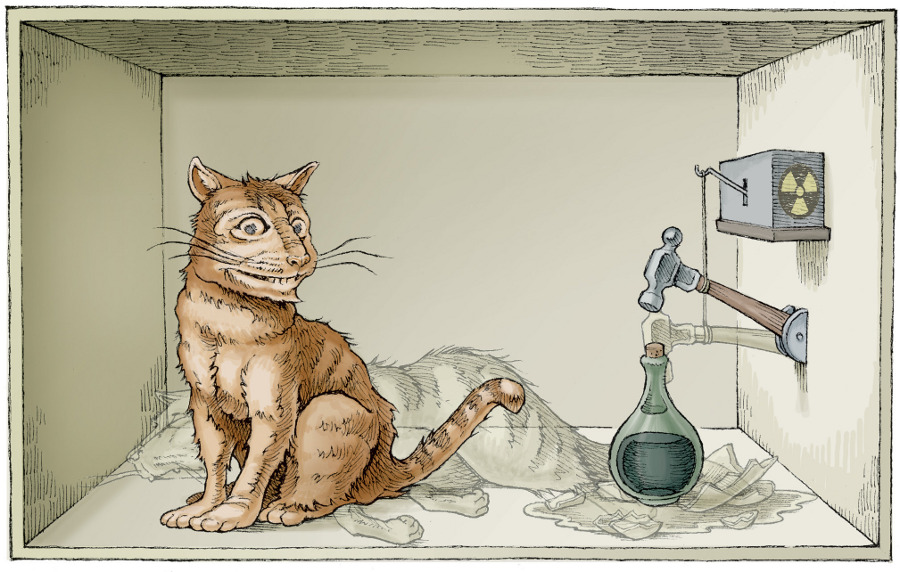
First, You Have to Understand About Schrödinger’s Cat

First, You Have to Understand About Schrödinger’s Cat

Vladimir Nabokov in his 1930 novelette The Eye seems to have anticipated Austrian physicist Erwin Schrödinger’s famous thought experiment of 1935. According to Wikipedia, it goes as follows:

Schrödinger’s cat: a cat, a flask of poison, and a radioactive source are placed in a sealed box. If an internal monitor detects radioactivity (i.e. a single atom decaying), the flask is shattered, releasing the poison that kills the cat. The Copenhagen interpretation of quantum mechanics implies that after a while, the cat is simultaneously alive and dead. Yet, when one looks in the box, one sees the cat either alive or dead, not both alive and dead. This poses the question of when exactly quantum superposition ends and reality collapses into one possibility or the other.

Naturally, most people do not entertain the notion of being alive and dead at the same time.  Yet in The Eye, the narrator Smurov commits suicide at the very beginning after having been ignominiously caned by the husband of his mistress Matilda. The rest of the story consists of Smurov investigating his own life among the Russian emigré population of Berlin, finding that he is roundly disliked by most everyone.

So, the question arises: Is Smurov alive or dead? Or is Smurov both alive and dead? (Or could the narrator be unreliable, having missed his heart with the revolver bullet?)

In an article in the May 2, 2015, issue of The New Scientist, Douglas Heaven speculates:

For [Physicist John Archibald] Wheeler, this meant the universe couldn’t really exist in any physical sense—even in the past—until we measure it. And what we do in the present affects what happened in the past—in principle, all the way back to the origins of the universe. If he is right, then to all intents and purposes the universe didn’t exist until we and other conscious entities started observing it.

Sound crazy? Then try this one on for size. Another interpretation of quantum mechanics is Hugh Everett’s many worlds hypothesis, which posits that everything that could happen has and does, in an infinite number of universes. Every time you make a decision, the universe splits in two, with you in one branch and an alternative you in the other, living the other possibility. The universe you occupy is, in some sense, an individual universe of your own making.

This idea is enough to give anyone a reality check. “My natural inclination is to be a realist,” says Chris Timpson, a philosopher of physics at the University of Oxford. “But if you’re going to be a realist about the quantum world then you’re left with a world that is very peculiar.” So peculiar, in fact, that the idea that it only exists because of us seems almost sensible.

There now, I’ll leave it up to you to decide whether Smurov is alive or dead or both. It all depends on your understanding of quantum mechanics in any universe you appear to be inhabiting at the moment, whatever THAT means!