Advancing the Schmilblick

Some Untranslatable French Expressions

Some Untranslatable French Expressions

I think we tend to seriously underestimate the French. (Oh, drat, I split another infinitive!) Here are a few expressions that you might find interesting.

Faire avancer le Schmilblick

That strange word means nothing more or less than “thing.” When having a conversation, comments not deemed to be helpful are described as not advancing the Schmilblick along. If you speak excellent French, here is a YouTube video describing the origin of the term.

C’est le petit Jésus en culotte de velours

You’ve just had an incredibly smooth wine. It was, in other words, “as smooth as Baby Jesus in velvet knickerbockers.” (You can’t say that about an American beer.)

Avoir le cul bordé de nouilles

You are incredibly lucky—such that your ass is surrounded by noodles.

Il pète plus haut que son cul (ou tête)

There are two variants to this one, both describing someone who is incredibly pretentious. The way Martine and her mother described it, “He tries to fart higher than his own head.” Others say  “higher than his own ass.” Perhaps Martine’s version is the way they say it in Normandy.
Serendipity: The Winds of Change

The Book Is the Same, Only the Reader Has Changed

The Book Is the Same, Only the Reader Has Changed

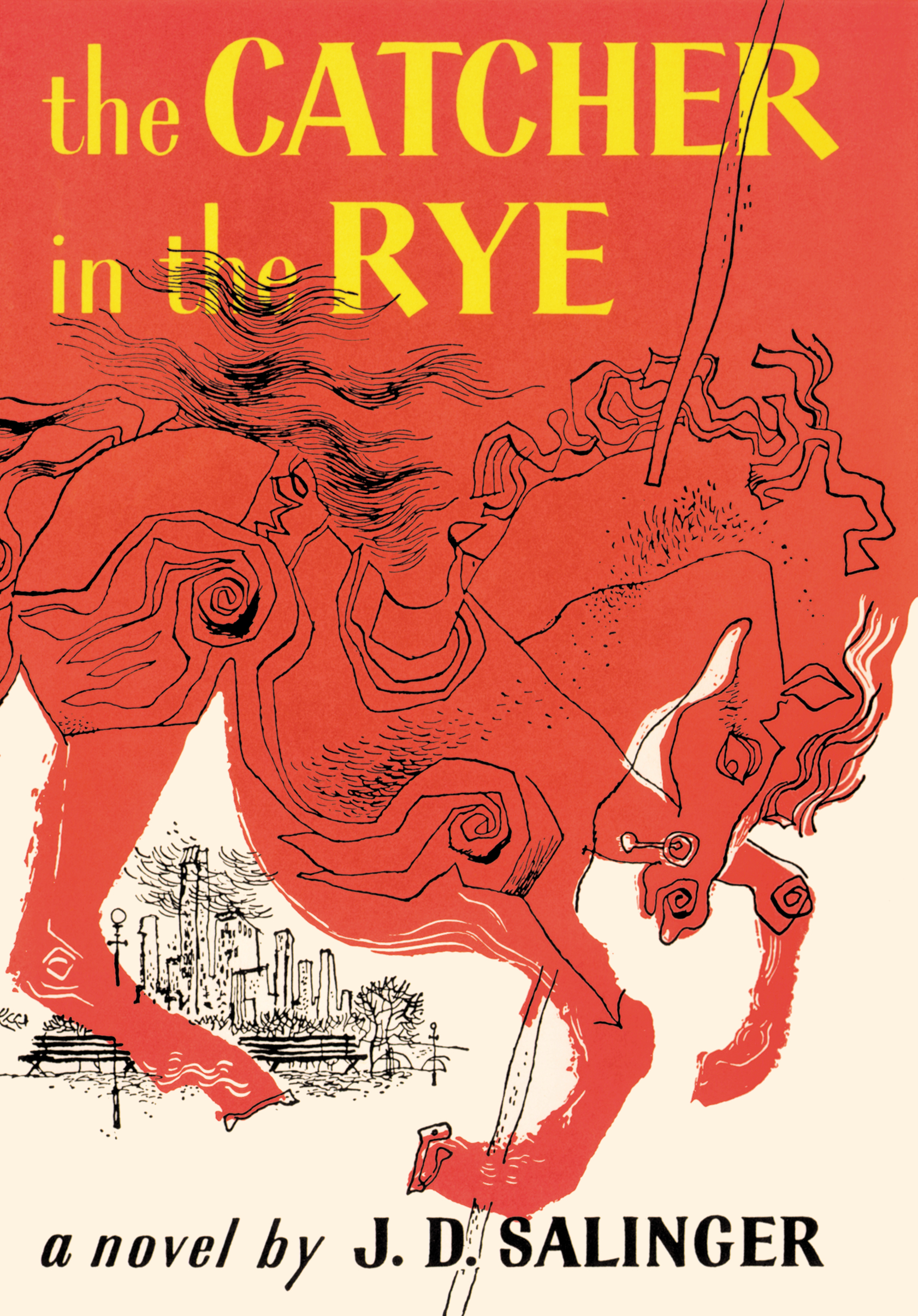
The thing about re-reading books you first encountered decades ago is to feel the winds of change in your life. When I first read J. D. Salinger’s The Catcher in the Rye, I was a high school student looking forward to leaving Cleveland to go to college. The book was a revelation to me, and re-reading it at this late stage in my life shows me sitting on the porch of our house at 3989 East 176th Street, turning the pages and marveling at a book written for kids like me. It’s a good feeling: I accept that 16-year-old kid. He was all right.

Following is a quote that pretty much describes my feeling at re-reading The Catcher in the Rye:

The best thing, though, in that museum was that everything always stayed right where it was. Nobody’d move. You could go there a hundred thousand times, and that Eskimo would still be just finished catching those two fish, the birds would still be on their way south, the deers would still be drinking out of that water hole, with their pretty antlers and their pretty, skinny legs, and that squaw with the naked bosom would still be weaving that same blanket. Nobody’d be different. The only thing that would be different would be you. Not that you’d be so much older or anything. It wouldn’t be that exactly. You’d just be different, that’s all. You’d have an overcoat on this time. Or that kid that was your partner in line last time had got scarlet fever and you’d have a new partner. Or you’d have a substitute taking the class, instead of Miss Aigletinger. Or you’d heard your mother and father having a terrific fight in the bathroom. Or you’d just passed by one of those puddles in the street with gasoline rainbows in them. I mean you’d be different in some way – I can’t explain what I mean. And even if I could, I’m not sure I’d feel like it.

Well, unlike Holden, I am in fact much older; but that’s okay. Better, in fact, than the alternative.


Costa, Sierra y Selva II

Physical Map of Ecuador

Physical Map of Ecuador

This is a kind of continuation of a blog I wrote a couple of years ago about Peru. In so many ways, Ecuador is a continuation of Peru—in terms of physical geography. Even a cursory glance at the above map shows that there are three distinctive zones vertically dividing the country:

  • Costa. This is the Pacific coast. While in Peru, much of the coast is a rainless desert, much of the Ecuadorian equivalent is a mangrove forest (I suspect perhaps mangrove swamp is a more appropriate term.). Guayaquil, the country’s largest city, is on the coast.
  • Sierra. The brown and purple zone occupying the center are the mountains and volcanoes of the Andes. This is where my brother and I will travel. The altitude ranges from 8,000 to 15,000 feet. The capital, Quito, is in this zone.
  • Selva. The pale green zone to the right of the Andes consists of jungle and a number of tributaries feeding the Amazon. Thanks the the mosquito population and the prevalence of Zika, I have no intention of seeing the Oriente region, as it is frequently called.

When I was in Peru, I spent a good part of the trip along or near the coast—especially since I fell in love with the raffish charms of Lima and the beauty of Arequipa and its volcanoes.


Ideo-Bursts and Promisoids

The Whole Medium Is IMHO Suspect

The Whole Medium Is IMHO Suspect

About a year ago, I signed up for Twitter. But then, when I found out I was supposed to “follow” three existing Twitter accounts, I suddenly lost interest, so I never finished my application. About once a week, Twitter e-mails me to finalize my application … but I never will.

Why? A certain Prezidenchul candidate has adopted Twitter as his preferred method of communicating with the world, and I suddenly saw what was wrong with the whole setup. Standing at the microphone (broken or not), Donald Trump thinks in limited bursts of thought that are compatible with the character limit on tweets. He jumps from one tweet-length position to another. This effectively prevents him for discussing such nasty things as details that may substantiate his short ideo-bursts.

On the other hand, these same tweets endear him to his fans, who are not into such mundane things as facts. They are, if anything, practitioners of identity politics: Trump re-connects with his base, and since they identify with him, that connection is all that counts.

When you go into details, you could wind up betraying your base. So, the idea is to just skip around, making short promisoids without pinning himself down on any one of them. Promisoids good, facts bad!

So I think I will never complete my Twitter application process. And here, in considerably more than 140 characters, is why.


Playhouse 90

Rod Serling with Playhouse 90 Logo

Rod Serling with Playhouse 90 Logo

Almost sixty years ago to the day—on October 4, 1956—CBS presented its first Playhouse 90. It was called “Forbidden Area,” written by Rod Serling, directed by John Frankenheimer, and starring the likes of Charlton Heston, Tab Hunter, Diana Lynn, Vincent Price, Victor Jory, and Charles Bickford.

As he did later with Twilight Zone, Serling takes us to the heart of the Cold War and a projected Christmas Eve nuclear attack by the Soviet Union on major cities across the United States. Charlton Heston is trying to discover why eight B-99s of the Strategic Air Command suddenly disappeared without a trace from radar screens.

Playhouse 90 was live television: There were no rehearsals. While American viewers were watching, the actors were acting. As difficult as it was, this was the Golden Age of Television. Now there are hundreds more channels, dozens of content providers, and tens of millions more viewers, what they are watching is nowhere near as good as during those heady days of the 1950s and the early 1960s.

I love television as it used to be. As it is today, I would rather leave the remote to Martine and go read a good book.

Tonight, the UCLA Film & Television Archive put on a double bill of Playhouse 90 episodes written by Serling. It was introduced by Matthew Weiner, creator of Mad Men, who gave an excellent speech about why those days were the artistic pinnacle of television as an art medium.