
La Nariz del Diablo, Part Uno

Old Rolling Stock on the Nariz Del Diablo Train

Old Rolling Stock on the Nariz Del Diablo Train

The day my brother returned to the U.S., I took a Patria bus to Alausi for one of the most spectacular train rides in the Americas: The Nariz Del Diablo route from Alausi to Sibambe and back.

Originally, there was a single long train ride from Quito to Guayaquil. It still exists, as a luxury train called the Tren Crucero. If you take it, you will see a lot of rich Americans and Europeans—and damned few Ecuadorans. What the Ecuadorans did was to break the route into manageable day trips from Quito, Riobamba, and Alausi, while keeping the complete route as a four day trip including deluxe hotel accommodations.)

What is interesting about the Nariz Del Diablo (translated as “The Devil’s Nose”) is the rapid descent from the Andes where there is really no room to turn around. So the rail engineers designed a simple and elegant solution:
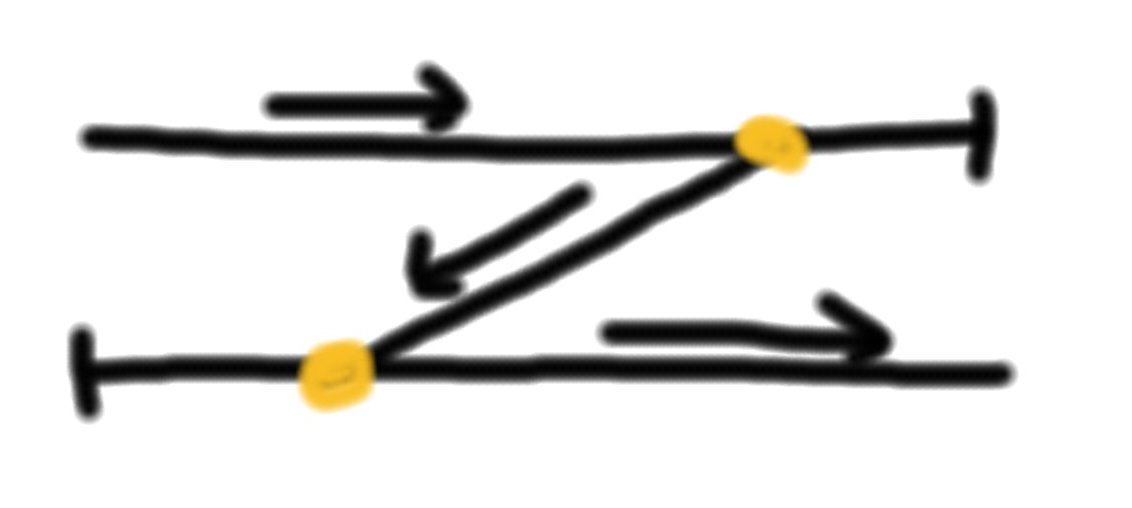
Excuse My Hand-Drawn Schematic

Excuse My Hand-Drawn Schematic

The train moves forward from the upper left to the end of track at the same level. Note the orange dots which represent switches. A rail employee throws the first switch, and the trains backs up past the second switch to the lower level end of track. Then the second switch is thrown, and the train moves forward at the lower level to its destination, the crafts village of Sibambe.

Here’s a view of the milieu:

Where There’s No Room to Turn Around ....

Where There’s No Room to Turn Around ….

Tomorrow, I will continue this post and also talk about our destination, Sibambe.
A Transcendent Moment

There It Was: Mount Chimborazo

There It Was: Mount Chimborazo

The text is from Matthew 18:22: “Jesus saith unto him, I say not unto thee, Until seven times: but, Until seventy times seven.” It refers to how many times one must forgive transgressors. That inspired the Swedish author, Lars Görling, wrote a novel entitled 491, which was made into a film by Vilgot Sjöman.

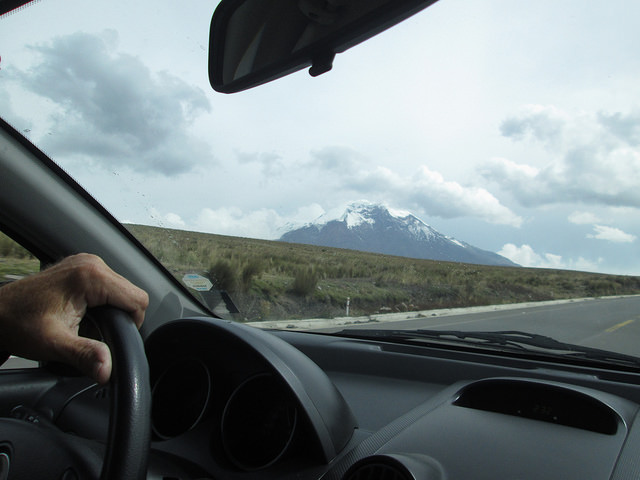
This is a very roundabout way of remembering the route Dan and I took as we emerged from the twisted warren of unmarked streets which is Ambato, one of Ecuador’s largest cities. We were looking for the E-35, which is the Pan-American Highway. Instead we were on E-491, which took us through a number of towns and villages which were not on my map of the country. Nor, for that matter, was E-491.

Then, as we rounded a hill, quite suddenly, we saw the volcano Chimborazo dead ahead of us. The clouds had moved aside, allowing us to see the glaciers on Ecuador’s tallest mountain. If you measure altitude from the center of the earth rather than sea level, it is the tallest mountain on earth, looming in splendid isolation from the rest of the Andes.

A Herd of Wild Vicuñas

A Herd of Wild Vicuñas

As we drew closer to the mountain, we espied a large herd of wild vicuñas on both sides of the road. Dan and I stopped to take pictures in the rarefied air, which must have been 15,000 feet altitude.

Throughout its length, E-491 was spectacular. Even the Indian villages along the route were more interesting. And then, as we approached the city of Riobamba, we crossed the Pan-American Highway. We spent the night in a spare, but scrupulously clean hotel near the railroad station. By then, we were on the “wrong” side of Chimborazo, which was now covered in clouds.

That was the end of our getting lost: The next day, we easily made our way to Cuenca in about five hours.

Where the Streets Have No Name

It’s Okay in the Center of Town, But ...

It’s Okay in the Center of Town, But …

When Dan and I started driving in Quito, we made a dismaying discovery. We spent a whole morning looking for a road atlas of Ecuador, and were greatly surprised that no one thought such a thing existed. And all city maps we had showed none of the outskirts, just the centro historico or tourist center of town.

Worse was to come: Once we left the center of town, there were almost no signs at street corners indicating where we were. Even if we had a good street atlas, it wouldn’t have helped, as most of the streets were strictly incognito. Missing were any directional indicators, most notably for E-35, the Pan-American Highway, the main trunk highway, which runs north/south through the center of the country. Where there were signs, they were more often than not for relatively minor streets.

The net result is that we got badly lost in the cities. All we could do is look out for intercity buses to see where they were going (if we were so lucky as to pass them) and follow them. Where there were no intercity buses in evidence, we tries to orient ourselves to the nearest known volcano and look for wider roads headed roughly in the right direction.

In Quito, we finally lucked out and found ourselves on the Pan-American Highway, but we didn’t know for about 40 miles that we were on the right track.

And then the E-35 lost itself in a warren of streets in the city of Ambato. In tomorrow’s post, I will explain how getting lost in Ambato led to the most transcendent moment in our whole vacation—just by sheer persistence and good luck!

For Ecuador With Love and Squalor

Cañar Indian Woman in Alausi

Cañar Indian Woman in Alausi

Late last night, I returned from Ecuador to another Los Angeles heat wave. It was yet another wonderful South American trip, with a number of highs and one very big low.

That low had nothing to do with Ecuador, and everything to do what happened to our country last Tuesday. Watching the election returns on CNN from my hotel in Quito, I spent a sleepless night twisting and turning, only to wake up early to leave for the airport.

But then, the Trumpster is our own American nightmare; and Ecuador for the most part cheered me and even amazed me. Even on the way to Mariscal Sucré Airport, my taxi driver pointed out the snow-covered Mount Cotopaxi looming to the south in a moment of extreme clarity. (It is not usually visible from Quito.)

Ecuador is a country with a number of viable indigenous cultures. In Otavalo, Alausi, Cuenca, and even Quito, I saw a number of what we incorrectly call Indians. I took a number of candid pictures, such as the one above.

One special feature of this trip was that I spent the first two weeks with my brother, and the last week alone, as Dan had to return to Palm Desert to fulfill some construction obligations. It was fun sharing my vacation with him, and it was a very different experience for me. I am not used to sharing the decision-making process during my trips; but here it worked out. We may be very different people, but there is considerable overlap in the matter of preferences.

It’s good to be back, even if it is to a Frankenstein-Dracula America. We’ll just have to see what happens.

On to Quito

Getting Ready to Pack

Getting Ready to Pack

The next couple of days, I will be busy cleaning up after tax season at work, and packing for my Ecuador vacation at home. Consequently, this is my last posting until my return in November. I do not anticipate making any postings while I am there.

Quito is two hours ahead of Pacific Daylight Time—essentially the same as Central Daylight Time (UTC -5 hours). That means there will be no jet lag. There will, however, be some danger of altitude sickness, as Quito is approximately 9,000 feet (around 3,000 meters) above sea level.

So, vaya con dios, amigos!

You Gotta Have Sole!

The Grier Musser Museum Near Downtown LA

The Grier Musser Museum Near Downtown LA

Today, Martine and I visited the Grier Musser Museum on South Bonnie Brae, about a mile west of downtown L.A. Even before we pulled into the museum’s parking lot, however, disaster struck. The right sole of my New Balance shoes came unglued and flapped like a tongue as I walked.

Fortunately, Ray and Susan Tejada, curators of the museum, allowed me to do the tour in my stocking feet. Else, I would have pitched down the stairs and landed on my head. When we left, Ray and Susan gave me some masking tape to wind around the shoe. The fix held until I walked into my apartment, whereupon the sole flapped—but I immediately tossed the shoes into the nearest trash bin.

This time of year, the Grier Musser Museum is chock full of Halloween displays ranging from antiques to recent Hallmark creations. The net result is to give us a sweeping view of what is fast becoming one of our major holidays. (I wonder how long it will be before it becomes a national holiday.)

Messing with Mother Nature

Chinese Mass Wedding

Chinese Mass Wedding

China is worried. The all-powerful Communist Party has messed with Mother Nature once too often. For many years, they banned having more than one child per family. That led, not surprisingly, to an excess of male newborns over female newborns. (Accidents sometimes happened to infant girls, when it was boys who were desired.)

Although the Party has eased up on its child restrictions, there are two serious consequences:

  1. The number of marriages is dropping, possibly because many young men cannot find a sufficient number of marriage-age women to wed. I also remember reading stories about suicides of male factory workers because they had no hope of being able to raise a family.
  2. A disconcerting 500,000 elderly have wandered off—most of them suffering from dementia—partly because there are not enough children to bear the burden of their support.

China has been in this type of situation before. One of the decrees during the Great Leap Forward period (1958-1962) was that the “Four Pests” were to be eradicated. The pests in question were rats, flies, mosquitoes, and sparrows. One effect of killing massive numbers of sparrows was that the ecological balance was upset as crops were eaten by insects that were kept under control by the birds.

Maybe having too much power over men and animals is dangerous in the long run.


Voting Against the Creepy Clown

It Was Worth It!

It Was Worth It!

Despite all my strong feelings about the upcoming election, there appeared a real possibility that I wouldn’t be able to vote. I could wait for the sample ballot with its attached absentee ballot application, but there was a better than 50% chance that I wouldn’t get the absentee ballot in my hands before I boarded my plane to South America.

So I called the Los Angeles County Registrar of Voters and asked what I could do. They said I could vote in person by going to the County Clerk’s office in Norwalk. Foolishly, I took the 105 Freeway to Norwalk and got stuck in a behemoth traffic jam. It took me all of two hours to drive the 30 miles to the County Clerk’s office and only 15 minutes to vote. Fortunately, I took a better route home (the Golden State Freeway over to the Santa Monica Freeway).

This election matters a great deal to me. I know that California will not go for Trump—even Republican ex-Governator Arnold Schwarzenegger refused to vote for him—but I have to be able to face myself when I look in the mirror. I have to act on my beliefs, or what am I?

You can bet that the Creepy Clown did not get an X in his box on my ballot. I can go to Ecuador now with a good conscience.

An Unnecessary Holiday

It Was Leif Eriksson Who Discovered America

It Was Leif Eriksson Who Discovered America

In fourteen hundred and ninety-two
Columbus sailed the ocean blue …

Okay, I’m willing to grant him that. He didn’t “discover” America, though. The original discoverers walked across what is now the Bering Strait (or sailed in from various Pacific islands) and scattered through North and South America thousands of years ago. If you’re looking for a European discoverer, your man is the Icelander Leif Eriksson, aided and abetted by information from one Bjarni Herjulfsson. He started a settlement at L’Anse aux Meadows at the northernmost tip of Newfoundland.

The Viking settlers did not stick around. They faced constant warfare with the Skraelings (i.e. aborigines) and gave it up as a lost cause. But they left behind an archeological record and wrote the experience up in the Vinland Saga, which you can read for yourself. Penguin Books has a good edition, which includes several related sagas bound in the same volume.

In the meantime, we are stuck with this holiday in October commemorating an Italian explorer who is reviled by generations of the people he called Indians. If you want to see what they really thought, read Eduardo Galeano’s Memory of Fire. The Spanish and Portuguese colonial experiences left behind some very pretty churches and millions of tormented Indian slaves, if they were so unlucky as to survive.

Columbus himself was not himself an arrant villain, but he made it possible for real arrant villains like Pedro de Alvarado and Nuño de Guzman to control the lives of thousands of innocents. Okay, so maybe they had human sacrifice—but nowhere on the scale of death practiced by the Iberian newcomers.