Going Independent

Goodbye, Donkey! Goodbye, Elephant!

This summer, I have re-registered to vote as an independent. Ever since I came to be of voting age, I have been a Democrat. For a while, I even tried to help out in a congressional election—my man lost—and even donated money to the party at various critical junctures. Of late, I did not particularly care for the leadership of the party. I did not like Debbie Wasserman Schultz. I do not like Tom Perez. And, as time passes, I do not care for the way Hillary Clinton screwed up her presidential campaign last year; and I am not altogether sure I would have liked it all that much had she won. Granted, she wouldn’t have been as bad as Trumpf. From her ivory tower, I think she has totally lost touch with the voters, a large percentage of whom hate her for various reasons—many of them trumped up by the Right.

My first presidential election was in 1968. I refused to vote for either the Democratic (Humphrey) or Republican (Nixon) candidate. Instead, I wrote in Otto Schlumpf, a Franciscan priest from Santa Barbara, for president and comedian Dick Gregory for vice president. Both were actively against the Viet Nam War, as was I.

Over the years, the Democrats have been wasting the many successes of Franklin D. Roosevelt. Lyndon Johnson came close when it came to domestic policy, but was a total washout in Viet Nam. He wisely withdrew when he realized how badly he had messed up. Too bad: He could have been one of the great ones. (But then Viet Nam made dunces out of a lot of otherwise smart politicians.)

I will probably still vote mostly Democrat, though no longer in the primaries. I don’t know what will happen to the Republican Party—nothing good, I hope—but I may conceivably vote Republican in some local elections, as I have done in the past, especially  when I voted for Schwarzenegger for governor of California against the Democrat Phil Angelides in 2006.

In time, I would like to see more than two major political parties in the U.S. And I don’t mean single-issue parties like the Libertarians and American Independents. The Democrats and Republicans will continue to morph over the next few years, most likely in a way that is unacceptable to me as a voter.

So now I’m an independent.

Serendipity: London Fog

Waugh’s Ambrose Silk Misses the Old Days

The following is taken from a monologue by one Ambrose Silk at London’s Café Royal. It can be found in Evelyn Waugh’s wonderful satire of England in the first days of the Second World War, Put Out More Flags.

“The decline of England, my dear Geoffrey,” he said, “dates from the day we abandoned coal fuel. No, I’m not talking about distressed areas, but about distressed souls, my dear. We used to live in a fog, the splendid, luminous, tawny fogs of our early childhood. The golden aura of the golden age. Think of it, Geoffrey, there are children now coming to manhood who never saw a London fog. We designed a city which was meant to be seen in a fog. We had a foggy habit of life and a rich, obscure, choking literature. The great catch in the throat of English lyric poetry is just fog, my dear, on the vocal cords. And out of the fog we could rule the world; we were a Voice, like the Voice on Sinai smiling through the clouds. Primitive peoples always chose a God who speaks from a cloud. Then, my dear Geoffrey,” said Ambrose, wagging an accusing finger and fixing Mr. Bentley with a black accusing eye, as though the poor publisher were personally responsible for the whole thing, “then, some busybody invents electricity or oil fuel or whatever it is they use nowadays. The fog lifts, the world sees us as we are, and worse still we see ourselves as we are. It was a carnival ball, my dear, which when the guests unmasked at midnight was found to be composed entirely of impostors. Such a rumpus, my dear.”

Ten years after Put Out More Flags was published, in 1952, a killer fog hit London that killed 4,000 Londoners and hospitalized 150,000.

On a much smaller scale, I remember the smog of Los Angeles in the 1960s and 1970s, when I developed a nasty case of asthma, which appears only at rare intervals now. I remember hearing the foghorn from Santa Monica Pier when I used to live on 11th Street early in the Seventies. I have not seen fog in Santa Monica for almost 30-40 years now.


Erasing the Confederacy?

Nathan Bedford Forrest (1821-1877)

For some reason that perplexes me, there seems to be a concerted attempt of late to eliminate all traces of the Confederacy: its memorials, its flags, and its heroes. I, myself, have nothing against Robert E. Lee, a man I regard as a legitimate American hero who just happened to fight on the losing side. I even admire the somewhat unsavory Nathan Bedford Forrest, a brilliant cavalry general who just happened to be one of the founding members of the Ku Klux Klan.

These are men who believed in slavery along with millions of their countrymen. In fact, Forrest had before the war been a slave dealer. Do I think slavery is evil? Yes. Do I blame people in the past for believing differently than we do? Not at all. Slavery was petty universal until some point in the 19th Century. It exists even today in the United States, where many prostitutes are in fact slaves of the men who pimp them. We are wasting our time when we are trying to reform our ancestors by pulling down statues, banning flags, and denigrating heroes of times past.

To a certain extent, I believe that much of this whitewashing the past is due to the fact that even the Solid South is not necessarily solid. Americans from Blue States have invaded part of the South, and Red Staters have returned the favor.  If I lived in Memphis today, I probably would be persistently annoyed by all the trappings of the War of the Southern Confederacy.

Let the South have their heroes. Does that mean that we should permit slavery in the 21st century? By no means. We just have to admit that times and mores have changed.

If you reject my reasoning, I suggest you read the three hefty volumes of Shelby Foote’s The Civil War: A Narrative.  It is written predominately from the Southern point of view. As I read it, I kept thinking, “These people were Americans, too!”

Favorite Films: The Salvation Hunters (1925)

The Pimp, The Girl, The Child, and The Boy

The first film that director Josef von Sternberg made in the U.S. cost only $5,000 and had only eight characters, none of whom bore anything but descriptive names. We meet the three main characters—The Boy, The Girl, and The Child—at the docks in San Pedro, California, where the center of attraction is a huge dredge sucking up mud from he harbor to deposit into a barge. The Boy (George K. Arthur) makes several attempts to get a job, but to no avail. The Girl (Georgia Hale) hangs around the docks and is hit upon by an oafish character called, simply, the Brute. The Child (Bruce Guerin) is a young boy who is beaten by the Brute until the Boy saves him from his clutches. The three drift together, a kind of centripetal relationship in which they care for and defend one another, but do not have a dime.

When a black cat suddenly jumps out of a closed chest full of harbor mud, the three decide to leave for the city, which presents no improvement. It is full of smoke, telephone wires, and broken-down slums. Here they attract the attention of a pimp (called in the credits simply The Man) who offers them a seedy apartment next to one of his women. He then hangs around trying to figure how how to draw The Girl into the trade.

Georgia Hale as The Girl

Georgia Hale was cast by Charley Chaplin as the leading lady in his next film, The Gold Rush (also 1925). In The Salvation Hunters, she is remarkably beautiful without any make-up whatsoever. When she thinks of hooking for The Man, she uses a burnt-out match the accentuate her eyebrows and borrows a dab of lipstick from her neighbor.

This is the second time I saw The Salvation Hunters. The first time was at UCLA in the period 1968-1972. I was initially so impressed by von Sternberg that I wanted to do my master’s thesis on him. In fact, I visited the director at his house in Westwood around 1969 (the year in which he died)  and asked if he had access to any prints of his films which I could screen. He was actually very kind as a host, though his reputation is as something of an ogre. My friend Joe Adamson, who introduced the film at Cinecon 53 today, told of his answering questions of his painterly vision in film when he had taught at UCLA by saying, simply, “I did it because I am an artiste.” He wrote a book about his career entitled Fun in a Chinese Laundry, in which he takes a couple of hundred pages before mentioning, in a subordinate clause, that he was married.

Josef von Sternberg (1894-1969)

Von Sternberg is best known today for the films he made with his protegeé, Marlene Dietrich. Some of these are among the greatest films ever made. Included among them are:

  • The Blue Angel (1930)
  • Morocco (1930)
  • Dishonored (1931)
  • Shanghai Express (1932)
  • Blonde Venus (1932)
  • The Scarlet Empress (1934), my favorite of his films
  • The Devil Is a Woman (1935)

That said, I think all his films are worth seeing. Even if you may not like them, they will change the way you experience film.

I cannot but think that The Salvation Hunter was something of a flop in 1920s America: It depicted a European sense of allegory and universality (a la Murnau’s Sunrise) and poverty. It is not a film that is presented purely for your entertainment. But it is one of the best films made in that decade, along with several other von Sternberg offerings such as Underworld (1927), The Last Command (1928), and The Docks of New York (1928).

Anything Goes

Poster for Anything Goes

Today was my second day at Cinecon 53 (I skipped Saturday) and came with Martine this time. Today’s highlights were two zany musicals. The first was Anything Goes (1936) with music by Cole Porter and starring Bing Crosby, Ethel Merman, Charlie Ruggles, and Ida Lupino (as a blonde no less!). The action takes place on an ocean liner on which Bing is stowing away, because he thinks the lovely Miss Lupino is in danger. Notable is the role of Arthur Treacher as Lord Oakleigh, who is escorting Lupino for what Bing suspects are nefarious purposes. I could describe the plot in more detail, but then it was never intended to make sense. It is merely a rack onto which a number of great Cole Porter tunes are (dis)played to advantage.

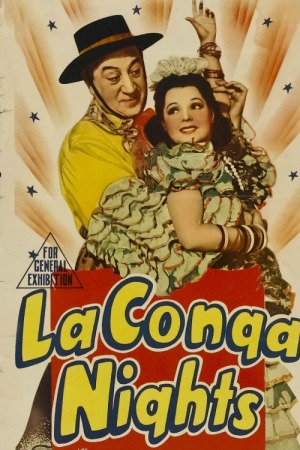
Universal’s La Conga Nights (1940)

The other loony movie was a 1940 quickie from Universal called La Conga Nights, with an even more improbable plot. First of all, the star is Hugh Herbert, who plays no less than six roles. Then there’s this boarding house which is laboring under an evacuation order for nonpayment of mortgage. The tenants, a musical set led by Dennis O’Keefe and Constance Moore, decide to turn the place into a nightclub called the Conga Room.

Neither of these films was slated for fame. They came out when Americans attended movie theaters in droves to see the hundreds of films that Hollywood cranked out year after year. Americans felt in their bones that there would be another war: Spain was already a demo zone for weapons from Germany, Italy, and Russia. But we had just survived a terrible depression, and people didn’t mind being a little silly. I wonder if the tendency will return with our having elected a president that is trying, under the rubric of “Make America Great Again,” to turn us into a Third World Country. So let’s laugh while we can!

An Unregenerate Auteurist

Film Critic Andrew Sarris (1928-2012)

Although I never met the man, he has made a lasting impression on my taste in films. It all started around 1964, when I was a student at Dartmouth College in Hanover, New Hampshire. I ran across the Spring 1963 issue of Film Culture magazine. Most of the contents was a 68 page article by Andrew Sarris, then movie reviewer for The Village Voice.  I remember photocopying the entire article while several other students fumed at the time I took to set up every page perfectly. In the end, I had the best survey of the work of American filmmakers then available.

My Original Encounter with the Auteur Theory

By the time I came out to Southern California, Sarris was working the same material into a book to be called The American Cinema: Directors and Directions, 1929-1968. The book became my bible, a guide to the real artists of the American cinema, the directors. In both the book and the Film Culture article, Sarris was adapting the work of critics at Cahiers du Cinéma and other French film magazines who were reacting to the French classical cinema and rediscovering American film.

I and my fellow auteurists at the UCLA Film Department ran into heavy opposition from the faculty, especially from my thesis adviser, one Howard Suber, whose idea of film criticism was to do a shot-by-shot analysis of Orson Welles’s Citizen Kane. I quickly discovered that the people who were most opposed to the auteur theory were not terribly interested in seeing films. In fact, they did not know very much about film. Where my friends and I were viewing upwards of fifteen films a week, I doubt that most of the UCLA professors saw that many in a year.

The Book Version of the 1963 Film Culture Article

Although over the years, my take on films has changed somewhat, I still love the great auteurs such as John Ford, Howard Hawks, Charley Chaplin, Josef Von Sternberg, Nicholas Ray, Orson Welles, Raoul Walsh, and Budd Boetticher. Now I am willing to admit that, in certain rare cases, the producer could be the main artist of the film. The only example I can think of offhand is Val Lewton, who as producer, created his own style that overrode such excellent directors as Jacques Tourneur, Mark Robson, and Robert Wise.

Yesterday, I attended the Cinecon 53 Classic Film Festival in Hollywood. The very best films were auteur classics: John Ford’s The Brat (1931), George Stevens’s Boys Will Be Boys (1932), and William S. Hart’s Shark Monroe (1918). But where I diverge from the auteurists is my enjoyment of some films by relative nobodies,. most particularly John Blystone’s Woman Chases Man (1937)—which ended up involving three directors and five writers—and Alfred S. Rogell’s No More Women (1934), itself a sequel to auteur director Raoul Walsh’s What Price Glory? (1926), starring the same leading actors.

There are indeed many terrible filmmakers whose work I would think nothing of walking out on. But at shows like Cinecon, there are some wonderful films by people I have never heard of.