Bumlandia

It’s Beginning to Look a Lot Like Calcutta

Whether you call them by the term bums or the more forgiving “the homeless,” the streets of Southern California are filling up with raggedy men (and some women) who are living off the streets, They like to position themselves near markets and convenience stores and ask for the inevitable “spare change.” Across the street from where I live, there are several more-or-less permanent tents where several bums (yeah, these guys are properly called bums) spend the night, howling at the moon.

There are food distribution programs that cater to L.A.’s street people, but they still beg for spare change. My theory is that the money they get is strictly for CBD—cigarettes, booze, and drugs. At least one of the bums across the street is a drug dealer: He has two cars parked on the curb and is frequently seen talking on a burn cellphone.

I am somewhat torn. I like the idea of helping the true homeless—those who have some chance of getting out of their present dire situation—but I absolutely refuse to help bums. It’s like putting out a cockroach feeder. I support the Salvation Army and several other charities that help the homeless, but I would prefer that the bums move on elsewhere. I can hear them all night swearing loudly at each other and sometimes fighting in he street. Every once in a while, the LAPD stops and asks them to move on, but they cannot force them unless there is a clear violation of the law.

In nearby Santa Monica, bums are not allowed to set up tents and sleep on the pavement; but Los Angeles has always been a bit more forgiving. In the meantime, there are breakins to the apartment laundry rooms where the perpetrators are searching for quarters. A neighbor’s bicycle was stolen; and other small crimes of the typr that did not happen until the bum encampment was set up.
In the Red Labyrinths

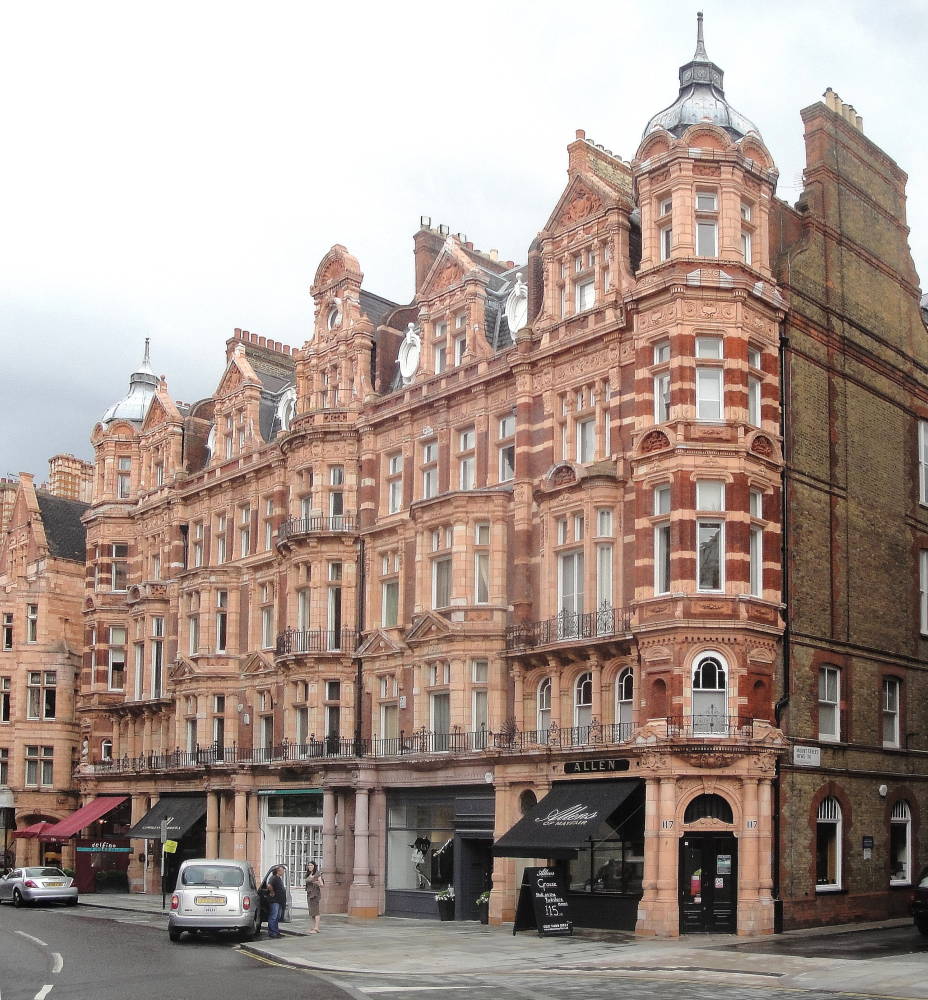
Victorian Block in London

Every once in a while, I feel I must return to Jorge Luis Borges, the man who has influenced so many of the paths my life has taken in the last forty years:

Browning Decides To Be a Poet

In these red labyrinths of London
I find that I have chosen
the strangest of all callings,
save that, in its way, any calling is strange.
Like the alchemist
who sought the philosopher’s stone
in quicksilver,
I shall make everyday words—
the gambler’s marked cards, the common coin—
give off the magic that was there
when Thor was both the god and the din,
the thunderclap and the prayer.
In today’s dialect
I shall say, in my fashion, eternal things:
I shall try to be worthy
of the great echo of Byron.
This dust that I am will be invulnerable.
If a woman shares my love
my verse will touch the tenth sphere of the concentric heavens;
if a woman turns my love aside
I will make of my sadness a music,
a full river to resound through time.
I shall live by forgetting myself.
I shall be the face I glimpse and forget,
I shall be Judas who takes on
the divine mission of being a betrayer,
I shall be Caliban in his bog,
I shall be a mercenary who dies
without fear and without faith,
I shall be Polycrates, who looks in awe
upon the seal returned by fate.
I will be the friend who hates me.
The Persian will give me the nightingale, and Rome the sword.
Masks, agonies, resurrections
will weave and unweave my life,
and in time I shall be Robert Browning.

The above photograph by Robert Freidus is from The Victorian Web.

Serendipity: The Sachem Passaconaway

Henry David Thoreau (1817-1862)

I am slowly reading Henry David Thoreau’s A Week on the Concord and Merrimack Rivers (1849), which he wrote after the fact about a canoe trip with his late brother John, who got tetanus seven years earlier when he cut himself shaving. It is a leisurely book full of philosophizing, local history, and poetry. In it I ran into this description of a former Indian chief who had lived in New England in earlier times:

In these parts dwelt the famous Sachem Pasaconaway, who was seen by Gookin “at Pawtucket, when he was about one hundred and twenty years old.” He was reputed a wise man and a powwow, and restrained his people from going to war with the English. They believed “that he could make water burn, rocks move, and trees dance, and metamorphose himself into a flaming man; that in winter he could raise a green leaf out of the ashes of a dry one, and produce a living snake from the skin of a dead one, and many similar miracles.” In 1660, according to Gookin, at a great feast and dance, he made his farewell speech to his people, in which he said, that as he was not likely to see them met together again, he would leave them this word of advice, to take heed how they quarrelled with their English neighbors, for though they might do them much mischief at first, it would prove the means of their own destruction. He himself, he said, had been as much an enemy to the English at their first coming as any, and had used all his arts to destroy them, or at least to prevent their settlement, but could by no means effect it. Gookin thought that he “possibly might have such a kind of spirit upon him as was upon Balaam, who in xxiii. Numbers, 23, said ‘Surely, there is no enchantment against Jacob, neither is there any divination against Israel.’ His son Wannalancet carefully followed his advice, and when Philip’s War broke out, he withdrew his followers to Penacook, now Concord in New Hampshire, from the scene of the war. On his return afterwards, he visited the minister of Chelmsford, and, as is stated in the history of that town, “wished to know whether Chelmsford had suffered much during the war; and being informed that it had not, and that God should be thanked for it, Wannalancet replied, ‘Me next.´”

The Sachem Passaconaway

Favorite Films: Detour (1945)

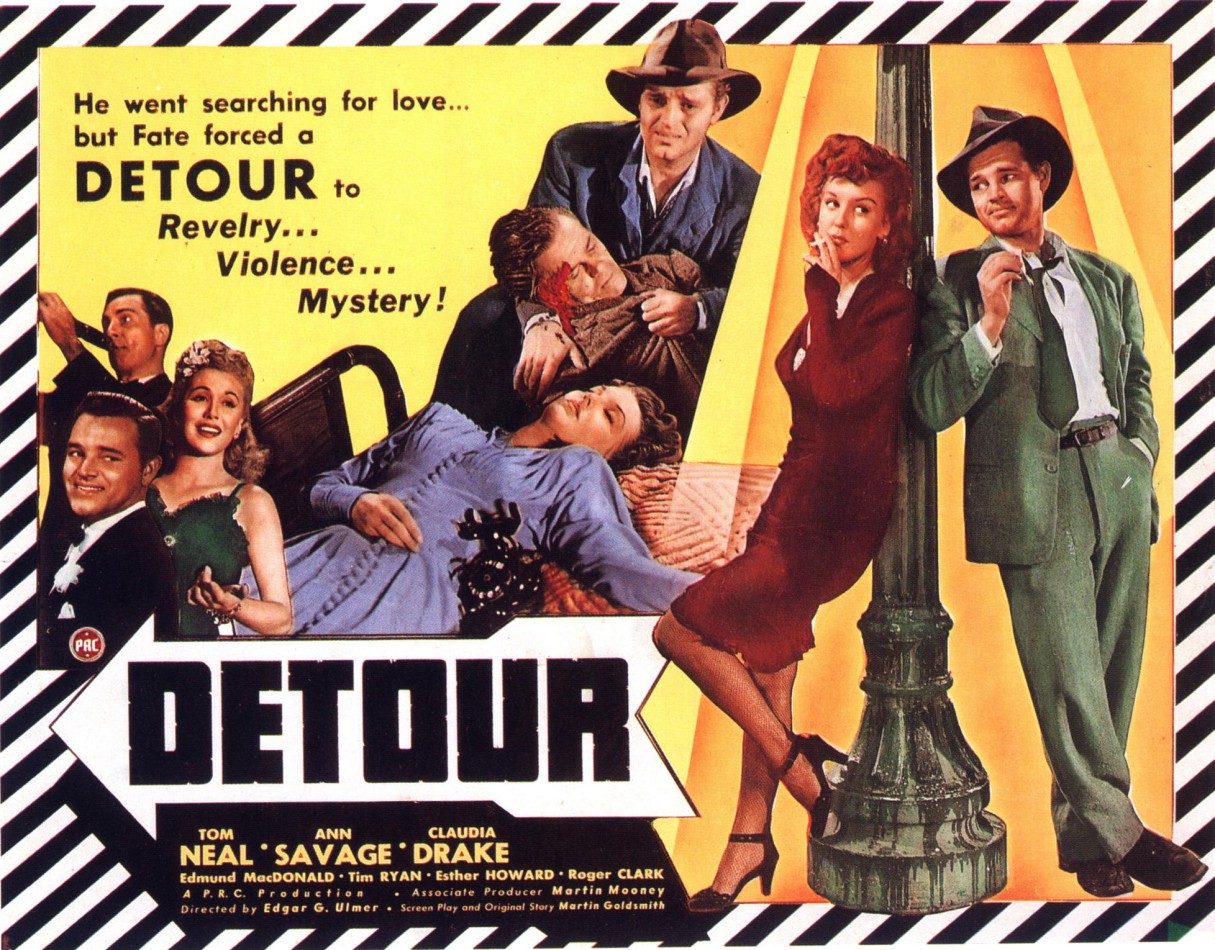
Poster for Edgar G. Ulmer’s Detour (1945)

The poster is a mess, but the film isn’t. It was released by the Producers Releasing Corporation (PRC) “studio” and starred Tom Neal and Ann Savage. Some forty years ago, I re-used the PRC abbreviation to stand for a film series I ran at UCLA which I called the Poverty Row Cinemathèque, whose highlight was a quadruple feature directed by that most maudit of film directors, Edgar G. Ulmer. In addition to Detour, we screened Girls in Chains (1943), Club Havana (1946), and (I think) The Pirates of Capri (1949).

Ulmer did direct two masterpieces. One was The Black Cat (1934), starring both Boris Karloff and Bela Lugosi. The other was Detour, the story of a down at heels New York pianist played by Tom Neal as Al  Roberts who hitchhikes to California to be re-united with his girlfriend. Fate intervenes: In Arizona, he is picked up by Charles Haskell, who is a bit of a con man, and who tells of a woman he had picked nup named Vera who scratched his wrist when he put some moves on her. While Al takes over the driving responsibilities, the rain begins to fall and—while putting up the canvas top on the convertible—he discovers that the guy who picked him up had suddenly died.

Rather than try to flag down the police, Al drags the body into the bushes and covers it loosely. He then takes his wallet and the car. The 68-minute film is half over when Al meets a young woman hitching a ride a a gas station. The woman turns out to be the same Vera who scratched up Haskell, and she begins to try to blackmail and sexually dominate Al. She knows the car and knows that Al is not Haskell.

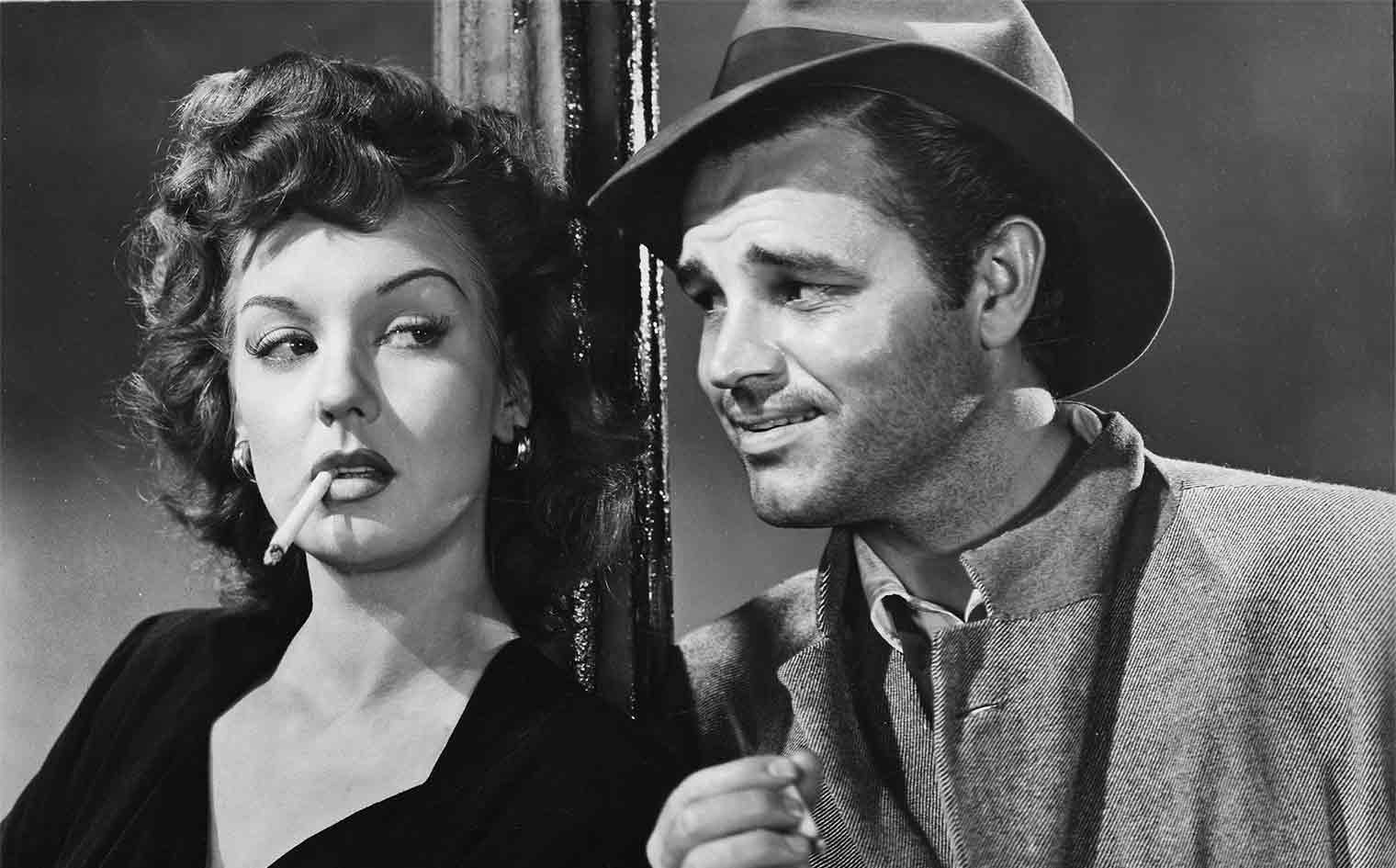
Ann Savage and Tom Neal

Vera turns out to be the center of the film. She is both relentless and ferocious. Never have I seen a female role that was so intense. By comparison, Al is passive and helpless. Rather than allowing him to part company, she tries to enlist him in a scheme to bilk Haskell’s dying rich father by passing himself off as the son. In the process, he accidentally kills Vera and, now thinking himself responsible for two deaths, hits the road.

If you’re interested in seeing this film, you should have no trouble. It is in the public domain and can be viewed in its entirety on YouTube. It is well worth your time.

The Flip Side of Gallup

The Gallup Inter-Tribal Indian Ceremonial

Gallup, New Mexico, in the 21st century would be nowhere without the Indians. Window Rock, Arizona, the capital of the Navajo Nation, is a short hop away across the state line. Yet, at the same time, Gallup is a dangerous place for Indians. The problem is that, with only 22,000 inhabitants, Gallup has 39 liquor licenses, or about 19 per 10,000 people—much larger than most big cities.

The Indians come to Gallup, get drunk, and frequently die. According to a 2015 article from the Indian Country Media Network:

In 2014, 36 unnatural deaths were recorded for Natives in or around the Gallup area. Almost all were alcohol related or caused from being homeless. Seventeen of those deaths were caused by motorists killing pedestrians attempting to cross major thoroughfares or I-40. Nearly all the victims were Native. This winter, too, has begun with record-setting deaths from exposure in McKinley County—12 so far; all the victims were Native.

Another lethal practice is for drunks in cold weather to lie down on the warmer asphalt highway, fall asleep, and get run over.

I have always seen Indians of the Southwest as a national treasure. Alas, it is a treasure that we have compromised by destroying their culture and leaving them to fend for themselves in the cold cruel world of contemporary America.

Would You Spend Your Afterlife With This Guy?

Marshall Applewhite, Alias “Do”

We are coming up on one of those sad anniversaries with which our history as a nation is crowded. Twenty years ago, the Heaven’s Gate cult committed mass suicide in a Rancho Santa Fe, California mansion. The members of the cult believed that, in the wake of the comet Hale-Bopp was a spaceship that was going to taken them to heaven. They dressed in black track suits with patches that said “Heaven’s Gate Away Team.” They also wore identical Nike Decade sneakers and took enough amphetamines with vodka to send them into another world, though probably not heaven.

Their leader was one Marshall Applewhite, who went by the name “Do”—and, yes, he did himself in as well. Looking at his picture (above), would you give your life for this obvious flake? Apparently thirty-nine people did, most of them in their forties, at an age when presumably they should have known better.

Logo From the Heaven’s Gate Website

The website of the group is still in existence, maintained by a couple who used to be members, but transgressed by getting married. It has a very 90s look to it, but then the group didn’t survive the decade. According to an article in today’s Los Angeles Times:

Several hundred people joined the group over the years, although the vast majority left for a variety of reasons. Some who left came back. Those who remained to the end were largely longtime devotees. Twenty-one were women, 18 men. They ranged in age from 26 to 72, with more than half in their 40s.

Almost all of them were veteran seekers of spiritual truths, people who had tried other religions, tried tarot cards, tried hallucinogenic drugs.

So when comet Hale-Bopp began to arrive, it was time to check out.


Originalism

It’s Not Like They Were Gods

One thing I do not understand is the judicial principle of originalism, according to which we have to somehow divine the intent of our Founding Fathers. That strikes me as rather silly. Take Thomas Jefferson and John Adams, for example. While Jefferson was Adams’s Vice President, he did everything possible to subvert him, including hiring a yellow journalist named James Callender to attack Federalist positions. This was at a time when the winner for President was forced to take the loser as his Vice President. And that was written in the Constitution! (It was not until later in life that Adams and Jefferson were reconciled, and they both wound up dying on July 4, 1826, fifty years to the day after the Declaration of Independence.)

If two of our Founding Fathers were such enemies, how is it possible to arrive at any consensus by reading their long-dead minds regarding the problems of the 21st Century. Remember, these same Founding Fathers were forced to accept slavery. Perhaps Trumpf’s nominee to replace the late Antonin Scalia, Neil M. Gorsuch,  would be more comfortable if slavery were reinstated.

Will we all have to wear powdered wigs and take snuff? Do we have to give up the automobile in favor of the horse and buggy? Would we have to give up the Internet and our whole telecommunications network just because some judge has this jones about some long dead politicians, as great as they were in the context of their own times.

From Point A to Point B

UPS Freight Jets

There is a growing branch of literature which consists of nonfiction. How is that possible? The Nobel Prize for Literature in 1996 was awarded to Svetlana Alexievich of Belarus for her work, which consists primarily of interviews of people affected by the nuclear accident at Chernobyl or the Soviet War in Afghanistan. As for Americans, we have John McPhee, who has written a series of nonfiction works of high literary quality.

I have just finished reading his Uncommon Carriers, which deals, in turn, with long-haul truckers; a place in France where ships’ pilots are trained; boats that tow barges on American rivers; the parcel sorting services of UPS; and mile-and-a-half-long coal trains. In between, there is a delightful essay by the author about retracing the route of Henry David Thoreau and his brother John described in A Week on the Concord and Merrimac Rivers—which I had read when it was first published in the New Yorker.

McPhee likes to take what looks like a boring subject that nobody would write about and turn it into a gem. For instance, there is that tetralogy he wrote about American geology beginning with Basin and Range and ending with Assembling California. One would think that McPhee’s books might be a tad boring, but they never are.

To date, I have read—in the order of publication—the following ten McPhee titles:

  • The Crofter and the Laird
  • Pieces of the Frame
  • Giving Good Weight
  • Basin and Range
  • In Suspect Terrain
  • La Place de la Concorde Suisse
  • Rising from the Plains
  • The Control of Nature
  • Looking for a Ship
  • Uncommon Carriers

There’s not a single boring read in the bunch. Each McPhee I read whets my appetite for more.

Computer Security Gone Wild

That Is 4 Sure!

As an IT specialist, I am surrounded by hundreds of passwords for our computer network and its users. Every system seems to have its own requirements, with financial institutions being the most demanding:

  • One or more capital letters
  • Several lower case letters
  • One or more numbers
  • One or more special characters (!@#$%^&* etc.)

As if that weren’t bad enough, some systems require you to change passwords every 90 days or so. Now the IRS has gotten involved: Users of accounting systems that store Social Security Numbers and Federal Tax IDs are required to create passwords that comply with the standards enumerated above, and moreover change them at 90 day intervals.

What is a good password? As the illustration above indicates, length is probably the best attribute. There is a fun website called How Secure Is My Password? that is fun to use. Given any password you type in, it tells you approximately how long a computer can crack it. Let’s enter a password called, simply enough, “password.” Your password would be cracked instantly. Let’s say your password is “Longer Passwords Make Stronger Passwords.” That would take a computer 89 septendecillion years to crack. You get the general idea. (I think it would actually be cracked sooner, because computers are always getting faster.)

Some people think that using letter/number substitutions such as “4“ for “for” or “B100dy Pa55w0rd5!” for “Bloody Passwords!” would do the trick. Not really. Not when a hacker uses brute computing force to check all possible letter/number/special character permutations. And these artificial passwords are always harder to remember. And you know what happens when you lose a vital password? You’re up Excrement Creek without a paddle.

What I do is keep all my passwords up to date in a Microsoft Excel file that is itself passworded. You can even create sequences of passwords, such as:

  • 1-2-Buckle-My-Shoe
  • 3-4-Shut-The-Door
  • 5-6-Pick-Up-Sticks
  • 7-8-Lay-Them-Straight
  • 9-10-A-Big-Fat-Hen

I’ve actually used that sequence for one bank (but no longer).

There are even computer programs that save your passwords for you—even Internet browsers. But if it’s a separate system, how do you know it wasn’t designed by computer hackers? It’s like all those unsolicited anti-virus systems whose sole purpose is to load viruses onto your system. It pays to be a bit suspicious.


“Nothing Gold Can Stay”

Fall Colors in Wisconsin

Here’s a short poem by Robert Frost about the brilliant gold leaves of a New England autumn. I miss them greatly: I went to college in New Hampshire, and in California there isn’t much brilliant foliage in the fall. The poem is entitled “Nothing Gold Can Stay.”

Nature’s first green is gold,
Her hardest hue to hold.
Her early leaf’s a flower;
But only so an hour.
Then leaf subsides to leaf.
So Eden sank to grief,
So dawn goes down to day.
Nothing gold can stay.