Tophet

Sky Full of Ash: The View from My Front Door

The wildfires to the north of us have filled the sky with ashes. When I wake up in the morning, I have to blow my nose to lessen the irritation. The air smells burnt.

According to Wikipedia:

In the Hebrew Bible Tophet or Topheth (Hebrew: תוֹפֶת‎; Greek: Ταφεθ; Latin: Topheth) was a location in Jerusalem in the Gehinnom where worshipers influenced by the ancient Canaanite religion engaged in the human sacrifice of children to the gods Moloch and Baal by burning them alive. Tophet became a theological or poetic synonym for hell within Christendom.

The traditional explanation that a burning rubbish heap in the Valley of Hinnom south of Jerusalem gave rise to the idea of a fiery Gehenna of judgment is attributed to Rabbi David Kimhi’s commentary on Psalm 27:13. He maintained that in this loathsome valley fires were kept burning perpetually to consume the filth and cadavers thrown into it.

In any case, it doesn’t sound very appetizing. There are times when Los Angeles is beautiful and fresh, but that’s only after a rare rain. Other times, it’s like a slow oven. And it could even be cold. When there’s a major earthquake, it feels that you can slide at any moment into a deep crevice near to the fires at the center of the earth.

But, still, it’s better than Cleveland.
 

You’ll Wonder Where the Yellow Went…

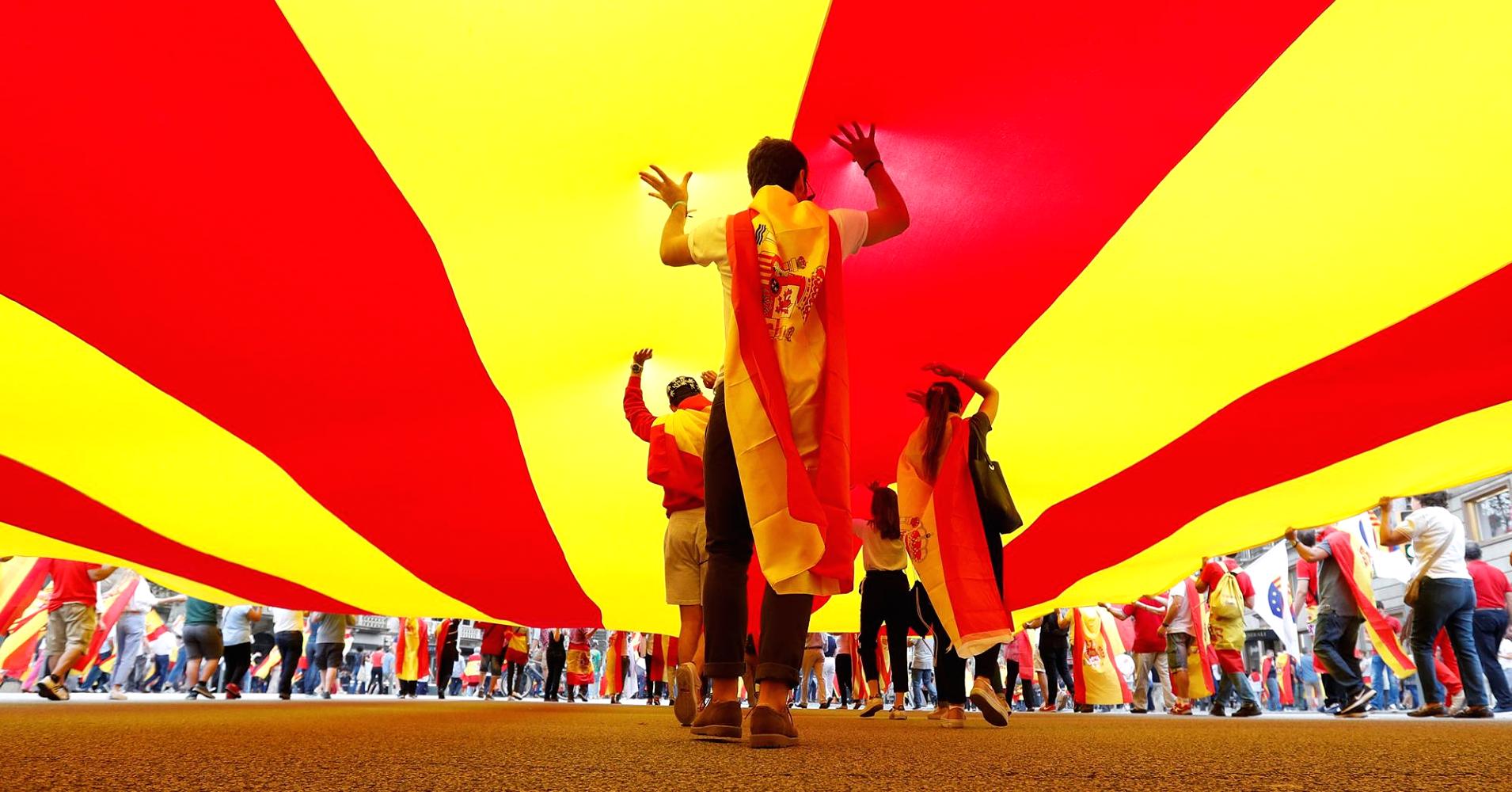
Can a Nation Ban a Color? Catalan Demonstrators in Barcelona.

Decades ago, I remember a stirring film about the Regime of the Colonels in Greece. The film, called Z (1969) and directed by Costa Gavras, ended with the announcement that the rightist Colonels had banned the use of the letter “Z” because it was used to signify that Grigoris Lambrakis, who had been assassinated in 1963 for the protests he had organized, was still alive.

Now, in a stunning repetition, Spain has banned the use of the color yellow, because it was used by Catalans to symbolize their aspirations for independence. They couldn’t altogether ban the color, because it’s one of the colors of the Spanish flag. You can read all about it on the BBC News website.

The Catalans Want to Be Independent of Spain

It’s interesting to me that Europe continues to fragment into ever smaller pieces. After the fall of the Soviet Union and the “segmentation” of the former Yugoslavia, we have a host of new countries: Latvia, Estonia, Lithuania, Slovenia, Croatia, Bosnia, Montenegro, Serbia, Kosovo, Macedonia, and Slovakia. As the countries become smaller, they become ever more appetizing targets to be reabsorbed by some larger nearby power. This is what seems to be happening to Belarus and Crimea (formerly part of Ukraine).

I am part Slovak: My father was born near Prešov. For its long history, Slovakia was never independent; but it became so under the presidency of Václav Havel after the Slovaks and the Czechs came to blows over the governing of Czechoslovakia. Now there’s the Czech Republic and the Slovak Republic.

How much farther will nationalism go? The states of the Confederacy are threatening to secede again from the Union. Canada continues to have problems governing Québec and other French-speaking areas. On a more local level, several rightist-leaning counties in California want to secede from the state and form their own state, to be called Jefferson. Oh, yeah, like we need more conservative senators in Congress!


To the Barricades?

Vladimir Putin: A Man’s Man?

We have been enemies with Russia for a century now. What happens sometimes during these long sieges of enmity, we lose sight of who we are and who the Russians are. We have gone from the benign presidency of Obama to what looks to us like a would-be Tsar, the narcissistic Trumpf. Russia, in the meantime, traveled a much longer route: From Communism where there was some attempt to help the common people, to the kleptocracy under Yeltsin, to the quasi-dictatorship of Vladimir Putin, former KGB Chieftain. And this Putin had the nerve to try to influence our election!

There is no doubt that Russia under Putin is an amalgam of discipline and targeted cruelty. Enemies of Putin, such as  journalist Anna Politkovskaya, were ruthlessly murdered; and friends of Putin shared in the billionaires’ bounty of their leader. Do we want Russia to become a democracy like ours? Like ours under Trumpf?

According to Russian novelist Mikhail Shishkin:

To call people to the barricades in Russia is beautiful, but senseless…. We lived through all this already in the early ’90s. All revolutions take place in the same way—the best people rise up to fight for honor and dignity, and they die. On their corpses, thieves and bandits come to power, and everything comes full circle. The same thing happened during the Orange Revolution in Kiev. The same thing is happening right before our eyes in the Arab world. Apparently, in Russia a new generation has grown up who want to experience the barricades. All right. They will experience them. And they will be disappointed.

There is, to my mind, very little difference between Trumpf and Putin—except the difference in the two cultures. Trumpf would do the same things as Putin if he could. There still seem to be checks and balances in the United States, but for how long?


The Tomb of the Hero

Honor Guard at the Tomb of José de San Martín in Buenos Aires

The liberators of South America from the Spanish are honored throughout South America. One keeps running into the names of Bolivar, San Martin, Sucré, and O’Higgins again and again. The honor guard at the Metropolitan Cathedral on the north side of the Plazo de Mayo in Buenos Aires is dressed in the uniforms of the early 19th century, with swords drawn and standing at rigid attention.

Even Jorge Luis Borges, who never served in any country’s military, bragged of being descended from Colonel Manuel Isidoro Suárez, hero of the Battle of Junín in far-off Peru back in 1824. Many of his poems refer to this ancestral hero. Here is the last stanza of “A Page to Commemorate Manuel Suárez, Victor at Junín”:

His great-grandson is writing these lines
and a silent voice comes to him out of the past,
out of the blood:
“What does my battle at Junín matter if it is only
a glorious memory, or a date learned by rote
for an examination, or a place in the atlas?
The battle is everlasting and can do without
the pomp of actual armies and of trumpets.
Junín is two civilians cursing a tyrant
on a street corner,
or an unknown man somewhere, dying in prison.

I have read biographies of Bolivar and San Martín—as well as Gabriel García Márquez’s excellent The General in His Labyrinth, about the former—only to find that the heroes are more honored today than they were in their lifetimes. San Martín became so disgusted with his fellow Argentines that he moved to France. Only many years later did the Argentines invest him with the sanctity he wears today like an uneasy crown.


A Checkered Career

Starting at the End of This Month

I have been working now for just a few months shy of half a century. At the end of this month, the accounting firm for which I have been working will close its doors. At this point I am not sure whether I will continue to seek part-time work. I thought you might find it interesting to follow my work career from beginning to end:

  • 1968 – Work at System Development Corporation in Santa Monica proofreading a digital version of the Merriam-Webster 7th Collegiate Dictionary and the Merriam-Webster New Pocket Dictionary. A film student at UCLA, I was hired to replace a young woman who just so happens to have been murdered by a film student at UCLA (whom I didn’t know, honest!)
  • 1969 – Picked up computer programming on my own and worked as a programmer for Research & Special Projects Statistical Services at System Development Corporation.
  • 1971 – Worked at programming to process the 1970 census tapes at Becker & Hayes, a subsidiary of John Wiley & Sons, Publishers. Programmed the first version of CENSAC, which accessed a full but highly compressed set of 1970 Census tapes.
  • 1973 – My census programming job at Becker & Hayes morphed into Urban Decision Systems (UDS), where I continued to work on demographic data retrieval systems for research and site location. Worked on the ONSITE system, wrote technical documentation for it, and put together a marketing program for the company’s sstems and services.
  • 1991 – UDS folded. I worked to help create a new company called Desktop Marketing Corporation, but it never really went anywhere.
  • 1992 – Worked as an IT specialist for Lewis, Joffe & Company, a tax accounting firm.
  • 2008 – When Lewis, Joffe & Company split into two pieces, I went to work for Brian Lewis & Company doing tax accounting support and IT.
  • 2018 – ?

What with Martine’s desire to leave (she’s still with me for now) and the possible end of my working career, I am facing new challenges. I can promise you one thing, however: I will not put on weird multicolored pants, put on weight, and play golf.

Wish Me Luck!

Substantially True

Polish Writer Ryszard Kapuściński (1932-2007)

Although he is usually classified as a writer on non-fiction, the late Ryszard Kapuściński has been “outed” by some journalists for embroidering the truth. In this era of fake news and outright official lying, I feel we need to appreciate someone who is 95% true, or even 90% true. Almost no one is 100% true. I keep thinking back to the ancient Greek and Roman historians who put polished speeches into the mouths of Greek heroes such as Pericles and Augustus Caesar. The idea was to give the general idea, and to adjust the truth just enough to show the basics. No matter that the historian spoke more elegantly than Pericles or Augustus ever could. Shall we dump Thucydides, Herodotus, Tacitus, and Livy for such venial sins, which were certainly not considered as sins at the time they were writing?

According to a biography by Artur Domoslawski, friend of Kapuściński, occasionally crossed the boundary between straight reportage and fiction: “Sometimes the literary idea conquered him. In one passage, for example, he writes that the fish in Lake Victoria in Uganda had grown big from feasting on people killed by Idi Amin. It’s a colourful and terrifying metaphor. In fact, the fish got larger after eating smaller fish from the Nile.”

It seems Domoslawski was perhaps less than a real friend of Kapuściński: He also included numerous accounts of the author’s sexual peccadillos and collaborations with Soviet intelligence.

I am reminded of another travel writer whose work I love, Bruce Chatwin, author of In Patagonia and Songlines. Instead of 90% truth, Chatwin aimed at perhaps 70% truth and occasionally fell short of that mark. And there was, with Chatwin, a lot of sex going on with even with his sources. (He died of AIDS in 1989 at the age of 49.) I still classify both authors as non-fiction, even though Domoslawski thinks they should be on the shelf with fiction.

After Domoslawski’s book came out, a bunch of other writers jumped on the topic, including such notable historians as Timothy Garton-Ash. I know that, for many years, Ryszard Kapuściński  has been on the short list to receive the Nobel Prize for Literature. Now that he is dead, he does not qualify. More’s the pity.


Serendipity: The Existence of Ghosts

My Belief Is: They Exist

The Original Farmer’s Market at 3rd and Fairfax is like a sort of souk for tourists and those L.A. natives who like to sit and reflect while drinking a cup of tea or eating a good lunch. I sat there this morning reading Chris Abani’s The Virgin of Flames, when I ran across this passage:

“Well, yes. Everyone is attended by ghosts,” Iggy said. What matters is whether we begin to attend to them.”

“How do you mean?”

“With some people, the ghosts are transparencies, barely visible as they hover around, sit at the table next to them and so on. They are particularly hard to see in bright sunlight. Sometimes, when memories are revisited, there is a flickering of light and shadow, image and text across them, and for a moment they flare up and then vanish.”

“So are you saying that ghosts are our memories?”

“Ghosts are the things, the shapes we make with our memories,” she said.

“Ah. So if some are light like…”

“Like well-worn lace drapes blowing in the wind.”

Black smiled.

“Yeah, like that. Then what are the other ghosts like? The ones we attend?”

“Like thick black lines drawn in a notebook. They are visible, brooding dark clouds that we drag around with us like reluctant sulky children. We feed them and they grow big and their haunting dominates our lives. We love them and we hate them and we are always measuring them for a coffin, yet we cannot let them die.”

“Why?”

”Madness, my friend. Madness.”


The Scorpion and the Frog, Circa 2017

There’s a Lesson Here for Voters

The story goes back to Aesop. A frog sitting by the riverbank is approached by a scorpion, who asks him to ferry him across. The frog hesitates: “But you’ll sting me and I’ll die.” The scorpion asks, “Where is the reason in that? If I stung you, we’d both die.” Being a reasonable creature, the frog agrees and lets the scorpion hop on. In the middle of the river, the frog feels a horrible pain as he is injected with the scorpion venom. As he feels his body shutting down, he asks: “Why did you do this thing? Now we’ll both die.” I don’t know if scorpions can shrug, but let us say this one can. His last words are: “I can’t help it: It’s my nature.”

Or you can hear Orson Welles tell the same tale in his film Mister Arkadin (1955):

Now what’s the moral of this story insofar as you and I are concerned? Let’s say the scorpion has a shock of bright orange hair. He’s been around for a long time, so we have some notion of how he behaves. Knowing that, why have we allowed that scorpion on our backs?


Words Words Words

We Are Losing Words All the Time

You can probably tell that I love words. Sometimes I tend to use words are are sesquipedalian (a foot and a half long), even though I risk losing some of my readers. This post is based on a story on the BBC News websie entitled “Twenty-Six Words We Don’t Want to lose.” I won’t throw all twenty-six at you, just the ones I particularly like. The following are from The Cabinet of Linguistic Curiosities by Paul Anthony Jones:

  • Beard-second. The approximate length a man’s beard hair grows in one second. The Jones book pegs this at 5 nanometers. As one who would have no beard hair unless I took my testosterone externally (having no pituitary gland), I can’t believe this is a useful measure.
  • Charette. This refers to a period of intense work or creativity to meet a deadline. In French, thy would be working en charette, “in the cart.”
  • Finger-post. In 18th century slang, this referred to parsons, as they pointed out the path of salvation to others without necessarily undertaking the journey themselves.
  • Mountweasel. I particularly like this concept. According to the BBC website:

Fictitious entries added to a book to set a trap for would-be plagiarists are known as ‘nihilartikels’ (literally ‘nothing-articles’) or ‘mountweazels’, the name of an Ohio-born fountain designer and photographer named Lillian Virginia Mountweazel who was listed in the 1975 edition of the New Columbia Encyclopedia. Despite her renowned photographs of rural American mailboxes and her tragic death in an explosion while on an assignment for Combustibles magazine, Ms Mountweazel never actually existed.

  • Proditomania. Here is a good word for Trumpf staffers. It refers to the irrational belief that everyone around you is a traitor—though, in the Executive Branch that belief might not be so irrational.
  • Wantum. A blend of “want” and “quantum”—a term invented by Samuel Beckett to mean “a quantifiable deficiency or desire.”

The BBC writers also propose the following useful words:

  • Hunchweather. Weather cold enough to make one walk outdoors all hunched up.
  • Scurryfunge. The rushed attempt to clean up one’s dwelling place when company is expected imminently.
  • Frowst. Extra time spent in bed during a Sunday. This is is 19th century schoolboy slang.
  • Shivviness. The uncomfortable feeling of wearing new underwear (especially when that underwear is made of wool).

Finally, here are three odd words—which I have not found reason to use in my fifty-odd years as an adult:

  • Medioxumous. Of or relating to the middle rank of deities.
  • Septemfluous. Flowing in seven streams, used in certain theological treatises to refer to Christ’s blood.
  • Stercoricolous. Inhabiting dung, usually used of certain beetles. This last was once used by a writer friend to describe my housekeeping.

Now, may your writing henceforth be more picturesque!


Eleven Bogies

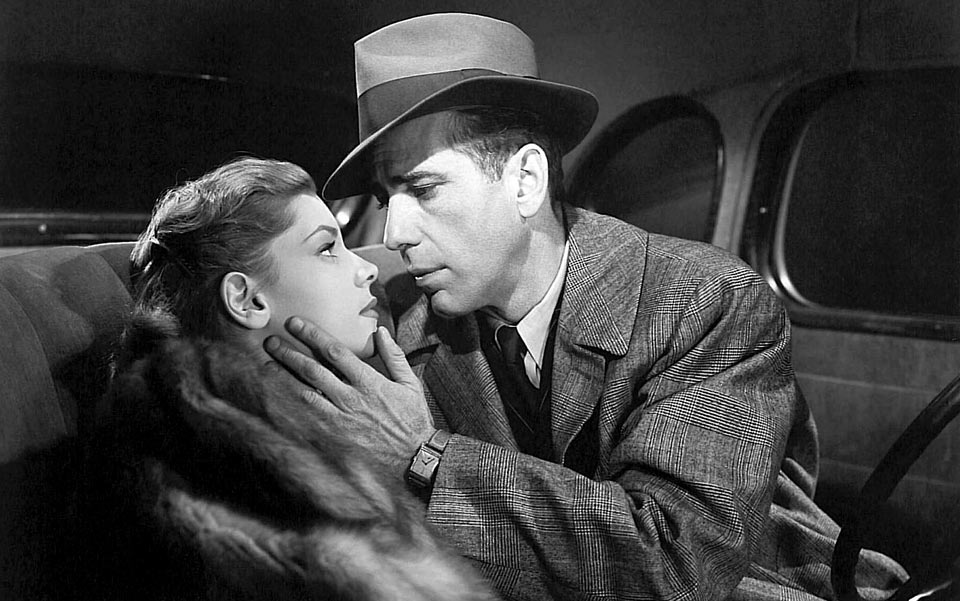
Bogart and Bacall in The Big Sleep (1946)

Today I finally broke down and purchased a DVD of Casablanca (1942), surely one of the greatest American films ever made. It set me on a train of thought about its star, Humphrey Bogart, always one of my favorites. I thought I would give you a list of my eleven favorite Bogie films in the order they were filmed:

  1. High Sierra (1941), directed by Raoul Walsh, one of the greats. Co-starring Ida Lupino in one of her best roles.
  2. The Maltese Falcon (1941), directed by John Huston. With Mary Astor. A classic.
  3. Casablanca (1942), directed by Michael Curtiz. Co-starring Ingrid Bergman. One of the best-loved American films of the 1940s.
  4. To Have and Have Not (1944), directed by Howard Hawks. Co-starring Lauren Bacall. Based on the Hemingway novel.
  5. The Big Sleep (1946), directed by Howard Hawks. To my mind Bogie’s best starring role, with Lauren Bacall. Based on the Raymond Chandler novel.
  6. Dark Passage (1947), directed by Delmer Daves, with Lauren Bacall. Based on a great novel by David Goodis.
  7. Treasure of the Sierra Madre (1948), directed by John Huston.
  8. Key Largo (1948), directed by John Huston. Co-starring Lauren Bacall.
  9. In a Lonely Place (1950), directed by Nicholas Ray. Co-starring Gloria Grahame.
  10. The African Queen (1951), directed by John Huston. Co-starring Katherine Hepburn.
  11. Beat the Devil (1953), directed by John Huston. Co-starring Jennifer Jones. A rare offbeat comedy.

Now I am going to sit down and see Casablanca again … and I will, I am sure, love it again.