Chicken Buses

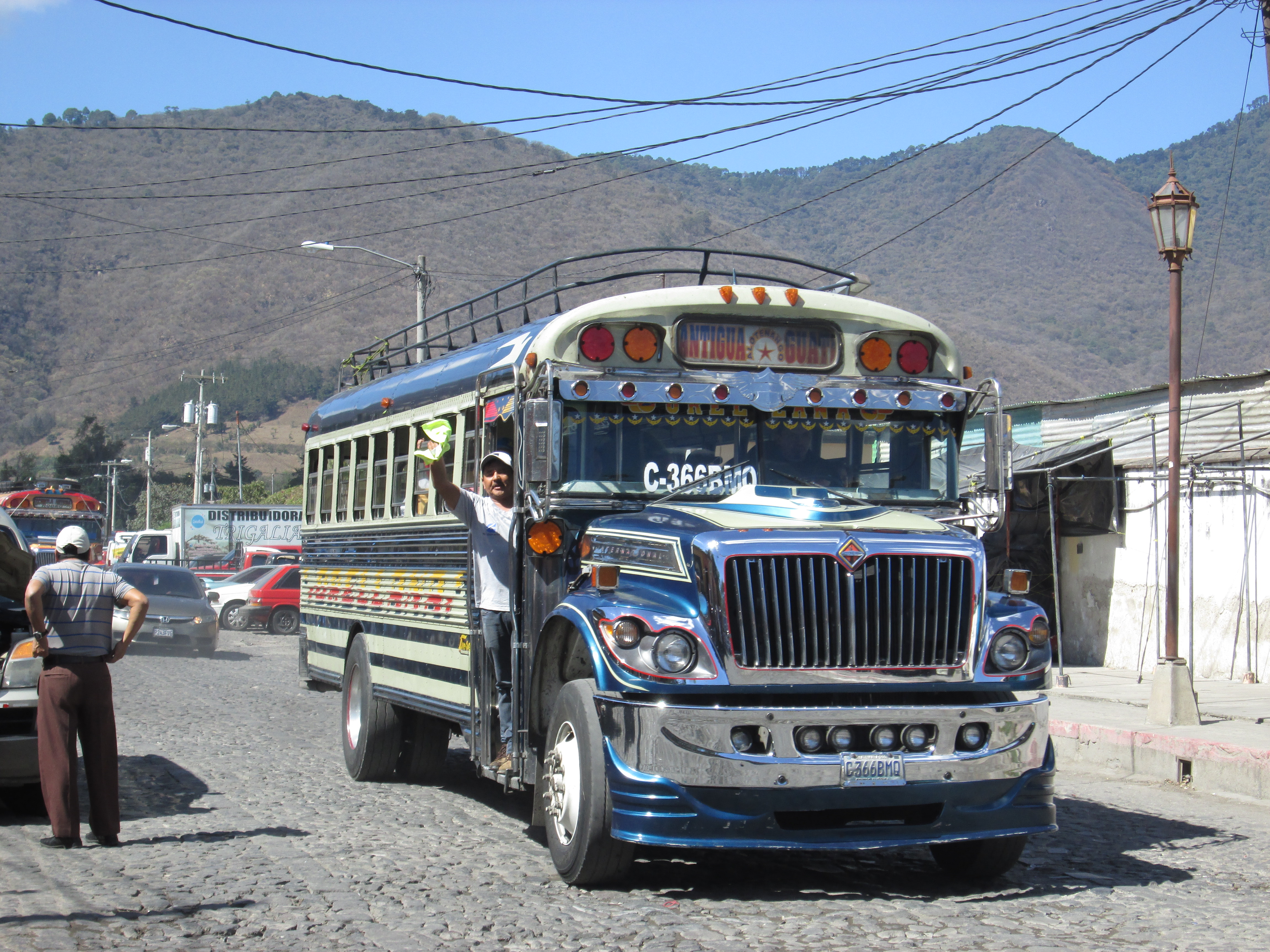
“Chicken Bus” with Conductor Hanging Out the Door

Old American school buses have a second life in Guatemala. They are imported, gussied up according to local taste, and converted into what are lovingly called chicken buses, because presumably the local Maya could transport pigs and chickens as well as themselves. They come with a driver and a conductor, who hangs out the front door as in the photo above, calling out the destination. Anyone could stop one of these second class buses by simply hailing it and climbing aboard. The conductor collects the fare and makes change, sometimes making the passenger wait until more fares are collected.

I did not take any chicken buses in Guatemala because of the potential for hold-ups and assorted violence. The guidebooks say to take tourist shuttles instead, even though they cost considerably more. Also, I do believe the language used by the driver and conductor is usually the local dialect of Mayan.

A Chicken Bus to Magdalena and Santa Lucia

There tend to be two, sometimes three, public transit options in the intercity market: chicken buses, tourist shuttles, and the (rare) first class bus that goes from point to point without picking up or discharging passengers on the way. (In a later post, I will tell you about my adventures careening through the jungle in a somewhat ratty first class bus.) The first class buses are usually for Ladinos; the chicken buses, for the locals; and tourist shuttles for Gringos.
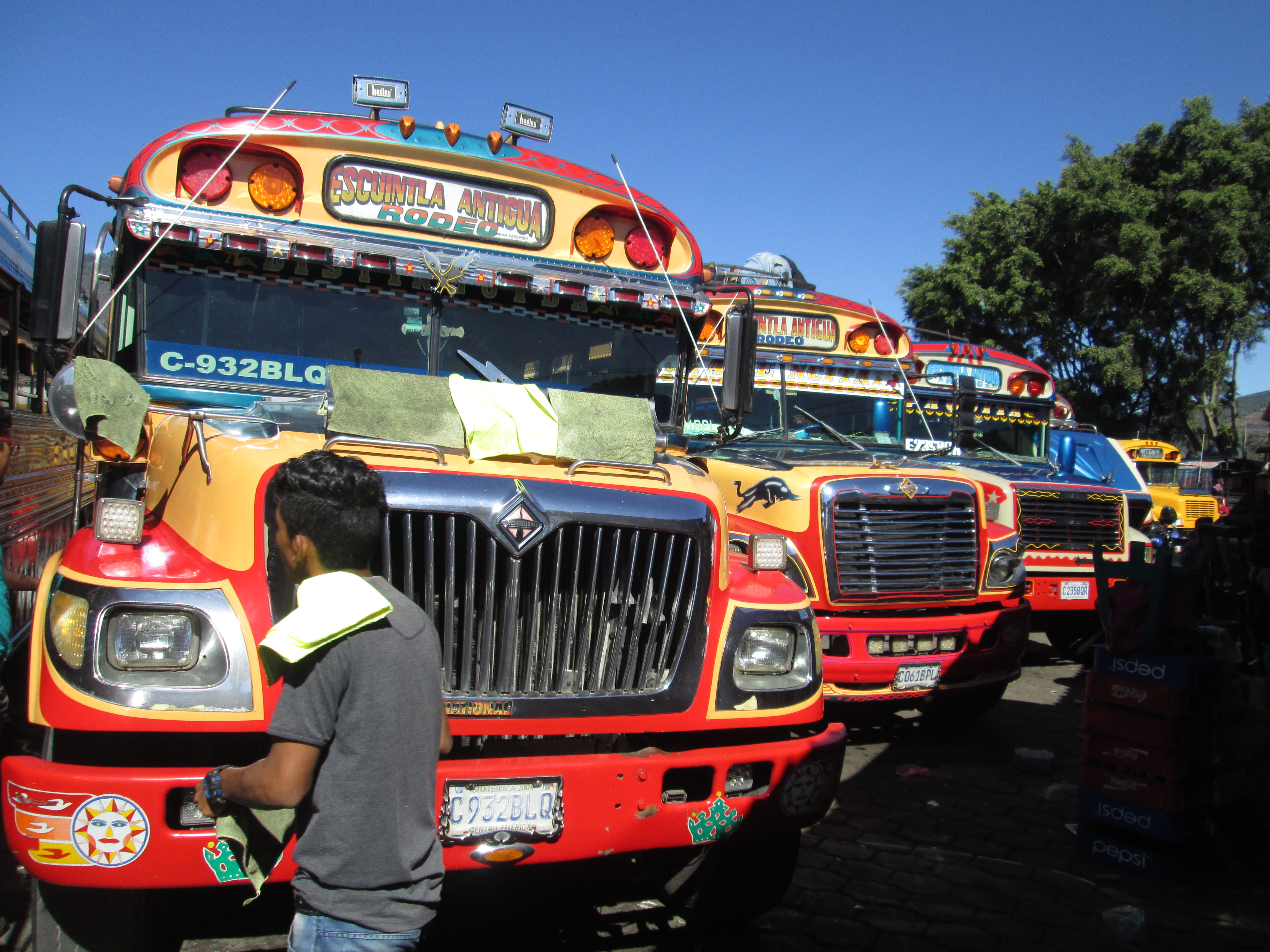
Chicken Buses Lined up at Antigua’s Bus Terminal

I noticed that the numbers on the front or rear windows of buses (and some cars) merely repeat the license plate in larger letters (for the convenience of witnesses and the police?),

All the buses shown on this page were taken in Antigua near the second class bus terminal. The buses in Eastern Guatemala are different. But more about that later.
Time and Chance

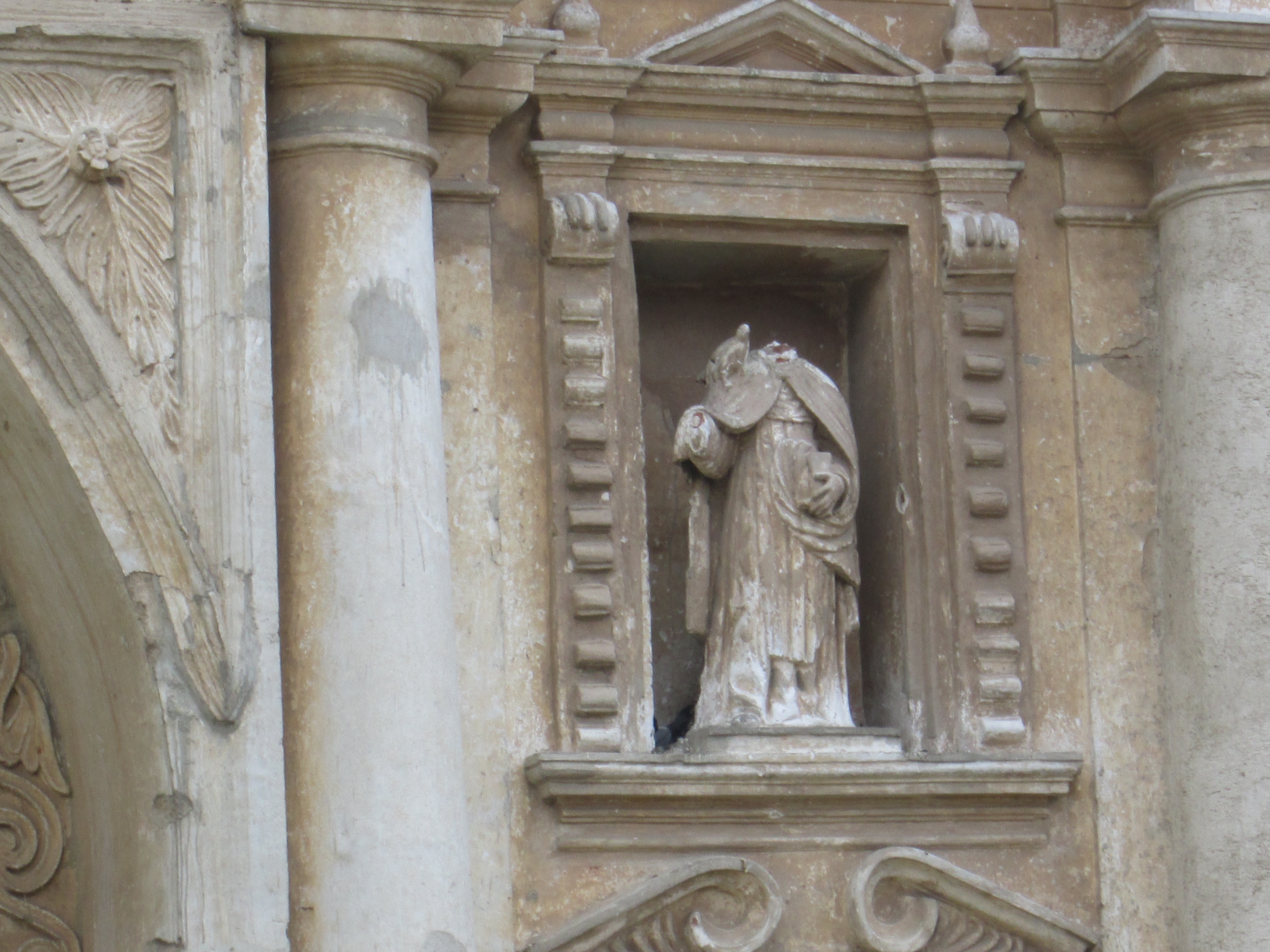
Statue Beheaded by the Santa Marta Earthquake of 1773

At 3:45 PM on July 29, 1773, a Richter 7.5 temblor struck the third capital of Guatemala, then called the Ciudad de Santiago de los Caballeros de Goathemalan. The city was filled with churches, monasteries, and convents. Half of the city’s religious were killed by the quake, and within a couple of years, the capital moved to its present-day location in the Valle de la Ermita, where it is known as Guatemala City.

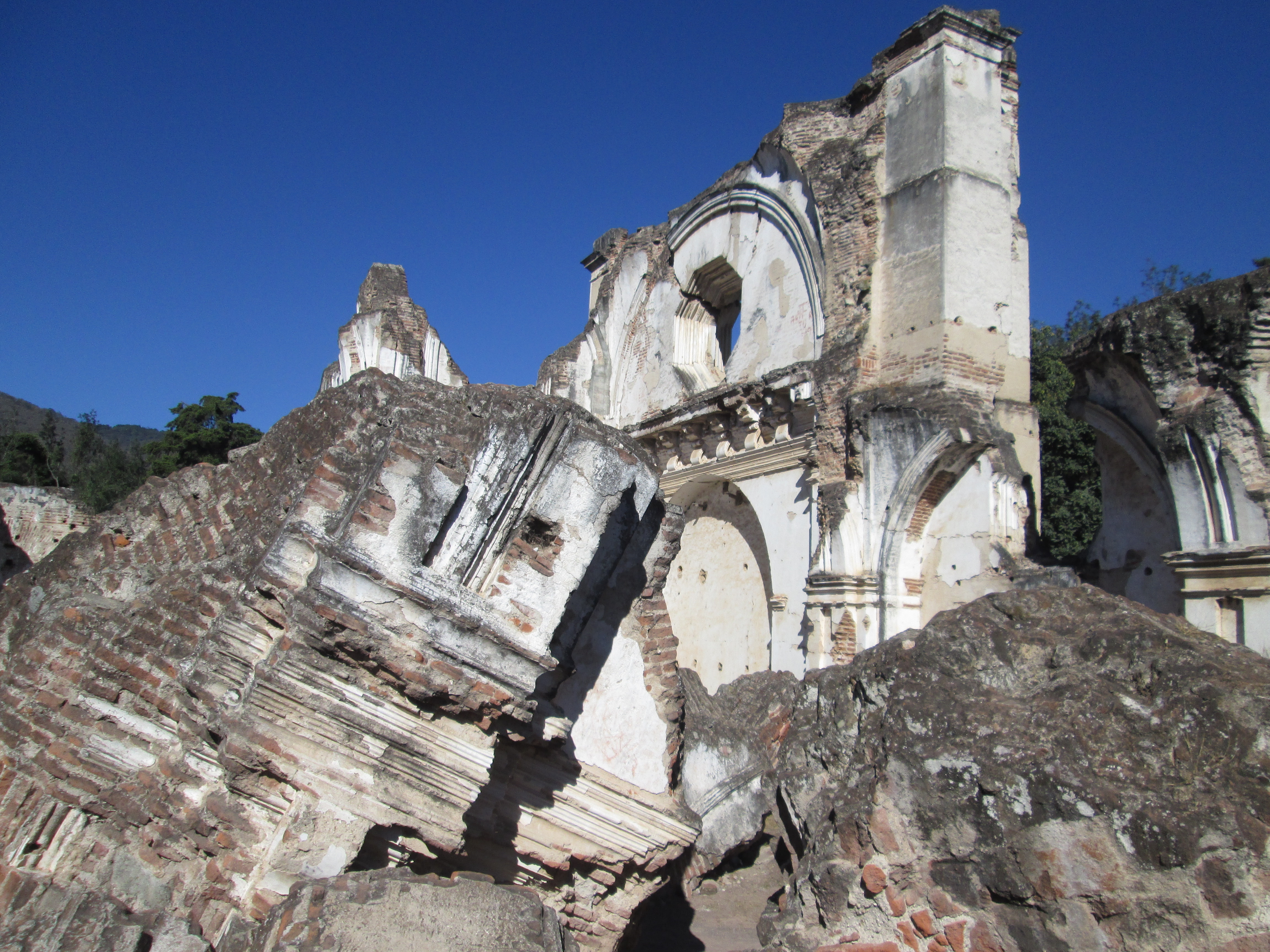
Nowhere was the devastation more apparent than the churches in the western half of the city now known as Antigua, especially the Church of the Recollects on 1a Calle Poniente. During my five-day stay in the city, I visited approximately a dozen ruined churches. None, however, made quite the impression on me as La Recolección.

Ruins of La Recolección in Antigua

The roof of the church had completely caved in, sending huge multi-ton masses of brick and concrete crashing to the floor. If any services were being held at the time, I find it hard to believe that there were any survivors. For all I know, there may still be skeletons under the masses of rubble.

While in Antigua, I called my brother in Palm Desert, California and described the chaos to him. Dan Paris, who has spent years building in earthquake country, told me that much of the disaster could have been avoided if only the Spanish had mixed straw with the concrete. The Maya, whose own houses were built based on a racial memory of thousands of years of shaking earth, did not suffer quite so much.

Not all the churches in Antigua were flattened by the Santa Marta quake of 1773. La Merced and San Francisco were two of the churches that managed to survive more or less intact, though the convent attached to La Merced was heavily damaged.

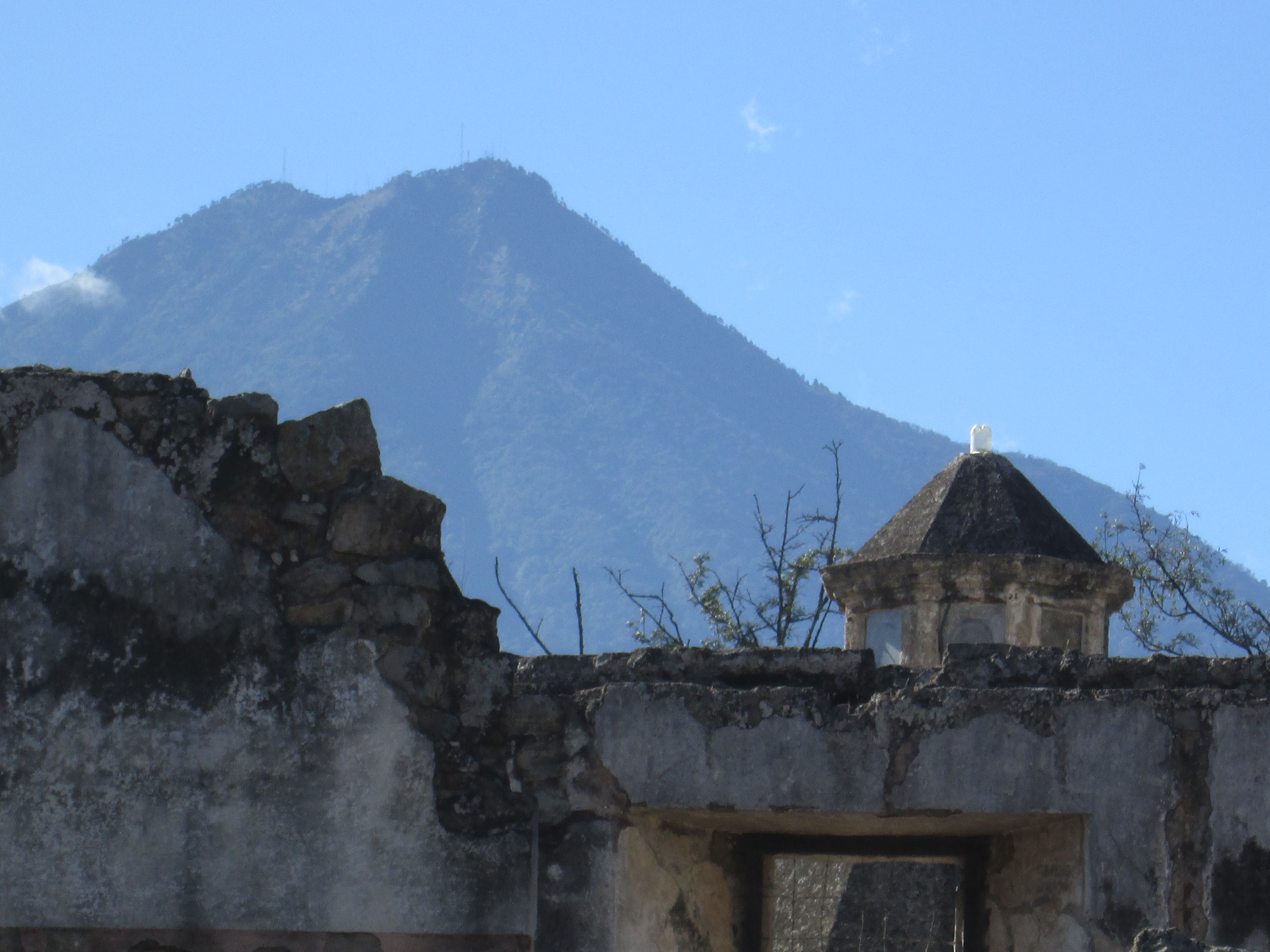
Ruins of La Recolección with Volcan Fuego in Background

It felt odd for me—who had traveled to Guatemala to see the ruins of ancient Maya cities—should have started my trip visiting the more recent ruins of Christianity. It made me feel as if the Christian ruins were, in their own way, equivalent to the Maya ruins, and that we are all subject to the vagaries of time and chance.


Tuk-Tuk? Nyuk-Nyuk!

An India Import: Auto Rickshaws, or Tuk-Tuks, from Bajaj Auto of Pune, the World Leader

If one travels to smaller towns in Central America, one is likely to travel around town in an auto-rickshaw, called a tuk-tuk from the sound of its engine. Above are two tuk-tuks parked near the public dock in San Juan la Laguna, on the shores of the Lago de Atitlán. In towns where taxicabs exist, they generally are more competitive, costing 5 or 10 quetzales instead of 20 or 30 quetzales (or more). As of today, the quetzal is worth 12.7 cents based on OANDA Corporation’s currency converter.

Riding a tuk-tuk is sort of fun, if you relish the experience of being puréed in a blender. Given the cobblestoned streets and the quick sideways maneuvers to avoid oncoming automotive traffic, you are likely to be tossed about a bit. And if you look closely, you won’t see anything that resembles a seat belt. You just have to hold on for dear life.

In Guatemala and Honduras, I have seen tuk-tuks with a driver and up to four passengers, three sitting in the back and one perched precariously next to the driver. But then, the Maya are not a large people. You can probably fit two American adults, max, in one of these three-wheeled wonders.

Tuk-Tuk Traffic in Panajachel

At first, I was afraid of trying to ride a tuk-tuk, until I found myself stranded at the eastern edge of Antigua. I was footsore from walking too many miles on rough cobblestones and narrow, dicey sidewalks, and I didn’t see any taxes passing by the Santo Domingo Museum, but a tuk-tuk stopped for me; and I was happy to take a load off my feet.