Letters

Say Goodbye to One of My Favorite Literary Forms

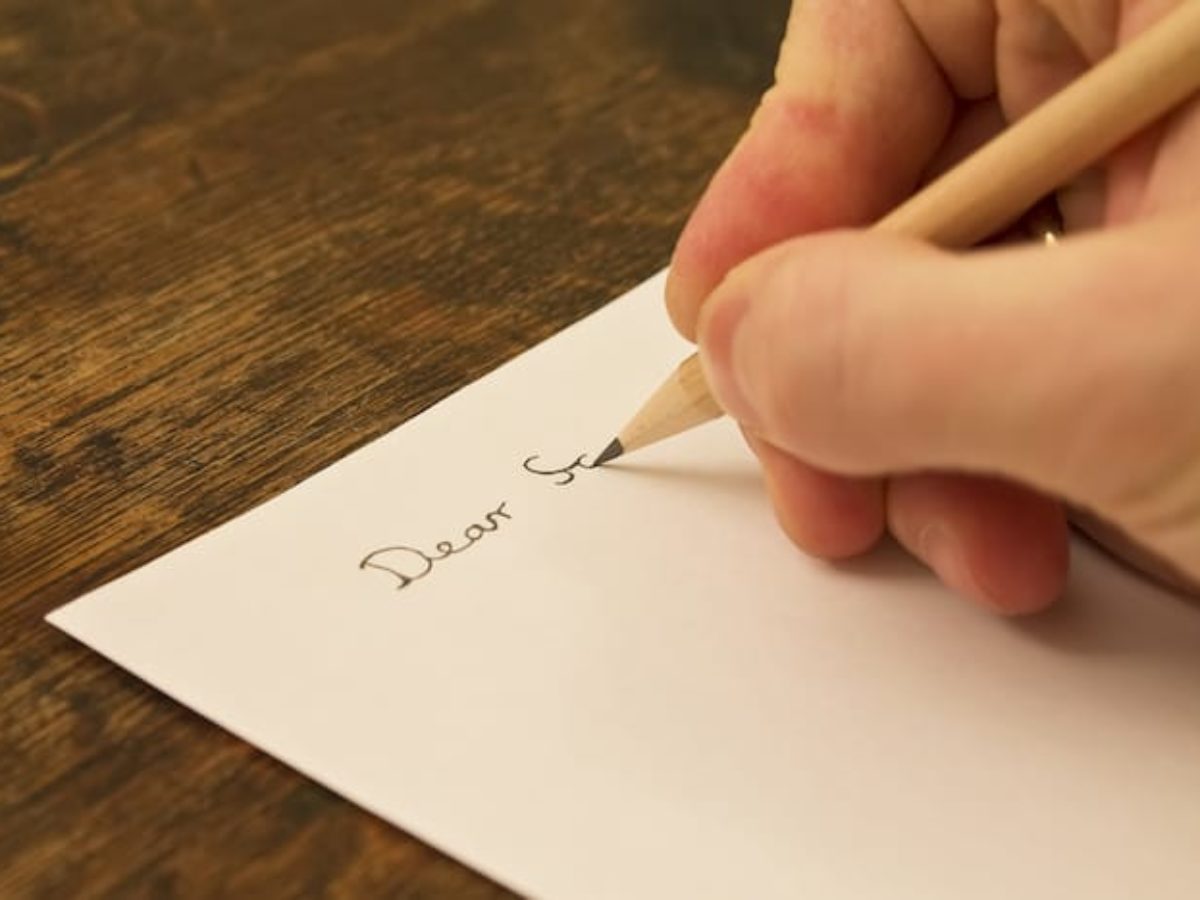
When was the last time you actually took pen in hand and wrote a letter to someone? I don’t mean an e-mail or a “text.” I rather think that most of the electronic communications will all disappear into some digital hell, and no one will actually write letters. As the Japanese novelist Haruki Murakami wrote, “How wonderful it is to be able to write someone a letter! To feel like conveying your thoughts to a person, to sit at your desk and pick up a pen, to put your thoughts into words like this is truly marvelous.”

As I continue to read the collected letters of Bruce Chatwin, I foresee that within a very short time (if not now), no one will write letters. The thought saddens me, as I think back on great letters of the past from such writers as Dostoyevsky, Tolstoy, Aldous Huxley, Chekhov, Joseph Conrad, Flaubert, Sir Walter Scott, and countless others. Already in Chatwin, many of the letters are scribbles on postcards, interspersed with a few lengthy think pieces.

Now there are so many more ways to communicate, including telephone, text messaging, e-mail, and more ad infinitum. I can’t for the life of me think of an e-mail I’ve written that was worth saving for any reason except for passing convenience.

People used to save letters because of their sentimental or literary value. Long-distance relationships were conducted in the mails, resulting in bundles of letters that were saved for decades, letters that warmed the soul as the cold of age started to set in. Do I save my text messages? Not for more than a week or two. As for e-mails, I do large-scale erasures every six months or so.

I think I will highlight in future posts some of my favorite letters from authors and poets.

Perpetuum Mobile

Author and World Traveler Bruce Chatwin (1940-1989)

I have several things in common with the late British writer Bruce Chatwin. He was not in love with the land of his birth: In one letter, he writes, “England is gradually closing in on me again, and the moments of euphoria become rarer and rarer as one gets paler and paler and fatter and fatter and the backbiting conversations grow bitchier and bitchier, and everyone thinks and talks of selling something to somebody else.” To his friend Ivry Freyberg, he writes,“My life at present is the way I like it. Perpetuum mobile.”

In like manner, although I had a happy childhood in Cleveland, I desperately wanted to get away from the place and see the world—this at a time when the family’s finances were unencouraging. I got my four-year scholarship to Dartmouth College and went off to graduate school in California, but it was to be another nine years after graduation in 1966 that I went beyond the borders of the U.S.

Reading the letters of Chatwin (published as Under the Sun: The Letters of Bruce Chatwin), I feel some of the same excitement as when I read his two masterpieces, In Patagonia and The Songlines. I loved reading about Bruce’s travels when he was at his best. At the same time, I am well aware of the flip side of his way of life. As his friend John Kasmin wrote, “Bruce’s biggest problem was where to be. He never knew where to be. It was always somewhere else.”

Even more damning was his wife Elizabeth’s judgment on his travels:

He would wear out people in certain places and then have to move on. Everything was absolute paradise etc for about a month and then things were not quite what he wanted them to be. I discovered after years of this nonsense that the sure-fire way of making Bruce not buy a house was for me to agree.

Part of Chatwin’s wanderlust was his own dual life as a bisexual. The letters show him to be seemingly happily married, yet spending most of his time on the road, enthusing about various places and people.

I, too, would like to be a traveler; but I am content to use Southern California as my base. And I hope not to be tempted by a double life.


Plague Diary 16: I Take a Walk

Bus Riders in El Monte

Once again, I hijack a picture from the Los Angeles Times showing the impact of the plague on the life of the United States’s second largest city. One would hardly think that there were upwards of ten million people squeezed into the county.

Today the weather was sunny and cool, so I decided to take a walk into Santa Monica. Not having any bookstores to go to, I made another stop at Bay Cities Italian Deli near Lincoln and Broadway. There I picked up a couple rolls of toilet paper (at $1/roll) and the fixings for another Italian pasta dish. I had bought the sausage yesterday at Marconda’s Meats at the Original Farmers Market at 3rd and Fairfax.

It was a lovely day for a walk, perfect for avoiding the masked phantoms who occasionally crossed my path during the two-mile trek. The shopping done, I boarded the #1 Santa Monica bus for the return trip home. Once so busy, the bus is full of masked phantoms staying as far apart from one another as the seating allowed. (Needless to say, I wasn’t wearing my mask: It was in the pocket of my jacket.)

When this whole plague period is over and done with, will we remember how strange it was? Being retired, I have no problems with apportioning my time at home, though I miss going to places. And I miss seeing my friends. I keep in touch with them on the telephone, but it’s not the same thing.


RLS on Vailima

Epitaph of Robert Louis Stevenson at Vailima on Samoa

He wrote his own epitaph for his grave atop a mountain in Samoa, and it is one of the great epitaphs:

Under the wide and starry sky
Dig the grave and let me lie.
Glad did I live and gladly die,
And I laid me down with a will.

This be the verse you grave for me;
“Here he lies where he longed to be,
Home is the sailor, home from sea,
And the hunter home from the hill.”

I have become obsessed by the last days of Robert Louis Stevenson in the South Pacific, where he busily spent his last days in a frenzy of writing, local politics, and building. I had always liked the work of RLS, but I think in the South Seas he came into his own.

One of the best books I have read over the last twelve months are the Vailima Letters:  Being Correspondence addressed by Robert Louis Stevenson to Sidney Colvin (1895) of the author, named after the estate he built in Samoa, just south of the capital at Apia.

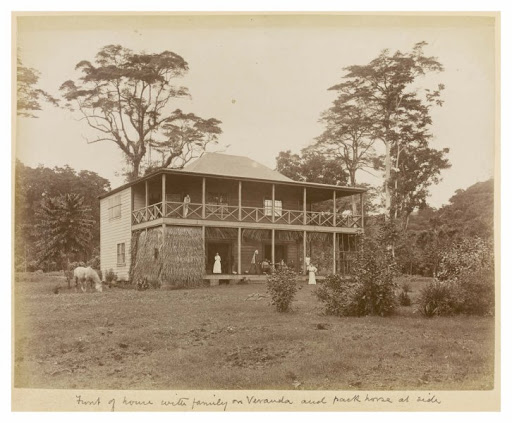
Stevenson’s Estate at Vailima: Early Stages

About a year ago, a friend in Australia recommended two books about Stevenson’s final days in Samoa: Joseph Farrell’s Robert Louis Stevenson in Samoa and Michael Fitzgerald’s The Pacific Room. I immediately downloaded both books from Amazon Kindle. The Farrell I read last May, and I am now halfway through the Michael Fitzgerald. Both have been excellent reads. Now I will try to read more of RLS’s last novels that he wrote from Vailima.

As I grow older, I find myself drawn more and more to Stevenson. His style is so limpid, and yet his thoughts can be so profound.


Beauty and Brains

Actress and Inventor Hedy Lamarr (1914-2000)

One of the most beautiful actresses ever to appear on the silver screen was also a brilliant inventor whose work—for which she did not receive a dime—is used by most Americans on a daily basis.

Hedwig Eva Maria Kiesler, better known as Hedy Lamarr, was an Austrian actress from a Jewish family that fled to the United States on the brink of World War Two. She was slightly notorious for having appeared in the nude in Gustav Machaty’s Czech film Ecstasy (1933). Not only was she unclothed, but was photographed in a tight facial shot simulating an orgasm. As a result, the sanctimonious studio boss of MGM, Louis B. Mayer, put her in films, but never in the big productions.

Poster for Ecstasy (1933)

Still, Hedy did her best, starring in many films, but also making a unique contribution to the war effort. Working with music composer George Antheil, she developed an invention for producing an unjammable system for communicating with a torpedo that has been released. The method involved hopping across a broad spectrum of frequencies. In 1942, her invention was granted a patent, but never used during the war because the Navy thought they knew better. But by the time the patent expired in 1957, it was being used and is used today in Bluetooth technology and on legacy versions of WiFi.

Because Miss Lamarr did not renew the patent, she did not receive any remuneration for her invention. I just saw a thoughtful documentary by Alexandra Dean entitled Bombshell: The Hedy Lamarr Story (2017). Perhaps, in the end, Hedy was too smart for Hollywood—and Hollywood did not tend to reward actresses for their brains. She drifted through several marriages and several bouts of plastic surgery. But looks were never her problem. This woman had a brain, and that was unforgivable.


Plague Diary 15: No Destinations

The Beach During the Early Days of the Plague: Now Forbidden

I used to love taking walks, but now I am somewhat indifferent. You see, what attracted me was not the mere exercise: It was having a destination. And my favorite destinations were bookstores. Well before the coronavirus plague reached our shores, the bookstores of Los Angeles pretty much melted into history. Now I will occasionally take a walk to an Italian grocery in Santa Monica or to the West Los Angeles Post Office.

For a while, it was possible to walk along the beach, or over the bluffs in Santa Monica overlooking the beach. Now both are closed to enforce social distancing. The above Los Angeles Times photo was shot during the early days of the plague. Now, the police are out in force chasing people from the beach or anything else that looks like a nice place to walk. We are urged only to walk for the sheer fun of it, or to go to the market or pharmacy to shop for necessaries.

One thing I absolutely refuse to do is wear a mask while taking a walk. If some random bozo attempts to upbraid me for it, I will gladly send my sputum in his direction. As I wrote in yesterday’s post, until I can find another solution, I cannot exercise while fogging up my glasses. I will gladly stay far away from other walkers, as my distrust of strangers long predates the arrival of the coronavirus. I am always happy to answer strangers’ questions in my ungrammatical Hungarian, which may include some colorful expressions of contempt.

Later this week, I will probably walk to Bay Cities Imports (the Italian deli in Santa Monica) to pick up one of their delightful Spaniard sandwiches together with some ingredients for a future Italian meal. Their pasta, sauces, and Italian sausages are nothing short of superb.


Plague Diary 14: From Not Recommended to Mandatory

What’s Next? Encasing Our Heads in Blocks of Lucite?

A scant week ago, the World Health Organization (WHO) was recommending that face masks should only be worn by people who had the coronavirus. Now, all of a sudden, security guards are turning away customers who are not masked. In no way does a face mask protect the wearer from getting exposed to the virus, unless it is from another person who has the virus but is not masked.

Now all this causes problems for me. First of all, my exhalations result in my eyeglasses fogging up. So imagine trying to read the ingredients of a food item through a fog of one’s own creation. I will try to rig up some kind of improvised cloth face mask for myself using a scarf, if I can.

Secondly, anything that inhibits me from inhaling normally occasionally causes me to gag or choke. Again, an improvised cloth face mask may be the answer.

The face mask I wear is identical with the one in the above photo, except that I have stretchy rubber loops that attach to my ears.


Henequen and Chicle

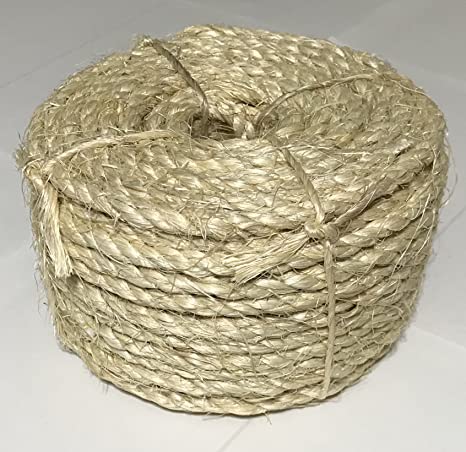
Henequen Was the Major Source of Yucatán’s Wealth Around 1900

While I am here quarantined in my apartment, I look back with pleasure to my trip to Yucatán in January and February of this year, before the coronavirus outbreak reached America’s shores.

Before the days of mass tourism to the peninsula, the economy of Yucatán was based primarily on henequen, and less importantly on the sap of the sapodilla tree. In the first case, henequen fiber was used to make a rope usually referred to as sisal, or matting. Such was the demand for the fiber that the owners of haciendas that grew henequen became millionaires. Today, their mansions line the Paseo de Montejo, once one of the richest residential streets in the world.

A Pre-Wrigley Gum Wrapper

The other substance for which Yucatán was known was chicle, originally the substance that made chewing gum possible. Chicle was made from the mily latex of the sapodilla tree, which was tapped similarly to rubber trees in the Amazon. Men known as chicleros ranged far and wide in jungle areas tapping the sapodilla trees, and in the process discovering many of the Maya ruins which are now major tourist attractions. I remember a number of years ago a brand of candy-coated chewing gum called Chiclets. Even then, it was no longer made using real chicle.

Nowadays, both henequen and chicle are no longer major economic forces in Southeast Mexico. There are still a couple of active haciendas specializing in henequen for ropes or matting, but the day of the chicleros is forever gone since chicle has been replaced by a synthetic substance known as a polyol.


Non-Academic Poet

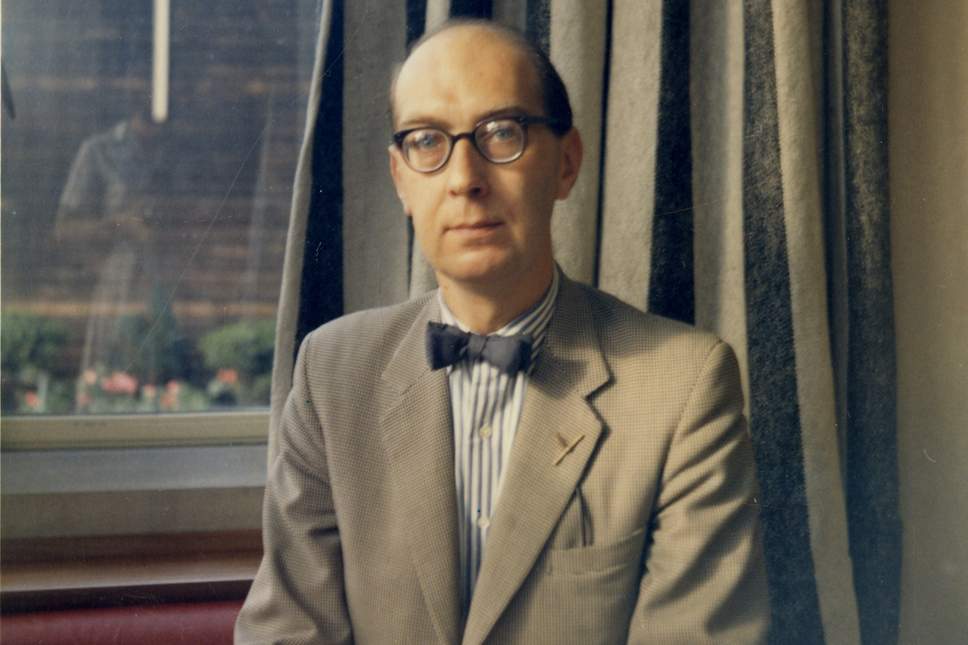
British Poet Philip Larkin (1922-1985)

Sometimes the greatest poets are not those favored by academics. Philip Larkin was not a prolific poet, yet what he wrote speaks volumes even to those who are not “academia nuts.” When I look back at 20th Century British poetry, I see him as one of the brightest literary lights of his time. Take for example the following:

Aubade

I work all day, and get half-drunk at night.
Waking at four to soundless dark, I stare.
In time the curtain-edges will grow light.
Till then I see what’s really always there:
Unresting death, a whole day nearer now,
Making all thought impossible but how
And where and when I shall myself die.
Arid interrogation: yet the dread
Of dying, and being dead,
Flashes afresh to hold and horrify.

The mind blanks at the glare. Not in remorse
—The good not done, the love not given, time
Torn off unused—nor wretchedly because
An only life can take so long to climb
Clear of its wrong beginnings, and may never;
But at the total emptiness for ever,
The sure extinction that we travel to
And shall be lost in always. Not to be here,
Not to be anywhere,
And soon; nothing more terrible, nothing more true.

This is a special way of being afraid
No trick dispels. Religion used to try,
That vast moth-eaten musical brocade
Created to pretend we never die,
And specious stuff that says No rational being
Can fear a thing it will not feel, not seeing
That this is what we fear—no sight, no sound,
No touch or taste or smell, nothing to think with,
Nothing to love or link with,
The anaesthetic from which none come round.

And so it stays just on the edge of vision,
A small unfocused blur, a standing chill
That slows each impulse down to indecision.
Most things may never happen: this one will,
And realisation of it rages out
In furnace-fear when we are caught without
People or drink. Courage is no good:
It means not scaring others. Being brave
Lets no one off the grave.
Death is no different whined at than withstood.

Slowly light strengthens, and the room takes shape.
It stands plain as a wardrobe, what we know,
Have always known, know that we can’t escape,
Yet can’t accept. One side will have to go.
Meanwhile telephones crouch, getting ready to ring
In locked-up offices, and all the uncaring
Intricate rented world begins to rouse.
The sky is white as clay, with no sun.
Work has to be done.
Postmen like doctors go from house to house.


Plague Diary 13: Rainy Day Quarantine

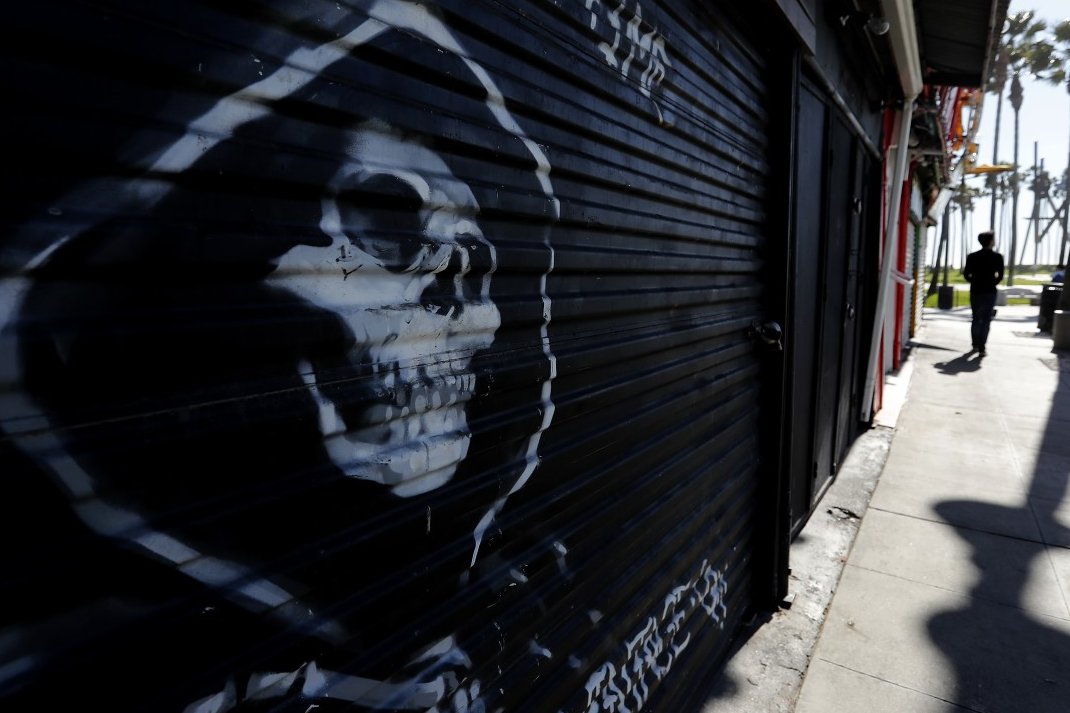
Death’s Head Overlooking Venice Beach

Once again, I have taken a Los Angeles Times photograph from their evocative series on the effects of the quarantine on L.A.’s public spaces.

Today has been a day of steady rain, which started late morning and will probably continue through the night. We did get out around 11 am: Martine needed repairs to her eyeglass frames that only an optician could make, and I picked up a couple of Chick-Fil-A chicken sandwiches for her. Martine was none too happy with the yellow split pea rice pilau I had cooked the previous evening, preferring meat dishes even as I drift slowly into a vegetarian diet.

Returning around noon, we have stayed in the apartment. I sat in the library finishing Daniel Defoe’s A Journal of the Plague Year. As I compare the current coronavirus disease with the bubonic plague, I would have to say that COVID-19 is by far less horrible. Whereas the mortality rate of the current outbreak is 2% of those afflicted, some 69,000 Londoners out of a total of 500,000 died of the 1665 outbreak.

The way that London enforced quarantine was to lock up any household where there was an instance of plague, enforced by two shifts of watchmen who would assist the tenants of the house get food and other necessities. But if one person in a household got the plague, it was fairly certain that all would die horribly.

On most days, I see at least one film, either from Spectrum Cable, Netflix’s DVD.COM service, or my personal DVD collection, consisting mostly of American and foreign classics. Today, since Martine did not go out for a walk, I decided not to induce her to retire to the bedroom to avoid listening to samurai sword fights, Western gunfights, or other irritatingly loud sound tracks.

Tomorrow, the rain will gradually taper off, and I will be able to play one of my films.