Do You Know Anyone Whose Opinion Was Changed by One?
This was originally posted on June 29, 2014.
I have always wondered why people are so willing to advertise their opinions, their place of work, info about their families and whatever, especially by sticking bumper stickers on their cars. I can think of at least three reasons why this is not such a good idea:
There are parts of town where I would not like to advertise my political beliefs, such as in Orange or San Diego Counties. My car is not a new one, but at least it still runs for now.
It is distinctively possible that your favorite candidate could turn out to be an unregenerate louse. After all, why would someone want to go into politics any more unless one is on a power trip? (It didn’t used to be that way, but it is today.)
Bumper stickers are a lot like tattoos: They’re a lot easier to apply than to remove.
As for myself, this blog is my bumper sticker. If, after reading it, you think I am a political conservative, you must not have read it very carefully.
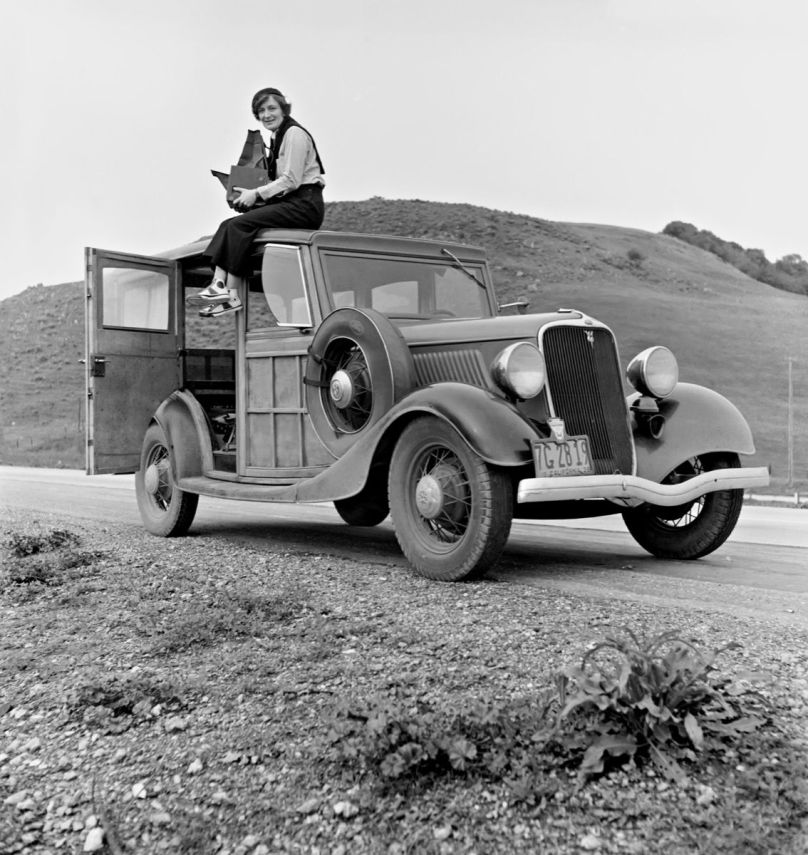
Ever since I attended an exhibit of Henri Cartier-Bresson’s work at Dartmouth College in the mid 1960s, I have been a strong believer in the art of photography. Photographers like Ansel Adams, Walker Evans, Diane Arbus, Edward Weston, and Robert Capa have been like gods to me—as was Dorothe Lange. I present only two of her photographs here, but they speak mostly for themselves.
Migrant Mother, Nipomo, CA, 1936
This is Lange’s most famous photograph—one of the canonical images of America during the Depression years. I am amazed at the effect of her two older children averting their eyes from the camera while their mother contemplates her situation.
The Road West, U.S. 54 in Southern New Mexico
Once again, Lange draws beauty out of desolation in this stark image of a highway running straight through the New Mexico desert. U.S. 54 runs north/south through the heart of New Mexico, bypassing the White Sands Missile Range where the first atomic bomb was exploded in 1945. I have been through the area at least twice on my way to Capitan and Alamogordo, New Mexico.
This post originally appeared on November 12, 2016, shortly after I returned to Los Angeles from Ecuador.
The text is from Matthew 18:22: “Jesus saith unto him, I say not unto thee, Until seven times: but, Until seventy times seven.” It refers to how many times one must forgive transgressors. That inspired the Swedish author, Lars Görling, wrote a novel entitled 491, which was made into a film by Vilgot Sjöman.
This is a very roundabout way of remembering the route Dan and I took as we emerged from the twisted warren of unmarked streets which is Ambato, one of Ecuador’s largest cities. We were looking for the E-35, which is the Pan-American Highway. Instead we were on E-491, which took us through a number of towns and villages which were not on my map of the country. Nor, for that matter, was E-491.
Then, as we rounded a hill, quite suddenly, we saw the volcano Chimborazo dead ahead of us. The clouds had moved aside, allowing us to see the glaciers on Ecuador’s tallest mountain. If you measure altitude from the center of the earth rather than sea level, it is the tallest mountain on earth, looming in splendid isolation from the rest of the Andes.
A Herd of Wild Vicuñas
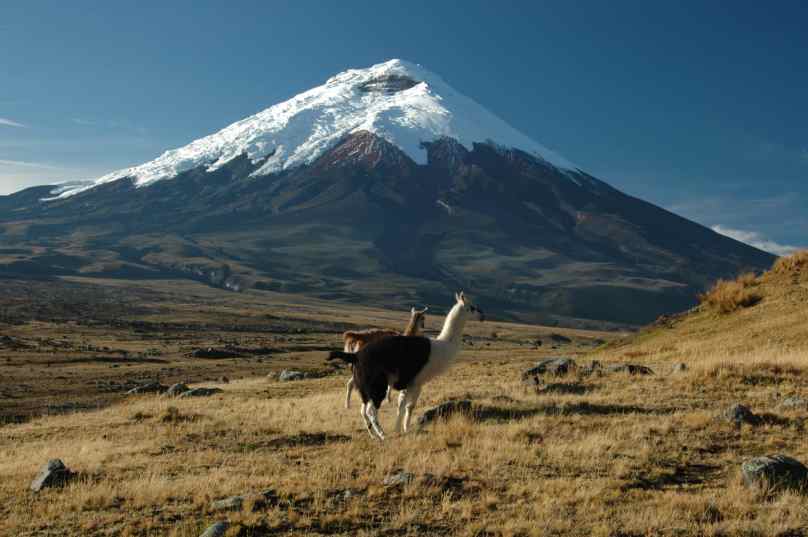
As we drew closer to the mountain, we espied a large herd of wild vicuñas on both sides of the road. Dan and I stopped to take pictures in the rarefied air, which must have been 15,000 feet altitude.
Throughout its length, E-491 was spectacular. Even the Indian villages along the route were more interesting. And then, as we approached the city of Riobamba, we crossed the Pan-American Highway. We spent the night in a spare, but scrupulously clean hotel near the railroad station. By then, we were on the “wrong” side of Chimborazo, which was now covered in clouds.
That was the end of our getting lost: The next day, we easily made our way to Cuenca in about five hours.
Mount Cotopaxi in Ecuador (19,347 Feet or 5,897 Meters)
The Earth is by no means a perfect sphere. If you are standing at either the North or South Pole, you are some 21 km nearer to the center of the planet than if you were near the Equator. The reason for this is that the rotation of the planet exerts a centrifugal force that makes of the Earth more of an oblate ellipsoid. The illustration below exaggerates this phenomenon, but gives you the general idea:
Earth as an Oblate Ellipsoid
One upshot of this phenomenon is that some of the mountains nearer the Equator are actually higher than any of the Himalayas, including Mount Everest. The so-called Equatorial Bulge calls for a more accurate measure of a mountain’s altitude than distance above sea level—especially as the bulge means that sea level is correspondingly higher. A more accurate measure is distance from the center of the Earth.
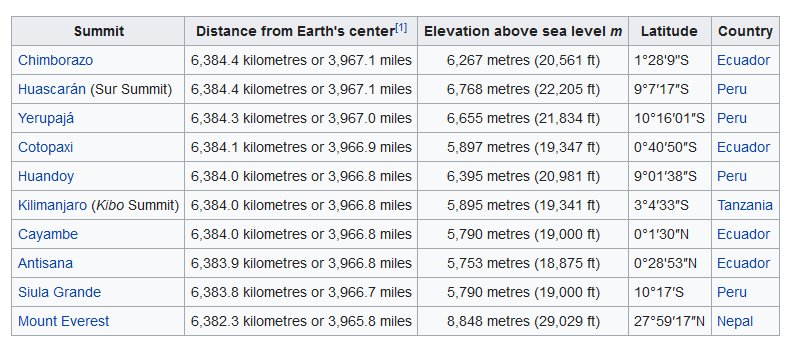
Using this measure, Mount Everest just barely makes the top ten list:
The Highest Mountains on Earth Measured by Distance from the Earth’s Center
According to this chart, the highest mountain is a virtual tie between Chimborazo in Ecuador and the South Summit of Huascarán in Peru. In fact, by this measure eight of the ten highest mountains in the world are in the Andes, the only exceptions being Kilimanjaro in Tanzania and Everest in Nepal.
Tomorrow, I will repost a blog I wrote about my visit to Mount Chimborazo in 2016.
To begin with, I have no problem about getting from 9 to 9½ hours of sleep. In fact, during the last year I have slept better than at any other time in my life. I wake at 9 or 9:30 am, stumble out into the living room to say good morning to Martine, who always wakes up before me, and take my pills, give myself a shot of insulin, and perform a finger-prick test for my sugar level. Only then am I ready for breakfast.
Almost all mornings, I make a pot of hot tea, the current choice being Ahmad of London’s Darjeeling. It is usually accompanied by scrambled eggs with chiles, oatmeal, toast, a fried egg sandwich on a muffin, or grits and sausage. While I breakfast, I always read the Los Angeles Times, devoting particular attention to the KenKen and Sudoku puzzles and the comics page.
By the time I am finished, it is close to noon; so I futz around on the computer for a while, either playing chess with the computer at Chess.Com or one of the free games on Arkadium.Com.
Lunch is not usually a big meal for me, so I delay it into the early afternoon, after which I either see a movie on TCM’s website or Amazon Prime Videos, or I read a book. My current read is Paul Theroux’s Sir Vidia’s Shadow: A Friendship Across Five Continents, which is about the author’s long friendship with V. S. Naipaul (1932-2018). Both are among my favorite authors.
At supper, we usually have a hot home-cooked meal. Today, it was turkey burgers with steamed carrots. Tomorrow, I’ll have to shop for and prepare another meal, about which I must first consult with Martine. She’s the one with the trick digestive system. Last week, we have baked ziti with Italian sausage—one of my better efforts.
After we’ve eaten, Martine washes the dishes while I repair to my library with my current book, where I both read and talk to friends on the phone until about 9 pm. That’s the hour when I write my book reviews for Goodreads.Com and my blogs for WordPress.Com.
By the time I am done, I watch TV until shortly before midnight, concentrating on such shows as Carol Burnett (MeTV), Bill Maher and John Oliver (HBO), Trevor Noah’s “The Daily Social Distancing Show” on Comedy Central, and the opening monologue on Steven Colbert (CBS).
Martine has a much more difficult time of it than I do. She either takes long walks or sleeps while playing an AM talk radio station. She goes to bed for the night much later than I do and wakes up earlier, as she is bedevilled by a bad case of nerves. As I always tell her, nerves are a bad business; so I don’t have any.
Pacific & Windward, the Center of Venice, California
If you squint hard when you look at the above picture, you can see the set of the Mexican border town in Orson Welles’s Touch of Evil (1958) in which Charlton Heston plays a Mexican drug enforcement officer—one of his weirder roles.
Now it’s just ground zero for one of Los Angeles’s main tourist attractions: The Venice Boardwalk. The boardwalk runs roughly between the Santa Monica Pier and the Venice Pier. It’s only when you cross the border from Santa Monica into Venice that the fun begins. There are scores of tattoo parlors, cafés, tourist junk shops, fortunetellers, psychics, and handcrafts. including a lot of dubious art. The Midwestern tourists who come by the busload see what they think is the “real” Los Angeles, whereas what they see has been created largely for their benefit.
I sort of enjoy the tatty atmosphere of the Boardwalk, but I mainly go because it contains one of Los Angeles’s last surviving bookshops, Small World Books. Today I picked up a copy of James M. Cain’s last novel, The Cocktail Waitress, and a book by Alan Watts about Buddhism. Then I had a slice of pepperoni pizza from Rey’s and trundled back to my car, which was parked at a confusing intersection of streets a few blocks away near Electric and Abbot Kinney.
If you go a few blocks south on Pacific, you will find the bridge over the Venice canal that was the scene of where Joseph Calleia plugs Orson Welles’s corrupt Captain Hank Quinlan.
I dedicated last month to reading books only written by women. On March 5, I posted a TBR (To Be Read) list from which I would choose the titles I would undertake to read and review. As was typical, I wound up reading about half the books on the list, adding to them some last-minute choices. Here is the list of what I read:
Celeste Ng (United States), Little Fires Everywhere **** †
Joyce Carol Oates (United States), The Man Without a Shadow ****
Ludmilla Petrushevskaya (Russia), The Time: Night ****
Patricia Highsmith (United States), The Black House (Short Stories) *****
Silvia Moreno-Garcia (Mexico), Gods of Jade and Shadow ***** †
Colette (France), The Pure and the Impure ****
Eve Babitz (United States), L.A. Woman ****
Sofi Oksanen (Finland/Estonia), The Purge **** †
Rosario Santos—Editor (Bolivia), The Fat Man from La Paz (Short Stories) **** †
Clarice Lispector (Brazil), The Hour of the Star *****
There wasn’t a stinker in the bunch, and four of the choices were superb (Woolf, Moreno-Garcia, Highsmith, and Lispector). Five of the books marked with a dagger [†] were by authors I had never read before (Ng, Robinson, Moreno-Garcia, and Santos). On my original TBR list, I thought I had never read any Ludmilla Petrushevskaya before, but I was mistaken.
I will continue to read more books by women authors than I have in the past, though I may not repeat the intensity of March’s reading project. It was an interesting experiment, as all the choices were pretty high quality.
I must think I’m going to live forever.Trapped in my apartment during the quarantine, I am thinking more and more about returning to Peru and including the altiplano of Bolivia. Here I am at age 76, thinking of a strenuous trip at high altitude to one of the most fascinating (albeit difficult) places on Earth.
In 2014, I spent some time on the western shore of Lake Titicaca, on the Peru side. I even took a tour on a launch to Isla Taquile and one of the Uros Isles, but as the boat left the dock, I discovered that I was beginning to suffer the effects of food poisoning. The former afternoon at Sillustani, I ate something in a farmer’s house that violently disagreed with me. What is more, I was hours away from a toilet. Under the circumstances, I was not able to appreciate the beauties of Lake Titicaca, and in fact I took no pictures that day.
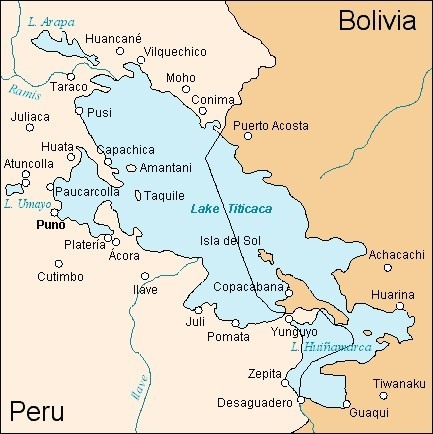
Map of Lake Titicaca, Showing the Location of Tiwanaku at Lower Right
Just as I returned to Tierra Del Fuego after breaking my shoulder there in 2006, I plan on returning to the Peruvian side of the lake, and adding some parts of Bolivia to the mix. I find myself suddenly interested in the Aymara-speaking peoples of the Andes.
A funny thing happened to me in Puno during my last visit. It was a bitterly cold morning, as it frequently is at that altitude (12,000 feet or 3,700 meters). I had neglected to bring a scarf with me, and I badly needed one. Enter a poor Aymara woman laden down with hand-knitted handicrafts. I walked up to her and brought a beautiful scarf at a reasonable price. Apparently, I made that woman’s day. She broke into a big smile and was almost prepared to welcome me into her family.
Over a thousand years ago, there was an Aymara empire centered at Tiwanaku in modern-day Bolivia. It lasted until AD 1100 when a massive and persistent drought led to a drop in the level of Lake Titicaca, leaving the Aymara fields high and dry. Hundreds of years later, the Inca took over; but their empire was short-lived once the Spanish conquistadores began to move in.
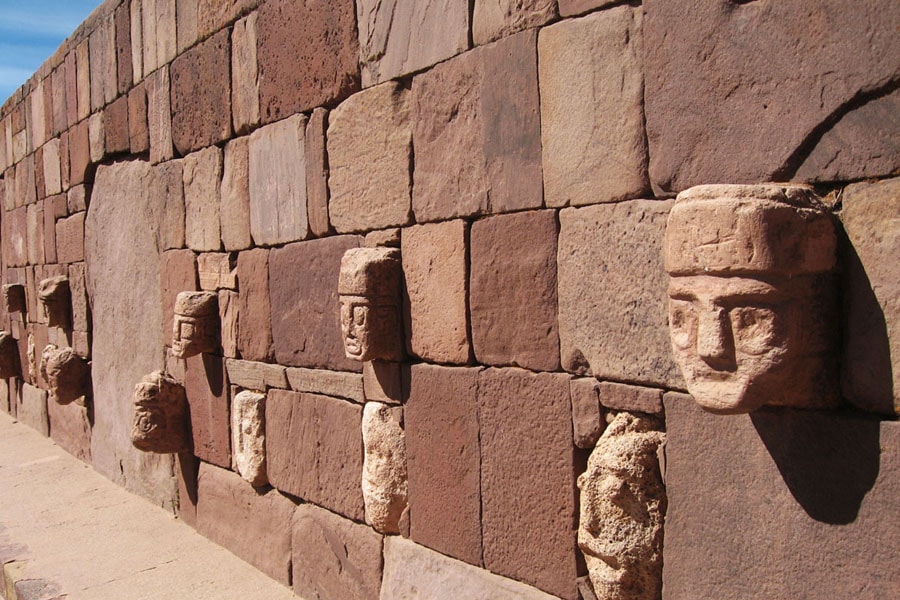
Walls of the Kalasaya Complex at Tiwanaku
Since the eco-catastrophe that destroyed the Aymara empire a thousand years ago, the Aymara have become a scattered people indulging in subsistence agriculture and the herding of llamas and alpacas.







 Tarnmoor
You must be logged in to post a comment.