Nine Apples

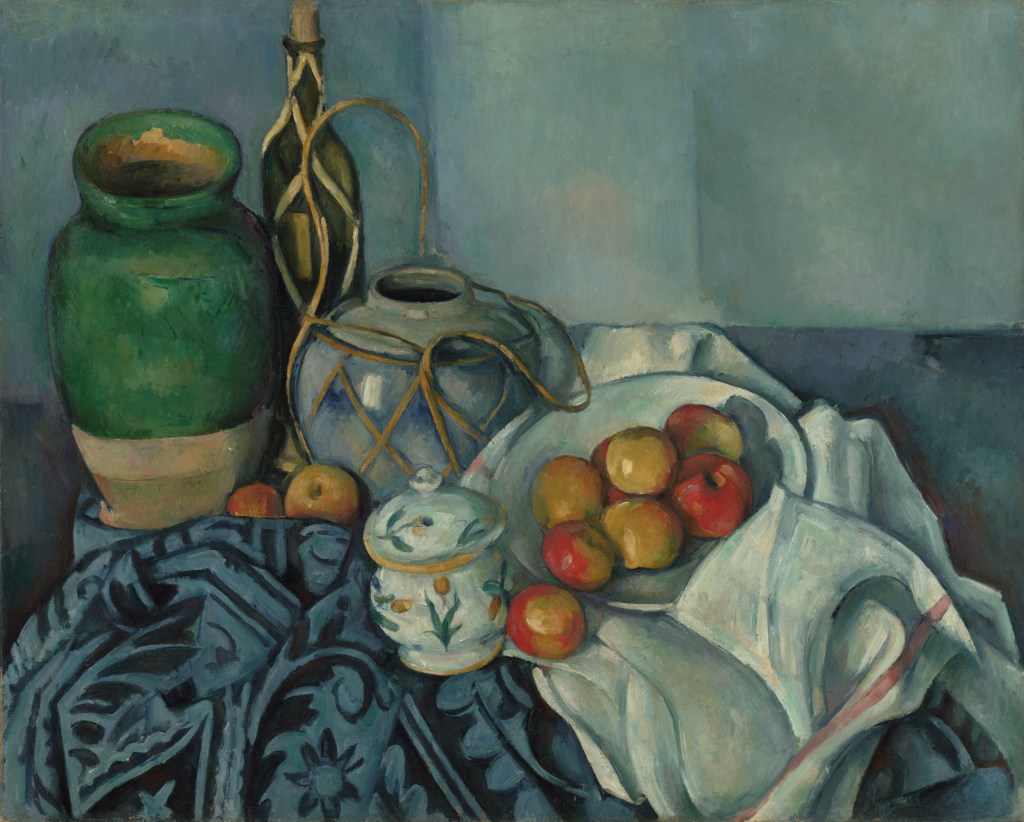
Illustrated above is Paul Cézanne’s “Still Life with Apples” (1893-1894). It is my second posting in my Gallery Talks series, based on a visit last week to the Getty Center in Los Angeles. I find that, whenever I visit an art museum, my mind tends to linger on the artworks that struck me the most.

To my mind, Cézanne is the modern master of the still life, easily rivaling the Dutch masters of that genre. Take a good look at the painting. What catches your attention?

Whereas most of the colors are muted greens, blues, grays.and off-white, what stands out are the nine red apples in two groupings, one of seven around a platter, and two more between two pieces of pottery. The table cloth is interesting in that we have no idea of how it covers the table, or how large the table is. Note that there is no real attempt at perspective: The folded dish towel at bottom right is clearly in front of the two jugs, yet the two jugs are not diminished in size. Then, too, what about those two vertical lines that emanate from the table up to the supposed ceiling. It is impossible to speculate from these what the shape or size of the room is. Or are those lines there just to direct our attention to the apples?

Each of the elements of the still life are nicely depicted, though the relationship between the various elements is difficult to ascertain. Was Cézanne telling us to keep our attention on those apples, especially the ones in the dish which seems to be on the point of dumping its contents onto the floor, or wherever?

According to the Getty’s own description of the painting:

During the last thirty years of his life, Paul Cézanne painted the same objects–the green vase, the rum bottle, the ginger pot, and the apples–over and over again. His interest was not in the objects themselves but in using them to experiment with shape, color, and lighting. He arranged his still lifes so that everything locked together. Edges of objects run into each other; for example, a black arabesque seemingly escapes from the blue cloth to capture an apple in the center; the sinuous curves of the blue ginger pot’s rattan straps merge with other straps on the body of the bottle behind. Giving form and mass to objects through the juxtaposition of brushstrokes and carefully balanced colors and textures, he gave the painting a sense of comforting stability.

I do not get a feeling of “comforting stability” from this painting. What I do come away with is a feeling of mastery with a touch of threatened instability. Cézanne knew what he was doing, and he probably enjoyed overturning the rules established by his forebears to point out new possible relationships between the depicted elements.
CGI: Hollywood

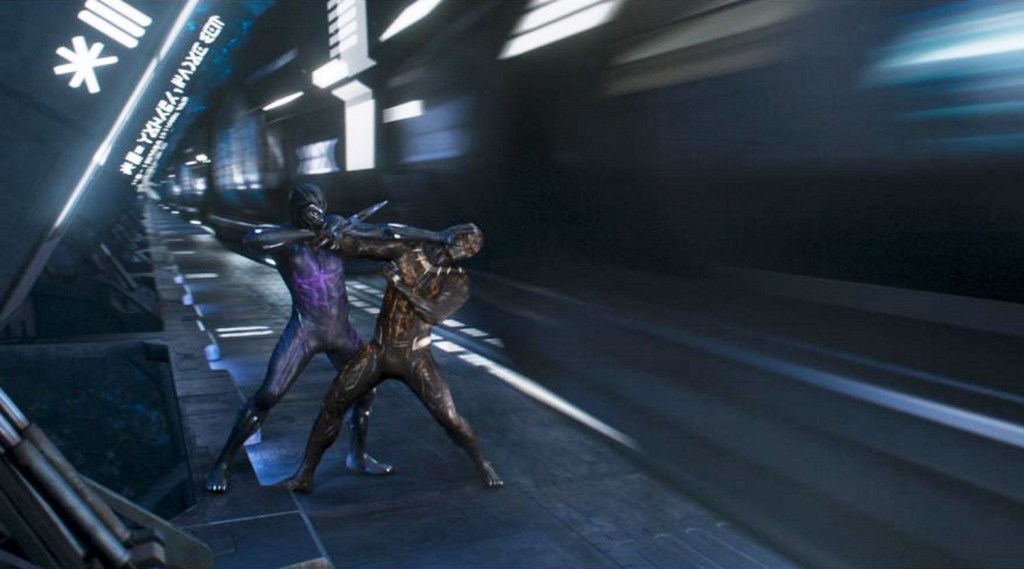
just When I wrote about seeing the new version of Dune yesterday, I refrained about commenting how dismayed I was by all the CGI (Computer Generated Imagery) that haunted all the action scenes. During the CGI scenes, the action becomes more vague; and the sound is pumped up to fill in the gaps. The 1984 version had some primitive CGI, but the action scenes were more honest: There was real action, and not fuzzy animation.

My dislike of CGI is one reason I avoid superhero films, in which CGI is more dominant. I prefer when the actors are humans that move like humans.

It seems that the CGI specialists are in the ascendant in Hollywood at the moment. That won’t bother all the middle school fans who love that sort of thing, but it keeps me from films that appeal to that mind(less)set.

In the end, I wonder if the computer has—overall—had a baneful effect on the film industry.

Return to Arrakis

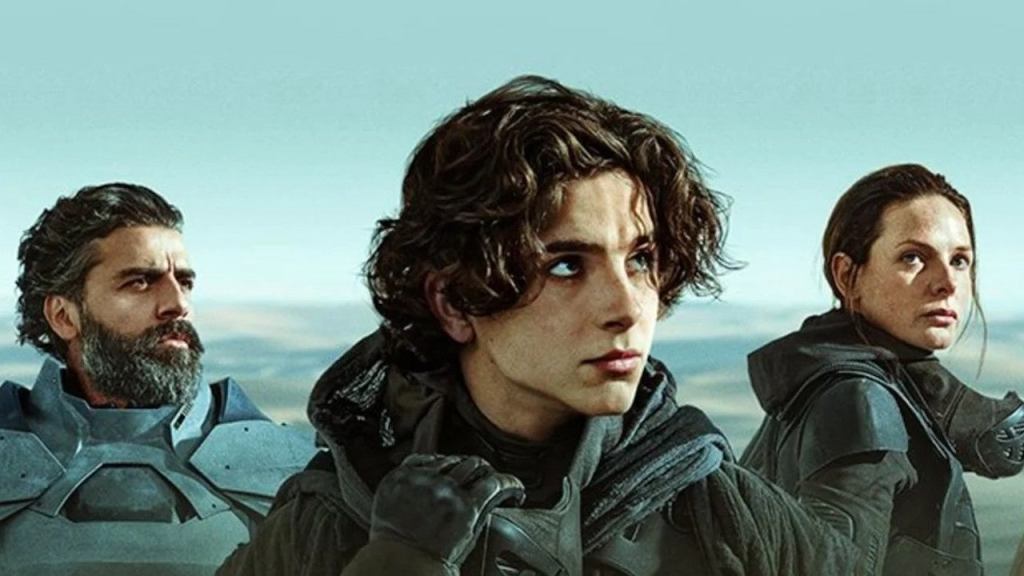
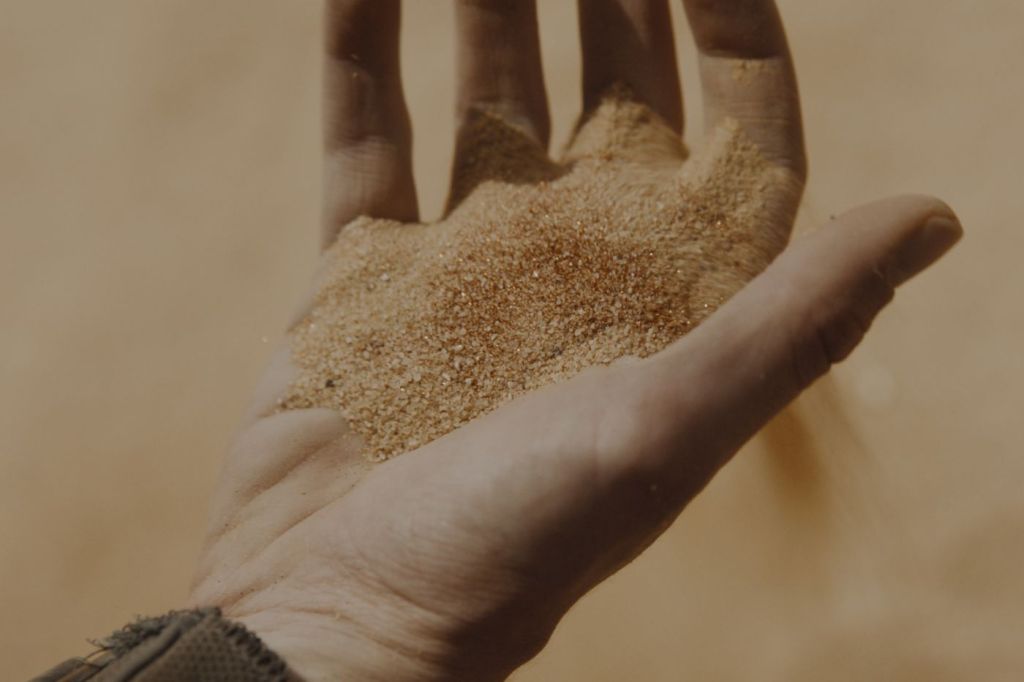
This afternoon, I went to the movies to see the new Dune: Part One directed by Denis Villeneuve. I went expecting not to like it, but ended up liking it a lot—but not quite so much as David Lynch’s magnificent 1984 Dune, as fragmentary as it was. What threw me off were all the stills of Timothée Chalamet as Paul Atreides. I kept saying to myself, “Why, he looks like a whiny little bitch!” In the actual film, he was quite good, at least as good if not better than the wooden Kyle MacLachlan in the David Lynch film.

Where the 1984 Dune came across as fragmentary, Villeneuve’s version plugged many of the gaps, such as the death of Duncan Idaho and the role played by Liet-Kynes, who seems to have changed both gender and race in the new film. (No matter, Sharon Duncan-Brewster was not only stunning: She could act!)

Frank Herbert’s original book is probably the closest the science fiction genre will ever come to a true epic. And as such, it is pretty much unfilmable. The new film does not tell the whole story: It stops just as Paul Atreides and Jessica are accepted by the Fremen, but does not show how Paul and the Fremen defeat the brutal Harkonnens and the whole empire. That was the weakest part of Lynch’s masterpiece, and I suspect that it would take a bit of doing to make it as interesting as Part One.

Whichever version you choose to see, I highly recommend you read the novel first. It is incredibly dense, but it manages to carry you along. To be confronted by the likes of the Bene Gesserit, the Spacing Guild, CHOAM, and Tleilaxu Face Dancers without having encountered them in the novel might be a bit much for most viewers. I’ve read the novel three times in the last half century, and I love it—despite its many flaws. As I said, it is probably the closest to an epic that you will ever see in the sci-fi genre.

Edge of the Storm

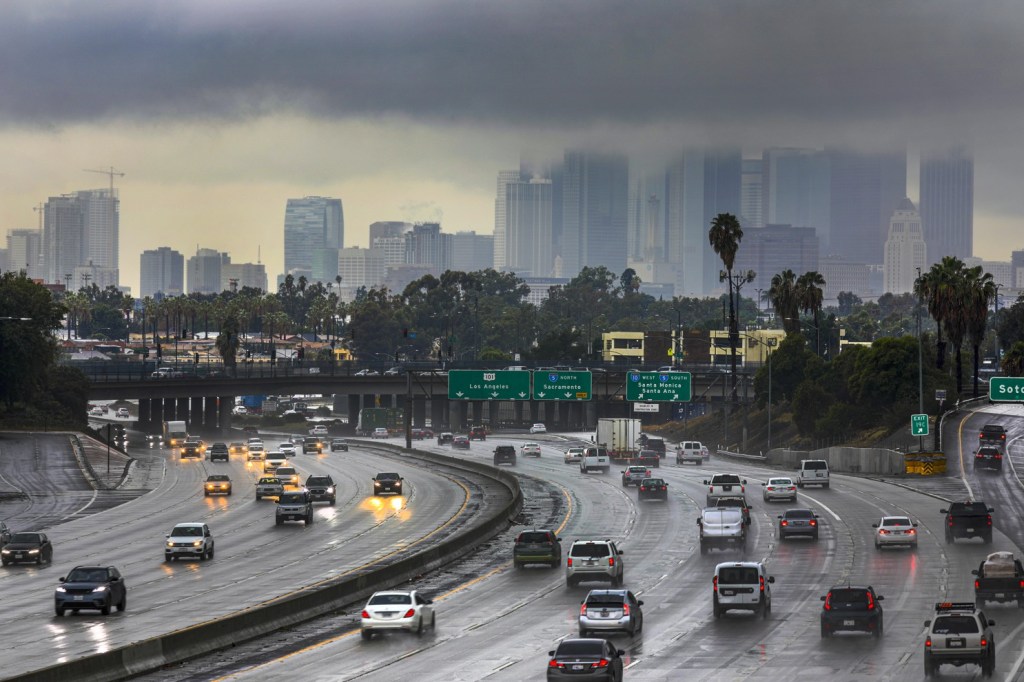
Today, Los Angeles got its first real rain this season. Mind you, it was the far southern edge of a more serious storm that hit Northern California; but still it was enough of a novelty to one who has not seen any real rain for the better part of a year.

If you are not familiar with California, the south is the part that doesn’t get much precipitation. The boundary seems to be at Point Conception in Santa Barbara County. Weather forecasts usually read “from Point Conception to the Mexican Border.”

You will notice that the shore of California north of Point Conception is considerably to the west of the south shore. To go from Los Angeles to Santa Barbara, one travels as much to the west as to the north.

When I first moved to Los Angeles, we had more rainy summers, especially around the early 1980s, when one storm carried away part of the Santa Monica Pier. There would be whole days of heavy rain, one following on the heels of the other. Now it seems to have a few widely spaced rains, usually dumping just a fraction of an inch. If this trend continues, the water shortage will get serious. There is not enough of a snowpack in the Sierras any more, and the Colorado River is drying up. And these are our two main sources of water.

The L.A. Department of Water and Power is planning on re-processing sewage to return to our faucets. The unfortunate moniker for this procedure if “toilet to tap.” It doesn’t sound very appetizing, and I foresee a lot of problems in its implementation.

Rembrandt Laughs

Rembrandt Laughing—Self Portrait ca. 1628

One thing about the later paintings of Rembrandt Harmenszoon van Rijn’s later paintings: They were pretty somber. Not only somber, but Old Testament somber. Therefore, it was nice to see something he painted in a lighter vein when he was in his early twenties.

What made Rembrandt laugh? He must have seen me accidentally dump a bowl of clam chowder in my lap at the Getty Center. The original is a small painting, only 22.2 cm × 17.1 cm (8¾ in × 6¾ in).

I think that, as we get older, we sometimes forget to laugh.We look at the news and are dismayed. We examine the younger generation’s report cards and strange subculture and are nonplussed. We visit the doctor and realize we are not immortal. But we can still laugh. If we can laugh, I think we will live longer and better. The young Rembrandt knew that. The older Rembrandt? Not so much.

For Rembrandt to yuck so heartily while wearing an uncomfortable-looking steel collar is all the more remarkable. I like this Rembrandt. He is fun without being quite so Harmenszoon, and that is a good thing.

This is the first of a series of posts I refer to as gallery talks, based on my visits to various art museums. This particular painting is at the Getty Center.

How Not to Serve Clam Chowder

Today, for the first time since quarantine began, I went to visit the Getty Center. There was an interesting exhibit of paintings by Hans Holbein the Younger, plus the usual permanent collection.

After seeing the Holbeins, I walked down to the café and ordered a cup of clam chowder. It was good and hot and tasty. I got up to get some black pepper, but when I returned to the table, I managed to dump most of the chowder into my lap, with some going on my shirt and other bits on my work boots.

There is no way to look cool when you are wearing a serving of clam chowder. I did the best I could to wipe the chunky bits off my clothes. Then I looked for a bench in an isolated part of the grounds and sat there to let the soup dry off my clothing.

On the plus side, I did see some interesting paintings. The idea came to me to write follow-up postings on individual art works that particularly impressed me—which I will start in a day or two.

I regret to say that I am off clam chowder for the time being.

English Lit—East

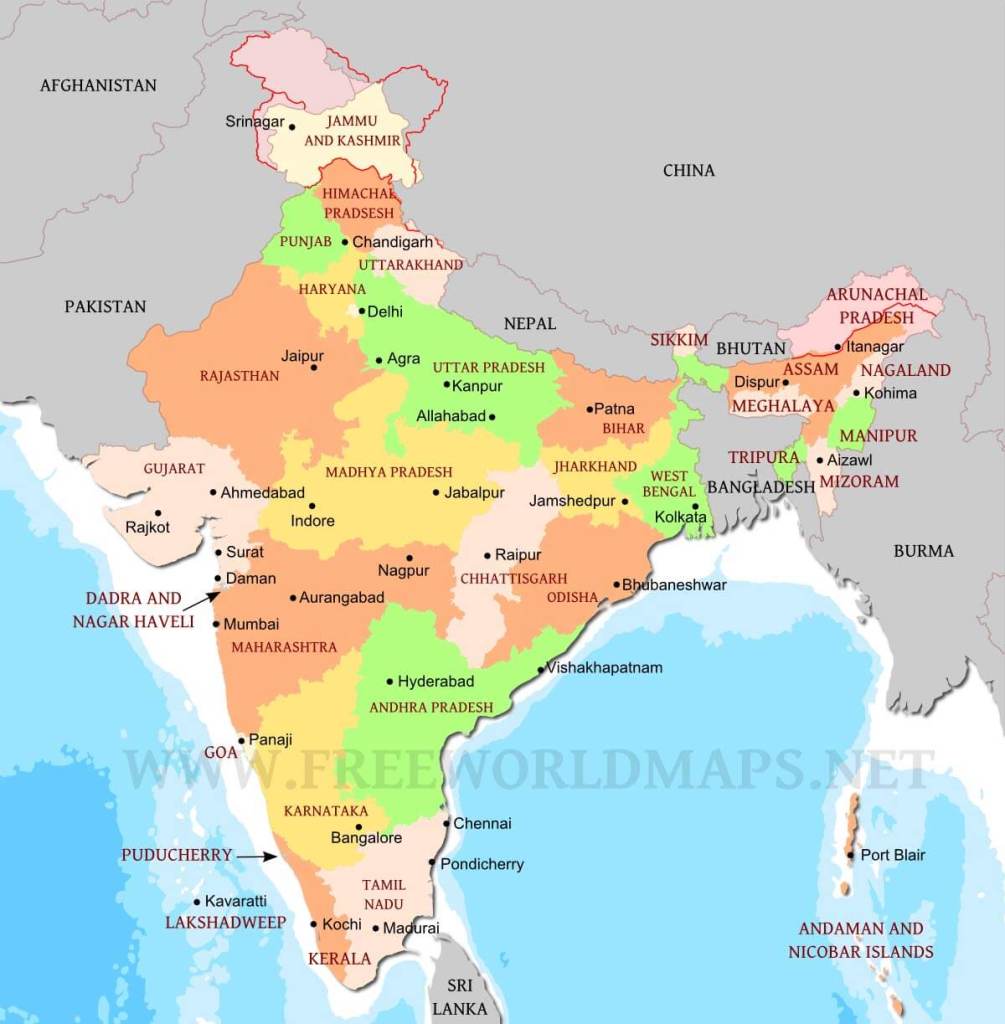
Many people are unaware of the fact that some of the best English literature of the last hundred years or so comes from India. The subcontinent has some 22 officially recognized languages and dialects spoken within its borders. Most people know about Hindi, but what about Assamese, Bengali, Bodo, Dogri, Gujarati, Kannada, Kashmiri, Konkani, Maithili, Malayalam, Marathi, Meitel, Nepali, Odia, Punjabi, Sanskrit, Santali, Sindhi, Tamil, Telugu, and Urdu? Actually, what binds all the various peoples of India together is, believe it or not, the English language, a holdover from British colonial days.

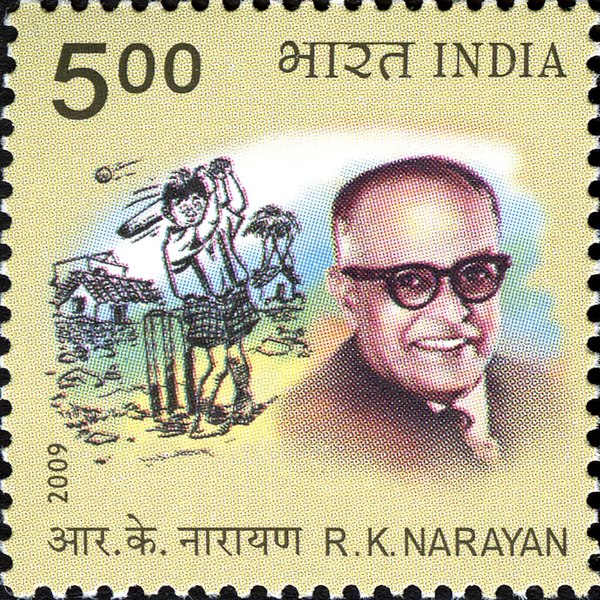
In this post, I will mention two writers whom I have read over the years with great pleasure. First, there is Rasipuram Krishnaswami Iyer Narayanaswami, better known as R K Narayan (1906-2001).

Narayan was brought to the attention of the English-speaking world by none other than Graham Greene. Like William Faulkner with his Yoknapatawpha County, Narayan created a fictional town in Tamil Nadhu called Malgudi and wrote numerous novels and short stories about the people who live there. My favorites among his novels are Swami and Friends (1935), The Financial Expert (1952), The Guide (1958), The Man-Eater of Malgudi (1961), and The Vendor of Sweets (1967).

Another excellent Indian writer writing in English is Anita Desai (born 1937), who currently teaches at MIT in Cambridge, Massachusetts.

Several times, Desai has been shortlisted for the Booker Prize. Among my favorites of her novels are Clear Light of Day (1980), Baumgartner’s Bombay (1988), Fasting Feasting (1999), and The Artist of Disappearance (2011).

There are others I can name, but I have not read as many works by them as I have from Narayan and Desai. If you are interested in the many worlds of India, I heartily recommend that you give them a try.

A Warning to Urbanites

William S. Burroughs (1914-1997)

Writing in 1959, the Old Junkie had a vision of Trump’s America. The following passages are from William S. Burroughs’s Naked Lunch:

The Old Court House is located in the town of Pigeon Hole outside the urban zone. The inhabitants of this town and the surrounding area of swamps and heavy timber are people of such great stupidity and such barbarous practices that the Administration has seen fit to quarantine them in a reservation surrounded by a radioactive wall of iron bricks. In retaliation the citizens of Pigeon Hole plaster their town with signs: “Urbanite Don’t Let The Sun Set On You Here,” an unnecessary injunction, since nothing but urgent business would take any urbanite to Pigeon Hole.

Americans have a special horror of giving up control, of letting things happen in their own way without interference. They would like to jump down in their stomachs and digest the food and shovel the shit out.

Tricked Out Caddies

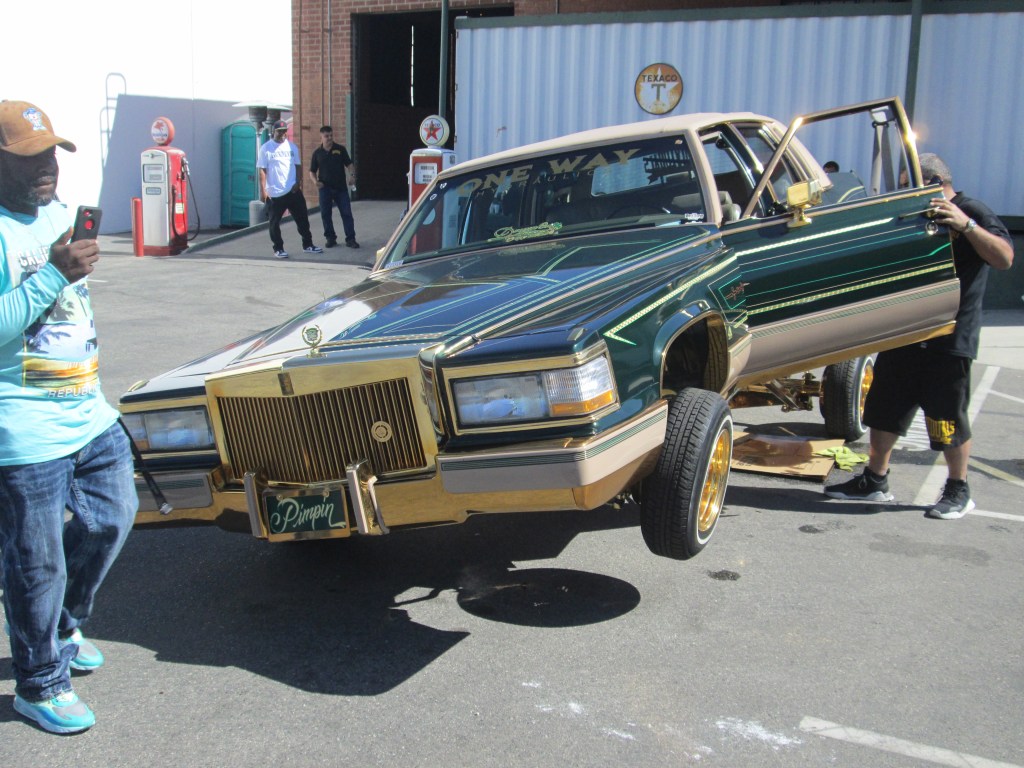
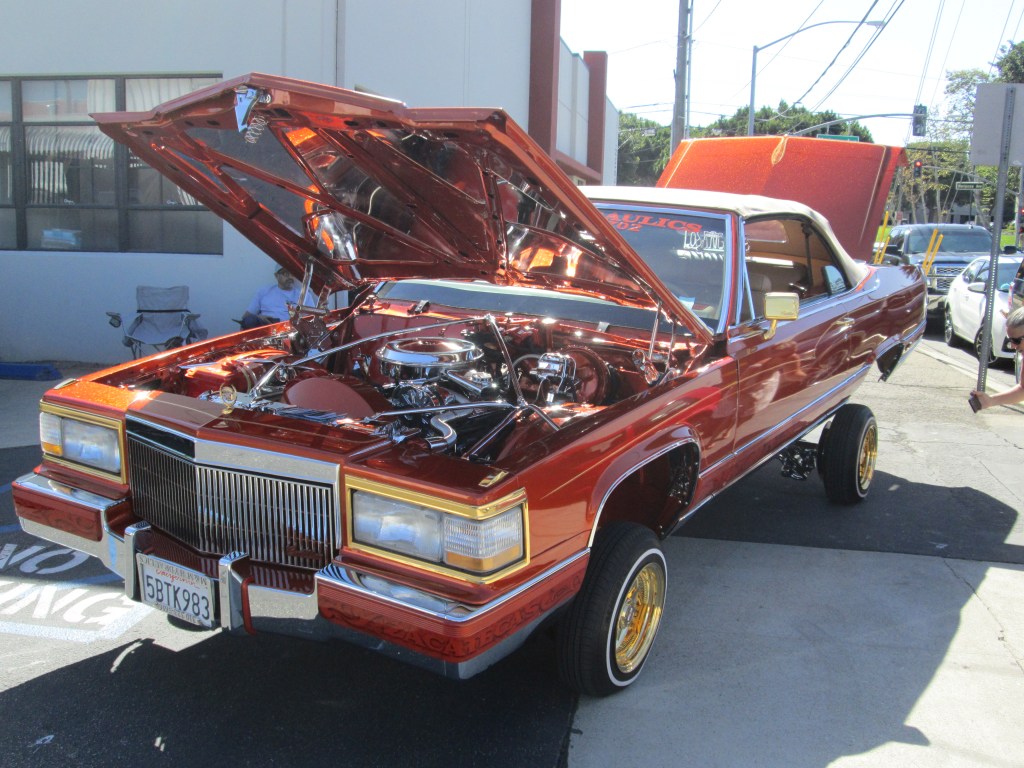
Last Saturday, Martine and I stopped in at the Zimmerman Automobile Driving Museum (newly re-named) to see a show of Cadillacs.on display from private collectors. I am not generally interested in Caddies, but what caught my eye were the cars tricked out with hydraulics and fancy paint jobs.

To me, there was a lot of humor in this, as if the car owners were sharing a joke. I liked them more than the Cadillacs that were, so to speak, mint in box.

I was rather surprised to see so many Caddies on view and so many visitors. I guess they have maintained a level of popularity with aficionados that I never suspected.

Parking

Talk About Something We Take for Granted …

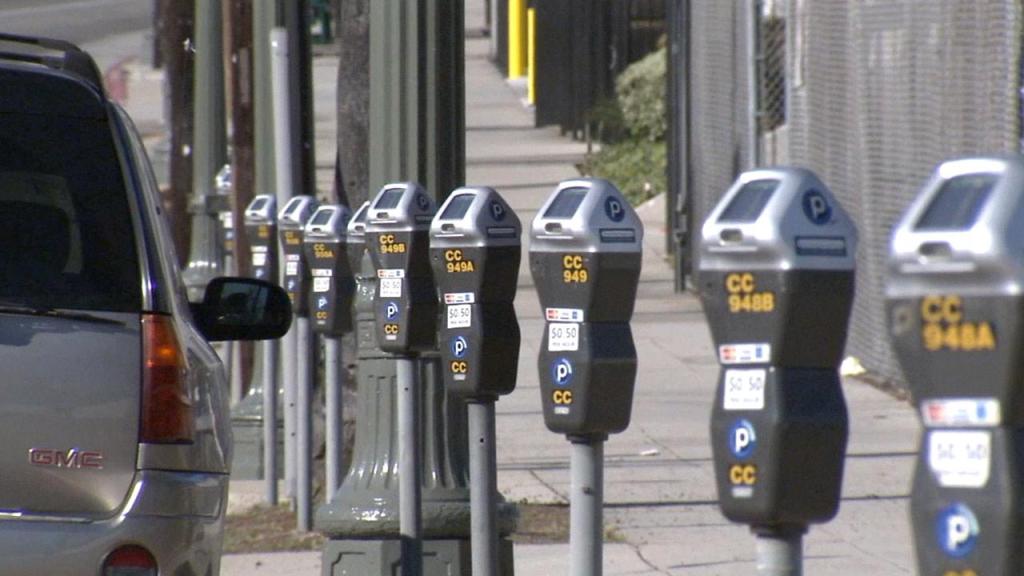
In just about every movie I’ve ever seen, the hero never has any trouble finding a parking spot directly in front of his destination. And, moreover, if there is a parking meter, he never has a problem getting the exact change or running his credit card. As for myself, I usually find that most meters have either been vandalized or never worked right in the first place.

And that’s not the worst of it. To use a meter, I have to make an existential decision. Which is more important to me? Quarters for parking, or quarters for the washer and dryer in my apartment building? Rarely do the meters accept any of my credit cards: I guess it’s more difficult to vandalize the coin reader part of the device.

Today was a rare day for me: When I went to see my doctor, I found a good parking place on the residential street just north of Wilshire Boulevard. Usually, I have to hike from four or five streets away; and even then I have reason to fear getting a parking ticket. Then, when I went to lunch at Gilbert’s El Indio I got the coveted parking space right next to the front door. And I was able to order the excellent Enchiladas Suizas Monday lunch special.

Speaking of parking, I typically avoid parking garages. It’s a quick way to not only empty your wallet but get your car all dinged up. So I have adopted a practice which I abbreviate as PFAW—short for “park far and walk.” I need the exercise anyway, so if I have to walk half a mile from my parking place, it’s probably good for me, no? I always smirk at the drivers who absolutely have to park right in front of their destination, even if it means messing with the flow of traffic. There is a Trader Joe Market near where I live which always has a bunch of “parking playas” jockeying for the ten desirable spots right in front. I just turn on Granville and park about a block away.

Parking is one of those activities that people don’t usually talk about. Yet you will find that the time one spends looking for a parking place (not to mention the money) adds up when you look at a whole year’s time.

Here’s hoping that the magical parking spaces will suddenly be available to you. If not, may you be philosophical about parking far and walking.