Films can be amazing, even they are not great. A couple of months ago, I viewed Wes Anderson’s The French Dispatch (2021) in Palm Desert with my brother and sister-in-law. The film sets were nothing less than outstanding, and the cast was to die for. But, overall it just didn’t make the cut.
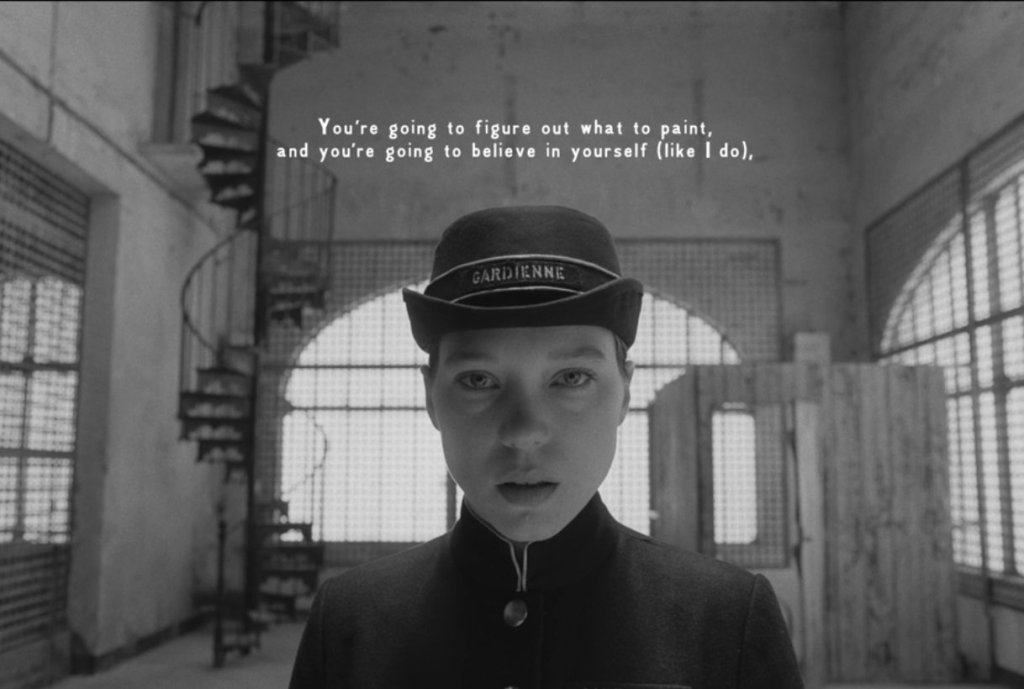
But I fell in love with the actress who played Simone, the prison asylum guard who poses nude for the imprisoned painter Moses Rosenthaler (Benicio del Toro). The part was played by Léa Seydoux, a stunning French actress with wide-spaced eyes. The memory of those eyes has made me watch her scenes several times.
Simone in Uniform
Although I will never think of The French Dispatch as a great film, there are scenes in it that I will never forget. Perhaps, in the end, it is a better film than I thought.
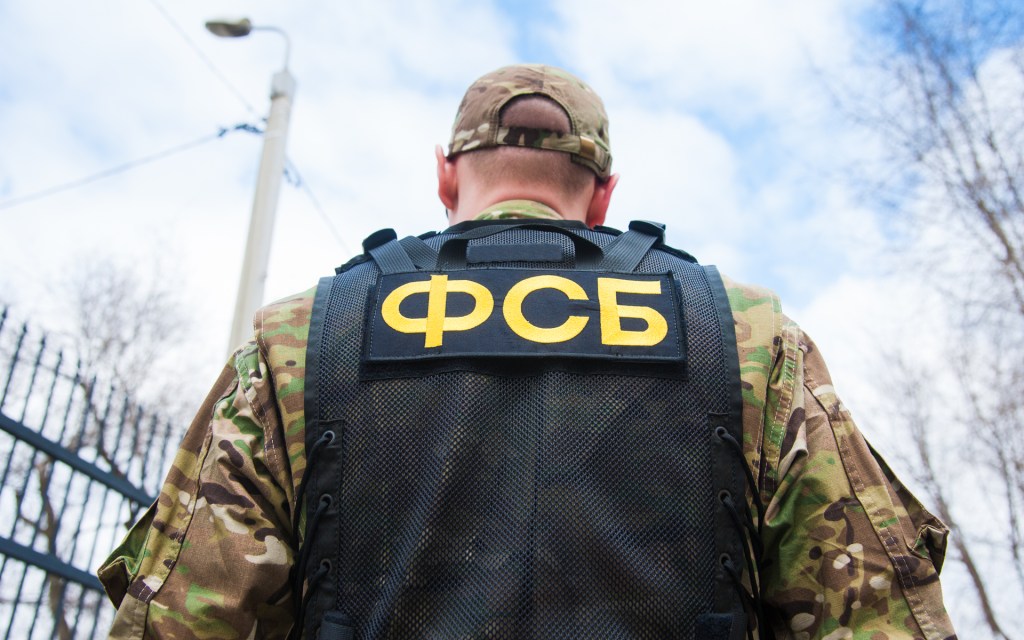
Did you ever wonder what happened to the old Soviet KGP? Apparently, it went the way of the Cheka, the NKVD, the OGPU, and the MGB. It just changed its name to the FSB (ФСБ in Cyrillic) or Federal Security Service and it continues its usual depredations on the Russian people.
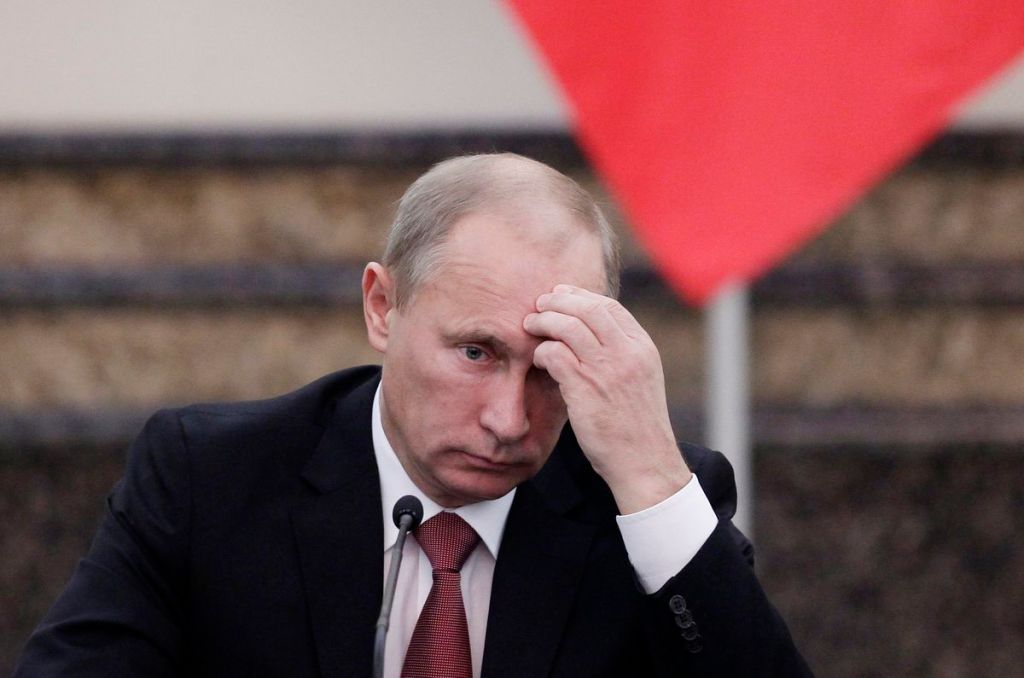
Do you remember what happened to Nikita Khrushchev after the Cuban Missile Crisis of 1962? He was sent to do gardening in the Ukraine and replaced by Brezhnev and Kosygin. I do believe that Vladimir Putin is risking the same sort of coup by the FSB and other Russian state security services—all because he squandered Russian resources in a madcap attempt to take over Ukraine.
Putin comes from the Russian state security services. He was a top officer in the KGB and spent time heading up security in East Germany. So he knows that the main threat to his rule over Russia is not the voters, not the oligarchs, not even the military, but actually the Federal Security Service (or Федеральная служба безопасности Российской Федерации) and its allied agencies. They made Putin, and they can just as easily unmake him.
Consider the following actions which make Russia look bad in the eyes of the world, and particularly in the eyes of the FSB:
Putin assumed the invasion would be met by welcoming Ukrainians bearing candy and flowers, and not stinger missiles and Molotov Cocktails.
After three weeks, the ground invasion has stalled.
Some 5,000 Russian soldiers are dead—twice the number of American deaths in 20 years fighting in Afghanistan.
The Russians are unable to supply their advance units with gasoline, food, trucks, tanks, or ammunition.
Putin has reportedly asked China for help in quelling the Ukrainians.
There are rumors of Putin employing mercenaries from Syria and elsewhere to shore up the depleted ground forces.
In the end, Ukraine may fall to the Russians, but only at an exorbitant cost.
The one part of Asia that I would like to visit is the island nation of Singapore. To me, it is like China and India rolled into one convenient package, yet not too far from its British colonial heritage to force me to learn a difficult new language.
What particularly earns it a spot on my travel bucket list is the cuisine. I love both Chinese and Indian food, and Singapore is known for both, as well as several adjoining cuisines such as Thai and Malayan.
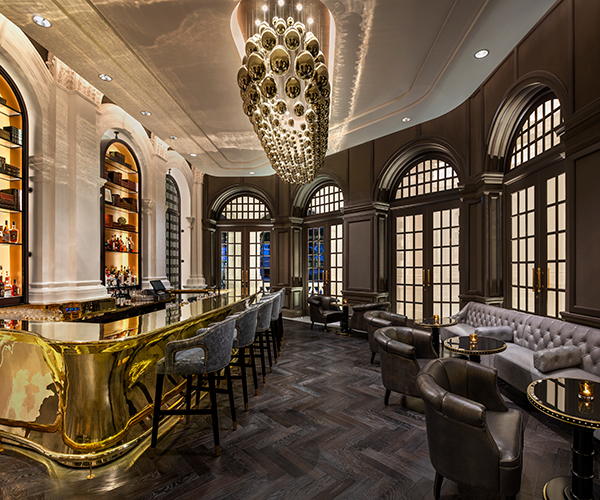
In fact, I cannot imagine myself losing weight during a Singapore visit. And that’s when I’m not drinking cold beers at the Writers’ Bar at the Raffles Hotel—the height of colonial decadence,
Of course I would fly there on Singapore Airlines and hang out a while at Changi Airport, reputed to be the most interesting airport in the world.
I came late to driving. In fact, I did not get my license until I was forty. Starting late as I did, I did not have many youthful bad habits exercising a baneful effect on my driving.
Other than adhering religiously to speed limits, what probably characterizes my driving more than anything else is, whenever possible, knowing what lane I want to be in and sticking to it, unless I feel I absolutely must pass some slow-moving vehicle.
Returning home from the desert, for example, I prefer to take the Pomona Freeway (California 60). I start out in lane 2 and change to lane 1 as I approach Interstate 5. That lane in turn becomes lane 3, giving me several miles to change to lane 2. If I stay on lane 2 as the highway becomes the Santa Monica Freeway (Interstate 10), I can ride it all the way to my exit ramp at Centinela Avenue fifteen miles farther on.
Why change lanes unless you have to? One of my beefs with performance cars is they feel as if they fail to change lanes every hundred feet, Elon Musk or Ferdinand Porsche will come and painfully twist their privates and take away their car keys. I estimate that, on the same trip, frequent lane changers drive 10-15% more miles as a result of traveling sideways.
One of my favorite travel books is Paul Theroux’s The Tao of Travel. When my favorite travel writer writes on the subject of travel literature, the result is nothing less than armchair satori. Take the following quote from his The Old Patagonia Express (1979), my first introduction to South America:
Travel is at its best a solitary enterprise: to see, to examine, to assess, you have to be alone and unencumbered. Other people can mislead you: they crowd your meandering impressions with their own; if they are companionable they obstruct your view, and if they are boring they corrupt the silence with non sequiturs, shattering your concentration with, “Oh, look, it’s raining” and “You see a lot of trees here.
It is hard to see clearly or to think straight in the company of other people. What is required is the lucidity of loneliness to capture that vision which, however banal, seems in your private mood to be special and worthy of interest.
Theroux’s book is full of such gems, such as this one from Mark Twain’s The Innocents Abroad (1869):
Travel is fatal to prejudice, bigotry and narrow-mindedness and many of our people need it sorely on those accounts. Broad, wholesome, charitable views of men and things cannot be acquired by vegetating in one little corner of the earth all one’s lifetime.
Here is a poetic contribution from Rudyard Kipling (“The Winners”:
Down to Gehenna or up to the Throne,
He travels the fastest who travels alone.


In Virginibus Puerisque, Robert Louis Stevenson imparts this wisdom:
Little do ye know your own blessedness; for to travel hopefully is a better thing than to arrive, and the true success is to labor.
As I return to this book, which I do often, I just want to set out for somewhere, anywhere. Well, maybe not Cleveland. Been there, done that!
After our recent trip to Vegas, I am thinking of provoking the Covid-19 demons with another road trip. It’s fun to travel, and my predilection for wanderlust has been seriously subdued by the pandemic.
I don’t think I can get Martine interested in another desert destination—even though she liked the Vegas trip—but there are other less arid possibilities like Catalina, San Diego, Santa Barbara, or the Santa Ynez Valley and Solvang. I’ll just have to put my thinking cap on.
Actually, there is one desert trip that Martine likes, which we have taken twice: Up U.S. 395 along the Eastern Sierras and the Owens Valley. To see what a rich target this is, check out this California Through My Lens website.
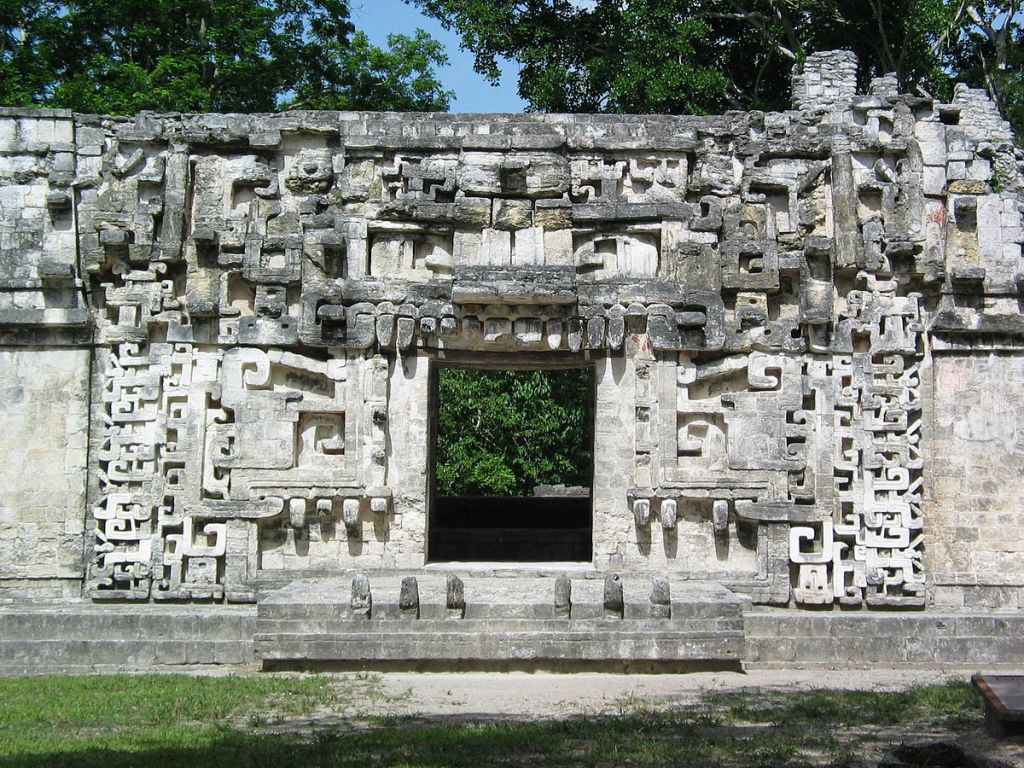
What with all my visits to the Maya ruins in Yucatan, Chiapas, Guatemala, and Honduras, you would think I would be getting tired of the endless ruins. Well, not yet! One incredibly dense region of Maya ruins is in the southeast corner of the state of Campeche, known as the Rio Bec region. Included are such archeological sites as:
Calakmul, with Tikal in the Petén region of Guatemala, perhaps one of the largest Maya cities at its height 1,500 years ago
Xpuhil (pronounced shpoo-HEEL)
Balamku
Chicanna
El Hormiguero (“The Anthill”)
Rio Bec
Becán
And these are only the better known ones, and even some of these are difficult to get to because they are at the end of dirt tracks in the jungles of the region.
Maya Ruins at Chicanna
Unlike many of the better known ruins in the state of Yucatán, those of the Rio Bec region are in steaming monkey jungles. The only town of any size is Xpujil near the eponymous ruins, and it’s only a blip on the long road between Francisco Escarcéga and Chetumal. To visit any of these ruins requires reserving a chunk of time, from three days to a week. Public transportation is virtually nonexistent, and the only places to stay (and not a large selection at that) are clustered around Xpujil.
To do the Rio Bec area any justice, I would have to rent a four-wheel-drive vehicle. Still, I would love to go. I would have to pack a lot of insect repellent (like 100% DEET) and be prepared for some really dicey shit. Hey, if it’s on my travel bucket list, you can bet it’s no cakewalk.
Purnululu National Park. Photo by Sean Scott Photography.
This is one of a series of posts about places I would love to visit, but probably never will for lack of time and money. I first heard about the Bungle Bungles from Bill Bryson’s excellent travel book In a Sunburned Country:
The Bungle Bungles are an isolated sandstone massif where eons of harsh, dry winds have carved the landscape into weird shapes—spindly pinnacles, acres of plump domes, wave walls. The whole extends to about a thousand square miles, yet, according to [his source] “were not generally known until the 1980s.”
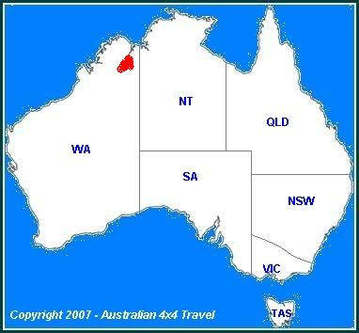
The area is now within the boundaries of Purnululu National Park in a remote part of Western Australia midway between Broome and Darwin. Bryson wanted to see it, but didn’t have the time, as it would have involved several thousand miles of hard driving on a desert two-lane highway.
Location of the Bungle Bungles
Expedia is currently running a series of TV ads about how we never regret the things we didn’t buy nearly so much as the places we never got to visit. I tend to agree. That’s why I plan to use some of my posts to dream about places that look fascinating. What with Covid-19, advancing age, and the high cost of travel, I will dream in print about visiting certain destinations. You might say it’s my travel bucket list.
In Chapter 9 of his book about Australia entitled In a Sunburned Country, Bill Bryson writes about an encounter with New South Wales’s Australian Flies, called in Australia “March Flies,” because that’s when they manifest themselves.
I had gone no more than a dozen feet when I was joined by a fly—smaller and blacker than a housefly. It buzzed around in front of my face and tried to settle on my upper lip. I swatted it away, but it returned at once, always to the same spot. A moment later it was joined by another that wished to go up my nose. It also would not go away. Within a minute or so, I had perhaps twenty of these active spots all around my head and I was swiftly sinking into the state of abject wretchedness that comes with a prolonged encounter with the Australian fly.
Flies are of course always irksome, but the Australian variety distinguishes itself with its very particular persistence. If an Australian fly wants to be up your nose or in your ear, there is no discouraging him. Flick at him as you will and each time he will jump out of range and come straight back. It is simply not possible to deter him. Somewhere on an exposed portion of your body is a spot, about the size of a shirt button, that the fly wants to lick and tickle and turn delirious circles upon. It isn’t simply their persistence, but the things they go for. An Australian fly will try to suck the moisture off your eyeball. He will, if not constantly turned back, go into parts of your ears that a Q-tip can only dream about. He will happily die for the glory of taking a tiny dump on your tongue. Get thirty or forty of them dancing around you in the same way and madness will shortly follow.
And so I proceeded into the park, lost inside my own little buzzing cloud of woe, waving at my head in an increasingly hopeless and desultory manner—it is called the bush salute—blowing constantly out of my mouth and nose, shaking my head in a kind of furious dementia, occasionally slapping myself with startling violence on the cheek or forehead. Eventually, as the flies knew all along, I gave up and they fell upon me as on a corpse.
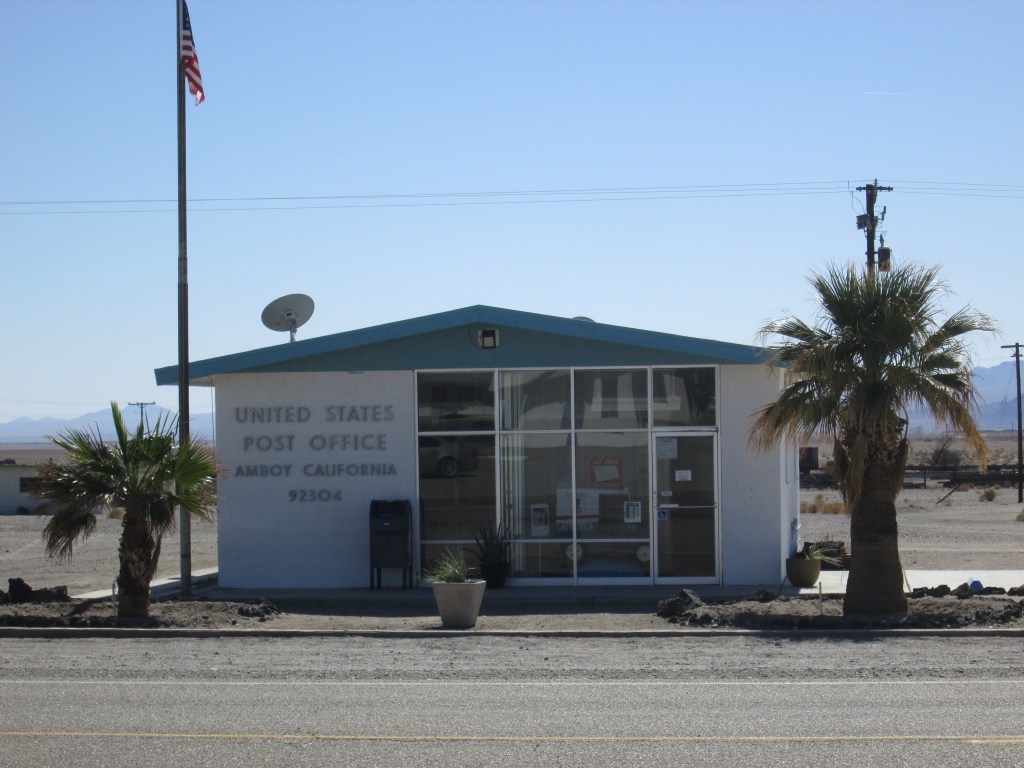
On our long road back from Las Vegas, we stopped for a few minutes in Amboy, on the “shore” of Bristol Dry Lake. In past years, I jokingly referred to Amboy as California’s equivalent of Tolkien’s Mordor. This time, the café was actually open; gas was being sold; and beverages and snacks were available.
One has to consider that Amboy is no longer really on the road to anywhere. It is where Old Route 66, the “Mother Road,” meets the road to Twentynine Palms. You can take Route 66 east from Barstow, but the road is closed past Kelbaker Road, which goes north to Kelso and ends up in Baker. That’s the way Martine and I took, staying on 66 only as far as the turnoff to Twentynine Palms, where Martine used to work as a civilian employee at the Twentynine Palms Marine Air Ground Task Force Training Command (MAGTFTC).
Although there was some human activity visible at Amboy, including a post office across the highway (?!), the desert heat is incredibly fierce. I can’t see anybody being comfortable there except for a few minutes around dawn or dusk. So I doubt you’ll see a McDonald’s or a Starbuck’s there any time soon.









 Tarnmoor
You must be logged in to post a comment.