“The American Night”

Here is one of my favorite poems by Jim Morrison of The Doors:

The American Night

for leather accrues
The miracle of the streets
The scents & smogs &
pollens of existence

Shiny blackness
so totally naked she was
Totally un-hung-up

We looked around
lights now on
To see our fellow travellers

I am troubled
Immeasurably
By your eyes

I am struck
By the feather
of your soft
Reply

The sound of glass
Speaks quick
Disdain

And conceals
What your eyes fight
To explain

She looked so sad in sleep
Like a friendly hand
just out of reach
A candle stranded on
a beach
While the sun sinks low
an H-bomb in reverse

Everything human
is leaving
her face

Soon she will disappear
into the calm
vegetable
morass

Stay!

My Wild Love!

I get my best ideas when the
telephone rings & rings. It’s no fun
To feel like a fool—when your
baby’s gone. A new ax to my head:
Possession. I create my own sword
of Damascus. I’ve done nothing w/time.
A little tot prancing the boards playing
w/Revolution. When out there the
World awaits & abounds w/heavy gangs
of murderers & real madmen. Hanging
from windows as if to say: I’m bold-
do you love me? Just for tonight.
A One Night Stand. A dog howls & whines
at the glass sliding door (why can’t I
be in there?) A cat yowls. A car engine
revs & races against the grain- dry
rasping carbon protest. I put the book
down- & begin my own book.
Love for the fat girl.
When will SHE get here?
~~~

In the gloom
In the shady living room
where we lived & died
& laughed & cried
& the pride of our relationship
took hold that summer
What a trip
To hold your hand
& tell the cops
you’re not 16
no runaway
The wino left a little in
the old blue desert
bottle
Cattle skulls
the cliche of rats
who skim the trees
in search of fat
Hip children invade the grounds
& sleep in the wet grass
’til the dogs rush out
I’m going South!

A and Not-A, B and Not-B, C and Not-C

Joan Didion (1934-2021)

I am beginning to realize that what I admire most about the essays of Joan Didion is that they do not take a stand. They present both A and Not-A, B and Not-B, and C and Not-C. Take, for instance, the title essay in The White Album. There is a constant feeling of dread, yet Joan never takes the easy way out. Here, for example, she writes about Huey Newton of the Black Panthers:

I am telling you neither that Huey Newton killed John Frey nor that Huey Newton did not kill John Frey, for in the context of revolutionary politics Huey Newtons guilt or innocence was irrelevant. I am telling you only How Huey Newton happened to be in the Alameda County Jail, and why rallies were held in his name, demonstrations organized whenever he appeared in court.

There is also a description of a 1968 recording session by The Doors at which Jim Morrison was not initially present. When he arrived wearing his tight black vinyl pants, the scene was a discombobulated one:

The curious aspect of Morrison’s arrival was this: no one acknowledged it. Robby Krieger continued working out a guitar passage. John Densmore tuned his drums. Manzarek sat at the control console and twirled a corkscrew and let a girl rub his shoulders. The girl did not look at Morrison, although he was in her direct line of sight. An hour or so passed, and still no one had spoken to Morrison.

Didion does not say that Morrison was an inconsiderate dick: She presents the scene and lets you draw your own conclusions. Particularly revealing is a quote from a psychiatric evaluation of Didion in Santa Monica after she reported “an attack of vertigo, nausea, and a feeling that she was going to pass out.” The evaluation concluded:

Patient’s thematic productions on the Thematic Apperception Test emphasize her fundamentally pessimistic, fatalistic, and depressive view of the world around her. It is as though she feels deeply that all human effort is foredoomed to failure, a conviction which seems to push her further into a dependent, passive withdrawal. In her view she lives in a world of people moved by strange, conflicted, poorly comprehended, and, above all, devious motivations which commit them inevitably to conflict and failure….

In her place, we might all be tempted to put our thumbs on the scale, to introduce our own prejudices and draw a conclusion which may be no closer to the truth, but mainly revealing of our own misperceptions. I do find it odd that she would quote a lengthy psychiatric diagnosis of her sense of dread near the beginning of the essay, or anywhere within it for that matter.

The Year of Reading Dictionaries

My first real job in Los Angeles was for System Development Corporation (SDC) in Santa Monica. My predecessor in the job was a young woman who was murdered by a UCLA film student. How odd that she was succeeded by another UCLA film student—me!

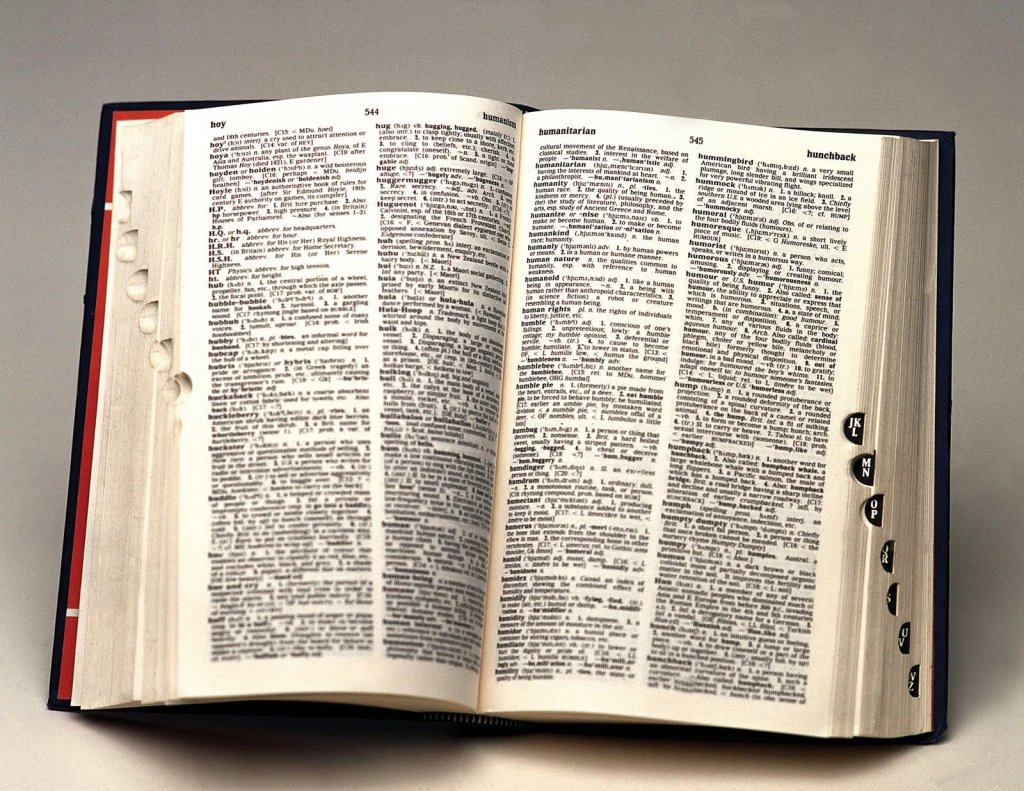
The nature of the job was to proofread two transcriptions of Merriam-Webster dictionaries. Thy had been punched on paper tape and converted to character files that were sent to a line printer. The first was the Merriam-Webster Seventh Collegiate Dictionary and the other was the M-W Pocket Dictionary.

Everything had been entered—not only the definitions but the pronunciations and etymologies as well. This was a database to be used to assist in computer translation between languages. Was it, in fact, ever used for this purpose? I don’t really know, because my part of the project ended before the database was ever used for any practical purpose.

The project ended with a publication in June 1969 of which I was a co-author: Two Dictionary Transcripts and Programs for Processing Them. Volume I. The Encoding Scheme, PARSENT, and CONIX. My co-authors were Richard Reichert and John Olney. If you are interested in reading it, you will find a copy in the Library of Congress.

Annapolis Royal

An Amazing Collection of Botanical Art

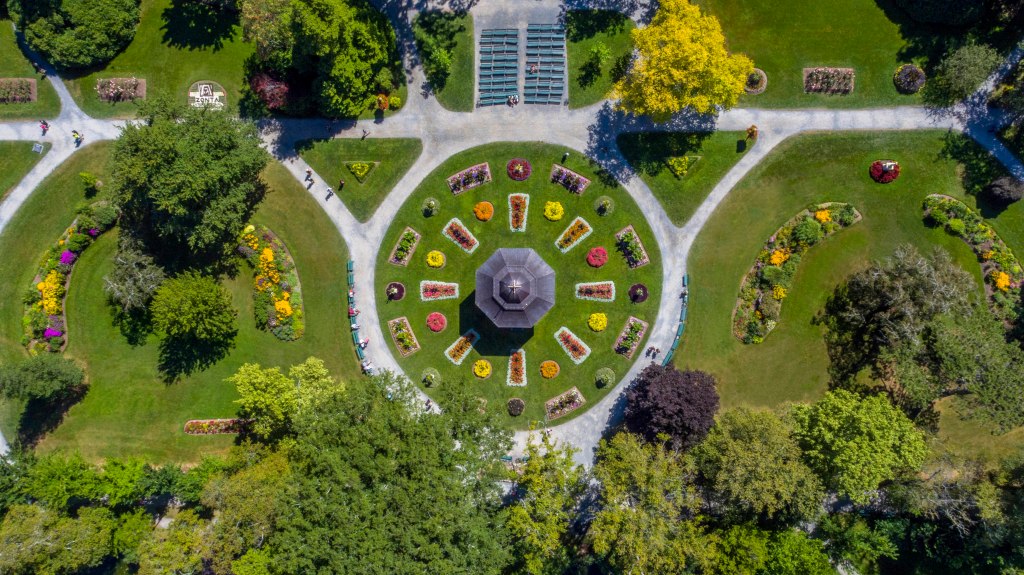
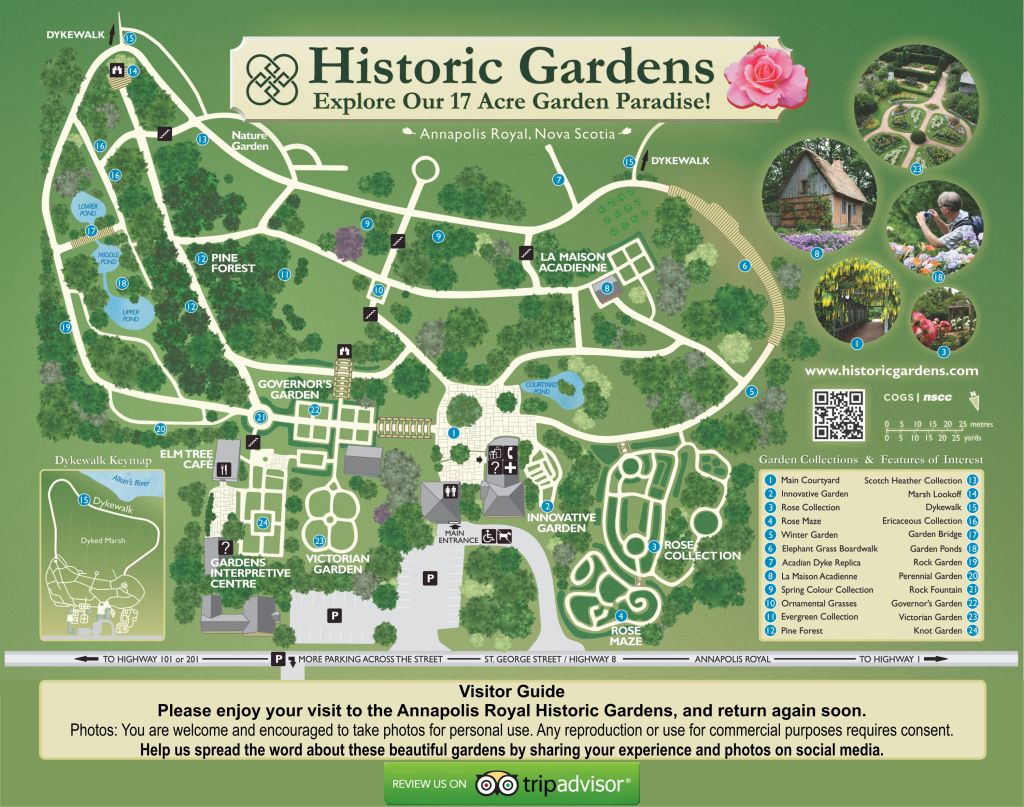
A few days ago, I wrote about Butchart Gardens on Vancouver Island. I have always enjoyed visiting botanical gardens. Two of the best are on opposite sides of Canada. Martine and I also loved visiting the Annapolis Royal Historic Gardens in Annapolis Royal, Nova Scotia. What I found interesting is that the Canadian gardens looked equally good rain or shine, while the ones in California looked best in sunny weather.

Also, the Canadians did a much better job in labeling the different plants than the American gardens we’ve visited.

One of the neat features of Annapolis Royal is that is only a few footsteps away from Fort Anne, originally built in 1629 to protect shipping. It saw action in five wars, terminating in the French and Indian War (1754-1763). On the northern part of the island is the extensive Fortress of Louisbourg, built by the French in 1713, which played a major role in the French and Indian War.

In general, Nova Scotia was our favorite part of Eastern Canada, followed by the City of Québec. We loved the lobster dinners and the French Acadian culture of towns like Chéticamp, where moose could be viewed from the window of our B&B.

Travels with Chris and Topher

Chris Raney and Topher of Yellow Productions

In doing research for my upcoming Hawaii trip, I ran into a great information resource: Chris Raney of Yellow Productions and his YouTube videos on travel. A resident of Southern California, Chris does his videos with a small stuffed panda whom he calls Topher. (Hmmm: Chris + Topher = Christopher?) Occasionally, he is accompanied by his cute little daughter whom he carries on his back or pushes in a stroller.

I started by watching his video entitled “Cheap Eats Waikiki.” Although it was done several years ago, it was still fairly up-to-date. He has also done videos about his favorite Japanese convenience store on American soil (Lawson Station at the Sheraton Waikiki), things to know before visiting O’ahu, and several other topics—including, for validation purposes, some of his videos about Los Angeles, about which I know a thing or two. He passes the test: Chris knows what he is talking about.

You can see a list of Chris’s videos here.

Paradise from an Old Quarry

Butchart Gardens in Brentwood Bay, British Columbia

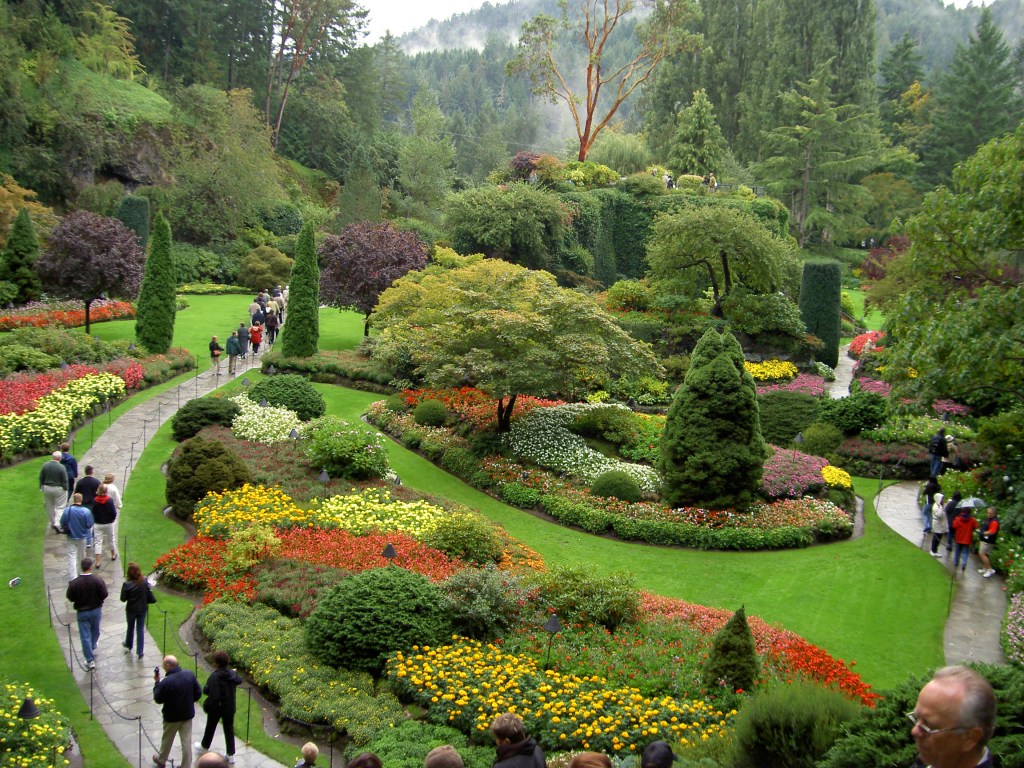
Eighteen years ago, I took a solo trip to Victoria and Vancouver, British Columbia. One of the highlights of my trip was my first visit to Butchart Gardens, fifty-five acres of botanical paradise a short distance from Victoria. Usually, botanical gardens look their best in bright sunshine. Curiously, Butchart shone as much in the rain as it did, later that afternoon, in bright sunshine.

I spent hours exploring the grounds, rewarding myself with a delicious English tea for lunch.

Back in 1904, the grounds were part of a large limestone quarry that looked dismal, until the wife of the owner Click here to see how Jenny Butchart turned that ruined earth into a small paradise. Today it is a National Historic Site that draws thousands of visitors from around the world.

A few years later, I returned with Martine, who also fell in love with the place.

Come to think of it, Butchart Gardens was one of two botanical gardens we visited in Canada. The other one was in Annapolis Royal, clear on the other side of Canada. I will write about it at some point in the coming week or so.

A Bird Came Down the Walk

This is probably one of Emily Dickinson’s clearest poems, and one of her best.

A Bird, came down the walk

A Bird, came down the Walk - 
He did not know I saw -
He bit an Angle Worm in halves
And ate the fellow, raw, 
 
And then, he drank a Dew
From a convenient Grass -
And then hopped sidewise to the Wall
To let a Beetle pass -
 
He glanced with rapid eyes,
That hurried all abroad -
They looked like frightened Beads, I thought,
He stirred his Velvet Head. - 
 
Like one in danger, Cautious,
I offered him a Crumb,
And he unrolled his feathers, 
And rowed him softer Home -
 
Than Oars divide the Ocean,
Too silver for a seam,
Or Butterflies, off Banks of Noon,
Leap, plashless as they swim.