Two Nightmares

In his collection Seven Nights (1984), Jorge Luis Borges wrote:

I have two nightmares that often become confused with each other. I have the nightmare of the labyrinth, which comes, in part, from a steel engraving I saw in a French book when I was a child. In this engraving were the Seven Wonders of the World, among them the labyrinth of Crete. I believed when I was a child (or I now believe I believed) that if one had a magnifying glass powerful enough, one could look through he cracks and see the Minotaur in the terrible center of the labyrinth. My other nightmare is that of a mirror. The two are not distinct, as it takes only two facing mirrors to construct a labyrinth. I always dream of labyrinths or of mirrors. In the dream of the mirror another vision appears, another terror of my nights, and that is the idea of the mask. Masks have always scared me. No doubt I felt in my childhood that someone who was wearing a mask was hiding something horrible. These are my most terrible nightmares: I see myself reflected in a mirror, but the reflection is wearing a mask. I am afraid to pull the mask off, afraid to see my real face.

Winning Back the Streets

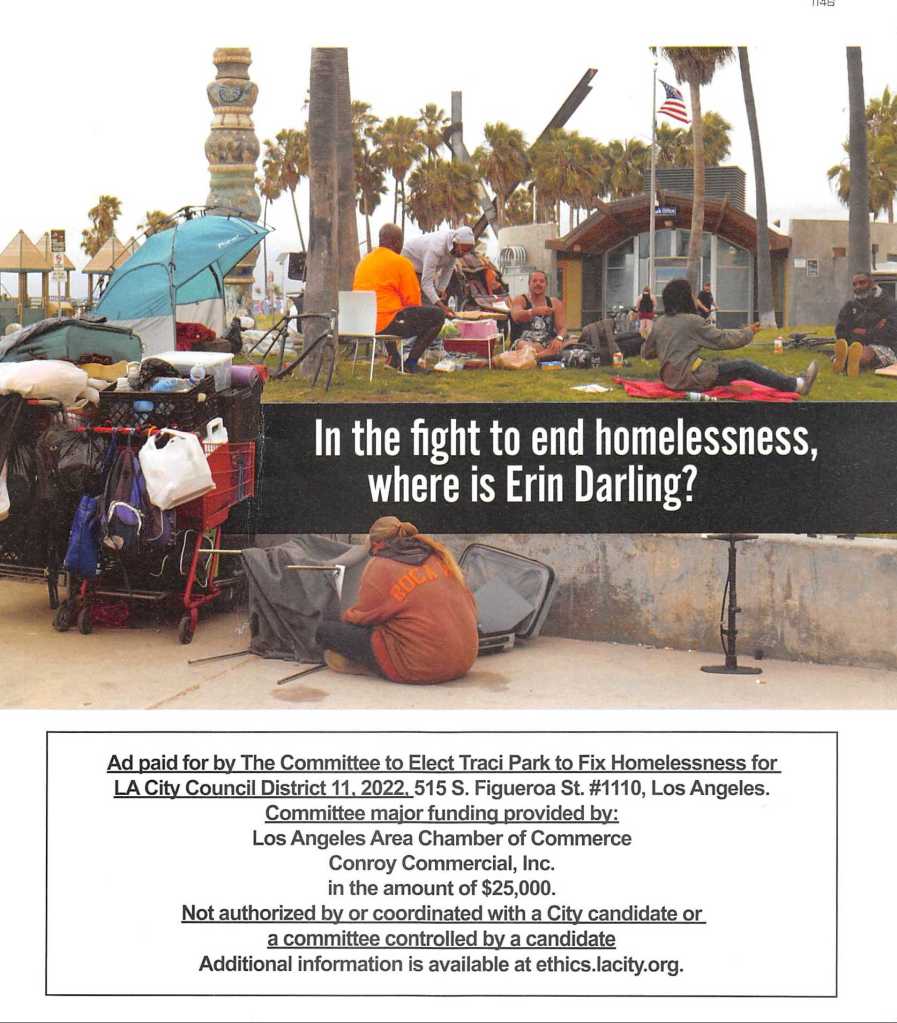
Political Handout for Traci Park

An intense campaign is shaping up for Los Angeles’s City Council District 11 between two defense attorneys: Erin Darling, a Progressive Democrat, and Traci Park, probably a Republican. At stake is the proliferation of homeless encampments in the district.

On Saturday morning, Martine and I had a chance to see a debate between Darling and Park. We were unimpressed by both of the candidates—though we suspect that Park is more willing to enforce existing laws forbidding encampments near schools, churches, and public parks.

In general, there are two prevailing voter viewpoints regarding the homeless: On one hand, there are the Mother Teresas and, on the other, the Darth Vaders. If a homeless person is willing to observe the law and is seriously interested in leaving the street encampments, I am willing to join the Mother Teresas to assist them. For those who are mentally hill and are unwilling to obey rules regarding alcohol and recreational drugs, I prefer the Darth Vader approach: drive them off the streets, by force if necessary.

Political Handout for Erin Darling

Although Erin Darling is endorsed by the Los Angeles Times and several liberal politicians and organizations, I see that Traci Park is endorsed by the Fire Department and local Police Departments. I rather suspect that Darling is one of those Woke Liberals I dislike as much as Trump’s MAGA insurrectionists. At one point in the debate, he spoke glowingly of the skateboarding community. What, aren’t they all still in Middle School? Sheesh!

The older I get, the more I realize that we are rarely presented with candidates and issues which we can enthusiastically support. All Martine and I care about is cleaning the garbage piles off the streets (usually associated with bums living in tents); cutting down on petty thefts of bicycles, medications, food, and drink; and threats of violence from rampaging bums (which have affected both Martine and me).

The Problem with Zoos

A Komodo Dragon (Varanus komodoensis)

Martine and I have this problem with zoos, namely: empty cages. It seems that one never knows whether a particular bird or animal is in residence or just hiding behind a rock or tree. The only zoos where this is not so much an issue are the San Diego and Santa Barbara Zoos and The Living Desert in the Coachella Valley.

The Honolulu Zoo is noted for its “exhibit absenteeism”: It seems that some 40% of the cages were unoccupied and without any notices that the animal is sick. I realize that in approximately half the cases, the cage occupant is lying doggo. If I were in a cage, I probably wouldn’t want to be stared at by a bunch of tourists or school children.

On the plus side, I did like the Komodo Dragon—my first. I also liked all the banyan trees, which kind of take my breath away. Below is Martine twirling a plumeria blossom in front of one of the zoo’s stately banyans:

It probably didn’t help that the temperature and humidity were in the 90s (Fahrenheit, that is).

50-Pound Coconuts

Look Out Below!

On our last full day in Hawaii, Martine and I visited the Foster Botanical Garden, just north of Chinatown in Honolulu. It was hot and humid day, but fortunately there were a lot of shady benches. One of the highlights of the garden was the double coconut tree (genus Lodoicea), a native of the Seychelles. Its coconuts can be as heavy as 99 pounds each (45 kilograms).

Needless to say, Martine and I did not risk going under the tree and violently shaking its branches.

Curiously, while the coconuts are edible, they are of no commercial interest.

My favorite part of the gardens was the greenhouse with its collection of orchids. It was so warm and humid that the greenhouse door was left open.

Orchids at Foster Botanical Garden

Martine and I liked the garden so much that we resolved to visit several of the other botanical gardens in the Honolulu area or on whatever islands we visit.

’Elepaio Press

Word Art at the Hawaii State Museum of Art

When we were in Honolulu, Martine and I paid a visit to the Hawaii State Art Museum across the street from the Iolani Palace. I was amused by art created by two Hawaiian brothers of Japanese ancestry—Richard Hamasaki and Mark Hamasaki—going under the collective name ’Elepaio Press.

Here are several more of their works:

It’s Not Nice to Play “52 Pickup” with the Alphabet

Favorite Films: Kill Bill 1 and 2

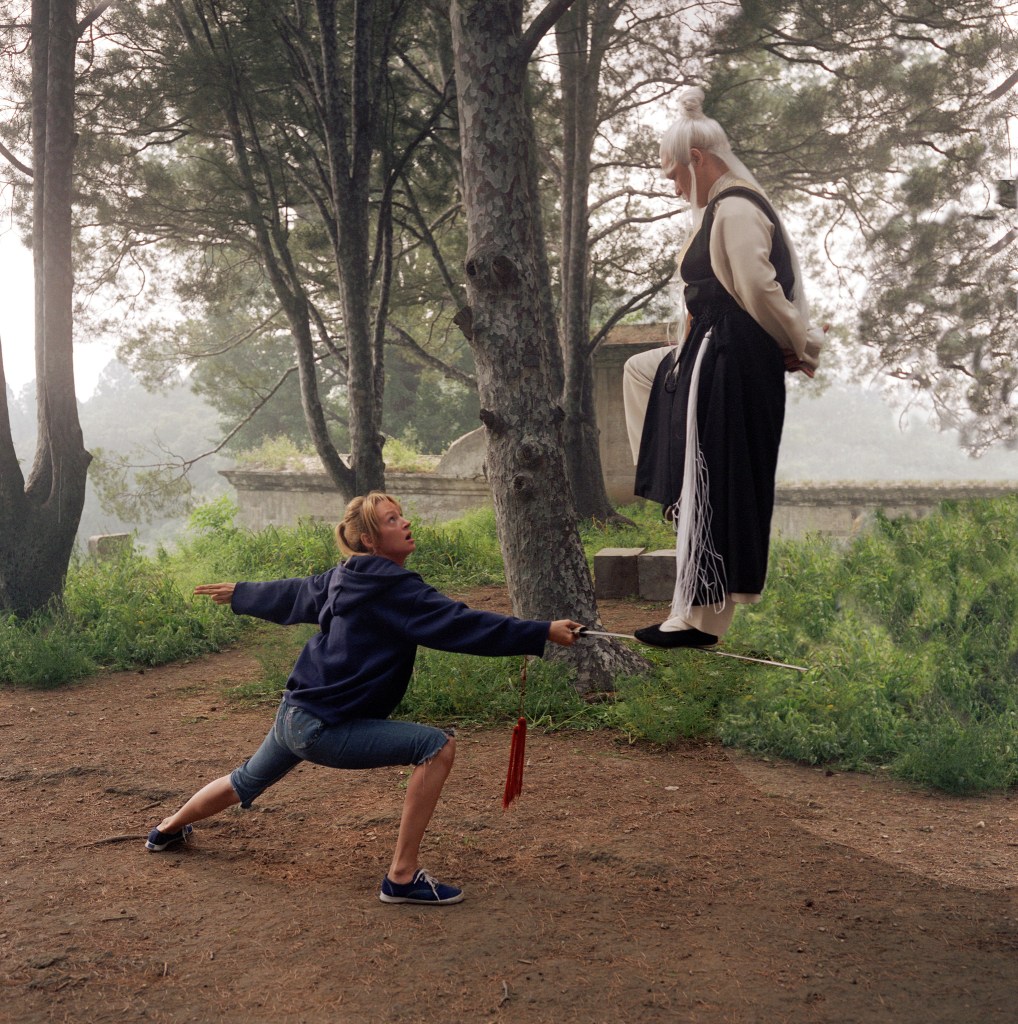
Uma Thurman as Beatrix Kiddo Wielding Her Hattori Hanzo Sword

Of the current batch of U.S. film directors, among the ones I like the most is Quentin Tarantino. Granted his films could be a tad violent, especially the two films in the Kill Bill series; but they are like bloody ballets. It also helps that the films star the lovely Uma Thurman, whom I had always thought was Swedish though she was born in Boston, Massachusetts.

Last night, I was surfing the Showtime channels when I landed around a quarter of an hour into Kill Bill Volume 2 (2004). Although I had seen both parts of the saga multiple times, I took the time to see Uma as Beatrix Kiddo kill several members of the Deadly Viper Assassination Squad who sprayed bullets into her attempted wedding to an El Paso record shop owner. In Volume 1 (2-003) messy she had sliced Vernita Green, O-Ren Ishii, and the latter’s Crazy 88s gang into sashimi. In Volume 2, she sends Bill’s brother Budd and Elle Driver (played by Darryl Hannah) into a white trash trailer massacre followed by Bill himself—who dies by the Five Point Palm Exploding Heart Technique at a Mexican beach resort.

Along the way, we have an interlude wherein Beatrix is taught advanced martial arts technique by a Chinese immortal named Pai Mei.

Pai Mei Astounds Beatrix Kiddo

This segment is almost a film in its own right, though it does show two things:

  • How Beatrix avoids beings buried alive in Barstow by Bill’s brother, who had shot her in the chest with two shotgun shells filled with rock salt
  • How Elle Driver had one eye poked out as a result of sassing Pai Mei

I don’t know how many more times I will see the Kill Bill films, though I bet I will continue to enjoy them.

In Praise of Minor Talents

The Good Doctor Ruffled a Few Feathers, Including Mine

As part of my annual Halloween reading, I just finished the Oxford World’s Classics Tales of Terror from Blackwood’s Magazine. In the early decades of the 19th century, that’s where budding writing talents turned for examples of tales of horror. Among the most devoted readers were Charles Dickens, the Brontë sisters, Nathaniel Hawthorne, Robert Browning, and—most particularly—Edgar Allan Poe.

Of the seventeen stories in the collection, I had only heard of two of them before: Sir Walter Scott and James Hogg, a.k.a. the Ettrick Shepherd. The other writers (who were all new to me) were Patrick Fraser-Tytler, John Wilson,Daniel Keyte Sandford, John Galt, John Howison, William Maginn, Henry Thomson, Catherine Sinclair, Michael Scott, William Mudford, William Godwin the Younger, and Samuel Warren. All of their stories were first class.

Now I understand why Poe wrote him famous essay “How to Write a Blackwood Article.” And why Leigh Hunt wrote in 1819:

A man who does not contribute his quota of grim stories now-a-days seems hardly to be free of the republic of letters. He is bound to wear a death’s head, as part of his insignia. If he does not frighten every body, he is nobody.

Well, I could testify that I was frightened by this collection—by a bunch of “minor” writers who knew what they were doing. The credit for this collection goes to the two co-editors, Robert Morrison and Chris Baldick.

I was particularly entranced by the three selections from a long-running serial in Blackwood’s entitled Passages from the Diary of a Late Physician (appearing from 832-1837) by Samuel Warren (1807-1877).

Impact

Now that NASA may have a solution to the problem, it’s interesting to see how, some 200 years ago, people viewed the possibility of a comet or asteroid crashing into the earth. The quote below comes from Tales of Terror from Blackwood’s Magazine from a story by Samuel Warren entitled “The Thunder-Struck.”

“Great God, Dr ——!” said he, laying his hand suddenly on my arm, his great black eyes gleaming with mysterious awe—“Think, only think! What if, at the moment we are talking together, a comet, whose track the peering eye of science has never traced—whose very existence is known to none but God, is winging its fiery way towards our earth, swift as the lightning, and with force inevitable! Is it at this instant dashing to fragments some mighty orb that obstructed its progress, and then passing on towards us, disturbing system after system in its way?—How—when will the frightful crash be felt? Is its heat now blighting our atmosphere?—Will combustion first commence, or shall we be at once split asunder into innumerable fragments, and sent drifting through infinite space?—Whither—whither shall we fly! what must become of our species?—Is the Scriptural JUDGMENT then coming? Oh, Doctor, what if all these things are really at hand?

“Light Shining Out of Darkness”

William Cowper (1731-1800)

This is perhaps the most famous poem by William Cowper (his last name is pronounced as if it were “Cooper”). It is simple, perhaps a touch too pious for our time. But it is a magnificent statement of a faith that is rare in the 21st century.

Light Shining Out of Darkness

1
God moves in a mysterious way,
His wonders to perform;
He plants his footsteps in the sea,
And rides upon the storm.

2
Deep in unfathomable mines
Of never-failing skill,
He treasures up his bright designs,
And works his sov'reign will.

3
Ye fearful saints, fresh courage take,
The clouds ye so much dread
Are big with mercy, and shall break
In blessings on your head.

4
Judge not the Lord by feeble sense,
But trust him for his grace;
Behind a frowning providence
He hides a smiling face.

5
His purposes will ripen fast,
Unfolding ev'ry hour;
The bud may have a bitter taste,
But sweet will be the flow'r.

6
Blind unbelief is sure to err,
And scan his work in vain;
God is his own interpreter,
And he will make it plain. 

When Scientists Go Awry

The following is from an exhibit at Honolulu’s Bishop Museum of humorous attempts at classifying plants and animals. The surnames of the scientists involved appear in parentheses.

Abra cadabra (Eames & Wilkins) 1957 – A variety of clam

Hebejeebie (Heads) 2003 – A genus of flowering plant that must give people the creeps

La cucaracha (Blesynski) 1966 – A moth that reminds one of a cockroach

Ba humbugi (Solem) 1983 – A snail much beloved of Ebeneezer Scrooge

Ittibittium (Houbrick) 1993 – A mollusc genus even smaller than genus Bittium

Heerz lukenatcha and Heerz tooya (Marsh) 1993 – Two wasps you would rather notencounter

Riga toni (Evenhuis) 2013 – A fly for pasta lovers

Ytu brutus (Spangler) 1980 – Beware the Ides of March!