You Can’t Beat a Deadhorse

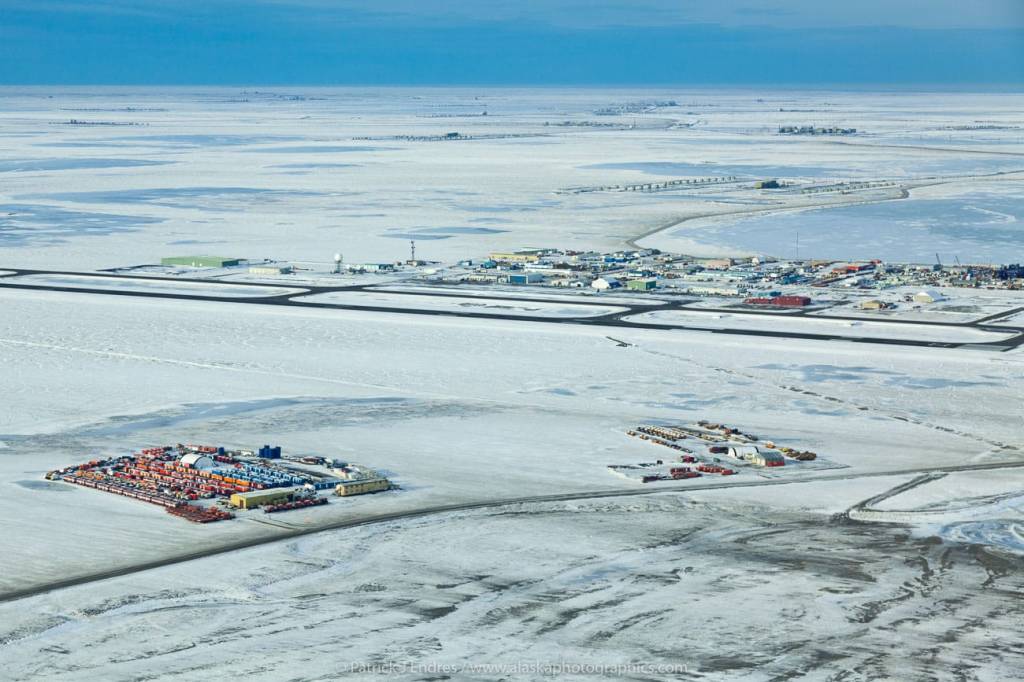
Winter Aerial of Prudhoe Bay, Also Known as Deadhorse, on the North Coast of Alaska, Beaufort Sea. ©Patrick J. Endres

It’s not exactly the northernmost point in the United States: That honor belongs to Barrow (aka Utqiagvik), which is probably a more interesting town because of its links to Iñupiat culture. Deadhorse, Alaska, is probably better known as Prudhoe Bay, the starting point of the Trans-Alaska Pipeline System, which sends crude oil flowing 800 miles to Valdez, Alaska, from where it is transshipped via tanker to refineries around the world.

To me, the interesting thing about Deadhorse is not that it’s a company town (owned by Alyeska Pipeline Service Company), but that there is daily bus from Fairbanks to Deadhorse via the Dalton Highway, which was formerly called the North Slope Haul Road. Once one leaves the “suburbs” of Fairbanks, there are only three populated areas along the route:

  • Coldfoot at Mile 175 (Population: 34)
  • Wiseman at Mile 188 (Population: 12)
  • Deadhorse at Mile 414 (Population: 25 Permanent and 3,500-5,000 Seasonal)

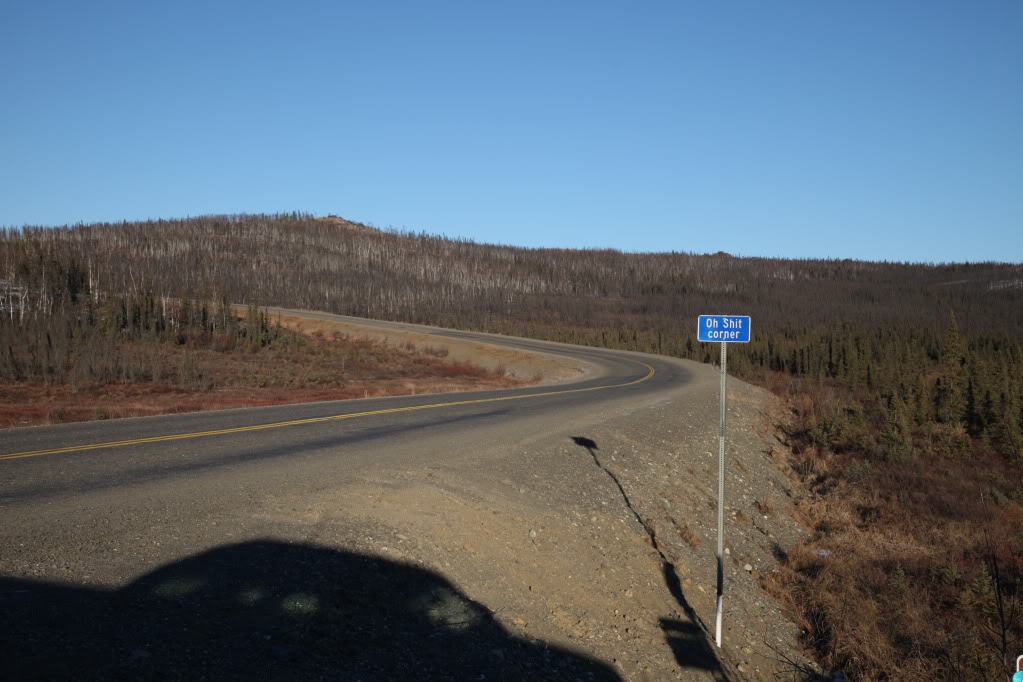
There are a number of sights along the way. Below, for example, is Oh Shit Corner at Mile 126:
More seriously, the highway passes by the Gates of the Arctic National Park and the Brooks Range, with occasional polar bear sightings as one approaches the end of the road.

If you are interested in seeing this wild part of the country, you can take the Dalton Highway Express to Deadhorse. It’s an all-day trip, though you won’t lack for company, Upwards of 150-250 trucks per day take the same road. Food and accommodations are available in Coldfoot, Wiseman, and Deadhorse. It’s more scruffy than luxurious, and you will be mostly in the company of Alyeska pipeline workers. Oh, and you’ll see a lot of the pipeline, because it pretty much follows the highway for its entire length.

“Apostle Town”

Canadian Poet Anne Carson (Born 1950)

My favorite Canadian poet, who I think is equal to the best current U.S. poets, is Anne Carson. A classical r as well as a poet, she did a great translation of three Euripides plays that was published by New York Review as Grief Lessons (2006).

Apostle Town

After your death.
It was windy every day.
Every day.
Opposed us like a wall.
We went.
Shouting sideways at one another.
Along the road.
It was useless.
The spaces between us.
Got hard.
They are empty spaces.
And yet they are solid.
And black and grievous.
As gaps between the teeth.
Of an old woman.
You knew years ago.
When she was.
Beautiful the nerves pouring around in her like palace fire.

The Other Football

Argentine Footballers Celebrating After Scoring Against Poland

Yesterday, I watched the World Cup match between Argentina and Poland. Unlike most viewers, there are a whole lot of teams I like. I realize that the United States is still new at this game and can be upset by the likes of Liechtenstein or Moldova. A generation from now, I suspect that what we call soccer will be more prevalent, if for no other reason that parents won‘t want their sons growing up brain-damaged like Herschel Walker.

In yesterday’s game, I liked both Argentina (as I’ve visited their country three times) and Poland (because I’m Eastern European myself). Argentina won the game 2-0, but both Argentina and Poland advanced to the quarter finals. I think it was because the sum of the team members’ jersey sizes was a prime number.

The announcers kept talking about how surreal the end of the game was because so many teams were still in play, irrespective of their win/loss standings. Also considered in the standings were scores for remembering to say “please” and “thank you”; the number of syllables in the first stanza of their respective national anthems; the teams’ overall dental hygiene; and how well the teams could pronounce the name of the country they were in. (I think the latter is something like “Catarrh”, no?)

Argentina dominated the game, but the poles had one real hero in their goalie, Wojciech Szczesny. (Gesundheit!) For the entire first half, he batted away everything the Argentinians could throw at him, including soccer balls, off-color epithets, and one extremely rusted steam locomotive. Only in the second period did two goals get by him.

The Star of the Polish Team: Goalkeeper Wojciech Szczesny

Although soccer football does have its problems, such as the higher mathematics involved in calculating who gets to move on to the quarter finals and the treatment of draws. In American sports, there are a lot of stops and starts to allow for advertisers to plug their products and services. Soccer football games stop only for injuries, and then they add a mysterious number of make-up minutes after the regulation ninety minutes. I guess Americans will just have to get used to all that intensity and uncertainty. The rest of the world seems to have.