Clarity and Emptiness

Lute Player (After Frans Hals)

From time to time, I love to read books of original source material on Eastern Religions. The following is taken from the Visuddhi Maga as quoted in a collection edited by Anne Bancroft entitled The Pocket Buddha Reader (Boston: Shambhala, 2001):

When a lute is played, there is no previous store of playing that it comes from. When the music stops, it does not go anywhere else. It came into existence by way of the structure of the lute and the playing of the performer. When the playing ceases, the music goes out of existence.

In the same way all the components of being, both material and nonmaterial, come into existence, play their part, and pass away.

That which we call a person is the bringing together of components and their actions with one another. It is impossible to find a permanent self there. And yet there is a paradox. For there is a path to follow and there is walking to be done, and yet there is no walker. There are actions but there is no actor. The air moves, but there is no wind. The idea of a specific self is a mistake. Existence is clarity and emptiness.
Sea Breeze

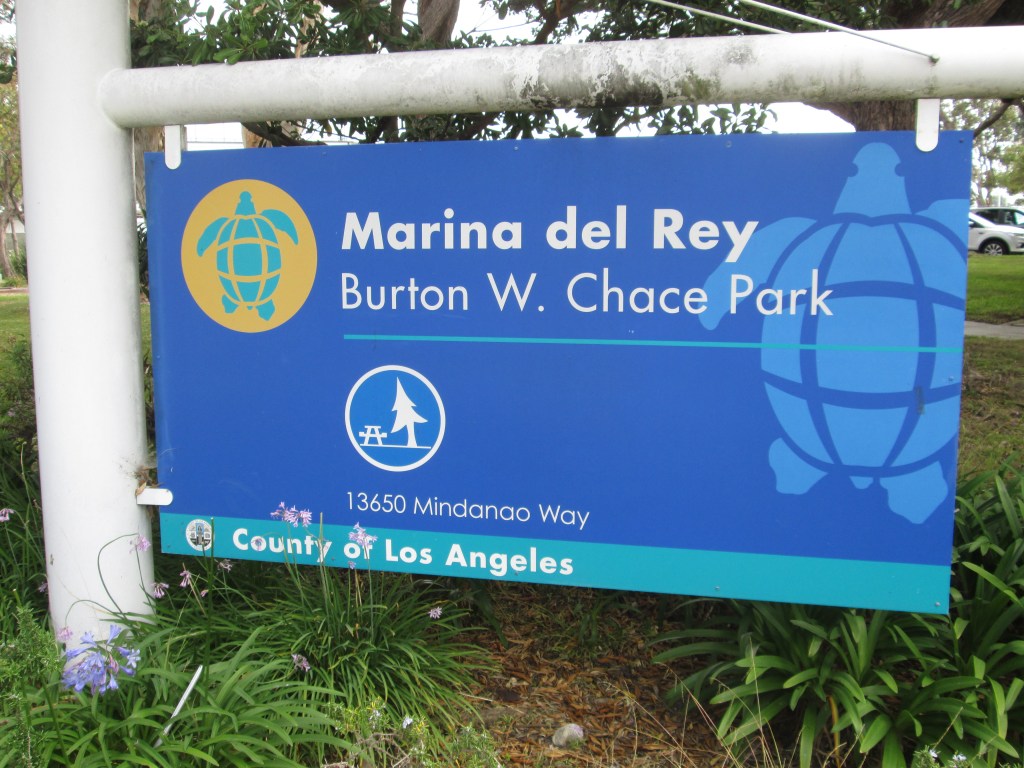
Whenever it gets too beastly hot, I frequently head to Burton W. Chace Park in Marina del Rey. On most days—the sole exception being times when there is a Santa Ana wind, bringing hot desert air from the Mohave Desert—it is always more comfortable there. Not only is the temperature at least five degrees cooler, but if one finds a spot to sit within a couple hundred feet of the shore, there is always a cooling sea breeze.

Today, I tested this as I walked inland to my parked car. By the time I was 300-500 feet from the shore, the breeze started breaking up. By the time I reached my car, it was nonexistent. Yet while I sat reading in the shade in Picnic Shelter A (the one closest to the shore), the cooling breeze was steady.

I don’t understand why this is so. The beaches to the north and south of the Marina aren’t all that comfortable, perhaps because of the heat radiated by the sun beating on the sand.

The park was full of small squirrels who were constantly chasing one another. I guess there was too much competition for the scarce food resources. At any given time, I could see as many as ten squirrels.

“This Kind of Fire”

This has been a month for re-reads. Today, I finished reading Charles Bukowski’s The Continual Condition, a posthumous collection of his unpublished poetry. I love Buk’s poetic voice. Here is a poem entitled “This Kind of Fire.”

This Kind of Fire

sometimes I think the gods
deliberately keep pushing me
into the fire
just to hear me
yelp
a few good
lines.

they just aren’t going to
let me retire
silk scarf about neck
giving lectures at
Yale.

the gods need me to 
entertain them.

they must be terribly
bored with all
the others

and I am too.

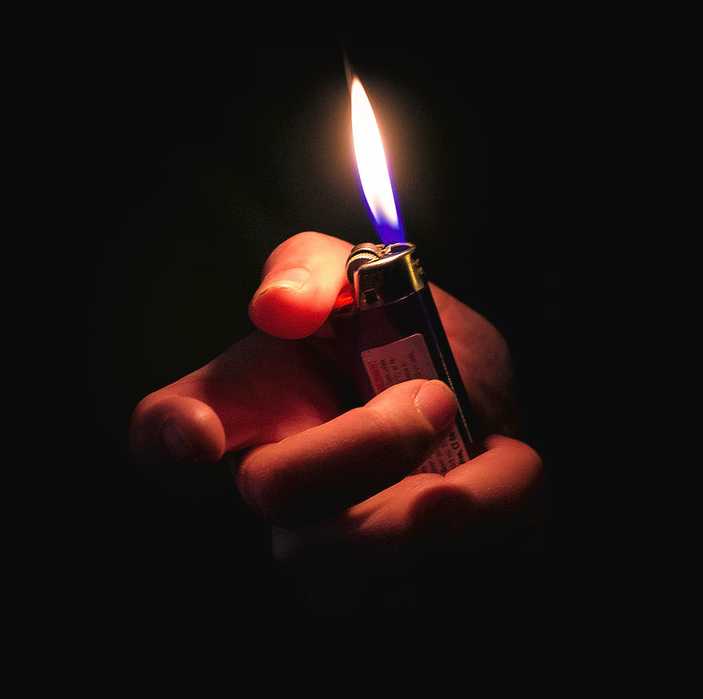
and now my cigarette lighter
has gone dry.
I sit here
hopelessly 
flicking it.

this kind of fire
they can’t give
me.

Drosophila Part Deux

Fruit Flies (Drosophila melanogaster)

Let me say at the outset that I hate fruit flies. And they appear to hate me. I love to eat lots of fresh fruit through the Los Angeles summer, but my apartment becomes infested with the damnable bugs. I have several traps filled with apple cider vinegar in which to drown the unwary. Alas, they seem to have caught on and—except for a about 10-12 weaklings per day—avoid falling into the vinegar.

Several times each day, I venture into the kitchen to squash a few dozen of the invasive Drosophila. They retaliate by flying around my head while I am sitting at the computer and playing the insect equivalent of “chicken.” That only annoys me more, so I go and kill a few dozen more.

Last year’s infestation ended when I purchased a kitchen wastebasket with a top, but I think the new generation has figured out a way to sneak through the cracks. I have to now make daily visits to the dumpster with my garbage.

(Excuse me. I am tired of having my head buzzed by fruit flies. I will go into the kitchen and wreak as much havoc as I can on the surviving population.)

There, I have dispatched another bunch to insect Valhalla. But these bugs are getting smarter. When I walk into the kitchen, they start flying, knowing that I have little chance of catching them in mid-air. It is only when they land that I have any chance of crushing them.

Pah, I almost just swallowed one of the little monsters!

Fuge, late, tace

Big Sur Coastline, Central California

The last two days, I was revisiting one of my favorite authors, Honoré de Balzac. In his novel The Country Doctor (Le Médecin de Campagne), Doctor Benassis visits 5the Grande Chartreuse monastery in the French Alps and finds the following inscription left by one of the monks in an empty cell:

Fuge, late, tace

This is Latin for “Flee, hide, be silent.”

Which reminds me of Stephen Dedalus’s “Silence, exile, and cunning” from James Joyce’s Portrait of the Artist as a Young Man. It also makes me think of Russian poet Joseph Brodsky’s “If one’s fated to be born in Caesar’s empire, let him live aloof, provincial, by the seashore.”

I embrace this advice (except for the part about being silent, of which this post is a clear violation). At my advanced age, I have no hope of—or even desire for—success.

To quote the old antique dealer in Balzac’s The Fatal Skin (Le Peau de Chagrin):

Man depletes himself by two instinctive acts that dry up the sources of his existence. Two words express all the forms taken by these two causes of death: DESIRE and POWER. Between these two poles of human action, there is another principle seized upon by the wise, to which I owe my happiness and my longevity [the speaker is 102 years old]. Desire sets us afire and Power destroys us; but KNOWLEDGE leaves our fragile organism in a state of perpetual calm.

Alas, Balzac wasn’t able to follow his own advice. He burned through his life in 51 years, yearning for years to marry the Polish Countess Evelina Hanska. No sooner did he get his wish and return to Paris with his bride than he took sick and died.

The Great Book Giveaway

Today I took another walk to the (on weekends, anyway) deserted office park. In my bag were three books I donated to the Little Free Library box at 26th and Broadway in Santa Monica. Then I sat down at a park bench and read the last forty pages of Georges Simenon’s The Hotel Majestic, in which Superintendent Maigret of the Paris Police Judiciaire solves a double murder that takes place in the cellars of the Hotel Majestic. When I finished the last page, I donated that book as well.

While I was reading, a very bossy young male voice emanated from the nearby tennis courts where Pickle Ball was being played. Somebody was carrying on a running commentary on the game with frequent snatches of advice. I cannot believe that the voice’s opponent enjoyed the outing.

Although much of the country is mired in a heat wave, there was a delightful sea breeze the whole time which was quite comfortable.

Let me see: At the rate of 10-12 books a week, it will take upwards of ten years to donate all my books. And I haven’t even gotten to the heart of the collection yet. Let’s face it, I probably never will as I am still buying books. I am totally incorrigible, On the other hand, I am living the bookworm’s dream that I dreamed from my earliest years. Never mind that it is not a dream shared by most of my fellow Americans, but it means a lot to me.

Should Democrats Learn the Haka?

The New Zealand All-Blacks Performing a Haka

According to a New Zealand website:

The haka is a ceremonial Māori war dance or challenge. Haka are usually performed in a group and represent a display of a tribe’s pride, strength and unity.

Actions include the stomping of the foot, the protrusion of the tongue and rhythmic body slapping to accompany a loud chant. The words of a haka often poetically describe ancestors and events in the tribe’s history.

Most people in the West have become aware of the haka through the All-Blacks Rugby Team of New Zealand, who perform the ritual before their games.Here, for example, is a video of one such performance:

I think the Democrats should perform a haka at political events, especially when they confront Republicans, such as at a debate or other event. It would take a bit of doing, as so many Democrats of the “Woke” persuasion come across as milquetoasts. And I suspect that Trumpists might be better at it, as expressing contempt is part of their standard repertoire.

Still, I think it would be a hoot.

Spending Summer in Middle Earth

The Main Characters from Sir Peter Jackson’s Film Version

I have decided that I will have a J. R. R. Tolkien summer during which I will re-read the Lord of the Rings trilogy and undertake to read The Silmarillion for the first time. And I will see all three films in Sir Peter Jackson’s masterful film version. (I own all three films on DVD). I have already had the same book/film experience last year with The Hobbit.

Less than half an hour ago, I completed my re-reading of The Fellowship of the Ring, probably my favorite novel of the three, because all nine major characters are interacting with one another during much of the length of the story.

It seems that Tolkien’s trilogy never grows old. I cannot but think that it is one of the great literary accomplishments of the Twentieth Century. It is fantasy, but with an eye cocked at the growth of fascism in Europe during the 1930s and its harvest as the Second World War. I wonder if someone even half so good as Tolkien will chronicle our own uneasy times.

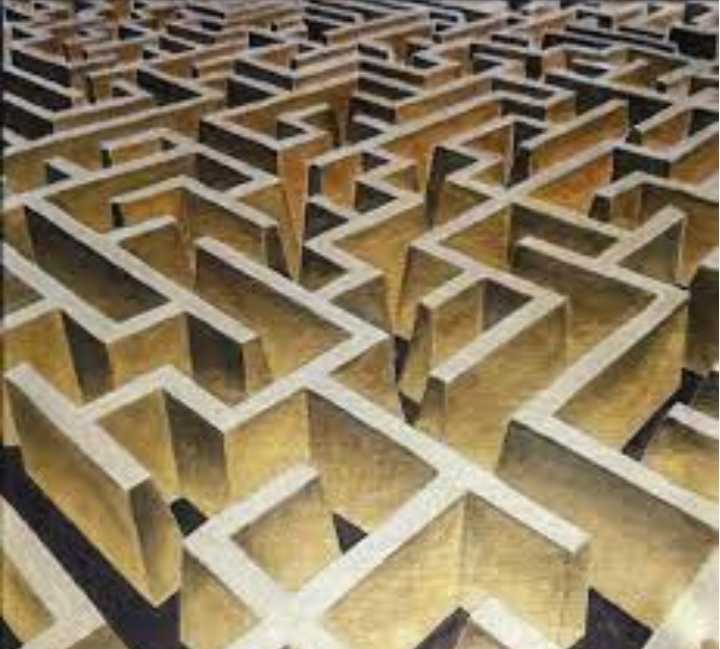
The Labyrinth

I keep returning to the poems of Jorge Luis Borges in the labyrinthine journey of my life. For over half a century, his writings have shone a strong light on my path forward. Several years after Borges died, John Updike translated his poem “The Labyrinth” and had it published in The New Yorker.

The Labyrinth

Zeus, Zeus himself could not undo these nets
Of stone encircling me. My mind forgets
The persons I have been along the way,
The hated way of monotonous walls,
Which is my fate. The galleries seem straight
But curve furtively, forming secret circles
At the terminus of years. And the parapets
Have been worn smooth by the passage of days.
Here, in the tepid alabaster dust,
Are tracks that frighten me. The hollow air
Of evening sometimes brings a bellowing,
Or the echo, desolate, of bellowing.
I know that hidden in the shadows there
Lurks another, whose task is to exhaust
The loneliness that braids and weaves this hell,
To crave my blood, and fatten on my death.
We seek each other. Oh, if only this
Were the last day of our antithesis!

One Ring To Rule Them All

Frodo and the Ring from Sir Peter Jackson’s Film

It was inevitable that I would re-read The Lord of the Rings for the third—or is it the fourth?—time. Too much of my memory of the volumes in the trilogy have been replaced by my memory of the masterful Sir Peter Jackson films. And a good thing, too! I was beginning to forget the Old Forest, Tom Bombadil, and the Barrow Wights, which were not represented in the film version of The Fellowship of the Ring (Volume I of The Lord of the Rings).

I first heard about J. R. R. Tolkien’s fantasy masterpiece from an exhibit at Dartmouth College’s Baker Library. A number of professors were asked to exhibit the books which most influenced them, and there, under glass, were first editions of the three volumes. I was enthralled before I ever read a word of it.

Only when I came to Los Angeles in the late 1960s did I find the trilogy being published in paperback. Naturally, I bought all three volumes and read them. I even read a very funny Harvard Lampoon parody called Bored of the Rings. (Do I still have it in my massive library?)

Now I am reading it in the glorious Folio Society hardbound edition, complete with glorious woodcuts and an Anglo-Saxon motif cover. Amazingly, I find myself being drawn into the story yet again, as if I were encountering it for the first time.

What a master story-teller Tolkien was! I must remember to also read The Silmarillion when I have finished re-reading the trilogy.