Explication de Texte

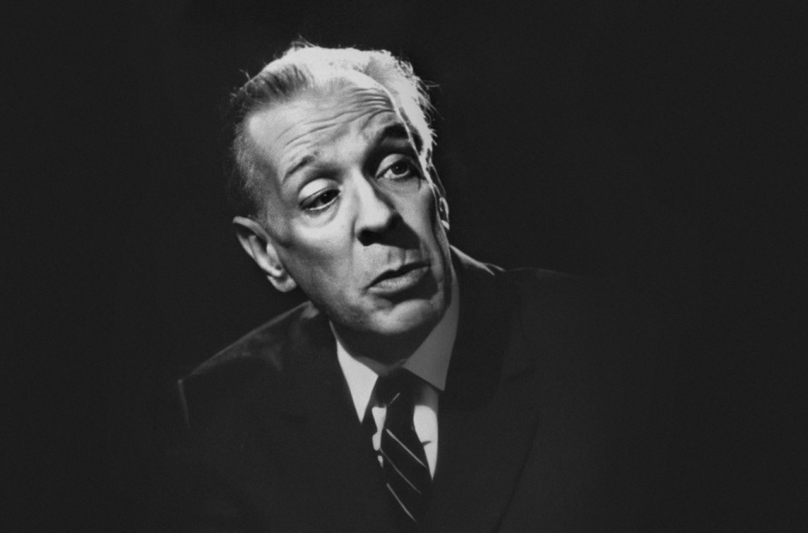
Argentinian Poet and Writer Jorge Luis Borges (1899-1986)

I am certain that French literary scholars are raising their hackles because of my interpretation of the term explication de texte. The type of close reading that the term implies includes style and is rarely used with literature that is translated from another language.

Jorge Luis Borges wrote in Spanish, but I have been reading his work in English translation for over half a century. I thought it would be fun to take a paragraph from one of Borges’s stories and, by my own idea of a close reading, give you an idea why the Argentinian is one of my favorite writers.

The story I have chosen is “Three Versions of Judas” as printed in Andrew Kerrigan’s translation of the American edition of Ficciones. Here is the story’s opening paragraph:

In Asia Minor or in Alexandria, in the second century of our faith (when Basilides was announcing that the cosmos was a rash and malevolent improvisation engineered by defective angels), Nils Runeberg might have directed, with a singular intellectual passion, one of the Gnostic conventicles. Dante would have destined him, perhaps, for a fiery sepulchre; his name might have augmented the catalogues of heresiarchs, between Satornibus and Carpocrates; some fragment of his preaching, embellished with invective, might have been preserved in the apocryphal Liber adversus omnes haereses or might have perished when the firing of a monastic library consumed the last example of the Syntagma. Instead, God assigned him to the twentieth century, and to the university city of Lund. There, in 1904, he published the first edition of Kristus och Judas; there, in 1909, his masterpiece Dem hemlige Fraharen appeared. (Of this last mentioned work there exists a German version, called Der hemliche Heiland, executed in 1912 by Emil Schering.)

Whew! The following notes rely heavily on Evelyn Fishburn and Psiche Hughes’s A Dictionary of Borges [ADOB] (London: Gerald Duckworth & Co Ltd, 1990) and my searches on the Internet.

Basilides: “An early Gnostic from Alexandria who integrated Pythagorean and Cabbalistic traditions with the Christian faith.” ADOB

Nils Runeberg: Fictional character.

conventicles: secret or unauthorized religious assemblies.

fiery sepulchre: Refers to the sixth circle of Dante’s Inferno, where heretics were punished by eternal flames.

heresiarchs: Borges loves this word and uses it frequently. It refers to the originators of heretical beliefs.

Satornibus:Could refer to Saturninus of Antioch, “who held that the angels, archangels, powers and dominations were created by the Supreme Unknown, the Father, but that the world and everything in it, including man, was created by seven of the lowest angels.” ADOB

Carpocrates: “A second-century Neoplatonist from Alexandria, the founder of a heretical sect which believed in the dualism of good and evil, denied the divinity of Christ and held that the soul is imprisoned in the body from which it strives to be free.” ADOB

Liber adversus omnes haereses: Translated as A Book Against All Heresies. As Nilos Runeberg is a fictional characters, all his works are nonexistent.

Syntagma: “The earliest collection of heretical doctrines by Justin Martyr. Another text of the same title, also directed against heresy, was written at the beginning of the third century by Hippolytus of Rome….” ADOB

Lund: Lund University in Sweden was founded in 1666.

Swedish and German titles: Runeberg was a fiction, as are his books. As is translator Emil Schering.

Note also the use of subjunctive verb forms: might have directed … would have destined him … might have augmented … might have been preserved … might have perished.

And I have barely begun analyzing this paragraph, which was designed to flummox lazy readers and excite explorers of strange literary byways like me.
From Borges to 12th Century Persia

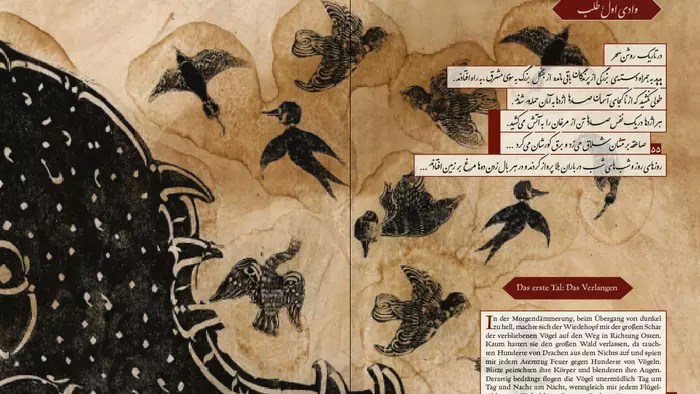
It all started over half a century ago when I discovered the books of the Argentinean writer Jorge Luis Borges. At two places within his Other Inquisitions: 1937-52, I saw intriguing references to a medieval Persian work, Farid-Ud-Din Attar. In “Note on Walt Whitman,” he wrote: “Attar, a twelfth-century Persian, sings of the arduous pilgrimage of the birds in search of their king, the Simurg; many of them perish in the seas, but the survivors discover that they are the Simurg and that the Simurg is each one of them and all of them.”

In the same volume, in the essay entitled “The Enigma of Edward FitzGerald,” Borges writes:

From the study of Spanish [FitzGerald] he has progressed to the study of Persian; he has begun a translation of the Mantiq-al-Tayr, that mystical epic about the birds who are looking for their king, the Simurg. They finally reach his palace, situated in back of seven seas, only to discover that they are the Simurg and that the Simurg is all of them and each one of them.

I was fascinated by this brief summary, which lay fallow, but unforgotten, in my memory for more than five long decades.

Quite unexpectedly, when I attended the Los Angeles Times Festival of Books at the University of Southern California campus on Saturday, by chance I listened to a reading by a local Persian poet, Sholeh Wolpé, who had translated Attar’s Mantiq-al-Tayr into English as The Conference of the Birds, as well as another work of Attar’s called The Invisible Sun. I was ecstatic that I could not only buy both works but have them signed by the translator.

Jorge Luis Borges has been, for me, a gateway to world literature. Through him I discovered G. K. Chesterton, Hilaire Belloc, Chuang-tze, Thomas De Quincey, the Icelandic sagas, W. H. Hudson, Blaise Pascal, and Emanuel Swedenborg. I quickly found that any name mentioned by Borges was worth following up on. Farid-Ud-Din Attar is one of them: I am currently reading Sholeh Wolpé’s translation of The Conference of the Birds with great pleasure. (You will see it mentioned in some future blog posts I am contemplating.)

And I am by no means finished with Borges. There are still some avenues which I hope I can follow, if I had but world enough and time.

My Light Is Spent

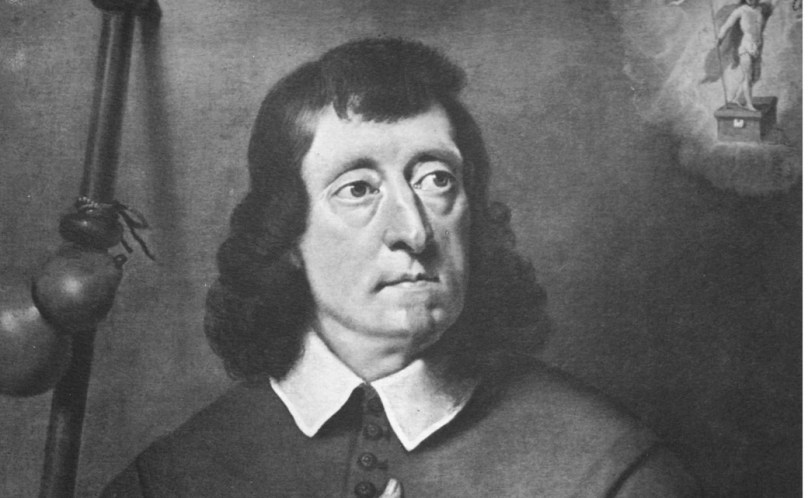
English Poet John Milton (1608-1674)

John Milton was blind, but he did not suffer from blindness. Rather, he did not let it hinder him from producing a body of work that was nothing short of amazing. It reminds me of another blind poet, Argentinian Jorge Luis Borges, who is one of my favorite writers and who wrote about Milton in a sonnet entitled “A Rose and Milton.” Now here is Milton in another sonnet writing about his own blindness:

When I consider how my light is spent,
Ere half my days in this dark world and wide,
And that one talent which is death to hide
Lodged with me useless, though my soul more bent
To serve therewith my Maker, and present
My true account, lest He returning chide;
“Doth God exact day-labor, light denied?”
I fondly ask. But Patience, to prevent
That murmur, soon replies, “God doth not need
Either man’s work or His own gifts. Who best
Bear His mild yoke, they serve Him best. His state
Is kingly: thousands at His bidding speed,
And post o’er land and ocean without rest;
They also serve who only stand and wait.”

Yes, that last line is quite famous and known to virtually everyone. The preceding thirteen lines, however, are not so well known—though they should be.

A Half Century of Proust

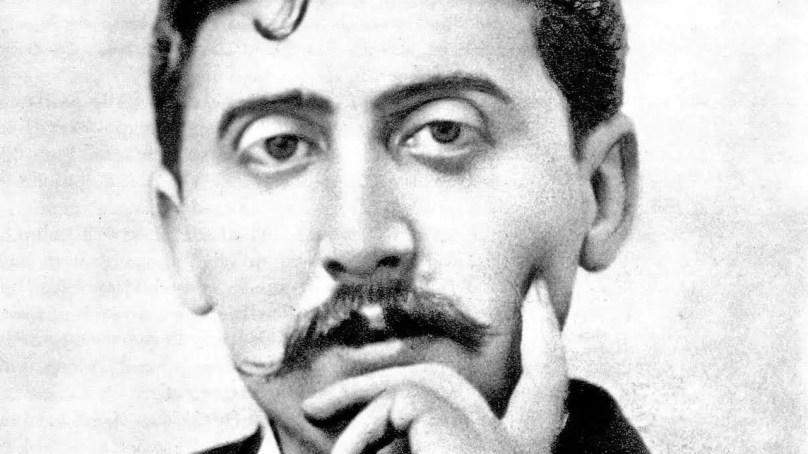
French Novelist Marcel Proust (1871-1922)

There are a handful of writers who have been a major influence in my life. They include William Shakespeare, Jorge Luis Borges, Honoré de Balzac, and G. K. Chesterton. Also Marcel Proust, whose seven-volume In Search of Lost Time I am reading for the third time. God grant that I may have a fourth go at Proust’s masterpiece.

I have always felt that one of the things that makes fiction great is that the main characters are able to change within the course of the work. For example, in Hamlet, we see the Danish prince resolve to revenge his father’s death. This is followed by Hamlet waffling and even leaving the country. When he returns, he fights a duel that becomes a massacre as summarized by the song “That’s Entertainment!” from the 1953 MGM musical The Bandwagon:

Some great Shakespearean scene
Where a ghost and a prince meet
And everyone ends in mincemeat.

In Search of Lost Time is about a boy named Marcel (last name not given) who fantasizes endlessly about young women, most particularly about Oriane, Duchesse de Guermantes, whose family were originally based in the village of Combray, where Marcel spends his first years. Over seven volumes, we see Marcel pursue first Gilberte, then Albertine, then Mlle de Stermaria, and even the Duchesse de Guermantes.

In The Guermantes Way, the third novel in the series, Proust ponders the strange disconnect between desire and reality:

Thus did the blank spaces of my memory gradually fill with names that, as they arranged and composed themselves in relation to one another, and as the connections between them became more and more numerous, resembled those perfected works of art in which there is not a single brush stroke that does not contribute to the whole, and in which every element in turn receives from the rest a justification it confers on them in turn.

I never said that Proust is an easy read, In fact, his work is among the most difficult ever written. That does not deter me from reading and re-reading his work. It’s no picnic, but the rewards are great. For me, the rewards have been coming over the decades since 1976, when I first started reading him.

Space, Time, and Borges

Argentinean Poet Jorge Luis Borges (1899-1986)

Here is another great poem by Jorge Luis Borges, a poet who has had perhaps a greater influence on my life than any other. Among other things, my thirst for knowledge about him has led me to Buenos Aires three times in the last twenty years.

Limits

Of these streets that deepen the sunset,
There must be one (but which) that I’ve walked
Already one last time, indifferently
And without knowing it, submitting

To One who sets up omnipotent laws
And a secret and a rigid measure
For the shadows, the dreams, and forms
That work the warp and weft of this life.

If all things have a limit and a value
A last time nothing more and oblivion
Who can say to whom in this house
Unknowingly, we have said goodbye?

Already through the grey glass night ebbs
And among the stack of books that throws
A broken shadow on the unlit table,
There must be one I will never read.

In the South there’s more than one worn gate
With its masonry urns and prickly pear
Where my entrance is forbidden
As it were within a lithograph.

Forever there’s a door you have closed,
And a mirror that waits for you in vain;
The crossroad seems wide open to you
And there a four-faced Janus watches.

There is, amongst your memories, one
That has now been lost irreparably;
You’ll not be seen to visit that well
Under white sun or yellow moon.

Your voice cannot recapture what the Persian
Sang in his tongue of birds and roses,
When at sunset, as the light disperses,
You long to speak imperishable things.

And the incessant Rhone and the lake,
All that yesterday on which today I lean?
They will be as lost as that Carthage
The Romans erased with fire and salt.

At dawn I seem to hear a turbulent
Murmur of multitudes who slip away;
All who have loved me and forgotten;
Space, time and Borges now leaving me.

Borges at Disneyland

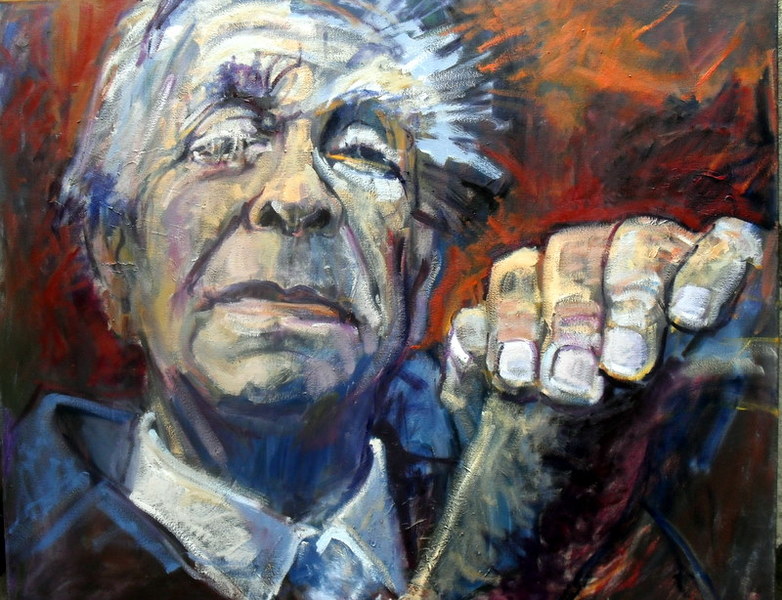
Painting of Argentinean Poet Jorge-Luis Borges (1899-1986)

This was a dream I had last night: I was taking my favorite 20th century writer, Jorge-Luis Borges on a tour of Disneyland. It wasn’t the real Disneyland: It was a dream Disneyland whose dimensions were two kilometers by two kilometers. It was interesting because it taught me something about Borges as well as something about myself.

We started in a two-story pavilion dedicated to horror. I was eager to guide Borges through the different galleries, promising a special treat on the second floor, where there was a gallery dedicated to Edgar Allan Poe. At this point, Borges started to say something disparaging about Poe; but I shrugged it off and went on to the second floor, while the poet got interested in one of the ground floor galleries.

I looked forward to taking Borges to one of the restaurants in the park, but Borges said he had no interest in another buffet.

Suddenly, we cut to the railroad that circled Disneyland. It wasn’t anything like the actual railroad that goes through the park, but a more modernized train with multiple passenger cars in which we were seated on long benches facing the direction the train was going. In Disneyland, the round-the-park train seats passengers facing to the right, so that they could see the many dioramas.

At the station, I took a seat and turned to my left to see if Borges was following me. He wasn’t. Instead, a middle-aged couple sat next to me. I became agitated, as the train passed seemingly through miles of open country—a far cry from the city of Anaheim around the park. Around the halfway point, I stopped at a station and started looking for a Disney public relations rep so that he could stage a search for the lost Argentinean writer.

At this point I woke up and said to myself, “What a strange dream!”

To Treasure Island

N. C. Wyeth Illustration of Blind Pew

Argentinian poet Jorge Luis Borges was a big admirer of Robert Louis Stevenson (as am I). The above illustration of the old pirate Blind Pew by N. C. Wyeth was for a 1911 edition of Stevenson’s Treasure Island. Here is a poem by Borges on the subject of the character who dominates the first chapter of the book:

Blind Pew

Far from the sea and from the lovely war
(For so love praises most what has been lost),
This blind, foot-weary pirate would exhaust
Road after English road or sodden moor.


Barked at by every dog from every farm,
Laughingstock of the young boys of the village,
He slept a poor sleep, trying to keep warm
And freezing in the black dust of the ditches.


But in the end, on far-off golden beaches,
A buried treasure would be his, he knew;
This softened some the hardness of his path.
You are like him—on other golden beaches


Your incorruptible treasure waits for you:
Immense and formless and essential death.

“You Are Inside Me Now”

El Jardin Botanico in the Palermo Neighborhood of Buenos Aires

Since I wrote about Buenos Aires being one of my favorite cities yesterday, I thought I would present a sonnet by Jorge Luis Borges, the poet of Buenos Aires, translated by Stephen Kessler from his collection of Borges’s sonnets:

Buenos Aires

Before, I looked for you within your limits
bounded by the sunset and the plain
and i the fenced yards holding an old-time
coolness of jasmine and of cedar shade.
In the memory of Palermo you were there,
in its mythology of a lost past
of cards and daggers and in the golden
bronze weight of the useless door knockers
with their hands and rings. I felt a sense of you
in the Southside patios and in the lengthening
shadows that ever so slowly obscured
their long right angles as the sun went down.
You are inside me now. You are my blurred
fate, all those things death will obliterate.

My Cities: Buenos Aires

Plaza de Mayo with Jacarandas

In my mind, Buenos Aires is forever associated with Jorge Luis Borges. It is my love of the author’s works which led me to Argentina three times: in 2006, 2011, and 2015. God knows, I would welcome a fourth visit. It’s a huge city (17 million population in the metropolitan area); it’s difficult to get around in; but I love it nonetheless.

What does one say to a city whose biggest tourist attraction is a cemetery? Each time, I visited the Recoleta Cemetery and viewed the crypt where Evita Peron is buried. Yet, poor Borges is buried in Geneva, Switzerland.

Funerary Monuments at Recoleta Cemetery

Borges taught me that Buenos Aires is a city of neighborhoods, of which my favorite is Palermo. At Borges 2135 in Palermo is where Jorge Luis spent his boyhood.

Palermo is also home to some of the loveliest parks in the city, including the Botanical Garden and the zoo where he visited the tigers that appeared in so many of his poems and stories.

Palermo’s Jardin Botanico

One thing that impressed me was the large stray cat population of the Jardin Botanico. While I was there, a local resident came and fed them. He then folded up his bag and walked toward the exit.

I think I would probably choose to stay in Palermo the next time I visit.

Signs

Bronze Chinese Bells

Here is a poem by Jorge Luis Borges of Argentina that mentions the butterfly dream by Zhuangzi that I wrote about in yesterday’s post.

Signs

for Susana Bombal

Around 1915, in Geneva, I saw on the terrace
of a museum a tall bell with Chinese characters.
In 1976 I write these lines:

Undeciphered and alone, I know
in the vague night I can be a bronze
prayer or a saying in which is encoded
the flavor of a life or of an evening
or Chuang Tzu’s dream, which you know already,
or an insignificant date or a parable
or a great emperor, now a few syllables,
or the universe or your secret name
or that enigma you investigated in vain
for so long a time through all your days.
I can be anything. Leave me in the dark.

About that last line: Remember that for the last thirty or forty years of his life, Borges was blind.